The True Consequences of a Bad Hire: More Than Just a Sunk Salary
By Humae · 10 May 2026
consequences of a bad hire
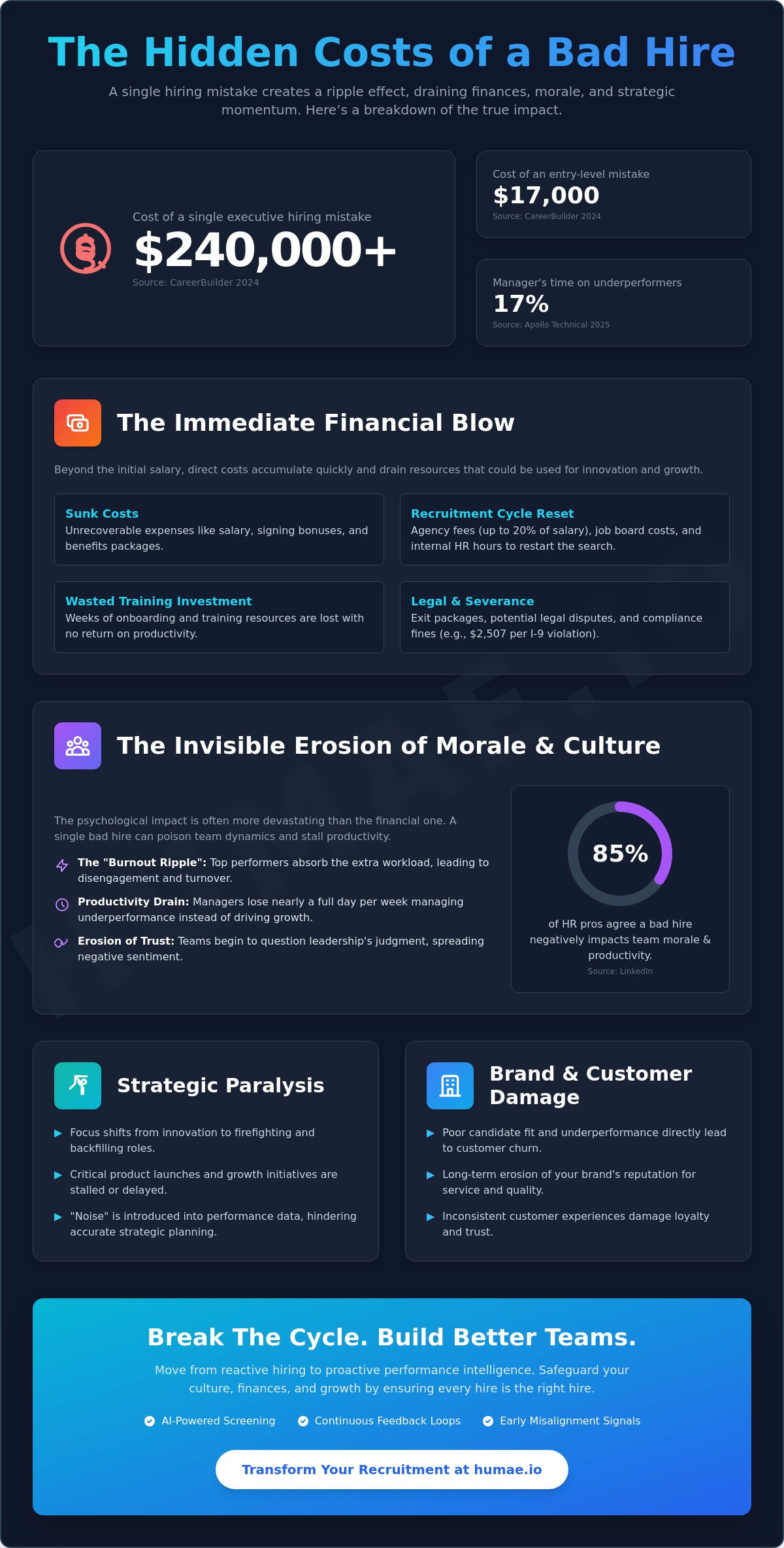
Did you know that a single executive hiring mistake can drain over $240,000 from your company's bottom line? According to 2024 CareerBuilder data, even entry-level errors cost an average of $17,000. These figures represent the visible consequences of a bad hire, but they're just the tip of the iceberg. You likely already feel the weight of wasted executive hours; in fact, Apollo Technical 2025 research shows managers spend 17% of their time managing underperformers. It's a heavy burden that stalls your momentum and burns out your best people.
We understand that hiring is about more than filling a seat; it's about protecting your culture and growth velocity. In this article, you'll discover the hidden financial and strategic costs of mismatches and learn how to safeguard your organization in 2026. We provide a clear framework to explain these risks to stakeholders and share strategies to ensure every new team member helps you scale rather than slow you down.
This article is brought to you by Humae, where we combine innovative technology with a deeply human approach to recruitment. Visit our Home Page to see how we help businesses grow, or join our community on Facebook.
Key Takeaways
- Identify the "sunk cost" trap where unrecoverable signing bonuses and benefits packages quietly drain your budget.
- Evaluate the consequences of a bad hire on your top talent, focusing on how a peer's underperformance triggers a burnout ripple across the team.
- Discover how hiring mismatches create strategic paralysis by introducing "noise" into your performance intelligence data and stalling critical product launches.
- Connect poor candidate fit directly to customer churn and the long-term erosion of your brand's service quality.
- Learn to leverage AI-powered screening and continuous feedback loops to catch misalignment signals during the crucial first 30 days.
Build a better recruitment experience with Humae. Join our community on Facebook.
The Immediate Financial Blow: Calculating the Direct Costs
High employee turnover doesn't just look poor on a quarterly report; it's a massive administrative drain. Think about the internal HR hours spent reviewing resumes and interviewing for a position you thought was already settled. When you factor in job board fees and agency commissions, which frequently reach 20% of the annual salary, the price of a mistake becomes staggering. You also lose the significant investment put into onboarding and training. You've spent weeks preparing someone for full productivity, only to realize they'll never reach the required performance ceiling.
The Recruitment Cycle Reset
Restarting a search is significantly more expensive than the initial hire. Your talent acquisition team loses focus on growth-oriented roles because they're stuck backfilling a failed position, compounding the consequences of a bad hire across the department. This creates a massive opportunity cost. While your recruiters are re-posting ads, they aren't finding the next visionary leader who could drive revenue. It's a cycle that slows down your entire organization's momentum.
Severance and Legal Liabilities
The Invisible Erosion: Team Morale and Digital Culture Friction
While the previous section focused on the tangible ledger, the psychological impact of a mismatch is often more devastating. Money is replaceable, but culture is fragile. When a bad hire enters the ecosystem, the primary damage manifests as the "Burnout Ripple." Your top performers don't just notice a peer's underperformance; they absorb the workload. They work late to fix errors or cover missed deadlines. This isn't just a temporary inconvenience. It's a systemic drain that leads your best talent to look for the exit. According to LinkedIn research, 85% of HR professionals agree that the consequences of a bad hire include a direct hit to team morale and productivity.
The Collaboration Tax
In modern agile environments, one missing link stops the entire chain. Underperformers slow down sprint cycles and create bottlenecks that frustrate the whole department. This is especially true for remote teams where communication clarity is vital. If your workforce management infrastructure doesn't catch these signals early, the psychological toll on the remaining staff becomes a heavy "collaboration tax." They lose the "flow" that makes high-growth companies successful. Using a modern performance intelligence tool can help you spot these cultural friction points before they become permanent scars.
Employer Brand Damage
The cycle doesn't stay behind closed doors. Glassdoor and social media ensure that a bad hire-fire cycle becomes public knowledge. A high cost of a bad hire often includes the loss of "A-players" who refuse to join companies with high turnover or toxic reputations. There's a direct link between employee engagement and your external reputation. If your brand becomes synonymous with poor judgment or high churn, your ability to attract elite talent in 2026 will diminish significantly.
Strategic Paralysis: OKR Misalignment and Growth Stalls
Strategy is only as good as its execution. When a key role is filled by the wrong person, the entire business trajectory shifts. One of the most dangerous consequences of a bad hire is the strategic paralysis that follows. This isn't just about missing a single deadline; it's about how that delay cascades through every department. When one missing link in the chain fails, it can stop a major product launch or market entry. The impact is felt long after the individual leaves the company.
Bad hires create a significant data gap. They provide "noise" instead of "intelligence" in your performance tracking systems. Imagine investing a large portion of your budget into a new expansion plan. If the person executing it is a bad hire, the results will be poor. You might conclude that the expansion strategy itself failed and pivot unnecessarily. In reality, the plan was solid, but the execution was the only failing variable. This leads to misallocated resources and wasted capital that could have fueled genuine growth.
Your leadership team's reputation is also on the line. Repeated hiring mistakes act as a direct threat to management credibility. When employees see that leadership cannot accurately assess talent, they lose faith in the company's direction. With 87% of companies currently facing or expecting a skills deficit by 2030, the ability to hire correctly the first time is a competitive necessity, not a luxury.
Breaking the OKR Chain
Modern organizations rely on interconnected goals. When one underperformer fails their specific objectives, it causes a cascade of missed OKRs across the entire department. OKR misalignment is the silent killer of startup growth velocity. It forces teams into cycles of strategic "re-work" and pivots that are driven by poor execution rather than market shifts. You end up running in place while your competitors move forward.
Loss of Performance Intelligence
It's difficult to measure true team capacity when a bad hire skews your data. Their low output creates "sentiment noise" that masks the real problems or successes within your department. Real-time analytics are essential to identifying these mismatches early. Without clear performance intelligence, you're flying blind, making critical business decisions based on distorted metrics and filtered reality.
The Long-Term Impact on Customer Experience and Revenue
The internal friction discussed in previous sections eventually spills over your office walls. When a client-facing role is filled by a mismatched candidate, the consequences of a bad hire manifest as lost contracts and rising churn rates. Poor performance isn't just a missed internal KPI; it's a bug in a software release or a cold interaction that alienates a long-term partner. Quality degradation happens slowly at first, then all at once. By the time you notice the quality of service dipping, the brand dilution has already begun. You've broken the "human" promise your brand makes to its customers.
Recovery doesn't happen the moment an underperformer leaves. It usually takes 6 months or more to regain the momentum lost by a single bad hire. During this "Recovery Period," your remaining team is still repairing the damage while trying to maintain current growth. It's a double burden that prevents you from reaching full velocity. You aren't just backfilling a role; you're rebuilding trust with your audience and your own staff.
The Revenue-Per-Employee Metric
A bad hire acts as an anchor on your revenue-per-employee metric. When one person underperforms, the collective productivity of the workforce drops. Gallup’s 2024 data estimates that low employee engagement costs the global economy $8.9 trillion annually, roughly 9% of global GDP. For growing firms, this drag affects investor confidence and overall valuation. Investors look for efficiency; a high-turnover environment suggests a lack of operational maturity. Calculating the "Lost Opportunity Revenue" during the vacancy and re-hiring period often reveals a figure much higher than the salary itself.
Customer Trust Erosion
Fixing mistakes made by an unqualified employee is an expensive endeavor. It often costs double to repair a client relationship than it does to maintain one. A single bad interaction can destroy years of brand loyalty in seconds. This is why workforce management is actually a critical customer service strategy. It ensures the right people are in the right seats to deliver on your brand promise. Stop the cycle of reactive hiring and start building a high-performance culture. Explore how Humae’s Performance Intelligence helps you protect your revenue and your reputation.
Preventing the Cycle: From Reactive Hiring to Performance Intelligence
Real-time data is your best defense against systemic failure. Centralized HRMS platforms provide a unified source of truth for hiring data, allowing you to track performance from the very first day. By implementing continuous feedback loops, you catch red flags within the first 30 days. This proactive approach prevents a minor mismatch from turning into a $240,000 executive-level crisis. Data doesn't lie. When you integrate sentiment analysis into your first 90 days, you gain a granular view of how a new team member is truly adapting to your culture and workflow.
Building a Resilient Hiring Infrastructure
You can use Humae features to audit your current hiring pipeline and identify where the signals are being missed. Sentiment analysis during the first 90 days of onboarding is a game-changer. It tracks how new hires integrate emotionally and professionally, providing early warnings that manual check-ins often miss. Real-time dashboards allow you to spot performance dips before they become cultural crises. This visibility ensures your growth velocity remains uninterrupted and your team remains focused on innovation rather than correction.
The Humae Advantage
Modern teams need AI-powered HR platforms to manage the complexity of the 2026 talent market. Streamlining the onboarding process through automation ensures every hire receives a consistent, high-quality experience. This reduces the friction that often leads to early turnover. A bad hire is an expensive lesson, but with the right infrastructure, it's a preventable one. You don't have to settle for "good enough" when technology can help you find "exactly right."
Secure Your Future Growth Velocity
Hiring isn't a gamble; it's the foundation of your business intelligence. We've explored how the consequences of a bad hire ripple through your direct finances, team morale, and long-term customer trust. You don't have to wait for a 17% loss in managerial time or a $2,507 I-9 compliance fine to make a change. By moving from reactive recruitment to a data-driven strategy, you protect your culture and your bottom line simultaneously. Every hiring decision you make today dictates your growth velocity in 2026.
Modern growth requires modern tools. You can stop the cycle of hiring mistakes with Humae’s AI-powered HR platform. Our system provides real-time performance intelligence dashboards and integrated OKR tracking to keep your strategy aligned. With a seamless onboarding infrastructure, you ensure every new team member becomes a success story from day one. This technology removes the blind spots that lead to expensive mismatches, allowing your managers to focus on innovation rather than performance correction.
Your team deserves leadership that values precision and human connection. Build something extraordinary today.
Frequently Asked Questions
What is the average cost of a bad hire in 2026?
The average cost of a bad hire is at least 30% of the employee's first year earnings according to Department of Labor guidelines. For specialized or executive positions, 2024 CareerBuilder data shows this loss can exceed $240,000. These figures include recruitment fees, salary, benefits, and the administrative burden of restarting the search.
How long does it take for the consequences of a bad hire to surface?
Most hiring mistakes become clear within 6 to 12 months, though early warning signals often appear within the first 30 days. Managers typically spend 17% of their work week managing underperformers before the mismatch is officially addressed. This delay compounds the financial and cultural damage over time.
Can a bad hire affect my company culture permanently?
Yes, a single poor fit can damage culture by triggering a burnout ripple among your high performers. When 85% of HR professionals report negative morale after a poor hire, the erosion of trust in leadership often outlasts the individual's tenure. It creates a contagion of disengagement that is difficult to reverse.
What are the early warning signs of a hiring mistake?
Look for consistent consequences of a bad hire such as missed OKRs and recurring friction in agile workflows. If a manager spends more than five hours a week correcting one person's errors, it's a clear sign of a mismatch. Cultural misalignment often manifests as negative sentiment contagion within the first 90 days.
How does an ATS help in preventing bad hires?
An Applicant Tracking System prevents mistakes by filtering for technical skills and cultural alignment simultaneously. It uses automated screening to remove the human bias that leads 75% of employers to make hiring errors. This infrastructure ensures only candidates who meet your core competencies reach the interview stage.
Is it better to leave a position vacant or hire someone who isn’t a perfect fit?
Leaving a position vacant is usually the safer financial choice for your organization. Hiring a "near-fit" candidate often results in a 30% salary loss plus the additional cost of fixing bugs or errors that alienate customers. A vacancy creates temporary pressure, but a bad hire creates long-term strategic paralysis.
How do OKRs help in identifying a bad hire early?
OKRs identify failures by providing clear, measurable benchmarks starting from day one. When a new team member misses 50% of their first-quarter key results, it signals a skills gap or cultural mismatch immediately. This data allows leadership to intervene before the consequences of a bad hire affect the entire department's growth velocity.
What role does AI play in reducing the risk of a bad hire?
AI reduces risk by using predictive analytics and sentiment analysis to match candidates with your specific team DNA. It helps organizations identify potential mismatches before the contract is signed by analyzing candidate data against successful peer profiles. This technology provides the intelligence layer needed to manage the complexity of the 2026 talent market.