What is Employee Engagement? The Comprehensive Guide for 2026
By Humae · 9 April 2026
employee engagement
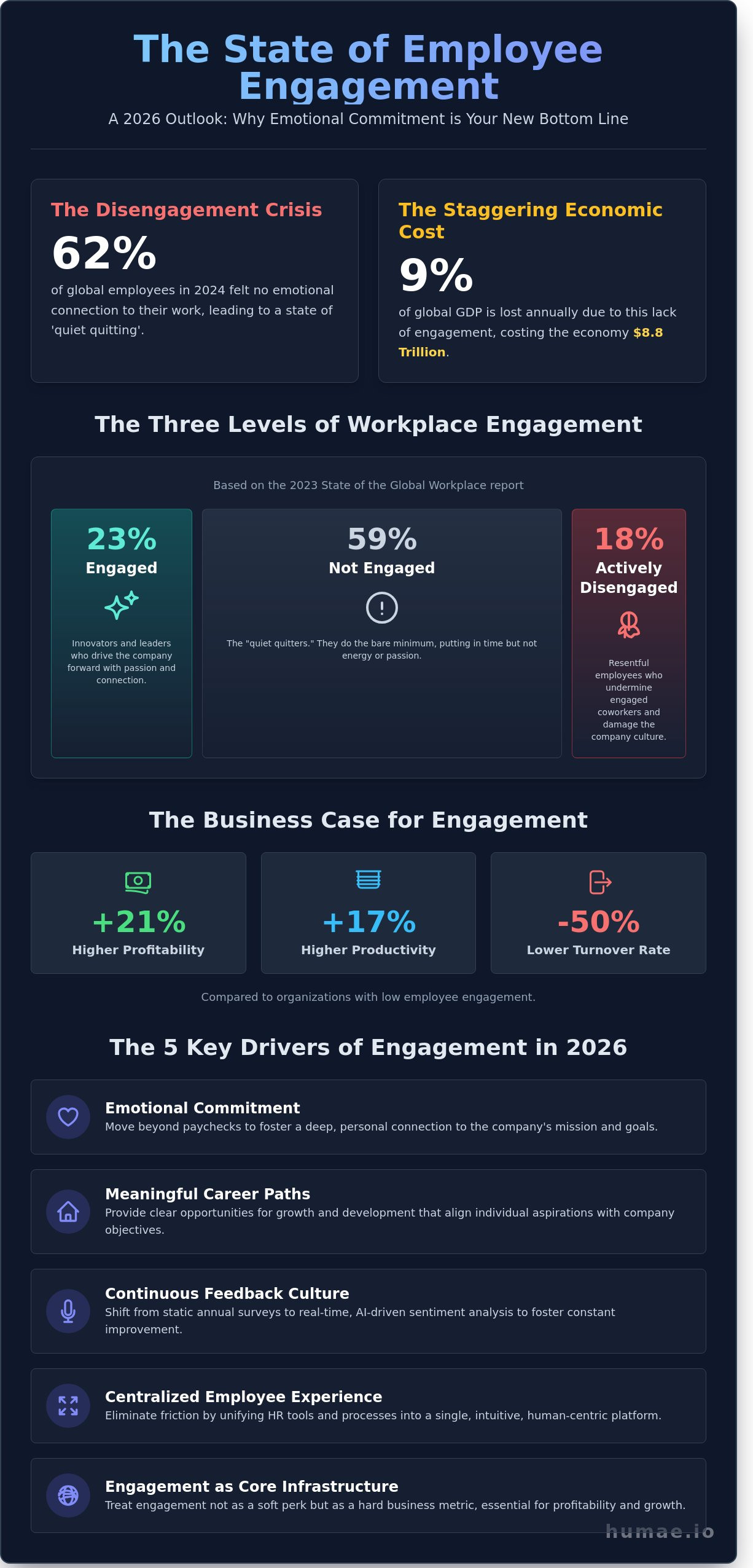
Did you know that 62% of global employees in 2024 felt no emotional connection to their work, costing businesses a staggering 9% of global GDP in lost productivity? You've likely seen this play out in your own office; talented people leave despite premium perks, and measuring the pulse of your team feels like guessing in the dark. It's exhausting to manage high turnover when you're trying to build something lasting. This guide will move you beyond basic job satisfaction into the realm of true emotional commitment. You'll discover how to use modern HR intelligence to foster a high-performing culture that keeps your best people through 2026. We'll break down the real definition of employee engagement, share actionable strategies for the coming year, and show you how tech finally makes culture measurable.
Humae is your partner in building a future where technology serves humanity. We help you create recruitment and retention experiences that resonate on a personal level. For more insights or to explore our platform, visit our home page at humae.io. Stay connected with our community and follow our latest updates on Facebook.
Key Takeaways
- Understand why emotional commitment, not just a paycheck, defines the 2026 standard for high-performing workplace cultures.
- Discover how to reduce turnover and boost profitability by prioritizing employee engagement as core business infrastructure.
- Identify the five key drivers that transform daily tasks into meaningful career paths aligned with your company mission.
- Shift from static annual surveys to real-time AI sentiment analysis to foster continuous feedback and data-driven growth.
- Learn how Humae centralizes the employee experience to eliminate friction and power a visionary, human-centric workforce.
Defining Employee Engagement in the Modern Workplace
The 2026 workplace demands more than a desk and a direct deposit. We define employee engagement as the deep emotional commitment an individual has to their organization's goals. It's not about how "happy" someone feels on a Friday afternoon; it's about how much they care about the company's success. The traditional "paycheck-only" contract is dead. Modern enterprises that rely on purely transactional relationships see a 50% higher turnover rate compared to those fostering emotional buy-in. To truly understand what is employee engagement, we must look at it through the lens of three psychological pillars: vigour, dedication, and absorption.
Vigour refers to high energy levels and mental resilience while working. Dedication involves a sense of significance, enthusiasm, and challenge. Absorption is that "flow" state where time passes quickly because the work is deeply involving. These aren't just HR buzzwords; they're the engine of modern performance. Engagement isn't a "soft" cultural vibe. It's a hard business metric. Companies with high engagement levels report 21% higher profitability and a 17% increase in productivity. If you aren't measuring it, you aren't managing your most valuable asset.
Engagement vs. Satisfaction: The Crucial Difference
Satisfaction is passive; engagement is active. A satisfied employee shows up, does their job, and collects their check. They might be "happy" because the coffee is good or the office is nice, but they won't go the extra mile. Engagement drives discretionary effort. While satisfaction focuses on past perks, engagement focuses on future growth. Data from 2024 shows that 65% of engaged workers stay because they see a path forward, while satisfied-only workers leave as soon as a higher salary is offered elsewhere.
The Three Levels of Workplace Engagement
Workforce dynamics fall into three distinct categories based on the 2023 State of the Global Workplace report. Understanding where your team sits is the first step toward improvement:
- Engaged (23%): These are your innovators. They lead projects, mentor others, and drive the company toward its 2026 targets. They work with passion and feel a profound connection to their company.
- Not Engaged (59%): These are the "quiet quitters." They do the bare minimum to avoid being fired. They've checked out emotionally but remain on the payroll, putting in time but not energy or passion.
- Actively Disengaged (18%): These employees aren't just unhappy; they're resentful. They act out their unhappiness and undermine what their engaged coworkers accomplish. Their negativity costs the global economy roughly $8.8 trillion in lost productivity annually.
Humae - Modern technology meets human-centered recruitment. Build a culture that lasts.
Explore our solutions: Platform Features | How It Works
Connect with us on Facebook
The Business Case: Why Engagement is Your Core Infrastructure
Stop viewing employee engagement as a soft HR initiative or a "nice-to-have" perk. In the competitive market of 2026, engagement is the bedrock of your workforce management infrastructure. It's the difference between a team that survives and one that dominates. When your people are engaged, they don't just complete tasks; they own the outcome. This psychological ownership acts as a natural safeguard against burnout and absenteeism, which cost businesses billions in lost productivity every year. A culture rooted in connection isn't just a vibe; it's a high-performance engine.
Impact on the Bottom Line
Disengaged employees aren't just quiet; they're expensive. Recent data shows that disengagement costs the global economy roughly $8.8 trillion, or 9% of global GDP. These losses stem from missed deadlines, poor customer service, and the constant need to backfill roles. High engagement flips this script by turning your staff into brand advocates. When employees love where they work, they attract top talent through word-of-mouth, which slashes your recruitment costs. Research into the key drivers of employee engagement confirms that empowering your team leads to measurable gains in operational efficiency.
- Engaged teams see a 41% reduction in absenteeism.
- Customer loyalty scores typically rise by 10% when handled by engaged staff.
- Profitability increases by 23% in highly engaged business units.
The ROI of engagement: According to 2024 Gallup benchmarks, organizations in the top decile of engagement achieve a 23% increase in profitability and significantly higher earnings per share compared to their competitors.
Engagement and Employee Retention
Retention is the most visible byproduct of a healthy culture. Gallup research indicates that engaged employees are 59% less likely to look for a new job in the next 12 months. This loyalty isn't accidental. It's built on "line of sight," the clear understanding of how an individual's daily work impacts the company's broader mission. When people see their value, they stay. They want to be part of the success they're helping to build.
Isolation is the enemy of retention. In a hybrid or digital-first environment, building social capital is a challenge. A centralized employee directory bridges this gap by fostering the immediate, human connections that prevent attrition. When a new hire can easily find a mentor or a peer with shared interests, they feel woven into the company fabric. This connectivity directly reduces turnover by replacing professional distance with genuine community. If you're looking to scale without losing your best people, it's time to explore tools that put people first.
Humae - Human-Centered Recruitment & HR Technology
We build the tools that make work feel more human. From innovative sourcing to seamless team integration, Humae is your partner in building a future-ready workforce.
The 5 Key Drivers of Employee Engagement in 2026
The final two drivers focus on the environment. Recognition and appreciation must move beyond the annual "Employee of the Month" plaque. Real-time, peer-to-peer feedback creates a culture of visible value. Finally, transparency and trust are the foundation. When workers have real-time access to company performance and goals, they feel like owners. This ownership mindset is the ultimate shield against turnover.
The Power of Clear OKRs (Objectives and Key Results)
Clarity is the enemy of disengagement. Understanding the OKR meaning is vital for any leadership team aiming to provide a clear "north star." When objectives are transparent, 74% of workers report higher levels of daily motivation. Moving from rigid annual reviews to continuous performance intelligence allows teams to pivot quickly. Real-time goal tracking ensures that no one feels lost in the shuffle of a fast-growing company.
Autonomy and the Hybrid Work Model
Humae is a modern, technology-driven partner dedicated to transforming the recruitment and retention experience. We combine innovative HR solutions with a deeply human-centered approach to help your business grow through its most valuable asset: people.
Actionable Strategies to Boost Engagement Today
Stop waiting for the end of the year to ask how your team feels. Static annual surveys are historical artifacts that don't help you solve problems in real time. Research shows that companies relying on yearly check-ins see a 15% higher turnover rate than those using agile feedback models. To keep your best talent, you must implement employee engagement strategies that prioritize data over guesswork.
Leveraging AI for Sentiment Analysis
AI-driven platforms now detect shifts in team morale up to 25 days before a manager notices a change. These tools analyze language patterns in digital communication to provide a thermal map of company culture. It's not about surveillance; it's about support. Maintaining 100% anonymity is critical here. When employees feel a sense of psychological safety, they share the honest truths that drive growth. Managers can then turn raw sentiment data into targeted interventions, such as adjusting workloads in a high-stress department before burnout sets in.
Creating a Continuous Feedback Loop
The traditional performance review is failing. A 2023 industry study revealed that 70% of employees find annual reviews ineffective for their development. Modern employee engagement thrives on weekly 10-minute check-ins. These micro-interactions allow for course correction in the moment rather than months too late. Use analytics dashboards to track engagement trends over 30-day windows to identify "disengagement hotspots." When you empower employees with self-service HR tools, they take ownership of their own growth and career trajectory.
- Build Peer-to-Peer Recognition: Recognition from colleagues increases productivity by 14% according to Deloitte data. It creates a culture where success is a shared experience.
- Artisanal Appreciation: In addition to feedback, tangible tokens of care—like high-quality wellness products—can reinforce a positive culture. For example, you can discover Természetízei.hu for premium producer honey and bee products that serve as meaningful gifts for your team.
- Identify Hotspots: Use data to see which teams are struggling. If one department has a 20% lower engagement score than the rest, you can act immediately.
Ready to modernize your approach? See how Humae features can transform your workplace culture through data-driven insights.
About Humae
Humae represents the intersection of cutting-edge technology and genuine human empathy. We provide a professional, innovative platform that transforms the recruitment and retention experience into something simple and successful. Our mission is to help companies grow by putting people first through smart automation.
Visit our home page: https://humae.io/
Follow us on Facebook: https://www.facebook.com/humae01
How Humae Powers a Highly Engaged Workforce
Employee engagement isn't a abstract concept; it's the direct result of a friction-free work environment. When teams struggle with fragmented tools, their energy drains into administrative black holes. Humae fixes this by centralizing the entire employee experience into a single, intuitive hub. We've designed a platform where performance intelligence and human empathy coexist, ensuring that every team member feels seen, heard, and valued.
Our approach focuses on four pillars of modern work culture:
- Performance Intelligence: AI-driven insights identify growth opportunities before stagnation sets in.
- Real-Time Alignment: OKR tracking keeps everyone moving toward the same 2024 strategic goals, turning individual tasks into shared victories.
- Data-Driven Culture: Leaders access actionable analytics to make decisions based on real sentiment, not just gut feelings.
High-growth companies using integrated platforms saw a 14% increase in team productivity in 2023. Humae provides the infrastructure to turn these statistics into your daily reality.
Unified Infrastructure for Modern Teams
App fatigue is a silent killer of motivation. Research from 2022 suggests that the average employee toggles between different applications nearly 1,200 times a day. Humae's features eliminate this chaos by consolidating workflows. From the moment a new hire starts, our simplified onboarding process builds engagement by removing technical hurdles. An intuitive organizational directory provides total transparency, letting everyone understand where they fit and how they contribute to the collective success.
The Human-Centric Tech Approach
Technology should serve people, not the other way around. You can see how it works in practice: our AI doesn't just crunch numbers; it bridges the gap between cold data and genuine empathy. Humae is the partner for leaders who refuse to choose between high-octane productivity and a healthy, supportive culture. We provide the tools to sustain long-term growth without burning out your best talent. You're not just buying software; you're investing in a more resilient organization.
Start building your engaged culture with Humae today. Let's transform how your team works together.
About Humae
Humae is committed to redefining the modern workplace through innovative, human-centric technology. We help businesses grow by putting their people first.
Return to Home Page | Connect with us on Facebook
Future-Proof Your Culture for 2026
By 2026, the definition of a high-performing team will center on how effectively a company integrates technology with human empathy. Success isn't just about output. According to Gallup, organizations with high employee engagement realize a 23% increase in profitability and significantly lower turnover rates. You can't leave these results to chance or outdated annual surveys. You need a dynamic infrastructure that treats people as your most valuable asset. Humae bridges the gap between data and human connection. Our platform provides the tools you need to lead with precision, including AI-driven sentiment analysis to catch burnout before it starts and real-time OKR tracking to keep everyone aligned. By moving to a centralized workforce infrastructure, you're not just managing tasks; you're building a community where people actually want to show up and excel.
Ready to transform your culture? Explore Humae's AI-powered HR platform today.
We're excited to help you build a workplace that thrives. Let's start making work better for everyone.
Frequently Asked Questions
Is employee engagement the same as employee satisfaction?
No, employee engagement isn't the same as satisfaction. Satisfaction measures how happy a worker is with their perks or pay, while engagement reflects their emotional commitment to the company's goals. Gallup's 2023 data shows that engaged teams see 23% higher profitability, whereas satisfied employees might just be comfortable without being productive.
What are the most effective ways to measure employee engagement?
The best method involves combining quantitative eNPS scores with qualitative pulse surveys. Successful firms send 10-question surveys every 14 days to catch shifts in sentiment quickly. This data-driven approach identifies friction points before they lead to turnover. Tracking participation rates above 80% ensures your data reflects the whole team's reality.
How does AI improve employee engagement in 2026?
AI improves employee engagement by predicting burnout risks before they happen. By 2026, predictive algorithms will analyze communication patterns to suggest breaks, potentially reducing burnout by 30% according to industry forecasts. These tools automate tedious tasks, letting your team focus on creative work that feels meaningful and impactful.
Can a small startup implement an engagement strategy without a large HR team?
Small startups can build strong cultures using automated tools and peer recognition. You don't need a 5-person HR department to implement a feedback loop. Using simple Slack integrations for daily shout-outs creates a transparent environment. This lean approach ensures even a 3-person team stays aligned without heavy administrative overhead.
The physical environment also plays a key role. For lean startups, joining a business incubator and coworking community can be a strategic move. For example, a hub like The Co-Spaces provides not just professional infrastructure but also a built-in network, helping to foster a strong culture without a large administrative overhead.
What is the manager's role in driving employee engagement?
Managers account for 70% of the variance in employee engagement scores. Their role is to act as coaches rather than taskmasters. Holding 30-minute weekly 1-on-1 meetings focuses on growth rather than just status updates. This direct connection bridges the gap between high-level company vision and daily execution.
How do OKRs help with employee engagement?
OKRs boost engagement by connecting individual tasks to the company's main goals. When workers see how their 3-month objectives impact the bottom line, their sense of purpose increases. Research indicates that 90% of people perform better when they've got specific, challenging goals. This transparency eliminates the frustration of not knowing how work contributes to success.
What are the first signs of employee disengagement to watch for?
Watch for a 15% drop in voluntary participation or missing two consecutive deadlines. Disengaged employees often stop contributing ideas during meetings or pull back from social interactions. These behavioral shifts are early warnings. Catching these signs within 30 days allows for intervention before the person decides to leave the company.
Humae is your visionary partner in modern hiring, blending cutting-edge tech with a deeply human heart. We transform recruitment into a seamless experience for both brands and candidates. To learn more about our approach, visit our home page or connect with us on Facebook.