What Is an HRIS? The 2026 Guide to Modern HR Infrastructure
By Humae · 30 April 2026
hris
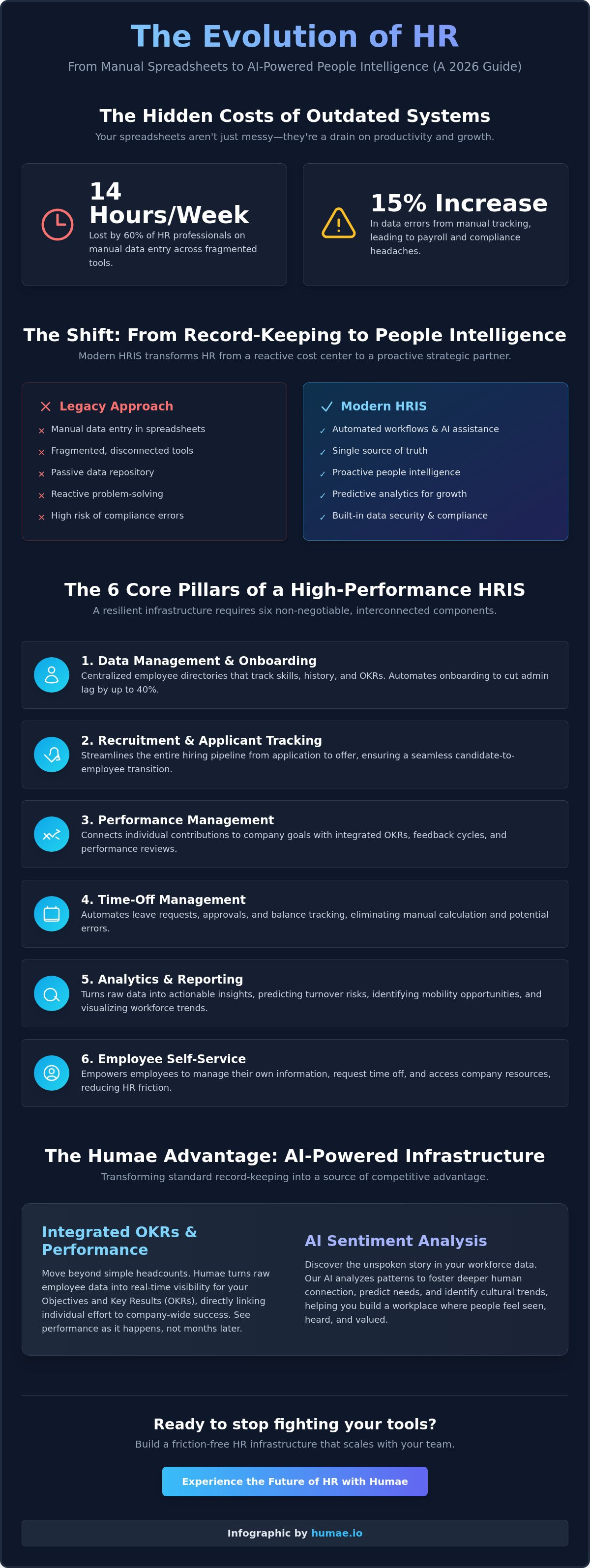
Your spreadsheets aren't just messy; they're actively draining your team's creative energy. Recent industry data shows that 60% of HR professionals still lose up to 14 hours a week on manual data entry across fragmented tools. It's a cycle of errors and missed insights that stalls growth. You likely feel the weight of these disconnected systems every time an onboarding process lags or a performance report comes back with conflicting numbers.
It's time to stop fighting your tools and start letting them work for you. This 2026 guide helps you master the fundamentals of a modern hris while revealing how AI-driven intelligence is transforming the way we manage people. You'll learn how to establish a single source of truth that automates time-off requests and onboarding instantly. We'll look at the specific features that turn raw data into real-time visibility for your OKRs and team performance.
Humae provides innovative, tech-driven solutions that keep the human experience at the center of every hire. To learn more about our vision for a better workplace, visit our home page or follow our latest updates on Facebook.
Key Takeaways
- Understand how AI-driven intelligence is evolving the modern HRIS from a passive database into a proactive, strategic partner for workforce management.
- Identify the six non-negotiable pillars—from data management to self-service—that ensure your HR infrastructure provides a unified and seamless employee experience.
- Navigate the "acronym jungle" to clarify the critical functional differences between HRIS, HRMS, and HCM for better organizational decision-making.
- Master a friction-free framework for selecting and implementing software that scales with your team’s growth without the typical technical "nightmares."
- Discover how Humae’s integrated OKRs and AI sentiment analysis transform standard record-keeping into a source of competitive advantage and deeper human connection.
Beyond the Database: Defining HRIS in the Age of AI
A Human Resource Information System (HRIS) acts as the centralized software engine for every employee data point and HR workflow. It's no longer just a digital filing cabinet. By 2026, the definition has shifted. An HRIS represents the single source of truth for organizational health. While legacy systems were passive repositories that required manual updates, modern platforms like Humae are active participants in your company's growth. They don't just store names; they facilitate the entire lifecycle of your talent.
The transition from paper-based files to cloud-based workforce management infrastructure happened rapidly. By 2023, over 80% of organizations had migrated their core HR functions to the cloud. This shift wasn't just about saving space. It was about accessibility and speed. In a world where 67% of teams operate in hybrid or remote environments, having a centralized, digital hub is the only way to maintain a cohesive culture. Your HRIS is the foundation that allows your team to scale without losing the human touch that defines your brand.
The Shift from Record-Keeping to People Intelligence
Data collection has evolved into actionable workforce analytics. We've moved past simple headcounts. Modern systems analyze patterns to predict turnover risks or identify internal mobility opportunities. AI now automates repetitive administrative tasks like data entry, which historically consumed 40% of an HR manager's week. This automation frees your team to focus on strategy and culture. Forward-thinking companies now prioritize an intuitive employee directory over static contact lists. It's about building a map of skills and connections, not just a list of phone numbers.
Why Your Organization Needs an HRIS Now
Most companies hit a tipping point when they reach 25 employees. At this stage, spreadsheets start failing. Manual tracking leads to a 15% increase in data errors, which can cause payroll delays or compliance headaches. For healthcare providers, these administrative errors can be even more costly; read more about how expert medical billing services can streamline your operations. In a digital-first world, regulatory compliance and data security are non-negotiable. With GDPR and CCPA regulations becoming stricter in 2025, relying on unencrypted files is a liability your brand can't afford. Implementing a modern system reduces "HR friction," making it easier for employees to request time off or update their details. This simplicity directly improves the overall employee experience, showing your team that you value their time as much as their talent.
The 6 Core Pillars of a High-Performance HRIS
A modern HRIS isn't just a digital filing cabinet. It's the engine room of your company. To build a resilient infrastructure for 2026, you need six non-negotiable pillars: data management, recruitment, performance, time-off, analytics, and employee self-service. These components don't live in silos. They talk to each other through a single, unified interface. This connectivity turns fragmented data into actionable insights. We're moving past simple workforce management toward workforce intelligence. This means using data to predict needs rather than just reacting to them. This hr software foundation ensures that every other business operation, from finance to operations, has the clean data it needs to function. According to industry leaders at Oracle, understanding What Is HRIS? involves recognizing it as the system of record that connects people to business outcomes.
Centralized Employee Directories and Onboarding
First impressions matter. You need to streamline the leap from "Candidate" to "Productive Team Member." Centralized profiles shouldn't just list contact info. They should track skills, history, and OKRs from day one. When you see how it works, you'll realize that onboarding automation cuts administrative lag by up to 40% in high-growth firms. It's about giving new hires the tools they need to succeed immediately without the paperwork headache.
Performance Management and OKR Tracking
Annual reviews are dead. Modern systems favor continuous feedback loops. Real-time OKR tracking keeps individual goals aligned with the company's vision. By 2026, leading platforms will integrate AI-driven sentiment analysis. This lets you spot team morale dips before burnout leads to turnover. It's about being proactive. Your hris should tell you when a team is struggling before the exit interviews start. It turns performance from a yearly chore into a daily growth strategy.
Time-Off and Absence Management
Manual spreadsheets create bottlenecks. Self-service portals allow employees to check balances and request leave instantly. Managers approve with one click. This data isn't just for payroll. It links directly to capacity planning. If 15% of your engineering team is out, your hris should automatically adjust productivity metrics and project timelines. This transparency builds trust and ensures the work actually gets done without overloading the remaining staff.
Ready to see how these pillars can transform your team's daily flow? Take a closer look at our feature set to find your perfect fit.
About Humae
Humae combines cutting-edge technology with a deeply human-centered approach to HR. We believe that better software leads to better candidate experiences and more successful companies.
Navigate back to our Home Page or connect with us on Facebook.
HRIS vs. HRMS vs. HCM: Navigating the Acronym Jungle
Choosing between HRIS, HRMS, and HCM often feels like decoding a secret language. While software vendors frequently use these terms interchangeably, their technical scope varies significantly. Think of them as layers of a functional pyramid. You start with a base of data and build toward a strategic peak. By 2026, the distinction matters less than the actual capability of your tech stack, yet understanding the nuance helps you select the right partner for your growth.
The industry is moving away from rigid silos. Instead of choosing a single category, modern businesses look for a unified experience. Humae functions as a hybrid platform. We've combined the data integrity of an hris with the strategic foresight of an AI-driven management system. This approach ensures you don't have to sacrifice administrative stability for innovative talent features.
HRIS: The Administrative Foundation
An hris provides the essential administrative foundation for any company. It manages static, objective data like names, addresses, Social Security numbers, and tax forms. The primary goal here is efficiency and data integrity. Research from 2024 indicates that 42% of HR professionals still report manual data entry as their biggest time sink. A robust hris eliminates this burden by centralizing records in a single source of truth. However, basic systems often stop at record-keeping. They lack the performance modules or talent pipelines needed to scale a modern workforce effectively.
HRMS and HCM: The Strategic Layers
HRMS adds the "Management" layer to the equation. It handles the active employee lifecycle, including recruiting, onboarding, and performance reviews. It's about moving from "who is this person?" to "how is this person performing?". To ensure these early touchpoints are effective, you can explore Candidate Experience Benchmarking to see how your hiring process compares to industry standards. HCM takes it even higher by adding the "Capital" layer. This involves strategic planning, succession tracking, and competency mapping. It treats employees as assets to be optimized rather than just names on a payroll list.
AI is rapidly blurring these traditional lines. By implementing an ai-powered hr platform, companies can now access all three layers within a single interface. These systems use predictive analytics to identify turnover risks and automate repetitive workflows, allowing HR teams to focus on culture rather than spreadsheets.
Modern infrastructure must also bridge the gap between compliance and employee satisfaction. This is exactly where total rewards acts as a critical component. It connects your core data with your high-level retention goals. By integrating compensation, benefits, and recognition into your central system, you create a transparent environment that attracts top-tier talent. Humae ensures this connection is seamless, turning your HR infrastructure into a competitive advantage.
About Humae
Humae represents a modern, technology-driven approach to HR that remains deeply human-centered. Our platform is built for visionary businesses that value growth, efficiency, and a superior experience for every candidate and employee.
Explore our solutions: Core Features | How It Works
Return to the Home Page
Connect with us on Facebook
How to Choose and Implement an HRIS for Your Team
Selecting an hris requires more than a feature list; it requires a vision for your team's growth. Small teams of 20 often prioritize speed and simplicity, while scaling organizations with 150+ employees need robust compliance and reporting. Forget the 1990s horror stories of year-long software rollouts. Modern SaaS deployment happens in weeks, not months. The shift to cloud-native infrastructure means you can implement features iteratively, starting with core employee records before moving to performance modules.
Integrations are the lifeblood of modern HR. If your system doesn't talk to Slack, Microsoft Outlook, or Google Calendar, it's creating more work than it's saving. A 2024 Sapient Insights Group survey found that companies with highly integrated HR tech stacks saw a 24% increase in data accuracy. Your goal is a "single source of truth" where a change in the HRIS automatically updates every other tool your team uses daily.
User experience is your most critical metric. If the interface feels clunky or dated, employees will avoid it. This leads to "ghost data," where records are incomplete or inaccurate because the hurdle to enter information is too high. Choose a platform that feels as intuitive as the apps your team uses in their personal lives. When the software is easy to use, adoption rates climb, and your data stays clean.
The Requirements Checklist for 2026
Modern HR demands more than digital filing cabinets. Ensure your chosen system is AI-native, offering predictive analytics to spot turnover risks before they happen. Mobile accessibility is non-negotiable for the 74% of professionals who now work in hybrid or remote-first environments. Look for a platform that offers features like real-time OKR tracking to keep your team aligned with company goals every single day.
Avoiding Implementation Pitfalls
Data migration is where most projects stumble. Don't move "dirty" data. Audit your current spreadsheets and delete duplicate records before the transition. Success also depends on change management. Instead of a dry training manual, frame the new system as a tool that gives employees more autonomy and faster access to benefits. Set clear KPIs for the 6-month mark, such as a 30% reduction in manual email inquiries or 95% employee profile completion. High-performing teams treat implementation as a cultural upgrade, not just a technical one.
Ready to transform your team's daily experience? Explore how Humae streamlines your HR infrastructure.
About Humae
Humae provides modern, human-centered HR solutions designed for the digital age. We believe technology should empower people, not replace the human touch in recruitment and management.
Return to Home Page
Connect with us on Facebook
Humae: The AI-Powered Infrastructure for Modern HR
Most platforms in the HR space act as digital filing cabinets. They store data but don't understand the people behind the numbers. Humae changes this by treating your HR infrastructure as a living, breathing system. We've built an environment where intelligence meets empathy. Instead of static lists, you get advanced features like AI-driven sentiment analysis. This tool analyzes communication patterns to detect burnout risks before they lead to resignation letters. It's a proactive approach to retention that saves companies thousands in turnover costs.
Our integrated OKR system ensures that 100% of your workforce stays aligned with the company's vision. Clarity is the foundation of a high-performing culture. When employees understand their impact, engagement levels naturally rise. Humae makes HR tasks feel like a premium experience rather than an administrative burden. It's the logical choice for teams that value intelligence over simple storage. We don't just track your people; we help you understand them. By turning data into dialogue, we ensure your infrastructure supports your most valuable asset.
Designed for Growth: From Startup to Enterprise
Scaling a business requires more than just adding new seats to a software plan. Your hris must adapt to complex hierarchies and shifting compliance needs as your headcount expands. Humae scales effortlessly whether you're a 12-person startup or a 600-employee enterprise. Our actionable analytics dashboards provide 24/7 visibility into performance trends. This allows you to make data-driven decisions based on real-time metrics rather than outdated spreadsheets. You'll gain insights into department health and productivity gaps instantly. Stay connected with our growing community and catch the latest product updates on the Humae Facebook page.
Ready to Transform Your People Operations?
The era of clunky, grey HR software is officially over. Modern teams deserve a centralized interface that feels as intuitive as their favorite smartphone apps. You can see our AI performance intelligence in action by scheduling a personalized demo. We'll show you how to turn manual chores into seamless, automated workflows that your employees will actually enjoy using. This transition is about more than just software; it's about building a better workplace. To take the first step toward a more human-centric hris infrastructure, visit the Humae Home Page today.
Harness the Power of Intelligent HR Infrastructure
Modern HR infrastructure isn't just about storing records; it's about driving growth through predictive insights. By 2026, high-performing teams will rely on a centralized workforce management infrastructure that eliminates manual data entry and focuses on high-impact strategy. A robust hris serves as the heartbeat of this digital transformation, connecting every pillar of your organization from recruitment to long-term retention. It's no longer enough to look at where your team was yesterday. You need AI-driven performance intelligence and real-time OKR tracking to see exactly where they're going tomorrow.
Humae provides the visionary tools needed to bridge the gap between technology and human connection. Our platform simplifies complex workflows so you can focus on building a culture that attracts top talent. Don't let legacy systems hold your growth back. It's time to embrace a solution that's as fast and dynamic as the modern market.
Streamline your workforce with Humae—the AI-powered HR platform built for 2026.
Humae
Back to Home | Connect with us on Facebook
Frequently Asked Questions
What is the difference between HRIS and HRMS?
An HRIS focuses on core data management like payroll and benefits, while an HRMS adds modules for talent management and performance. In 2026, 85% of industry experts use these terms interchangeably because modern platforms now combine both functions into a single experience. You'll find that the distinction matters less than the specific tools your team needs to thrive.
Does a small startup really need an HRIS?
Small startups should implement an hris once they reach 10 employees to avoid administrative debt. Manual tracking costs founders approximately 12 hours every week in lost productivity. Automating these tasks early allows you to focus on your people and your product instead of getting buried in spreadsheets and compliance paperwork.
How much does an HRIS typically cost in 2026?
Cloud-based systems in 2026 generally range from $5 to $20 per employee per month based on recent G2 market analysis. Some providers also charge a one-time setup fee that can start around $1,000 for small businesses. These subscription models ensure you only pay for the value you receive as your team grows.
Is my employee data safe in a cloud-based HRIS?
Can an HRIS help with employee retention?
An hris can increase retention rates by 14% by improving the overall employee experience. Providing self-service tools and clear paths for feedback makes workers feel valued and heard. When you remove the friction from daily HR interactions, you create a culture where people actually want to stay and grow.
How long does it take to implement a system like Humae?
Implementing Humae typically takes between 2 and 4 weeks from the initial kickoff. This timeline depends on how quickly you can migrate your existing data and the complexity of your current workflows. Our team works beside you to make the transition fast and painless so you can start seeing results immediately.