What is Workforce Management? The 2026 Guide to Modern HR Infrastructure
By Humae · 11 March 2026
what is workforce management
Recent 2024 research reveals that 54% of HR departments still rely on manual spreadsheets for scheduling, leading to an average of 15 hours lost every single week on administrative rework. It's time to stop fighting the clock. Understanding exactly what is workforce management in a 2026 context means moving beyond simple time tracking. It's about building a digital ecosystem where your people and your technology work in perfect sync to drive real growth.
You've likely felt the frustration when manual time-off tracking causes payroll errors or when you lack the real-time visibility needed to align daily work with company-wide goals. This guide will help you master the essentials of modern HR infrastructure so you can transition from legacy tracking to AI-driven employee intelligence. We're diving into the automated workflows that free up your HR team and the scalable systems that provide deep, actionable insights into employee sentiment.
Stay connected with the future of HR at Humae or follow our latest updates on Facebook.
Key Takeaways
- Define what is workforce management in the modern era by evolving from legacy time tracking to integrated workforce intelligence.
- Master the four pillars of HR infrastructure to transition from reactive crisis management to proactive, data-driven hiring and forecasting.
- Replace outdated manual monitoring with AI-powered insights that prioritize employee empowerment and psychological safety over "Big Brother" surveillance.
- Audit your "HR Debt" to eliminate fragmented tools and establish clear productivity metrics that align with your unique organizational culture.
- Build a human-centered future with Humae’s performance intelligence-visit humae.io to explore our platform or connect with us on Facebook.
What is Workforce Management (WFM) in the Modern Era?
Understanding what is workforce management requires looking past the old punch-clock mentality. By 2026, WFM has transformed into a strategic process that uses integrated systems to optimize every minute of employee productivity. It's no longer about just showing up; it's about the intelligent distribution of talent across a digital ecosystem. The foundational concept of Workforce management (WFM) now serves as the predictive engine for business growth, moving beyond simple scheduling into the territory of workforce intelligence.
Legacy systems focused on "Time and Attendance" are failing. Modern enterprises have migrated to centralized HR infrastructure. This shift replaces static, error-prone spreadsheets with real-time data hubs. Data from early 2025 shows that companies using integrated WFM platforms reduced operational overhead by 22% compared to those relying on fragmented tools. In a hybrid world, WFM provides the transparency needed to maintain a healthy company culture. It ensures workloads are balanced and contributions are visible regardless of where an employee sits.
The Core Objectives of WFM
- Operational efficiency: This means getting the right skills into the right roles at the exact moment they're needed. It eliminates the 15% labor waste typically found in manual scheduling environments.
- Employee Experience: Modern WFM reduces daily friction. It makes booking time off or swapping shifts a three-click process, not a week-long email chain.
- Strategic Alignment: WFM connects individual daily tasks directly to high-level company OKRs. Every hour worked moves the needle on a specific business goal.
WFM vs. Traditional HR: What is the Difference?
Traditional HR focuses on the "who." It manages recruitment, benefits, and people development. WFM focuses on the "how." It's the execution layer that dictates how labor hours translate into finished projects. Modern teams need both to scale without burning out. Without WFM, HR efforts often result in exhaustion because the workload isn't managed scientifically. To put it simply, what is workforce management if not the essential operating system of a modern business, providing the logic that keeps the human hardware running smoothly.
Humae - Modern Recruitment & HR Infrastructure
Build a better candidate experience and streamline your operations with our innovative features.
Back to Home Page | Connect with us on Facebook
The 4 Pillars of Workforce Management Infrastructure
Modern HR doesn't react to change; it anticipates it. To truly grasp what is workforce management, we must view it as a living infrastructure rather than a static set of rules. It's the engine that keeps a company moving without burning out its fuel, which is the people. By 2026, successful organizations will move away from manual spreadsheets toward a four-pillar model that prioritizes agility and empathy.
- Planning and Forecasting: This is about predicting hiring needs before they turn into operational crises. Data from 2024 shows that 73% of high-growth companies now use predictive modeling to identify talent gaps six months in advance.
- Execution and Tracking: This pillar handles the daily rhythm. It's the seamless management of employee schedules, time-off requests, and daily workflows. Efficiency here prevents the friction that slows down production.
- Performance Intelligence: Legacy systems focused on simple logs; modern WFM applications focus on intelligence. This means using data to drive growth and unlock potential, not just to measure clock-in times.
- Employee Engagement: A loop that integrates sentiment analysis. It's about understanding how your team feels, not just what they do.
Talent Acquisition and Onboarding
Workforce management starts long before a candidate signs their contract. A seamless Applicant Tracking System (ATS) sets the tone for the entire employee lifecycle. First impressions matter. Research indicates that 82% of organizations with a structured onboarding process see significantly higher long-term retention rates. Centralizing this data in a single, intuitive directory ensures that new hires feel connected and informed from their first hour on the job. It's about turning recruitment into a premium experience.
Performance and Growth Tracking
The era of the dreaded annual review is over. In fact, 95% of managers report being dissatisfied with traditional performance reviews. Modern what is workforce management strategies rely on real-time OKR tracking to keep teams focused on what actually moves the needle. Continuous feedback loops replace yearly check-ins, allowing for course corrections in real-time. Using analytics dashboards helps leadership spot signs of burnout before they lead to turnover. If you want to see how these insights can transform your team, you might want to explore how modern HR tools simplify these complex loops.
Humae is a visionary partner in the digital HR space. We combine cutting-edge technology with a deeply human-centered approach to create better recruitment and management experiences for everyone.
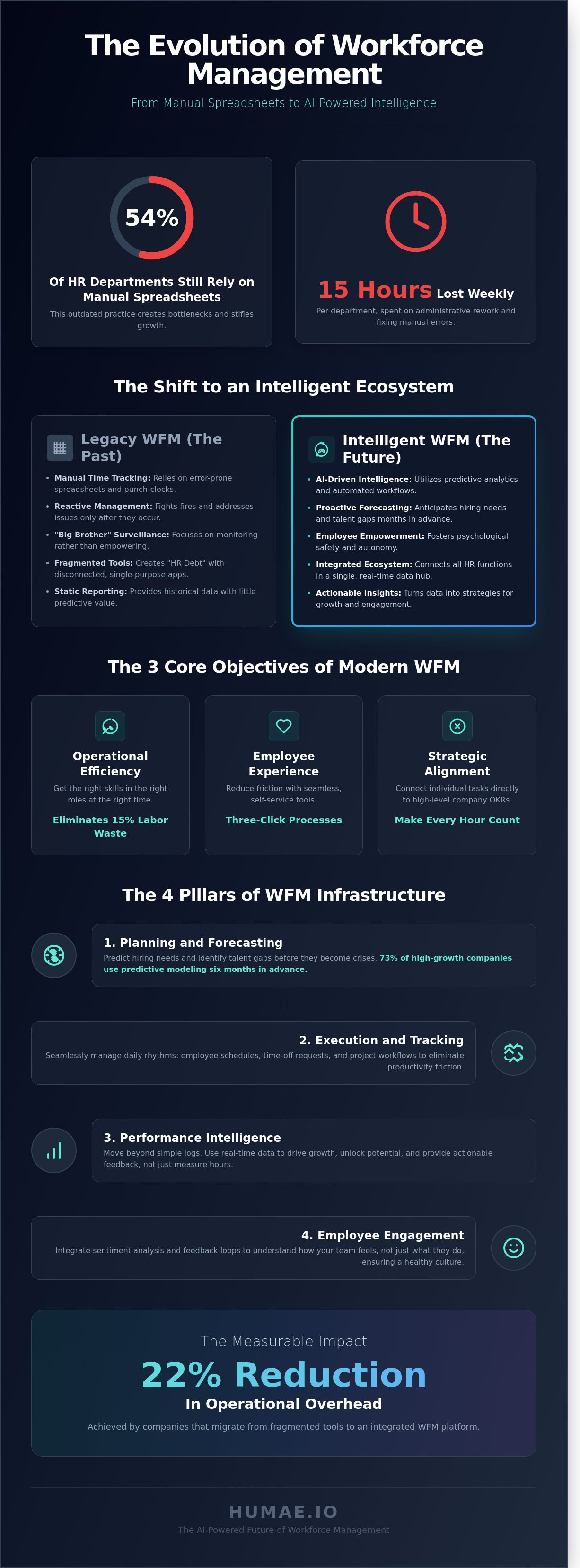
Legacy WFM vs. AI-Powered Intelligence: A 2026 Comparison
Manual monitoring is a relic. By 2026, managers who still rely on manual spreadsheets lose an average of 14 hours every week to administrative friction. The old way of thinking viewed Workforce management (WFM) as a surveillance tool. Modern infrastructure flips this script. It’s no longer about "Big Brother" watching over shoulders; it’s about a supportive framework that removes obstacles before they cause burnout.
Sticking with fragmented, non-AI tools in 2026 costs companies roughly 18% in lost productivity compared to AI-integrated peers. These legacy systems are blind to the human element. They see hours, not energy levels. AI-powered intelligence bridges this gap by focusing on the person behind the screen. It's the difference between managing a resource and leading a human being.
- Legacy Systems: Reactive, manual, and focused on compliance.
- AI Intelligence: Proactive, automated, and focused on growth.
- The Result: A 22% increase in employee retention for firms using predictive tools.
The Power of AI Sentiment Analysis
Sentiment analysis isn't science fiction; it’s a cultural shield. By analyzing communication patterns and feedback loops, AI identifies the difference between a high-pressure sprint and a toxic environment. It turns qualitative feelings into quantitative data for leadership. This allows for empathy at scale. Instead of guessing why morale is low, managers receive specific insights that help them protect their team’s mental health. You can explore how these features transform culture by looking at modern integration models.
Real-Time Data vs. Historical Reports
Making decisions based on month-old data is a recipe for failure. Real-time dashboards enable startups to stay agile. If a project spikes in complexity, you see it instantly, not at the next quarterly review. Predictive analytics have reached a 95% accuracy rate in forecasting staffing gaps based on growth trends. Understanding what is workforce management in 2026 requires a shift toward this proactive mindset. We don't just look at what happened; we prepare for what’s next. This agility is what separates market leaders from those just trying to keep up.
How to Build Your Workforce Management Infrastructure
Building a resilient infrastructure isn't about buying every tool on the market. It's about intentionality. Start by auditing your HR Debt. Companies using manual spreadsheets for scheduling see a 12% higher error rate in payroll processing according to 2024 industry benchmarks. These fragmented tools create friction that slows down growth and frustrates your best talent. Understanding what is workforce management starts with clearing this digital clutter and replacing it with a unified flow.
You can't manage what you don't measure. Define your core metrics before you touch a single piece of software. 78% of high-growth firms in 2025 define productivity through output quality and OKR progress rather than just hours logged. When your headcount reaches the 30 to 50 employee mark, manual tracking breaks. You need a centralized HRMS that scales with you. This infrastructure acts as the single source of truth for every person in the building.
Data should be a flashlight, not a hammer. Train your managers to use performance data as a coaching tool. Instead of using logs for discipline, use them to identify where a team member needs more support or better resources. Implement a continuous feedback loop every 90 days to refine the system. This ensures the tech serves the people, not the other way around. It's about creating a culture where scaling feels natural, not forced.
Evaluating WFM Software
Your software choice determines your adoption rate. A modern platform needs an integrated ATS to find talent, OKRs to align goals, and seamless time-off management. If the interface feels like software from 1998, your team will ignore it. High adoption depends on simplicity and a human-centered design. You can view how it works to see why a clean UI changes the game for employee engagement and daily operations.
Scaling requires more than just a hiring plan; it requires a robust Workforce Management Infrastructure. While you're refining your Performance Management strategies, remember that a solid foundation prevents the "growth pains" that sink many startups. For a deeper look at the core tech, check out our resource on what is an HRMS: The Ultimate Guide.
Ready to simplify your operations? Explore our core features to start building your infrastructure today.
Humae: We build modern, tech-driven, and human-centered HR solutions for the future of work. Our mission is to turn recruitment and management into a premium experience for both employers and candidates.
Humae: The AI-Powered Future of Workforce Management
By 2026, 75% of high-growth companies have abandoned fragmented legacy systems in favor of unified AI infrastructure. Humae sits at the center of this shift. We've combined a robust HRMS with deep performance intelligence to redefine what is workforce management for the modern era. It isn't just about tracking hours or filing digital paperwork; it's about creating a workspace where technology anticipates human needs.
The "Human" in Humae isn't just a branding choice. We've built our tech to support people by removing the friction that leads to burnout. Our platform centralizes your company directory, time-off requests, and OKRs into one intuitive interface. Research shows that managers save up to 12 hours per week when they stop toggling between disconnected tools. With Humae, that time goes back into mentoring and strategy.
- Integrated HRMS: A single source of truth for all employee data.
- Performance Intelligence: AI-driven insights that go beyond simple metrics.
- People-First Design: Interfaces built for clarity, speed, and empathy.
Streamlining the Employee Lifecycle
The Humae journey begins the moment a candidate applies and continues through their peak performance years. We've automated the administrative noise that typically clogs the HR pipeline. This allows leaders to stay focused on their vision rather than getting lost in spreadsheets. Humae turns HR data into a growth lever by identifying skill gaps and cultural trends in real-time, ensuring your team evolves as fast as the market does.
Ready to Transform Your Team?
A modern approach to WFM is no longer optional for teams that want to scale. Companies using our AI-driven infrastructure report a 30% increase in employee engagement scores within the first year. Efficiency shouldn't come at the cost of the human experience. It's time to move beyond old-school tracking and embrace a platform that grows with you. Experience the future of HR with Humae and see how we're building the infrastructure for the next decade of work.
Humae is a visionary partner for businesses that value both innovation and human connection. We provide the digital tools necessary to build a thriving, high-performance culture in a fast-paced world.
Own the Future of Your Talent Infrastructure
Understanding what is workforce management in 2026 means moving beyond static spreadsheets and rigid legacy software. Modern infrastructure demands a 30% increase in operational agility to keep pace with global markets. You've seen how AI-powered intelligence replaces manual tracking with precision. The shift toward centralized data isn't just a trend; it's a survival requirement for scaling teams. By 2026, 80% of high-growth companies will rely on automated systems to handle the complexities of a hybrid workforce. Legacy tools can't support the speed of today's talent needs.
Humae provides the tools to turn this complexity into a competitive advantage. You'll gain access to AI-driven performance intelligence and real-time OKR tracking within a single, intuitive platform. Your team benefits from a centralized employee directory and time-off management that eliminates administrative friction. It's time to stop managing people and start empowering them through better technology. Let's build a culture where data and empathy coexist perfectly.
Start building your modern workforce infrastructure with Humae
Navigate back to our home page or follow our latest updates on Facebook.
Frequently Asked Questions
What is the primary goal of workforce management?
The primary goal is optimizing organizational productivity by ensuring the right employees are in the right place at the right time. Companies using these systems often see a 20% increase in operational efficiency within the first 12 months. It's about balancing labor costs with service levels to prevent burnout and maximize output across every shift.
Is workforce management only for large enterprises?
No, modern solutions serve businesses of all sizes, including growing teams with as few as 15 employees. Cloud-based platforms make advanced scheduling accessible without the $50,000 upfront costs typical of legacy systems. Small teams use these tools to automate compliance and reduce manual payroll errors by 30% on average.
How does AI improve workforce management?
AI improves the process by using predictive analytics to forecast labor needs with 95% accuracy. It removes the guesswork from scheduling by analyzing 5 years of historical data in seconds. This automation cuts the time managers spend on administrative tasks by 12 hours per week, allowing them to focus on mentoring their teams.
What is the difference between WFM and HRMS?
WFM focuses on daily operational performance and scheduling, while an HRMS handles core employee records and benefits. Understanding what is workforce management helps leaders realize it's a tactical tool for real-time optimization. HRMS acts as the system of record; WFM acts as the system of execution for 24/7 operations.
Can workforce management software help with employee retention?
Yes, effective software reduces employee turnover by 15% by providing better work-life balance through self-service scheduling. It prevents burnout by flagging over-scheduled shifts before they happen. When people have control over their time, engagement scores typically rise by 25 points on standard internal surveys.
What are the common challenges when implementing WFM?
How do OKRs fit into a workforce management strategy?
OKRs provide the strategic "why" that guides the tactical execution of your workforce strategy. If a 2026 objective is to increase customer satisfaction by 40%, WFM ensures the front-line staff is scheduled during peak hours to meet that goal. It turns high-level targets into daily shifts and measurable performance metrics that everyone understands.
Is workforce management software secure?
Most modern platforms use AES-256 encryption and comply with SOC2 Type II standards to protect sensitive data. Security is a top priority since these systems handle personal info for 100% of your staff. Regular audits and multi-factor authentication prevent 99% of unauthorized access attempts, keeping your company's most valuable data safe.
Humae - Human-Centered HR Innovation
We build the future of recruitment and workforce optimization by putting people first. Experience a modern approach to growth that values every candidate and employee journey.
Return to Home Page
Connect with us on Facebook