What Is Management? The Definitive Guide for Modern Leaders in 2026
By Humae · 17 April 2026
management
By 2026, industry data suggests that 75% of traditional management tasks will be automated or augmented by AI, rendering the "supervisor" persona obsolete. You likely feel the weight of this shift daily. Moving from a top individual contributor to a leader is a high-pressure transition, and it's easy to feel overwhelmed when you're caught between tracking output and avoiding the micromanagement trap. You want to lead with impact, yet the line between management and leadership often feels blurred in a digital-first environment.
This guide provides the clarity you've been looking for. You'll discover how the definition of management has evolved into a sophisticated blend of human empathy and AI-driven workforce intelligence. We'll give you a clear framework to master both people and processes, using real-time data to drive team success with total confidence. We're exploring the specific tools and mindsets required to build high-performance teams that thrive on trust rather than oversight.
Experience a more human way to grow with Humae. Return to our home page to explore our latest innovations, or stay connected with our community on Facebook.
Key Takeaways
- Understand the critical shift from 20th-century "command and control" to a modern empowerment-led model designed for the 2026 workforce.
- Master the four pillars of modern management to build a resilient workforce infrastructure that scales efficiently in volatile markets.
- Learn to bridge the gap between systems-focused stability and visionary leadership to excel as a high-impact "Manager-Leader."
- Identify the essential data literacy and strategic communication skills needed to interpret analytics and master the art of the feedback loop.
- Discover how AI-powered platforms like Humae automate administrative burdens, allowing leaders to focus on human-centric growth and culture.
Defining Management: Beyond the Dictionary
Management isn't just about oversight; it's the art of orchestrating talent and technology to hit targets without wasting energy. In the 20th century, managers often acted like drill sergeants under a rigid command and control model. That era is over. Modern leadership focuses on enablement and empowerment. Leaders now clear roadblocks so their teams can sprint toward success. Whether you operate in a traditional hierarchy or a flat startup structure, your primary goal remains the same: maximizing output while maintaining a healthy culture.
The Core Concept of Business Management
The Evolution of Management Theory
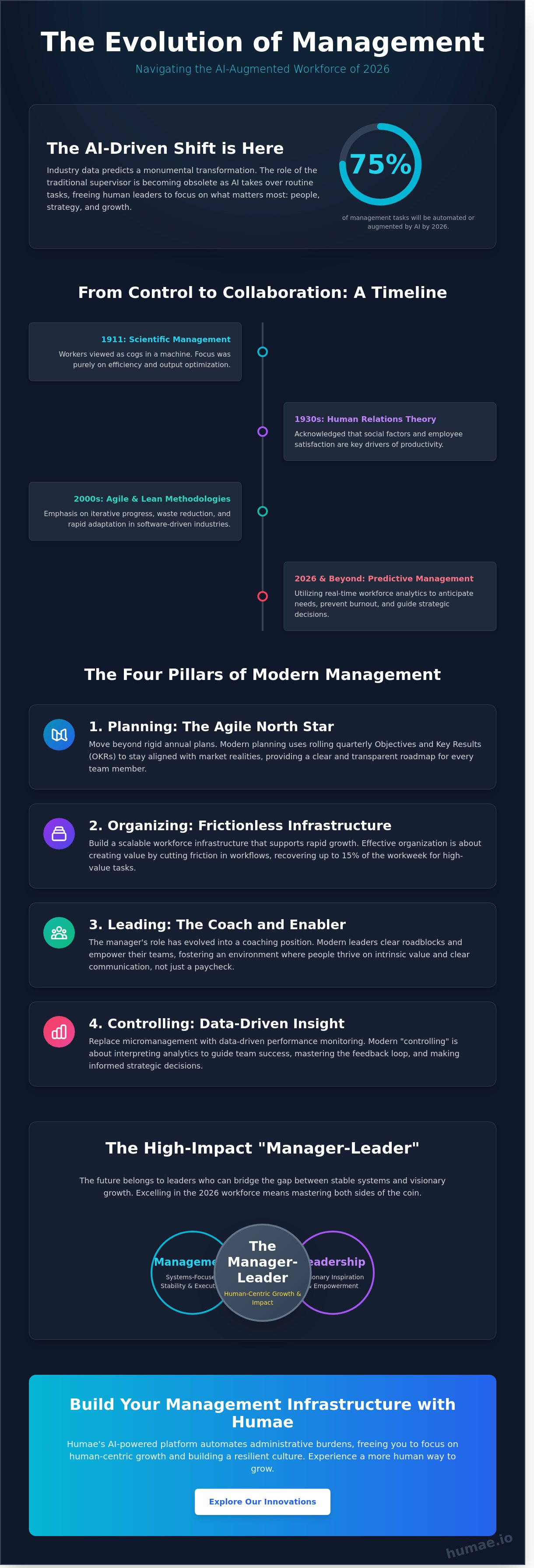
We've come a long way from Frederick Taylor’s Scientific Management in 1911, which treated workers like cogs in a machine. The Human Relations Theory of the 1930s finally acknowledged that social factors and employee satisfaction drive productivity. Today, Agile and Lean methodologies dominate software-driven firms, emphasizing iterative progress and waste reduction. Looking toward 2026, the industry is moving toward Predictive Management. This approach uses real-time workforce analytics to anticipate needs and stop burnout before it starts, ensuring the technology you use actually serves the people behind the screens.
Powered by Humae
We believe in a future where technology and human connection thrive together. Our tools are designed to simplify your recruitment and management processes, putting the focus back on what matters: your people.
The Four Pillars of Management in the Digital Age
Management isn't a static set of rules; it's a living system that adapts to the pulse of the market. Since 2020, the business world has seen a 25% increase in market volatility, making traditional "command and control" styles obsolete. Modern management requires a shift toward agility and human-centric systems. Effective Planning today means setting a North Star while staying flexible. You can't predict the specific challenges of 2026 with a spreadsheet made two years ago. Organizing involves building a scalable workforce management infrastructure that supports rapid growth without adding layers of friction. Leading has evolved into a coaching role. People don't just work for a paycheck; they work for intrinsic value and clear communication. Finally, Controlling is about monitoring performance through data, not through the trap of micromanagement. According to the U.S. Bureau of Labor Statistics, management occupations continue to grow as companies seek leaders who can balance technical efficiency with emotional intelligence.Modern Planning and OKRs
Annual planning is dead. A 12-month roadmap is often obsolete by month three. Modern teams now move toward rolling quarterly objectives. This rhythm keeps everyone aligned with the current reality. OKRs (Objectives and Key Results) provide a transparent roadmap for every team member. When an employee sees how their daily tasks contribute to a specific 15% increase in customer satisfaction, they feel a direct connection to the corporate mission. Transparency isn't just a buzzword; it's a productivity tool.
Leading Remote and Hybrid Teams
By 2026, managing a distributed workforce is no longer an experiment; it's the standard. The unique challenges include maintaining culture across time zones and building trust without physical proximity. Centralized HRMS platforms act as the digital office where transparency lives. Smart leaders use absence management data to ensure team health and prevent the burnout that currently impacts nearly 42% of global office workers. Trust is built when processes are clear and people feel seen, even through a screen.
Building a culture of trust starts with the right tools. You can explore how to streamline your team's operations by checking out our core management features.
About Humae
Humae is a modern, technology-driven partner dedicated to transforming the HR experience. We combine innovative automation with a deeply human-centered approach to help businesses grow sustainably and treat their people like the assets they are.
Back to Home | Connect with us on Facebook
Management vs. Leadership: Navigating the 2026 Workforce
The distinction between managing and leading has never been sharper than it is approaching 2026. While traditional systems prioritize stability and order, the modern workforce demands movement and vision. Effective 2026 leaders don't just supervise; they inspire. We're seeing a shift where the most successful professionals are "Manager-Leaders" who bridge the gap between operational logic and human inspiration. They understand the fundamental Principles of Management while remaining agile enough to pivot when market conditions shift. In creative and tech-heavy industries, the danger of over-managing is real. Micromanagement kills 35% of productivity in high-skill teams by stifling autonomy. When you under-lead, you lose the "why" behind the work. Teams become efficient machines that lack direction. Successful 2026 strategies focus on setting the destination and letting the team build the path.The Technical Side of Management
Leadership is the human element that software can't replace. It's about creating psychological safety where 90% of employees feel comfortable sharing innovative ideas without fear of failure. Modern leaders use sentiment analysis tools to read the digital room, catching burnout or frustration before it leads to turnover. Coaching has replaced traditional annual reviews as the primary driver of retention. When people feel mentored rather than just monitored, their loyalty increases by up to 60%. This empathetic approach turns a group of workers into a cohesive community. The rise of AI has fundamentally changed these roles. AI tools now handle the repetitive management tasks like data entry and basic reporting. This shift frees humans to focus on high-level leadership. By 2026, your value isn't found in how well you track hours, but in how effectively you grow your people.Humae: Modern technology for a more human workplace.
We help businesses build better cultures through innovative HR solutions and empathetic leadership tools.
Essential Management Skills for High-Growth Teams
Scaling a team at pace requires more than just leadership intuition. Modern management demands a blend of analytical rigor and radical empathy. High-growth environments often see productivity drop by 20% when communication breaks down, making specific technical and interpersonal skills non-negotiable for leaders. Success in this fast-paced environment depends on how well you bridge the gap between human needs and business objectives.
Bridging this gap also involves understanding your external market; you can discover Human Instinct to leverage data-driven insights that help refresh stagnant brands and reach new audiences.
- Data Literacy: Leaders can't rely on gut feelings alone. You need to interpret analytics dashboards to spot bottlenecks before they stall growth. A 2023 study showed that managers who use data-driven insights are 56% more likely to hit their quarterly targets.
- Strategic Communication: This involves mastering the feedback loop. Effective managers ensure information flows both ways, reducing project delays by up to 30%.
- Conflict Resolution: Managing grievances requires a balance of fairness and speed. Unresolved tension costs companies an average of 2.8 hours per week in lost productivity, so addressing issues early is vital.
- Technological Proficiency: Leveraging AI-powered HR platforms isn't optional. It automates the administrative burden, letting you focus on human strategy rather than paperwork.
Mastering Performance Intelligence
The days of the dreaded annual review are over. Performance intelligence is the GPS for people operations. High-growth firms that switch to continuous feedback see a 14.9% lower turnover rate. By using real-time data, you can identify high-potentials early or support at-risk employees before they disengage. It's about proactive intervention, not reactive damage control.
Building a Culture of Accountability
Accountability starts during the first hour of onboarding. When you set clear expectations immediately, employees are 2.3 times more likely to stay engaged. Transparency is the engine here. If everyone sees the goals, everyone owns the results. You can integrate Humae features to track progress visibly, ensuring no one feels left in the dark. This visibility builds trust and eliminates the need for micromanagement.
Ready to transform your management approach and build a more resilient team? Explore how Humae streamlines team growth.
Humae - Human-centered HR technology for modern, high-growth teams.
Building Your Management Infrastructure with Humae
Scaling a business requires more than just grit; it demands a robust technical foundation. Humae provides an AI-driven platform that handles the repetitive tasks that often drain a leader's energy. By automating contract generation, onboarding workflows, and leave tracking, the system returns roughly 12 hours of productive time per week to your leadership team. Modern management relies on this efficiency to keep the focus on people, not just processes. You don't need to be buried in paperwork to be an effective leader.
Centralization is the key to sustainable growth. When your team expands from 10 to 1,000 members, fragmented data becomes a massive liability. Humae brings employee directories, OKRs, and performance reviews into one unified dashboard. This eliminates the "data silos" that cause 25% of communication breakdowns in growing firms. Real-time analytics allow you to spot burnout or high performance instantly. You'll make workforce decisions based on live evidence, moving from a reactive stance to a proactive strategy that anticipates team needs before they become problems.
This need for unified data often extends to external sales channels as well; to learn how automation handles these complex networks, you can visit Computer Market Research for a comprehensive guide on partner relationship management.
Why Modern Managers Choose Humae
Leaders choose us because we simplify the how it works of daily operations. You'll stop hunting through 15 different spreadsheets just to find a single performance score or a hire date. Humae transforms raw data into actionable insights that actually matter. It's about seeing the "why" behind the numbers. We empower you to lead with empathy and precision, ensuring that as you grow, your company culture remains intact and your people feel seen.
Getting Started with Intelligent Management
Implementing a centralized HRMS is the first step toward professional management at scale. By establishing a single source of truth, you ensure that every department stays aligned on the same goals and metrics. This clarity reduces friction and builds trust across the entire organization. It's time to move past the manual era of HR. Transform your style and build a culture where everyone thrives by choosing a partner that understands the human side of technology.
Explore More About Humae:
Return to our Home Page to see how we can help your team grow.
Stay connected and follow our journey on Facebook.
Mastering the New Era of Team Success
The transition to better leadership starts with the right tools. You'll find that when your infrastructure matches your ambition, your team's potential becomes limitless. Stop fighting against legacy systems and start building a workspace that inspires. Ready to simplify your team management? Discover Humae today.
We're excited to see how you'll transform your workplace culture. Stay connected with us for more insights on the future of work. We're here to help you navigate every step of your growth journey.
Back to Home | Connect on Facebook
Frequently Asked Questions
What is the simplest definition of management?
Management is the coordination and administration of tasks to achieve a specific goal. In a business context, it involves overseeing people, resources, and processes to ensure a company operates efficiently. Data from 2024 shows that 82% of high-growth firms attribute their success to structured management practices. It's the engine that turns strategic vision into measurable results through organized action and clear communication.
What are the 5 basic functions of management?
The five basic functions are planning, organizing, staffing, leading, and controlling. By 2026, these roles have evolved to include data-driven intelligence and AI-assisted decision-making. This shift helps leaders support modern, flexible work environments effectively. A 2025 industry report found that 65% of managers now use digital tools to maintain team cohesion in hybrid settings across various global time zones.
What is the difference between management and leadership?
Management focuses on maintaining order and systems through consistency, while leadership centers on vision and driving change. You manage the work but you lead the people. Research from 2023 indicates that teams with leaders who balance both traits see 21% higher engagement levels. Modern managers must be visionaries who also understand the daily mechanics of operations to build a high-performance culture.
Why is effective management important for a business?
Effective management ensures that resources aren't wasted and employees stay focused on their objectives. Without it, organizations face operational chaos and high turnover rates. Gallup's 2024 report shows that poor management costs global economies $8.8 trillion in lost productivity annually. It provides the necessary structure to scale a business while maintaining a positive candidate experience and a healthy, sustainable company culture.
How is AI changing the role of a manager?
AI transforms the manager's role by automating administrative tasks like scheduling, data entry, and basic reporting. This shift allows leaders to spend 40% more time on high-value human activities like coaching and strategic problem-solving. By removing the burden of manual work, technology empowers you to focus on building a stronger community. It turns the manager into a mentor and strategist rather than a task-tracker.
What skills do I need to be a good manager in 2026?
You need a mix of technical data literacy, emotional intelligence, and the ability to lead hybrid teams. Mastering HR software platforms like Humae is essential for modern recruitment and retention. Statistics from 2025 suggest that 74% of top-performing managers use automation to improve the overall candidate experience. Success in this role requires a blend of digital fluency and a deep, empathetic commitment to human connections.
Humae is a modern, tech-driven partner dedicated to human-centered HR solutions. We help businesses grow by making recruitment an inspiring experience for everyone involved.
Navigate back to our home page for more resources.
Connect with us on Facebook to join our community.