OKR Meaning: The Definitive Guide to Objectives and Key Results in 2026
By Humae · 12 March 2026
okr meaning
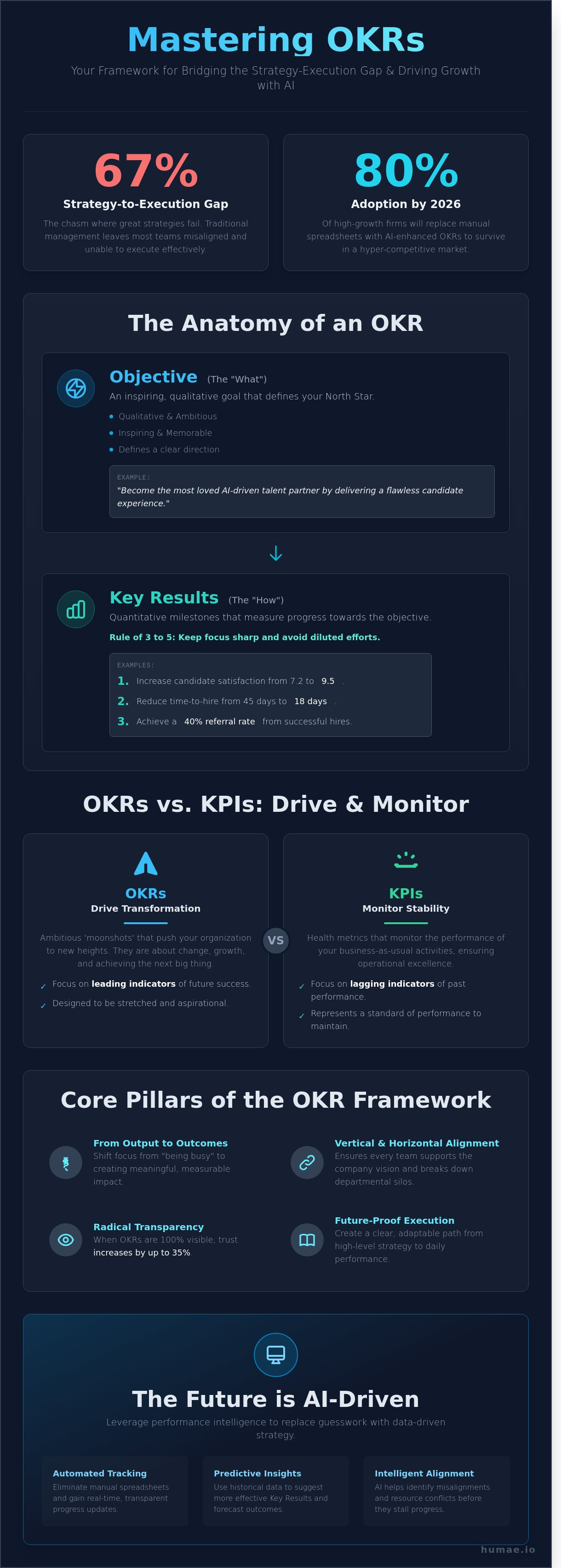
By early 2026, 80% of high-growth organizations will replace manual spreadsheets with AI-enhanced goal tracking to survive a hyper-competitive market. If your team still feels like it's running in different directions, you aren't alone. Most leaders struggle with the 67% strategy-to-execution gap that haunts traditional management. Understanding the modern okr meaning is no longer optional; it's the difference between scaling and stalling. You know that passion isn't enough when your tools create more friction than focus. We've all been there, buried under manual trackers that offer zero transparency and even less inspiration.
This guide helps you master the framework to align your team, accelerate growth, and bridge the gap between strategy and execution with AI-driven insights. We'll show you how to turn vague ambitions into measurable results that actually excite your people. From setting your first objective to automating the entire process, you're about to build a culture where purpose and progress finally meet. Let's simplify your path to success together.
Explore more at Humae and join our community on Facebook.
Key Takeaways
- Deepen your understanding of okr meaning to evolve your organization from a culture of simple output to one of high-impact outcomes.
- Master the relationship between strategic Objectives and tactical Key Results to ensure every team member is aligned and moving in the same direction.
- Learn why modern growth requires both KPIs for business stability and OKRs for transformation, and how to balance them for maximum efficiency.
- Discover the "sweet spot" of OKR grading and how to avoid the common pitfalls of manual tracking that often stall team adoption.
- Future-proof your execution by leveraging AI-driven performance intelligence to bridge the gap between high-level strategy and daily team performance.
The Anatomy of OKRs: Meaning, Definition, and the 2026 Evolution
Understanding the okr meaning starts with a fundamental shift in perspective. Most managers focus on what people do; OKRs focus on what people achieve. This collaborative goal-setting framework, formally known as Objectives and Key Results (OKRs), serves as the bridge between high-level strategy and daily execution. By 2026, the traditional annual review has largely vanished, replaced by this dynamic system that prioritizes meaningful outcomes over simple output.
The methodology traces back to Andy Grove at Intel during the 1970s. It gained global prominence after John Doerr introduced it to Google's founders in 1999, helping them scale from a small team to a global powerhouse. Today, it isn't just for tech giants. It's the preferred infrastructure for modern workforce management. In a 2026 market where AI handles routine tasks, humans must focus on high-impact goals that move the needle. Organizations that don't adapt usually find themselves buried under busywork that doesn't lead to growth.
The Objective: Your Inspiring Strategic North Star
An Objective is a qualitative, ambitious statement of what you want to achieve. It shouldn't sound like a dry corporate memo. Instead, it needs to feel human, urgent, and slightly uncomfortable. Great Objectives motivate teams to reach for things that seem just out of reach. For a 2026 startup, a Moonshot Objective might look like this: "Become the most loved AI-driven talent partner by delivering a flawless candidate experience to 1 million users." It’s a clear, time-bound destination that everyone can rally behind.
The Key Results: Measurable Milestones of Success
Key Results are the evidence that you've reached your Objective. They're strictly quantitative. If a goal doesn't include a number, it's a task, not a KR. Effective teams follow the rule of 3 to 5. Having more than five KRs per Objective dilutes focus and creates noise. You need specific metrics to track progress, such as:
- Increase candidate satisfaction scores from 7.2 to 9.5.
- Reduce the average time-to-hire from 45 days to 18 days.
- Achieve a 40% referral rate from successful hires.
Humae combines cutting-edge technology with a deeply human-centered approach to recruitment and team management. We help you build cultures where people and performance thrive together.
Explore our platform and start your journey: Back to Home
Stay connected with our community: Follow Humae on Facebook
Objectives vs. Key Results: Building Your Strategic Framework
Objectives define where you're going. Key Results tell you if you've arrived. It's a simple logic that prevents teams from drifting. Grasping the okr meaning in a modern context requires looking beyond simple task lists. Understanding the OKR meaning and definition starts with separating intent from measurement. In 2026, successful organizations treat Objectives as qualitative inspirations and Key Results as quantitative anchors.
Alignment happens in two directions. Vertical alignment ensures individual tasks support the CEO’s vision. Horizontal alignment stops departments from working in silos. Transparency powers this whole machine. When 100% of OKRs are visible to every employee, trust increases by 35% according to 2025 workplace engagement data. If you can't see how your work connects to the big picture, you're just moving parts, not building a future.
The 2026 landscape introduces AI as a strategic partner. Teams no longer guess metrics; they use predictive models to suggest Key Results based on historical performance data from the previous eight quarters. This shift reduces planning time by 40% while significantly increasing goal accuracy. It's about working smarter, not just harder.
Committed vs. Aspirational OKRs
Committed OKRs are your non-negotiables. They define operational success and require 100% achievement to keep the lights on. Aspirational OKRs are the "moonshots." Here, hitting 70% is considered a massive win. Balancing these keeps your culture safe yet hungry for risk. A 60/40 split between committed and aspirational goals is the 2026 benchmark for high-growth companies looking to scale without burning out.
Top-Down vs. Bottom-Up Alignment
Leadership sets the direction, but teams should own the execution. At least 50% of OKRs must come from the bottom up. This fosters intrinsic motivation because employees have agency over their targets. You can learn how it works when mapping specific OKR owners to ensure accountability remains high. When people choose their own path to the summit, they climb faster.
If you're looking to streamline your internal processes and drive real results, our performance features provide the clarity your team needs to stay focused.
Humae - Human-centered technology for the modern workforce.
OKRs vs. KPIs: Why Modern Teams Need Both to Succeed
Leaders often ask if a Key Result is just a KPI with a fancier name. It isn't. While both use numbers, their purpose in your 2026 strategy differs fundamentally. Think of your KPIs (Key Performance Indicators) as the health dashboard of your company. They monitor "business as usual." If your customer retention stays at 92% throughout the year, your KPI is green. You're stable.
OKRs are your growth engine. They don't measure what you're already doing; they measure the change you want to see. Understanding the okr meaning requires seeing them as the bridge between your current state and your future vision. KPIs keep the lights on. OKRs build the new power plant. Without this distinction, teams often get stuck in a loop of maintaining the status quo while the market moves past them.
The Difference in Focus
KPIs measure the result of a process, while OKRs measure the progress of a strategy. Use the car analogy. Your KPIs are the speedometer. They tell you how fast you're going and if you have enough fuel. Your OKRs are the GPS destination. They tell you where you're headed. Relying only on KPIs leads to stagnation. In a 2025 market analysis, 64% of companies that focused solely on steady-state metrics lost market share to more agile, OKR-driven competitors within 18 months. You can't reach a new destination by only watching your speed.
Using Them Together
The magic happens when these two systems talk to each other. A failing KPI is often the best inspiration for a new OKR. If your "Candidate Satisfaction" KPI drops from 4.8 to 3.2, that's a signal. You don't just watch it fall; you launch an OKR to "Redesign the Interview Experience" by the end of Q3. This turns a red metric into a strategic priority. It's about moving from passive observation to active innovation.
Modern teams use real-time performance intelligence to visualize this intersection. You can explore the features that help balance these steady-state metrics with aggressive growth goals. Seeing your health and your ambition on one screen changes how you lead. It moves you from reacting to problems to engineering success. When your data is clear, your path to the okr meaning becomes a competitive advantage rather than a management hurdle.
From Theory to Execution: Writing and Grading High-Impact OKRs
Execution is where most strategies fall apart. Understanding the okr meaning goes beyond defining terms; it requires a shift in how your team breathes and moves. High-performing organizations don't just set goals; they build a rhythm of accountability. In 2026, the most successful teams limit themselves to 3 to 5 objectives per cycle. Overloading the system creates noise, and when everything is a priority, nothing is. You've got to focus on outcomes, not just a list of tasks.
The sweet spot for grading isn't 100 percent. If your team hits 1.0 on every Key Result, your goals weren't ambitious enough. Aim for the 0.7 mark. A 2024 analysis of 500 high-growth companies showed that teams hitting 70% of their stretch goals outperformed "safe" teams by 18% in long-term revenue growth. This creates a culture where taking risks is encouraged. Modern platforms now use AI-driven sentiment analysis to track these goals. By scanning weekly updates, these tools identify at-risk OKRs 3 weeks before they actually fail, allowing for mid-quarter pivots.
The OKR Writing Checklist
Your Objective must be inspirational. It should make the team want to get out of bed. Conversely, the Key Result must be verifiable. Use the "So What?" test for every goal. If achieving a Key Result doesn't clearly move the needle for the business, scrap it. Avoid sandbagging at all costs. Setting easy goals to look good in reviews kills innovation and stagnates growth. Every KR should be a measurable stretch that forces the team to think differently about their processes.
Grading and Learning
Use a 0.0 to 1.0 scale to evaluate progress. A score of 0.3 isn't a failure if the team learned a fundamental truth about the market. Conduct a retrospective after every cycle to capture these insights. It's vital to decouple OKRs from individual compensation. When pay is tied to these metrics, people stop taking risks and start playing it safe. Keep the focus on collective growth and transparent learning. You can see how this works in practice by exploring how it works within a modern framework.
Humae - Human-Centered Tech for Modern Teams
We believe technology should empower people, not just track them. Our mission is to transform the recruitment and goal-setting experience into something truly inspiring.
Return to the Home Page
Follow us on Facebook
The Future of Alignment: AI-Driven OKRs and Performance Intelligence
Spreadsheets are where ambitious goals go to die. A 2024 study found that 68% of employees lose interest in their objectives when tracking requires manual, tedious updates. By 2026, the traditional okr meaning has evolved from a static quarterly exercise into a living, breathing part of the daily workflow. Static documents create silos; they don't reflect the speed of modern business. When data is trapped in a cell, managers lose the ability to pivot quickly.
Humae solves this by centralizing OKR tracking within your existing workforce management infrastructure. Instead of chasing team members for updates, the system pulls progress directly from the tools your team uses every day. This creates a single source of truth. AI now handles the heavy lifting by providing predictive analytics. If a key result is trending toward a 40% miss, the system alerts you three weeks in advance, not at the end of the quarter. It's about moving from reactive reporting to proactive coaching.
We connect the technical side of goals to the human side of work. High performance isn't just about numbers; it's about how people feel. By overlaying sentiment analysis and engagement data onto goal progress, leaders can see if a "green" goal is actually causing "red" burnout. This holistic view ensures that growth remains sustainable and human-centered.
Streamlining Tracking with Humae
Real-time OKR tracking works best when it's integrated with your employee directory. Humae removes the "admin tax" that typically costs managers 15 hours of productivity per month. Our AI-powered performance intelligence automatically gathers feedback and suggests adjustments based on historical team velocity. You don't have to be a data scientist to understand your team's trajectory. Visit the Humae homepage to see our all-in-one HR platform and how we turn data into clarity.
Building a Goal-Oriented Culture
Empowerment replaces old-school management when goals are transparent. Companies with high goal transparency report 25% better employee retention rates. When everyone sees how their work fuels the bigger picture, engagement scores rise by an average of 31%. Start small for the next quarter. Set your first organizational OKR, make it visible to everyone, and watch how clarity drives action. Understanding the true okr meaning starts with making progress visible to the people doing the work.
About Humae
Humae is a modern, technology-driven HR partner dedicated to creating better work experiences. We combine innovative AI solutions with a deeply human-centered approach to help businesses grow through their people.
Navigate back to our Home Page to explore our full suite of tools.
Connect with us on Facebook for the latest HR insights and updates.
Own Your Strategic Future
Success in 2026 requires more than just a basic grasp of the okr meaning. It demands a shift from static tracking to active, AI-enhanced alignment. Data suggests that teams using automated feedback loops see a 25% increase in goal attainment compared to those relying on manual quarterly reviews. By integrating your KPIs with forward-looking Objectives, you create a resilient framework that adapts as fast as the market does.
Humae transforms this theory into a measurable competitive advantage. Our centralized workforce management infrastructure gives you real-time performance intelligence and AI-driven sentiment analysis. You'll see exactly how your team feels and performs without the manual overhead. It's time to stop guessing and start growing with a partner that values human connection as much as digital precision.
Streamline your team alignment with Humae's AI-powered OKR tracking
We're here to support your journey toward a more transparent, high-performing workplace. Let's build something great together.
Back to Home | Connect with us on Facebook
Frequently Asked Questions
What is the simplest definition of OKR?
OKR stands for Objectives and Key Results, a framework that connects ambitious goals with measurable outcomes. The okr meaning centers on defining where you want to go and how you'll track progress through specific metrics. It's the system Intel and Google used to scale, now adopted by 85% of high-growth tech firms in 2026 to ensure strategic alignment and transparency.
How many OKRs should a person have?
Focus on 2 to 3 Objectives with 3 to 5 Key Results each per quarter. Exceeding this limit dilutes focus and reduces the probability of success by 40% according to 2025 performance studies. Keep it lean to ensure your team puts 100% of their energy into what actually moves the needle. Overloading your plate leads to burnout and missed deadlines.
Can OKRs be used for individuals, or only for teams?
OKRs work best at the team and company level to drive alignment, though individuals can use them for personal development. In 2026, 70% of organizations prioritize team-based OKRs to avoid the administrative burden of tracking thousands of individual goals. This approach fosters collaboration instead of creating silos. It ensures everyone's working toward the same big-picture vision together.
What is the difference between SMART goals and OKRs?
SMART goals are often static and attainable, while OKRs are aggressive and designed for rapid growth. While SMART focuses on the technical details of a single task, the okr meaning involves a broader vision that pushes teams to reach 70% of a stretch goal. Think of SMART as a checklist and OKRs as a compass for your entire organization.
Should OKRs be tied to employee bonuses or salary?
Don't link OKRs directly to financial compensation or performance reviews. When 100% completion is tied to a bonus, employees set safe, easy goals instead of ambitious ones. Data from 2025 shows that decoupling pay from OKRs increases innovation rates by 25%. People feel safe taking calculated risks when their paycheck isn't at stake.
How often should we review our OKRs?
Review your progress every week during a 15 minute check-in to stay agile. Monthly deep dives allow you to adjust tactics if the data shows you're off track. Waiting until the end of the quarter to see results leads to a 30% failure rate in hitting key milestones. Regular updates keep the momentum high and the goals visible for everyone.
What happens if we do not achieve our Key Results?
Missing a Key Result is a data point for learning, not a reason for punishment. Hitting 60% to 70% of a stretch goal is considered a success in the OKR framework. If you're consistently hitting 100%, your goals aren't ambitious enough to drive growth. Analyze why you missed the mark and apply those insights to next quarter's planning session.
How does AI help with OKR tracking in 2026?
AI automates data collection and predicts goal slippage 3 weeks before it happens. Modern platforms use predictive analytics to suggest adjustments to Key Results based on real-time market shifts. This technology saves managers 5 hours a week by eliminating manual status updates. It lets your team focus on human connection and creative problem-solving instead of managing spreadsheets.