The Hidden Costs of Manual Employee Management: A 2026 Financial Analysis
By Humae · 5 May 2026
hidden costs of manual employee management
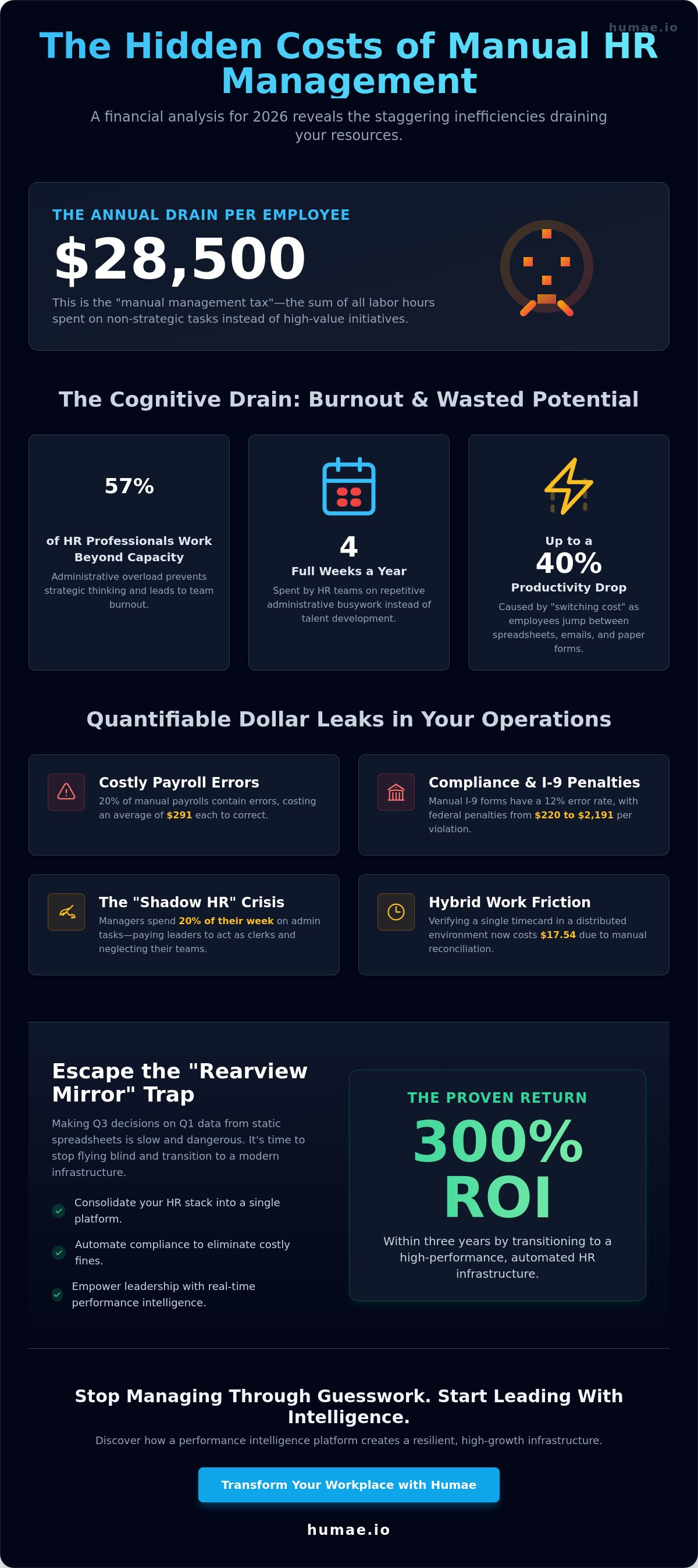
Did you know that manual data entry can cost your company as much as $28,500 per employee annually in hidden inefficiencies? It's a staggering figure that highlights the true scale of the hidden costs of manual employee management in 2026. You're likely already feeling the pressure; 57% of HR professionals report working beyond their capacity, often spending nearly four full weeks a year on administrative busywork. It's frustrating to watch your most talented people drown in spreadsheets while 20% of manually processed payrolls continue to trigger errors that cost $291 each to fix.
We understand that you want to move past these invisible leaks and build a culture where data actually drives decisions. In this financial analysis, you'll discover the specific areas where your resources are draining, from $89 benefits enrollment fees per person to $161,323 OSHA penalties, and learn how to transition to a high-performance infrastructure. We'll outline a clear ROI case for HR automation that can deliver a 300% return within three years. It's time to stop managing through guesswork and start leading with intelligence.
Key Takeaways
- Quantify the labor drain beyond simple data entry and see how hybrid work models amplify operational expenses.
- Identify the hidden costs of manual employee management that prevent your HR team from evolving into a strategic management partner.
- Learn why relying on lagging manual reports for OKR tracking leads to misaligned teams and missed quarterly targets.
- Uncover the critical security risks and compliance liabilities lurking within unencrypted spreadsheets and fragmented data silos.
- Discover how consolidating your HR stack into a performance intelligence platform creates a resilient, high-growth infrastructure.
The Quantifiable Dollar Leak: Beyond the $4.86 Data Entry Trap
Industry standards often cite $4.86 as the cost of a single manual HR data entry. In 2026, this figure is just the tip of the iceberg. The real hidden costs of manual employee management manifest as a "manual management tax" on your entire organization. This tax is the sum of every labor hour your team spends on non-strategic data entry instead of high-value initiatives. For a company relying on legacy systems, these inefficiencies can cost as much as $28,500 per employee annually. It's a silent drain on your capital that often goes unnoticed until the end-of-year audit.
The rise of hybrid work has only compounded these issues. Verifying a single timecard in a distributed environment now costs an average of $17.54. Managers must reconcile digital logs across different time zones and physical presence records manually. We also see the damaging rise of "shadow HR." This happens when department leads spend 20% of their work week on administrative tasks like tracking attendance or updating contact info. It's a leadership crisis; your best managers are being paid to act as clerks while their teams lose the guidance they need to succeed.
Effective Human resource management requires real-time agility that static spreadsheets cannot provide. When data is trapped in manual files, leadership makes decisions based on "lagging data." Making Q3 strategy shifts based on Q1 reports is like driving a car while looking in the rearview mirror. It's dangerous, slow, and expensive.
The Anatomy of a Manual Data Entry
Consider a simple time-off request. In a manual system, it starts with an email, moves to a manager's spreadsheet, shifts to a shared calendar, and finally lands in a payroll file. Each hand-off is a point of failure. Manual time management tasks cost $113.40 per employee every year. Double-entry isn't just a nuisance; it's a financial leak. "Free" spreadsheets are actually the most expensive tools in your stack because they lack the intelligence to prevent fatigue-related mistakes. Human error is inevitable when people are forced to act like machines.
Payroll and Tax Compliance Penalties
Manual filing errors are devastating to your bottom line. As of May 2026, the average cost to correct just one payroll error is $291. If you're processing I-9 forms manually, you're facing a 12% error rate. Federal penalties for these defects range from $220 to $2,191 per form. Beyond the direct fines, the cost of audit preparation is massive. Teams using manual systems spend weeks digging through paper trails, while automated systems generate compliant reports in seconds. You don't just save money on fines; you save weeks of your team's life.
The Cognitive Drain: How Paperwork Suffocates Strategic Leadership
Paperwork kills vision. When your HR team is buried under a mountain of disconnected email threads and physical files, they lose the capacity to think about the big picture. This isn't just about lost hours; it's about the "Switching Cost" that drains mental energy. Every time a professional jumps from a spreadsheet to an email to a paper form, their productivity drops by up to 40%. These hidden costs of manual employee management are often invisible on a balance sheet, but they're felt in every delayed strategy meeting and missed growth opportunity.
Your team should be acting as a strategic management partner, focusing on culture and long-term scaling. Instead, 57% of HR professionals report they're working beyond their capacity. This administrative overload leads to a dangerous cycle of burnout. In fact, 56% of employees are currently experiencing burnout due to repetitive manual data entry. When your best people leave because they're tired of being human data-entry machines, you aren't just losing an employee; you're losing institutional knowledge and future leadership potential.
The "Strategic Opportunity Cost" is the true price of manual systems. Consider what your team could build if they weren't spending four full weeks every year on basic filing. They could be developing mentorship programs, refining your employer brand, or analyzing performance trends. Instead, the hidden costs of manual employee management keep them stuck in a reactive loop, solving the same clerical problems day after day.
Decision Fatigue in Talent Acquisition
Hiring in 2026 moves at light speed. If your team is stuck with manual applicant tracking, you're losing top-tier talent to faster, more agile competitors. A poor candidate experience has a direct financial impact; it's a brand tax that makes future hiring even harder. Manual onboarding processes cost $58.79 per new hire, and this fragmented start often leads to a 20% higher turnover rate within the first 90 days. You're effectively paying to hire people who will leave before they've even provided value to the company.
The Managerial Friction Point
Managers are your most expensive assets. When they spend their afternoons chasing time-off requests instead of coaching their teams, you're wasting their salary and their talent. Manual systems create information silos where data is hoarded rather than shared. This lack of a unified workforce management infrastructure creates friction that slows down every department. By upgrading your workforce intelligence, you can remove these barriers and let your leaders focus on what they do best: leading.
The Performance Intelligence Gap: The Cost of Flying Blind
Running a business without real-time data is like flying a plane with a broken altimeter. You might feel like you're ascending, but the ground is closer than you think. One of the most dangerous hidden costs of manual employee management is the reliance on "Lagging Data." When your HR team manually compiles reports, leadership often makes Q3 strategic decisions based on data from Q1. This delay creates a massive intelligence gap. You can't pivot quickly if your information is three months old. It leads to misallocated bonuses and promotions, where rewards are given based on visibility rather than actual impact.
Manual OKR tracking is another silent drain on your resources. Most companies treat goals as a "set and forget" exercise because updating spreadsheets is too tedious for busy managers. This lack of alignment means your team isn't pulling in the same direction. Without real-time visibility, productivity drops as employees lose sight of how their daily tasks contribute to the bigger picture. Modern performance intelligence solves this by making progress visible every single day, ensuring that every hour worked moves the needle forward.
The hidden costs of manual employee management also manifest in the total absence of sentiment analysis. It's nearly impossible to spot early signs of disengagement in a manual system. By the time an employee submits their resignation, it's usually too late to fix the underlying problem. You're left reacting to crises instead of preventing them. This reactive stance doesn't just hurt your workflow; it damages your reputation as an employer of choice.
Manual OKRs vs. Real-Time Intelligence
The "Set and Forget" trap of manual reviews is a productivity killer. When goals aren't integrated into the daily workflow, they become irrelevant. Financial losses from misaligned goals are staggering because they represent wasted salary on low-priority tasks. In contrast, AI-driven sentiment analysis can identify burnout before it leads to a resignation. It's the difference between a static map and a live GPS that helps you avoid traffic jams before you're stuck in them.
The Invisible Cost of High Turnover
Replacing a high-performer is a financial disaster. It typically costs between 1.5x and 2x an employee's annual salary to find, hire, and train a replacement. This is the "Culture Tax" that erodes employee engagement. When people feel like their growth is ignored because it's not captured in a digital file, they start looking for the exit. Performance intelligence acts as your best insurance against talent poaching by showing you exactly who needs support and recognition right now.
Risk, Compliance, and the Fragility of Spreadsheet Security
The hidden costs of manual employee management often hide in plain sight within your shared drives. Most companies rely on a single "Excel wizard" to maintain their workforce data. This creates a dangerous "Single Point of Failure" risk. If that person leaves, they take the logic, the passwords, and the history of your organization with them. You're left with a brittle system that no one else understands, turning a simple resignation into a full-scale operational crisis. In 2026, this level of fragility isn't just an inconvenience; it's a strategic liability.
Data privacy has moved from a "nice-to-have" to a massive legal requirement. Storing sensitive employee information, like home addresses or salary history, in unencrypted spreadsheets is an open invitation for internal data breaches. Unauthorized access to compensation data can destroy team morale in an afternoon. Manual systems also struggle to meet the "Right to be Forgotten" requirements of modern privacy laws. Finding and deleting every instance of a former employee's data across ten different files is nearly impossible, leaving you exposed to heavy regulatory fines.
The Liability of Information Silos
Fragmented records create "Grievance Blindness." When manager notes are tucked away in private folders, leadership misses the legal red flags that precede a lawsuit. This makes defending against wrongful termination or discrimination claims an uphill battle. Compliance audits become an administrative nightmare when you have to prove your processes through a paper trail. With manual I-9 processing carrying a 12% error rate, you're looking at federal penalties between $220 and $2,191 per defective form. Even a small team can rack up thousands in fines through simple clerical oversight.
Security and Data Integrity
Making million-dollar decisions on "Dirty Data" is a recipe for disaster. Versioning hell, where multiple versions of an employee directory exist simultaneously, leads to missed communications and payroll delays. OSHA penalties have also scaled significantly; serious violations now exceed $16,131, while willful violations can reach $161,323. Centralized HRIS systems are no longer just a luxury for large corporations. They're a fundamental security requirement for any business that values its people and its capital. Secure your people data and protect your bottom line by switching to a modern HRMS today.
Building a Resilient Workforce Infrastructure for 2026
Stopping the bleeding is only the first step. To thrive in 2026, you need to move beyond reactive administration and embrace proactive Performance Intelligence. The hidden costs of manual employee management don't just vanish; they must be replaced by a system that generates value. Organizations that implement modern HR automation see an average ROI of 300% within the first three years. This isn't just about saving money on paper; it's about consolidating your tools to eliminate software bloat and reclaim your team's focus.
Empowering your team through self-service is a massive financial win. Every time an employee has to email HR to find basic information, it costs your company an average of $9.42 in lost productivity. Multiply that across your entire workforce, and the "search for info" tax becomes a significant drain. By providing a digital hub, you eliminate these micro-costs instantly. AI sentiment analysis also changes the game. With 95-99% accuracy, these tools provide better insights than expensive annual "culture consultants" who only capture a single moment in time. You get real-time awareness for a fraction of the cost.
The Humae Approach: AI Meets Empathy
We believe technology should make your company feel more human, not less. By streamlining your employee directory, we enable instant collaboration that breaks down silos. When your data is centralized, real-time OKR tracking ensures that every dollar spent on payroll actually drives growth. We help you reduce the "Administrative Tax" to near zero. This allows your HR professionals to spend their time on mentorship and talent development rather than chasing signatures or correcting $291 payroll errors.
Calculating Your Automation ROI
Transitioning to a modern workforce management infrastructure is a logical financial move. Compare your current manual costs—onboarding, error corrections, and the $113.40 annual time-management leak—against a simple SaaS subscription. You'll likely find that the software pays for itself in months. There's also a "Happiness Dividend" to consider. Better tools lead to longer employee tenure because people stay where they feel supported and empowered. Start your transition today by auditing your manual touchpoints and choosing a partner that values both your data and your people.
Future-Proofing Your Workforce Infrastructure
The numbers from this 2026 analysis are clear. Sticking to legacy processes isn't just slow; it's a direct threat to your bottom line. We've seen how the hidden costs of manual employee management scale from $291 payroll errors to $161,323 OSHA penalties. You've recognized the 57% administrative burden that keeps your HR team from acting as true strategic partners. The gap between companies using real-time intelligence and those stuck in spreadsheet versioning hell will only widen as this year progresses.
It's time to reclaim your team's focus and eliminate the cognitive drain. You can transition to a system where AI-powered performance intelligence provides real-time insights instead of lagging reports. With a centralized employee directory and integrated OKR tracking, your growth becomes measurable and predictable. Stop leaking profits and start building your modern workforce infrastructure with Humae. Our platform combines empathetic, human-centric design with the technical rigor required for 2026 teams. You've seen the data; now it's time to lead your organization toward a more efficient, inspired future.
Frequently Asked Questions
What are the most common hidden costs of manual HR?
The most frequent costs include labor hours spent on data entry, which averages $4.86 per entry, and the $291 price tag for correcting a single payroll error. You also face heavy compliance risks, such as federal I-9 penalties ranging from $220 to $2,191 per form. These expenses quickly stack up, creating a significant "manual management tax" on your operating budget that drains capital silently.
How does manual employee management impact company culture?
Manual systems often lead to widespread employee burnout, with 56% of workers reporting fatigue from repetitive data tasks as of April 2026. When managers spend 20% of their time on admin instead of coaching, team morale drops. This friction creates a culture of frustration rather than innovation, making it harder to retain your top talent in an increasingly competitive global market.
Is HR software worth the investment for small startups?
Yes, HR software is a critical investment for startups because it prevents the hidden costs of manual employee management from scaling alongside your team. Organizations implementing automation see an average ROI of 300% within three years. Starting with a digital foundation allows you to focus on growth and talent acquisition instead of fixing fragmented, unencrypted spreadsheets as your headcount increases.
How much time can HR automation really save our team?
Automation can save your HR team up to 57% of their time currently spent on administrative tasks. This equates to nearly four full weeks per year reclaimed for strategic initiatives. By automating time-off requests and data updates, you eliminate the $113.40 annual cost per employee associated with manual time management, allowing your leaders to focus on high-impact cultural work.
What is the "EY $4.86 rule" and does it still apply in 2026?
The EY rule states that every manual HR data entry costs an average of $4.86 in labor and overhead. While this remains a baseline in 2026, the real cost has actually increased due to the complexity of hybrid work models. Modern inefficiencies can now cost companies as much as $28,500 per employee annually when you factor in manual verification and multi-system reconciliation.
Can manual employee management lead to legal issues?
Manual management significantly increases your legal exposure through compliance errors and data privacy risks. As of 2025, OSHA penalties for serious violations can exceed $16,131, while manual I-9 processing has a high 12% error rate. Storing sensitive data in unencrypted spreadsheets also makes you vulnerable to "Right to be Forgotten" requests that are nearly impossible to fulfill without centralized software.
How do I calculate the ROI of switching to an HRMS like Humae?
To calculate ROI, sum your annual costs for manual data entry, payroll error corrections, and the 1.5x salary cost of turnover caused by disengagement. Compare this total against the cost of a modern HRMS subscription. Most businesses find that the hidden costs of manual employee management are far higher than the investment in a centralized, automated platform that drives performance intelligence.
What happens to our data during the transition from spreadsheets to software?
Your data is cleaned, validated, and migrated into a secure, encrypted environment. This transition eliminates "versioning hell" where multiple outdated spreadsheets exist across the company. By centralizing your records into a single source of truth, you ensure 95-99% data accuracy and protect your organization from the "Single Point of Failure" risk that occurs when a spreadsheet owner leaves.