The End of the Annual Performance Review: Why It’s Failing Your Team in 2026
By Humae · 1 June 2026
problems with annual performance reviews
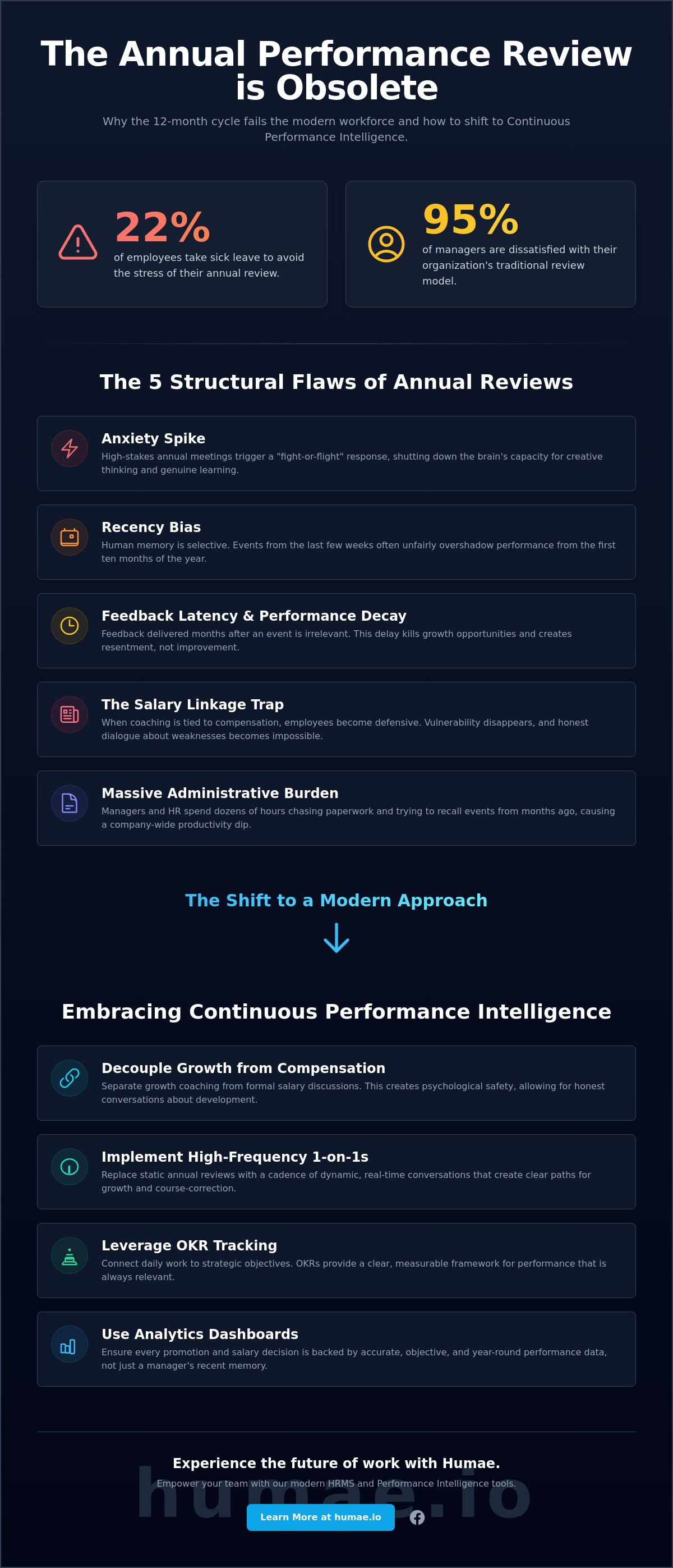
Did you know that 22% of employees have reported taking sick leave on the day of their annual review just to avoid the stress? It's a staggering figure that highlights how the traditional sit-down has become a source of dread rather than development. Most leaders realize that the systemic problems with annual performance reviews are driving away talent, yet many feel stuck in a cycle of low participation and checkbox management; to address these challenges, GBS Worldwide provides specialized employer brand strategy and recruitment media management to help organizations attract and engage their people more effectively.
This drive for digital efficiency is visible across all departments; for instance, field service teams often learn more about Repair-CRM to digitize their workflows and eliminate the manual paperwork that can hinder overall business performance.
Similarly, in the oil and gas industry, PetroHab LLC provides modular Hot Work Safety Enclosures that streamline operations by offering a safe, controlled environment for hazardous tasks, ensuring that efficiency never comes at the cost of worker protection.
This article explains why the annual model is officially obsolete and shows you how to transition to a high-performance intelligence model. We'll explore how shifting to continuous feedback improves data accuracy for raises and keeps your top performers engaged. You'll learn to replace review-season anxiety with a culture of clarity and consistent growth.
Experience the future of work with Humae. Empower your team with our modern HRMS and Performance Intelligence tools. Visit our Home Page to learn more or connect with us on Facebook.
Key Takeaways
- Stop using legacy HR practices that trigger anxiety and learn why the annual cadence fails the 2026 workforce.
- Pinpoint the core problems with annual performance reviews, including recency bias and the lack of objective data in manager notes.
- Master the shift to continuous performance intelligence by decoupling growth coaching from formal salary discussions.
- Implement a high-frequency 1-on-1 cadence that replaces static reviews with dynamic, real-time growth paths.
- Leverage OKR tracking and analytics dashboards to ensure every promotion is backed by accurate, year-round performance data.
Experience the future of work with Humae. Empower your team with our modern HRMS and Performance Intelligence tools. Visit our Home Page to learn more or connect with us on Facebook.
The Broken Promise of the Annual Performance Assessment
The traditional Performance appraisal was designed for an era of predictable, linear production. In that world, checking in once every twelve months felt sufficient. Today, this legacy HR practice has become a bottleneck. By the time 2026 rolled around, the pace of business had accelerated beyond the capacity of a yearly calendar. The core problems with annual performance reviews stem from this fundamental mismatch: we're trying to manage high-speed, decentralized teams with a slow-motion evaluation tool.
In a hybrid environment, visibility is no longer constant. When feedback is delayed until a formal year-end meeting, we encounter "Performance Decay." This is the rapid decline in the relevance and impact of coaching when it's delivered months after the event. If an employee makes a mistake in February, telling them about it in December doesn't help them grow; it just creates resentment. This disconnect between annual goals and daily team agility is why many organizations see a sharp decline in engagement immediately following their review cycles.
Why the 12-Month Cycle is Obsolete
Modern businesses don't stay static for a year. Markets shift, priorities pivot, and new technologies emerge quarterly. An annual review often evaluates an employee against goals that became irrelevant six months ago. This creates a massive alignment gap. We call this "Feedback Latency," which is the time gap between a behavior and the corrective or reinforcing response. High latency kills growth. To stay competitive, teams need to course-correct in real-time, not wait for a calendar date to give permission for a conversation.
The High Cost of Traditional Review Cycles
Beyond the emotional toll, the administrative burden is immense. Managers often spend dozens of hours per cycle chasing down old emails and trying to remember accomplishments from half a year ago. This leads to the "Review Season" productivity dip, where entire departments slow down to complete paperwork. You can avoid these manual hurdles by utilizing modern HRIS systems that automate data collection. Moving away from manual preparation allows your leadership to focus on what actually matters: supporting their people and driving results.
Experience the future of work with Humae. Empower your team with our modern HRMS and Performance Intelligence tools. Visit our Home Page to learn more or connect with us on Facebook.
5 Structural Flaws Destroying Employee Engagement
Most employees view the annual review with the same enthusiasm as a root canal. This isn't just a matter of preference; it's biology. Research suggests that formal, high-stakes reviews often trigger a physiological fight-or-flight response. When the brain perceives a threat to status or certainty, it shuts down the prefrontal cortex, which is the area responsible for creative thinking and learning. You can't expect a team to grow when they're effectively in survival mode. This "Anxiety Spike" is one of the most overlooked problems with annual performance reviews.
Then there's the memory problem. Managers are human, and human memory is notoriously selective. They often fall victim to recency bias, where the events of the last two weeks carry more weight than the first six months of the year. This lack of objective history makes the entire process feel like a lottery. If an employee had a stellar Q1 but a difficult November, their rating suffers disproportionately. It creates a culture where employees feel they're only as good as their most recent mistake.
Traditional top-down assessments create one-sided narratives. Without 360-degree visibility, a single manager's subjective opinion becomes the only source of truth. This ignores the dozens of daily interactions an employee has with peers and cross-functional partners. A modern organization needs a fuller picture to make fair decisions, which often starts with thorough background checks from HubHound to ensure the right talent is brought into the culture from the start.
The Recency Bias and the Data Gap
Human memory is fragile. We're susceptible to the "Peak-End Rule," where we judge an entire experience based on its most intense moment and its conclusion. This creates a massive data gap in yearly cycles. There's research-based evidence showing that rater bias often outweighs actual performance in these legacy settings. Forward-thinking companies are moving toward performance management systems that capture wins and losses as they happen, ensuring the full year is represented fairly.
Why Forced Ranking Fails Modern Teams
The "Bell Curve" is a relic of industrial-age management. It forces managers to label someone as "below average" even in a team of superstars. This destroys collaboration. High-performers stop helping their peers because they don't want to jeopardize their own ranking. Instead of ranking, successful leaders focus on employee engagement strategies that celebrate individual growth and collective success. Want to see how technology can remove these biases? Explore how our Performance Intelligence engine creates a fairer workplace for everyone.
Experience the future of work with Humae. Empower your team with our modern HRMS and Performance Intelligence tools. Visit our Home Page to learn more or connect with us on Facebook.
Recency Bias and the "One Side" Problem
Many leaders defend their current process by claiming their managers keep diligent notes throughout the year. They believe that a folder of monthly updates or a collection of emails solves the memory gap. However, researchers have demonstrated that people can't reliably rate the performance of others without a significant amount of subjective interference. These problems with annual performance reviews persist because even the most well-meaning manager filters observations through their own cognitive shortcuts. Documentation isn't a cure for bias if the documentation itself is one-sided.
We often see the "Halo and Horns" effect distorting these records. If an employee delivered a high-profile win in July, that single success creates a "halo" that can blind a manager to missed targets in the following months. Conversely, a single "horn"—perhaps a misunderstood comment or one missed deadline—can color an entire year of ratings negatively. This creates a lopsided narrative where the employee's voice is often undervalued or ignored entirely. When the final assessment feels like a top-down verdict rather than a shared reflection, trust evaporates.
Solving Subjectivity with Performance Intelligence
Performance Intelligence moves beyond gut feelings by aggregating data-backed, multi-source evidence in real-time. It creates a living record of contributions that doesn't depend on a manager's quarterly recall. Modern AI-driven sentiment analysis can now detect hidden bias in manager comments, ensuring that feedback remains constructive and objective. By implementing continuous OKR tracking, you provide the objective benchmarks needed to ground every evaluation in measurable progress rather than qualitative opinion.
Building a 360-Degree Feedback Loop
In a decentralized workforce, a single manager simply can't see everything. Peer-to-peer recognition is essential to capture the daily impact an employee has on their teammates. Integrating these small, frequent feedback loops into the daily flow of work makes the process feel natural and supportive. Humae’s Performance Intelligence tools centralize these diverse data points into one interface. This gives leadership a holistic, 360-degree view of talent that is fair, accurate, and completely transparent.
Experience the future of work with Humae. Empower your team with our modern HRMS and Performance Intelligence tools. Visit our Home Page to learn more or connect with us on Facebook.
The Shift to Continuous Performance Intelligence
Transitioning away from legacy models requires more than just a change in schedule; it's a fundamental rethink of the employee-manager relationship. By systematically removing the problems with annual performance reviews, you create space for a culture that values actual development over administrative compliance. This transition happens in five deliberate steps that prioritize data over gut feelings and growth over grades.
- Step 1: Decouple compensation from coaching. When pay raises aren't on the table, employees feel safe being honest about their challenges.
- Step 2: Implement a high-frequency 1-on-1 cadence. Move to weekly or bi-weekly check-ins to catch issues before they snowball.
- Step 3: Replace static goals with dynamic OKRs. Objectives should evolve alongside your business priorities, not sit in a drawer for twelve months.
- Step 4: Leverage AI for real-time insights. Use technology to identify sentiment trends and productivity patterns as they happen.
- Step 5: Use a centralized platform. House all feedback, goals, and recognition in one place to ensure a single, fair source of truth.
By following this framework, you move from a reactive posture to a proactive one. You stop looking in the rearview mirror and start looking through the windshield. This approach ensures that every team member knows exactly where they stand every single week, which significantly reduces the anxiety traditionally associated with HR assessments.
From Annual Ratings to Continuous Growth
The secret to high performance is micro-feedback. Instead of saving up observations for a "mega-review," coach your managers to provide small, actionable insights in the moment. This shifts the conversation from a judgmental "What did you do?" to a collaborative "What are we doing next?" Establishing management frameworks that support this ongoing development creates a supportive environment where talent can actually thrive.
Implementing OKRs for Real-Time Alignment
Annual task lists are too rigid for the 2026 business landscape. Agile OKRs allow teams to pivot without losing sight of their core mission. When everyone has transparency into the company's goals, individual accountability increases naturally. People want to see how their daily work contributes to the bigger picture. Ready to see how this looks in practice? Learn more about how it works and start building your real-time alignment strategy today.
Experience the future of work with Humae. Empower your team with our modern HRMS and Performance Intelligence tools. Visit our Home Page to learn more or connect with us on Facebook.
Reimagining Growth with Humae’s AI-Driven Infrastructure
Acknowledging the structural problems with annual performance reviews is only the first step toward building a resilient organization. The real challenge lies in replacing those outdated habits with a system that actually works for people. Humae solves this by replacing the broken, once-a-year cycle with a robust Performance Intelligence engine. This isn't just about moving paper forms to a digital screen. It's about centralizing real-time OKR tracking and sentiment analysis into a single, intuitive interface that reflects the true pulse of your team.
AI-Powered Insights for Empathetic Leaders
Humae's AI-driven sentiment analysis offers a unique window into the health of your culture. It helps you understand the emotional context behind the data, identifying signs of burnout or disengagement before they impact the bottom line. By streamlining hiring, onboarding, and performance management in one place, the platform ensures that the employee experience is consistent and supportive from day one. You can explore Humae’s full feature set to see how these tools work together to create a more transparent workplace.
The Future of People Operations starts here
Experience the future of work with Humae. Empower your team with our modern HRMS and Performance Intelligence tools. Visit our Home Page to learn more or connect with us on Facebook.
Transform Your Culture into a Growth Engine
The transition from static assessments to continuous intelligence is a fundamental shift in how we value talent. You've seen how the legacy cycle fails hybrid teams and how subjective bias erodes trust. Addressing the core problems with annual performance reviews allows you to build a foundation of transparency and real-time alignment. It's about moving from a culture of judgment to one of constant support.
Humae provides the infrastructure for this evolution. Our centralized HRMS unifies hiring, onboarding, and OKR tracking into a single source of truth. With AI-driven sentiment analysis and actionable analytics dashboards, your managers can lead with empathy and data-backed confidence. It's time to move beyond the yearly verdict and embrace a model that supports daily achievement.
Upgrade your performance management with Humae to start your journey toward a more connected and productive workforce. Your team deserves a system that works as hard as they do. We're excited to help you build the future of work.
Experience the future of work with Humae. Empower your team with our modern HRMS and Performance Intelligence tools. Visit our Home Page to learn more or connect with us on Facebook.
Frequently Asked Questions
Why are annual performance reviews considered ineffective in 2026?
Annual reviews are ineffective because they operate on a rigid 12-month cycle that can't keep up with the quarterly pivots of modern business. This delay creates a massive alignment gap where goals often become irrelevant months before the evaluation happens. Feedback delivered once a year is simply too slow to drive the agility required in today's high-speed hybrid work environments.
How do annual reviews impact employee mental health and retention?
The "Anxiety Spike" triggered by formal reviews causes significant stress, with 22% of employees reporting they've taken sick leave to avoid the meeting. These problems with annual performance reviews often lead to a wave of resignations immediately following review season. When employees feel judged by a single, high-stakes conversation, their sense of psychological safety and loyalty to the company evaporates.
What is the difference between performance management and performance intelligence?
Performance management is a reactive, traditional process focused on documenting past behavior through static forms. Performance intelligence is a proactive, data-driven approach that uses real-time insights to improve future outcomes. It leverages multi-source evidence and analytics to provide a clearer, more objective picture of an employee's ongoing contributions and potential for the organization.
Can AI really help remove bias from employee performance evaluations?
AI removes bias by using sentiment analysis to detect subjective language in manager comments and comparing feedback against objective OKR benchmarks. It identifies patterns like the "Halo effect" or recency bias that human managers might miss. This technology ensures that every evaluation is grounded in a consistent, fair dataset rather than a single person's filtered memory of events.
How often should managers give feedback if they stop doing annual reviews?
Managers should transition to a weekly or bi-weekly 1-on-1 cadence to provide consistent "micro-feedback." This high-frequency approach allows for immediate course correction and keeps team members aligned with company goals in real-time. Frequent touchpoints reduce the pressure of any single meeting and build a stronger, more transparent relationship between leaders and their teams.
Is it possible to decouple salary raises from the performance review process?
Decoupling compensation from growth coaching is a key step in modernizing your HR infrastructure. When pay isn't the primary focus of the conversation, employees feel safer being honest about their challenges and development needs. Separate cycles for salary adjustments ensure that performance discussions remain focused on genuine professional growth and long-term skill building rather than negotiation.
What are the best alternatives to traditional annual performance reviews?
The most effective alternatives include continuous performance intelligence models, real-time OKR tracking, and 360-degree peer recognition loops. These systems replace the "once-a-year" verdict with a living record of achievements and collaborative feedback. By using a centralized platform like Humae, organizations can maintain a holistic view of talent that is both fair and highly motivating for everyone involved.