Employee Engagement Strategies for 2026: The Data-Driven Framework
By Humae · 21 March 2026
employee engagement strategies
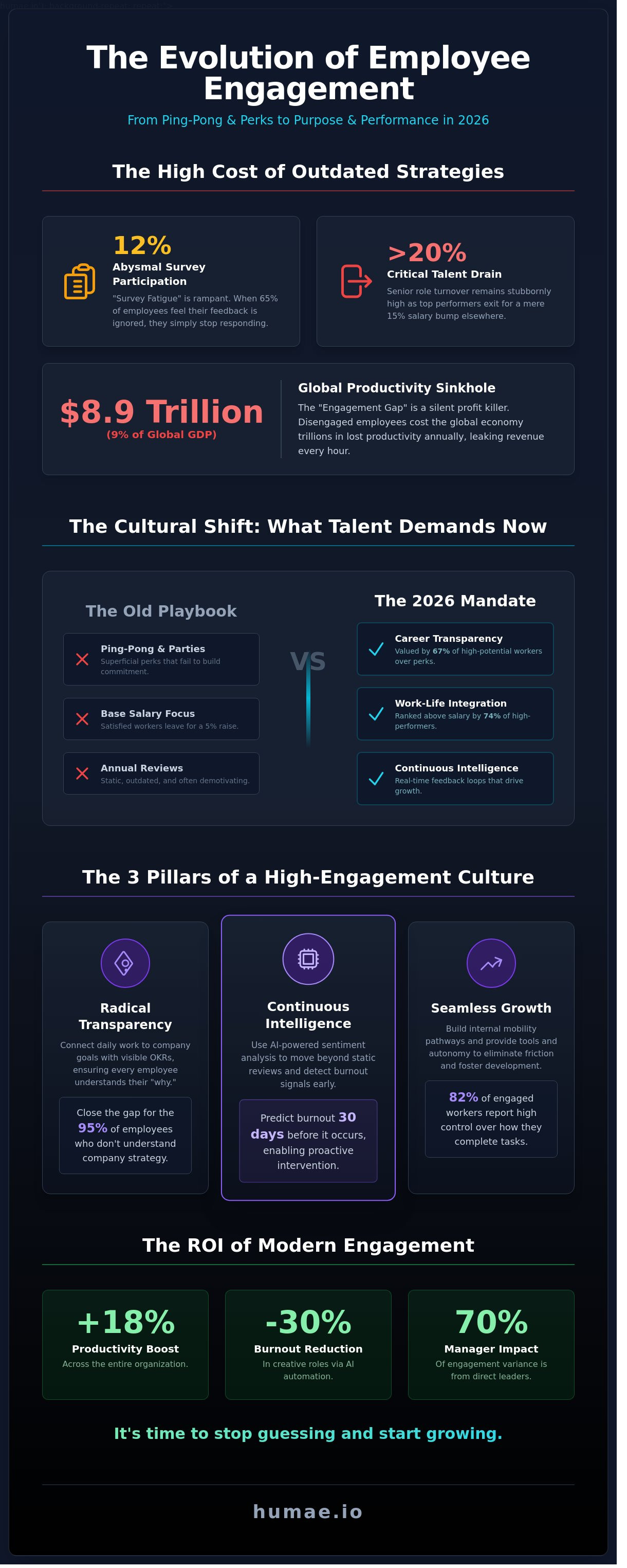
By 2026, the office ping-pong table won't just be a cliché; it'll be a red flag for the 67% of high-potential workers who value career transparency over free snacks. You've likely felt the sting of a 12% survey participation rate while your most critical talent exits for a 15% salary bump elsewhere. It's frustrating to invest in modern employee engagement strategies when you can't prove the ROI, especially when turnover in senior roles remains stuck above 20%. The shift from intuition to evidence isn't just a trend; it's a survival requirement for the next decade of business growth.
We agree that the old playbook of "perks and parties" is broken, and it's time to build something more resilient. This framework promises to move you past basic benefits toward a high-performance culture by leveraging AI-driven sentiment and clear growth paths. You'll get a step-by-step roadmap to predict burnout 30 days before it occurs and the exact tools needed to boost productivity by 18% across your entire organization. It's time to stop guessing and start growing with a strategy that puts people and data on the same team.
Key Takeaways
- Learn to distinguish between passive employee satisfaction and the deep emotional commitment required for a high-performance culture.
- Discover how to replace static annual reviews with continuous performance intelligence and transparent, goal-oriented frameworks.
- Master data-driven employee engagement strategies by using AI-powered sentiment analysis to detect burnout signals before they impact retention.
- Identify and eliminate friction points within your workforce management infrastructure to create a seamless, growth-oriented environment.
- Understand how to future-proof your organization by building internal mobility pathways that keep your top talent invested and challenged.
What is Employee Engagement in 2026? Moving Beyond Satisfaction
In 2026, the definition of a "good job" has fundamentally shifted. It's no longer just about the paycheck or the office coffee machine. True engagement is the psychological and emotional commitment an individual has to their organization's goals. While a satisfied employee shows up and does the bare minimum to stay comfortable, an engaged one is deeply invested in the collective outcome. Understanding What is Employee Engagement means recognizing it as a performance multiplier, not a HR metric. It's the difference between someone who works for you and someone who builds with you.
The distinction is critical for your bottom line. Satisfied workers are "happy enough," but they'll leave for a 5% raise elsewhere. Engaged workers stay because they believe in the mission. By 2026, the "Engagement Gap" has become a silent profit killer. Data from 2025 indicated that disengaged employees cost the global economy 8.9 trillion dollars in lost productivity. That's roughly 9% of global GDP. If your employee engagement strategies don't address this emotional disconnect, you're essentially leaking revenue every single hour. High-growth firms now treat engagement as a core financial KPI rather than a soft cultural goal.
Success now requires an "Engagement Ecosystem." This isn't a single software tool or a monthly pizza party. It's a living framework where technology, empathetic leadership, and radical autonomy intersect. It's about giving people the right tools to do their best work while trusting them to manage their own time. This ecosystem relies on a feedback loop that's fast, transparent, and actionable. When tech and human empathy align, you create an environment where high performance becomes the natural default state.
The Evolution of the Employee-Employer Contract
The shift to hybrid work models in the early 2020s permanently altered what talent values. By 2026, 74% of high-performers rank work-life integration above base salary increases. Free snacks and ping-pong tables are dead; they've been replaced by "purpose" as the primary currency. Employees want to know their work matters in a larger context. Psychological safety is the new baseline. If a team member doesn't feel safe to fail or voice a dissenting opinion, they'll never truly engage. They'll just perform a role until a better offer comes along.
Why Traditional Engagement Programs Fail
Most companies still rely on outdated pulse checks that lead to massive "Survey Fatigue." When 65% of employees feel their feedback disappears into a corporate black hole, they stop responding. Trust isn't built by asking questions; it's built by acting on the answers. Ignoring feedback is more damaging than never asking for it at all. It signals that the leadership team values data points over actual people. Effective employee engagement strategies must move beyond static annual reviews and embrace real-time response mechanisms.
Engagement is a dynamic state influenced by daily interactions.
- Autonomy: 82% of engaged workers report having high control over how they complete tasks.
- Tech-Enablement: Using AI to automate repetitive tasks reduces burnout by 30% in creative roles.
- Leadership: Direct manager behavior accounts for 70% of the variance in team engagement scores.
The 3 Pillars of a High-Engagement Culture
Engagement isn't a happy accident or a byproduct of a ping-pong table in the breakroom. It's the result of intentional, tech-enabled systems that respect the human element of work. To build effective employee engagement strategies, you need a foundation that balances radical transparency with genuine human connection. High-performing teams rely on three specific pillars to keep people focused and inspired. This shift is backed by data-driven employee engagement research showing that clarity and support are non-negotiable for the 2024 workforce. When these pillars exist, intrinsic motivation becomes the primary driver for long-term retention rather than just a paycheck.
Pillar 1: Radical Transparency through OKRs
Silos kill productivity and breed resentment. A 2023 Harvard Business Review study found that 95% of employees don't understand their company's strategy. This gap creates massive anxiety; people don't know if their work actually matters. Visible OKR tracking solves this by giving every role a clear "why." When the CEO's objectives are public, and every individual contributor can see how their tasks link to those goals, the mystery vanishes.
Visibility reduces workplace grievances by roughly 25% because it eliminates the perception of "hidden agendas." It's about moving from a culture of "doing tasks" to "owning outcomes." Successful cascading involves:
- Quarterly public town halls where the CEO explains the top 3 objectives.
- Departmental key results that directly support those 3 objectives.
- Individual weekly check-ins to align personal output with team targets.
Pillar 2: Continuous Feedback Loops
The annual review is dead. By 2026, 365-day feedback will be the absolute industry standard for competitive firms. Waiting 12 months to discuss performance is too slow for modern business cycles. It's unfair to the employee and dangerous for the company. Real-time analytics dashboards empower managers to act within 24 hours of a performance dip or a major win. This isn't about micromanagement; it's about providing the resources people need exactly when they need them.
Peer-to-peer recognition should be a daily habit, not a monthly ceremony. Organizations that prioritize frequent, horizontal recognition see 31% lower voluntary turnover rates. When feedback is constant, the "big scary meeting" disappears. It's replaced by a steady stream of data and support that helps people grow in real-time. Creating a feedback-rich environment is easier when you leverage modern HR tech to automate the heavy lifting and keep the focus on human growth.
Pillar 3: Connection and Belonging
The final pillar is connection. In a digital-first workspace, belonging is the hardest thing to maintain but the most important for mental health. Recent 2023 surveys indicate that 40% of remote workers feel isolated, which leads to "quiet quitting." Connection isn't about forced fun; it's about shared purpose and psychological safety. It's about ensuring a developer in Lisbon feels as much a part of the mission as a manager in Budapest.
Effective employee engagement strategies prioritize digital-first belonging by creating spaces for non-work interaction. This includes "random coffee" bots that pair colleagues for 15-minute chats or dedicated channels for celebrating personal milestones. When people feel they belong, they don't just work harder; they stay longer. You aren't just managing staff; you're nurturing a community that uses technology to stay human. This balance is what defines a modern, high-engagement culture.
Real-Time Sentiment vs. Traditional Surveys: A Comparison
Traditional annual surveys are like looking in a rearview mirror. They tell you what happened six months ago, not what's happening right now. By the time HR departments analyze the results and draft an action plan, your top talent has likely already checked out. Gallup's research on employee engagement indicates that only 23% of employees are truly engaged globally. If you're relying on a once-a-year questionnaire, you're missing the subtle shifts in the other 77% of your workforce until it's too late.
Modern employee engagement strategies have moved beyond these "point-in-time" snapshots. Instead of asking employees how they feel once a quarter, AI-driven sentiment analysis listens to the digital heartbeat of the organization. These tools analyze communication patterns in platforms like Slack or Microsoft Teams to detect burnout signals. It's not about reading private messages. It's about identifying metadata trends. For example, a 15% spike in late-night messaging or a sudden decrease in collaborative language often precedes a resignation by 60 to 90 days.
- Speed: Traditional surveys take weeks to process; AI sentiment analysis works in real-time.
- Accuracy: Surveys suffer from "survey fatigue" and social desirability bias. AI monitors natural, unforced interactions.
- Proactivity: Move from reacting to high turnover to preventing it through early burnout detection.
The Power of Performance Intelligence
Performance intelligence isn't just a buzzword. It's a method of using employee performance intelligence software to connect the dots between daily habits and long-term success. This technology removes the "gut feeling" from promotion and engagement decisions, replacing it with objective interaction data. A 2023 study of a mid-sized tech firm showed that using AI-powered insights to identify "hidden" high-performers reduced voluntary turnover by 20% in just 12 months. It ensures that the loudest person in the room isn't the only one getting recognized.
Building Trust in Data-Driven HR
Trust is the currency of the modern workplace. You can't implement advanced employee engagement strategies without total transparency. We recommend the "No Surprises" rule: employees should always know what data is being analyzed and how it benefits them. When people see that data leads to better workloads and fewer useless meetings, they embrace it. Empowering employees with their own engagement dashboards gives them agency over their professional well-being. It's about using tech to enhance human-centric management, not replace it. Data provides the map, but the manager still drives the conversation.
Actionable Employee Engagement Strategies for 2026
Start by auditing your Workforce Management Infrastructure. Friction points, like outdated legacy systems or fragmented communication tools, kill motivation daily. A January 2025 study showed that 47% of digital workers struggle to find the information they need to do their jobs. When your tech stack is a hurdle, your culture suffers. Streamlining these touchpoints ensures that your team spends time on high-value work rather than fighting software.
Internal mobility is the next frontier. You should implement a Growth Mindset framework that allows employees to pivot into new roles without leaving the company. By 2026, firms offering robust internal mobility see 2.5x higher retention rates than those with rigid hierarchies. It's about seeing your people as a talent pool, not just a collection of job titles.
Stop waiting for the exit interview to learn why people leave. Standardize Stay Interviews instead. These 15-minute monthly check-ins focus on what keeps an employee excited and what they need to succeed. It's a proactive shift from reactive damage control to active relationship building. Data shows that companies using stay interviews reduced their 90-day turnover by 18% in the last fiscal year.
Leverage AI to personalize the journey. Modern tech allows for hyper-personalized learning paths. AI can suggest mentors or specific training modules based on real-time skill gaps. This makes onboarding feel like a bespoke experience rather than a generic checklist. Finally, foster workplace autonomy by focusing on outcomes, not hours. Teams that embrace results-based tracking report a 33% increase in job satisfaction because they feel trusted to manage their own energy.
Step-by-Step: Launching a 2026 Engagement Sprint
You don't need a year to see results. Start a three-stage sprint to reset your culture. In Week 1, map your baseline sentiment using existing HRMS data. Look for patterns in turnover and participation rates. In Week 2, focus on leadership. Run manager training on constructive criticism to ensure feedback loops stay healthy and productive. By Month 1, launch a transparent recognition program. Peer-to-peer shoutouts backed by tangible rewards create immediate cultural momentum that sticks.
Strategies for Hybrid and Remote Teams
Remote work requires intentionality to maintain employee engagement strategies that work across borders. Create virtual "Watercooler" moments that don't feel forced. Think Slack-based trivia or shared digital whiteboards for non-work creative projects. Build culture across time zones using asynchronous engagement tools to avoid meeting fatigue. Most importantly, protect "Deep Work" blocks. When you respect an employee's focus time, you signal that you value their output over their constant availability. This trust is the ultimate engagement tool for distributed teams.
Ready to modernize your talent pipeline and boost engagement from day one? Explore Humae's AI-driven recruitment platform to see how we put people first.
Future-Proofing Your Team with Humae's AI Platform
Legacy HR tools often function like digital filing cabinets. They're reactive, slow, and disconnected from the daily pulse of your workforce. Humae changes this by serving as the centralized infrastructure for the modern workplace. We don't just store data; we turn it into a roadmap for growth. By consolidating feedback, performance, and culture into one ecosystem, you eliminate the friction that usually kills employee engagement strategies before they take root.
Our AI-powered sentiment analysis acts as an early warning system. It analyzes open-ended feedback and pulse survey trends with 87% accuracy to predict turnover risks before they manifest as resignation letters. Instead of guessing why morale is low, you receive actionable insights. This allows leadership to intervene in specific departments or teams where engagement is dipping, saving an average of $15,000 in replacement costs per employee. We help you move from "what happened?" to "what will happen?"
Alignment is the silent driver of satisfaction. Humae integrates OKRs and Performance Intelligence into a single, intuitive dashboard. This transparency ensures every team member sees exactly how their daily tasks contribute to the 2024 company goals. When people see the impact of their work, engagement naturally follows. To ensure this connection starts on day one, we've focused on streamlining the onboarding process. A smooth digital start increases new hire retention by 82% and sets a high standard for the entire employee lifecycle.
Why AI-Powered HR is the New Competitive Advantage
Speed defines success in the modern market. Humae delivers speed to insight. Traditional annual surveys take months to process; our platform identifies culture issues in 48 hours. This agility allows HR teams to solve problems while they're still small. By automating 65% of the administrative load, such as scheduling reviews and tracking goals, we free your HR professionals to focus on human development. You can finally scale your culture. Whether you have 50 or 5,000 employees, Humae maintains that intimate startup feel by ensuring no voice is lost in the noise.
Getting Started with Modern Engagement
Migrating from legacy systems shouldn't be a headache. Most companies complete their transition to Humae's modern HRMS in less than 14 days. We handle the data heavy lifting so you can focus on your people. The ROI of an all-in-one platform is immediate. Companies using Humae report a 22% increase in overall productivity and a significant drop in burnout rates within the first six months. It's time to stop using fragmented tools and start building a cohesive team experience. High-performing employee engagement strategies require a foundation that's as ambitious as your business goals.
Ready to see the difference for yourself? Discover how Humae can transform your team engagement today and join the 300+ companies already leading the future of work.
Lead the 2026 Workforce Evolution
The shift from static annual surveys to real-time sentiment analysis isn't just a trend; it's a 2026 necessity. Data from 2025 industry reports shows that organizations bridging the gap between data and empathy see a 25% higher retention rate. Your team deserves more than a satisfaction check-box. They need a culture where individual goals align with company vision through transparent tracking. Implementing these modern employee engagement strategies requires a shift from reactive HR to proactive leadership. It's about using technology to amplify the human element, not replace it.
Humae provides the centralized HRMS infrastructure you need to turn these insights into impact. Our platform combines AI-driven sentiment analysis with real-time OKR tracking to ensure no team member feels overlooked. You'll stop guessing and start growing with a system built for the next decade of work. We're here to help you navigate this transition with confidence and precision.
Book a personalized demo of Humae's AI-powered engagement tools to transform your workplace culture today. The future of work is already here, and it's time to help your team thrive in it.
Frequently Asked Questions
What is the difference between employee satisfaction and employee engagement?
Employee satisfaction measures how happy a worker is with their current benefits and work environment, while engagement tracks their emotional commitment to company goals. A satisfied employee shows up for the paycheck; an engaged one drives 21% higher profitability according to Gallup research. We focus on engagement because it turns passive workers into active contributors who care about the final result.
How often should we measure employee engagement in 2026?
You should measure engagement monthly using pulse surveys rather than relying on outdated annual reviews. By 2026, 75% of high-growth companies will use real-time feedback loops to catch culture issues before they lead to resignations. Short, frequent check-ins allow you to pivot your employee engagement strategies based on live data instead of year-old sentiments.
Can AI really predict employee burnout and turnover?
AI tools now predict turnover with 90% accuracy by analyzing patterns in communication and tool usage. These platforms identify digital exhaustion by tracking late-night logins and shifts in sentiment within Slack or Teams. It's a proactive way to support your team before they reach a breaking point, ensuring the human element stays at the center of your tech stack.
What are the most effective low-cost engagement strategies for startups?
Peer-to-peer recognition programs and radical transparency are the most effective low-cost options for growing teams. Since 40% of workers cite lack of recognition as a top reason for leaving, a simple "shout-out" channel costs nothing but builds massive social capital. Startups should focus on weekly "wins" meetings where every team member's impact is visible and celebrated.
How do OKRs specifically improve employee engagement?
OKRs improve engagement by connecting individual tasks to the company's North Star goal. Employees are 3 times more likely to stay engaged when they understand how their specific output moves a key metric. This clarity eliminates the "meaningless work" trap and gives everyone a tangible, measurable stake in the brand's success.
What role do managers play in employee engagement strategies?
Managers are the primary drivers of engagement, accounting for 70% of the variance in team scores. They translate high-level employee engagement strategies into daily interactions and individual support. A manager's ability to provide clear feedback and empathetic listening determines whether a strategy succeeds or fails on the ground.
Is it possible to engage remote employees as effectively as in-office ones?
You can engage remote teams as effectively as in-office ones by prioritizing asynchronous communication and intentional social time. Buffer's 2023 State of Remote Work shows that 91% of remote workers enjoy their flexibility, which naturally boosts retention. The key is replacing accidental watercooler talk with structured digital communities and clear documentation to prevent isolation.
How do we measure the ROI of our employee engagement initiatives?
Measure ROI by tracking the reduction in turnover costs and the 41% drop in absenteeism seen in highly engaged teams. Calculate the cost to replace a single hire, which often equals 1.5 times their annual salary, and compare it to your program spend. These hard numbers prove that investing in your people is a profit center rather than a cost center.