Presenting HR Tech Investment to the Board: The 2026 Strategic Playbook
By Humae · 14 May 2026
presenting hr tech investment to the board
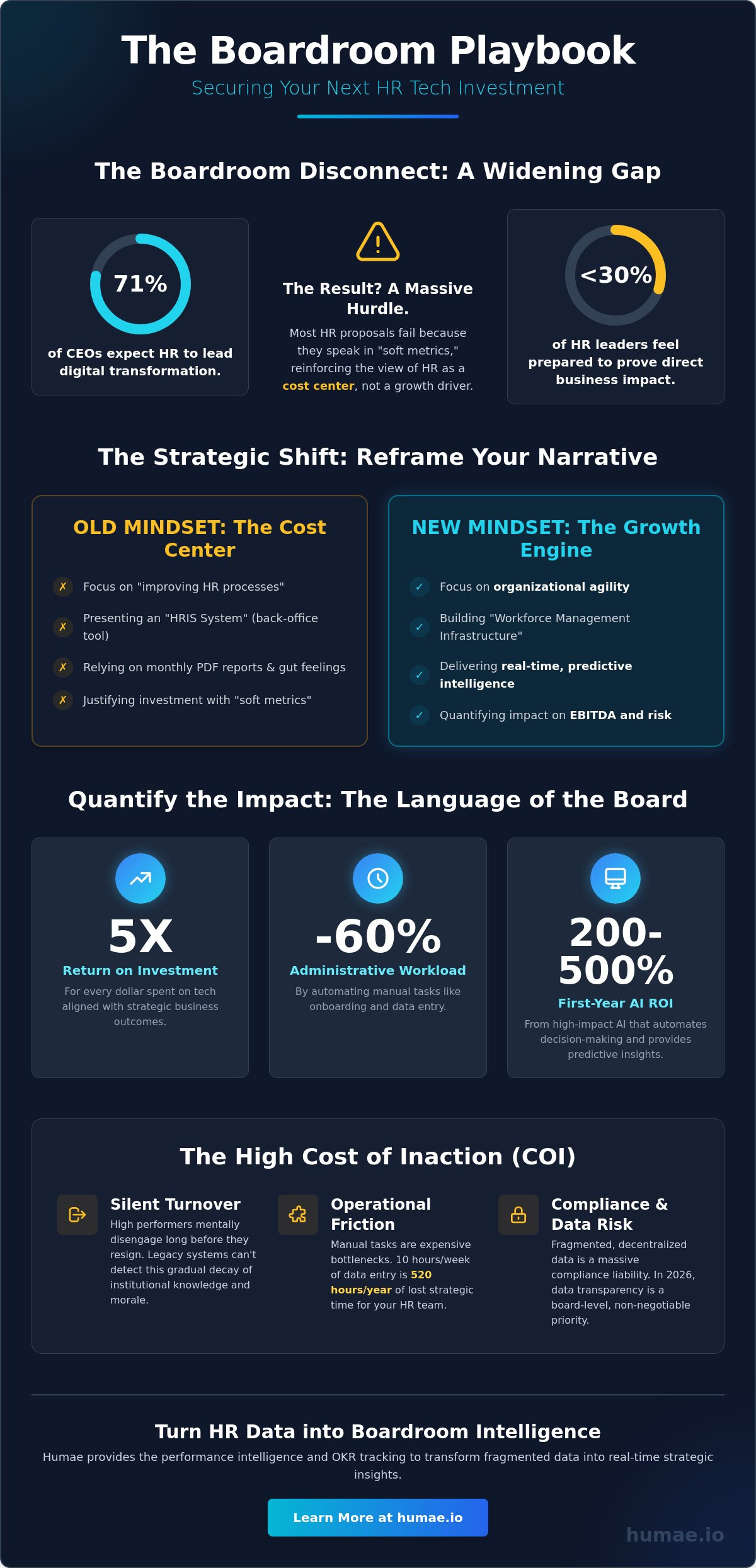
Did you know that 71% of CEOs now expect HR to lead digital transformation, yet fewer than 30% of HR leaders feel prepared to prove their direct business impact? This gap creates a massive hurdle when you're presenting hr tech investment to the board. Most directors still view HR as a cost center, often because the proposal relies on soft metrics that fail to speak the language of finance.
You've likely felt the sting of a budget rejection because the ROI felt too abstract or the AI benefits sounded like mere hype. It's a common pain point, but staying with legacy systems carries a hidden risk that your competitors aren't willing to take. This strategic playbook will help you master the boardroom narrative by transforming your HR software into a growth engine. You'll learn to secure immediate approval by focusing on EBITDA impact and risk mitigation rather than just features.
We'll explore how to quantify a 5x return on investment and explain how automated environments can reduce administrative workloads by 60% to modernize your workforce.
Humae: Transforming HR data into strategic boardroom intelligence. Return to the home page. Connect with us on Facebook.
Key Takeaways
- Shift your narrative from administrative costs to building a workforce infrastructure that drives organizational agility.
- Quantify the hidden financial impact of "Silent Turnover" and operational friction to build a compelling case for change.
- Balance direct cost savings from automation with strategic gains in culture and employer branding for a complete ROI picture.
- Master a slide-by-slide blueprint for presenting hr tech investment to the board that prioritizes business outcomes over software features.
- Utilize performance intelligence and OKR tracking to transform fragmented HR data into real-time boardroom intelligence.
Humae: Strategic intelligence for the modern workforce. Back to home | Connect on Facebook
The Strategic Shift: Why Boards Care About HR Tech in 2026
The boardroom conversation has changed. Directors don't just want to see cost-cutting measures anymore. In 2026, they want to ensure the company can pivot faster than the competition. When you're presenting hr tech investment to the board, you have to stop talking about "improving HR processes" and start talking about "building workforce management infrastructure." This shift reflects a move from reactive record-keeping to predictive intelligence. Boards now expect HR to act as a central nervous system that provides real-time visibility into the organization’s health and future readiness.
This evolution aligns perfectly with the CEO’s top strategic priorities: talent velocity, operational agility, and digital transformation. According to Gartner's 2026 benchmarks, enterprises that align their tech investments with these business outcomes report a 5x return for every dollar spent. By positioning your proposal as a strategic growth engine, you move HR from the sidelines of the budget meeting to the center of the company’s expansion strategy.
Moving Beyond the HRIS Label
Calling your proposed software a "system" or an HRIS often limits your budget potential. A Human Resource Management System is traditionally viewed as a back-office tool for compliance and administration. However, modern boards view technology as the foundation for all company operations. It's the plumbing and electricity of a digital organization.
By reframing your pitch around what is workforce management infrastructure, you position the tool as an essential utility. It's no longer about managing people in a vacuum; it's about enabling the entire organization to scale without manual friction. Infrastructure implies longevity, stability, and a base for future growth, which is exactly what a cautious board wants to hear in a volatile market.
The Board’s New Expectations for People Data
Executive decision-making has evolved past monthly PDF reports. The question isn't "How many people do we have?" but "How productive are they, and where is the risk of burnout?" Real-time data is now a non-negotiable requirement. Boards want to see the direct correlation between people initiatives and financial outcomes like revenue per employee.
This demand requires a shift toward modern leadership skills that prioritize data-driven insights over gut feelings. When you're presenting hr tech investment to the board, emphasize that high-impact AI programs can deliver a 200-500% ROI in the first year by automating decision-making. You aren't just buying software; you're buying the ability to make faster, smarter business decisions based on verified workforce intelligence.
Quantifying the Cost of Inaction (COI) and Strategic Risk
Boards are naturally risk-averse. When presenting hr tech investment to the board, your most powerful weapon isn't the price tag of the new tool. It's the price tag of doing nothing. This is the Cost of Inaction (COI). In 2026, inaction often manifests as "Silent Turnover." This occurs when high performers mentally disengage long before they hand in their notice. Legacy systems can't track this decay. AI sentiment analysis, however, can detect shifts in communication patterns and engagement levels. Without this predictive intelligence, you're essentially flying blind, losing cultural momentum and institutional knowledge every single day. To combat this, forward-thinking leaders discover Apevie Simulators to see how high-performance simulation hardware can reinvigorate workplace culture and prevent disengagement.
Operational friction adds up faster than most executives realize. Manual onboarding and fragmented time-off requests aren't just minor inconveniences; they're expensive bottlenecks. If your HR team spends 10 hours a week on manual data entry across decentralized directories, that’s 520 hours a year of lost strategic time. Even worse, decentralized data creates a massive compliance risk. In 2026, data transparency is a board-level priority. Consider these specific risks of sticking with the status quo:
- Data breaches stemming from unsecured, "shadow" HR spreadsheets.
- Inconsistent performance records that lead to costly wrongful termination suits.
- Failure to meet AI governance regulations that became standard in early 2026.
- Opportunity cost from slow talent acquisition that stunts quarterly revenue growth.
Calculating the "Talent Debt"
Think of "Talent Debt" as the compound interest you pay on outdated processes. When you use legacy systems, employee engagement naturally decays. New hires feel the friction from day one, which increases the likelihood of early departure. If your talent acquisition process is slow, you aren't just missing out on people; you're missing out on revenue. You can frame this for the board by calculating the revenue lost for every day a critical role stays vacant. If a salesperson generates $1M annually, every month of delay costs the company over $83,000 in potential growth. That's a direct hit to the bottom line that modern tech eliminates.
AI as a Risk Mitigation Engine
Modern AI doesn't just automate tasks; it protects the organization's most valuable assets. By using sentiment analysis, you can identify teams at risk of burnout before they hit a breaking point. This acts as an early warning system for the board. Preventing the departure of just one high-level executive can save the company up to 200% of their annual salary in replacement costs. Implementing data-driven employee engagement strategies isn't a "nice-to-have" anymore. It's a financial safeguard that ensures your workforce remains a competitive advantage rather than a liability.
You can start reducing your COI today by exploring how Humae centralizes your workforce intelligence to eliminate these hidden costs.
Building a Multi-Dimensional ROI Framework
The board's primary language is finance, but their vision is strategic. When presenting hr tech investment to the board, you must move beyond simple cost-per-employee metrics. A multi-dimensional ROI framework proves that your proposal isn't just a purchase; it's a value-creation engine. This framework balances "Hard ROI," which involves measurable cash savings, with "Soft ROI" and "Strategic ROI" to paint a complete picture of organizational health. By showing how technology accelerates the company's "OKR Velocity," you demonstrate that HR is directly fueling the business's ability to hit its quarterly targets.
Time-to-Value is the most critical metric in this framework. Boards are wary of multi-year rollouts that drain resources without showing results. In 2026, the expectation is high-impact delivery within the first six months. High-impact AI programs can deliver a 200-500% ROI in the first year alone, provided the implementation is lean and focused on immediate friction points. Demonstrating a fast path to value reduces the perceived risk and positions you as a leader who respects the company’s capital efficiency.
Direct Savings and Consolidation
Efficiency starts with simplification. Most organizations are currently paying for a fragmented "tech stack" consisting of five or more disconnected point solutions. Moving toward a modern HRIS allows you to consolidate these costs into a single, high-performance platform. This doesn't just lower license fees; it slashes IT overhead and security risks associated with maintaining multiple data silos. According to Forrester Research, moving to a highly automated "Zero-Touch" environment can reduce HR administrative workloads by up to 60%. These savings are most visible in areas like time off management, where automation eliminates the need for manual tracking and reconciliation, freeing your team for high-value strategic work.
Goal Alignment and Execution Speed
Execution is where most strategies fail. By integrating your workforce data with clear objectives, you can show the board a direct link between people and profit. Understanding the OKR meaning within your specific business context is the first step toward reducing "wasted work." When every employee knows exactly how their performance intelligence contributes to the larger mission, productivity naturally spikes. OKR tracking accelerates company-wide strategic focus by bridging the gap between high-level vision and daily execution through transparent, measurable progress milestones. This alignment ensures that your workforce is always moving in the same direction as the CEO’s top priorities.
The Presentation Blueprint: How to Structure Your Pitch
A successful pitch is less about the software and more about the story you tell. When presenting hr tech investment to the board, you need a structure that mirrors a strategic business case rather than a product demo. Your presentation should follow a logical flow that builds tension around existing problems and offers your proposal as the inevitable solution. Boards respond best to a narrative that moves from risk to resolution in eight slides or fewer.
To refine your storytelling and ensure your business case is meticulously researched, you may learn more about Clarami to discover how their intelligent workspace helps professionals streamline complex writing tasks.
- Slides 1-2: The Business Problem. Start with the CEO’s goals. If the company aims to scale by 20% this year, show how the current manual infrastructure acts as a bottleneck. Don't frame it as an "HR problem." Frame it as a "Growth Blocker."
- Slides 3-4: The Cost of Inaction. This is your "Burning Platform." Use the data we discussed earlier regarding silent turnover and operational friction. Mention that 51% of HR leaders now rank AI governance as a top compliance priority. If you don't act, you're leaving the company exposed to regulatory and financial risks.
- Slides 5-6: The Solution. Shift the focus to outcomes. Instead of listing features, talk about "Revenue-Readiness." For instance, mention that AI-led onboarding can reduce time-to-proficiency for new hires by an average of 30%.
- Slides 7-8: The ROI and Pilot Plan. De-risk the investment. Present a phased implementation plan that shows immediate wins within 90 days. This proves you aren't just asking for a check; you're offering a managed, low-risk transition.
The "Language of the Board"
Board members often tune out when they hear traditional HR terminology. To keep their attention, you must translate your goals into financial and strategic terms. Stop using the word "onboarding" and start using "revenue-readiness." This simple shift changes the perception from a back-office task to a sales-enablement priority. Similarly, replace "employee engagement" with "retention-driven cost avoidance." When you use analytics dashboards to visualize these metrics, you provide the board with the same level of data clarity they expect from the CFO or COO.
Handling the Objection Matrix
Expect questions about timing and ethics. When the board asks "Why now?", point to current market trends. Research shows that 49% of organizations are increasing their HR budgets in 2026 to stay competitive. If they raise concerns about AI ethics, address them upfront. Acknowledge the "verification tax" where leaders spend time checking AI work, and explain how your chosen platform manages these risks through transparency and human-in-the-loop oversight. A phased rollout plan is your best defense against the objection of "too much change at once."
Ready to build your case? Explore the Humae platform to see how we turn workforce data into boardroom-ready insights.
Humae: Turning HR Data into Boardroom Intelligence
The final hurdle in presenting hr tech investment to the board is proving that your chosen platform can deliver the "Single Source of Truth" they demand. Board members don't want more reports; they want more certainty. Humae isn't just another software layer. It's a strategic intelligence hub. By centralizing everything from the employee directory to OKR tracking, Humae eliminates the data silos that lead to executive blind spots. When the Board asks for a progress report on strategic goals, you won't need weeks to compile a spreadsheet. You'll simply open a dashboard that shows real-time performance intelligence.
This level of centralization is the ultimate argument for the C-Suite. It moves workforce management from a series of disconnected tasks into a unified infrastructure. Boards in 2026 value this visibility because it reduces strategic risk. It ensures that every dollar spent on talent is aligned with the company’s mission. You aren't just proposing a tool; you're proposing a way to make the entire organization more transparent and accountable.
The Humae Advantage for 2026 Leaders
Modern leadership requires a balance between data and empathy. Humae’s AI performance intelligence doesn't just crunch numbers; it provides context. We call this "Empathetic AI." It helps you identify high-potential talent and burnout risks with the same precision. These aren't just "soft" observations. They're actionable analytics that the Board can use to make critical capital allocation decisions. When presenting hr tech investment to the board, you can explore how Humae’s features bridge the gap between people and profit by turning raw data into strategic narratives that resonate with financial stakeholders.
Ready to Transform Your Workforce Infrastructure?
The boardroom narrative has shifted. HR is now at the center of digital transformation. Don't wait for another budget cycle to modernize your organization. You have the playbook and the data; now you just need the partner who understands the human side of technology. We invite you to see the Humae platform in action through a tailored executive demonstration. This is your chance to show the Board exactly how you'll de-risk the future and drive strategic velocity.
Secure your seat at the strategic table by moving beyond legacy systems. In an era of rapid AI adoption, modern HR tech isn't just an operational choice. It's the ultimate competitive advantage for the visionary organization.
Secure Your Strategic Future
The boardroom landscape has shifted, and your approach must shift with it. Success in presenting hr tech investment to the board requires moving beyond administrative features to focus on strategic velocity and risk mitigation. By framing your proposal as essential workforce management infrastructure, you align yourself with the CEO's top priorities for 2026. You now have the framework to quantify the cost of inaction and build a multi-dimensional ROI case that speaks the language of finance.
Whether you're leveraging AI-powered sentiment analysis to predict turnover or using real-time OKR tracking to drive execution, the goal is clear: transform HR into a growth engine. Modernizing your workforce infrastructure isn't just a technical upgrade; it's a commitment to a more agile, human-centric organizational culture. It's time to stop managing spreadsheets and start leading the business. Your seat at the strategic table is ready.
Discover how Humae turns people data into strategic intelligence and provides the global workforce management infrastructure you need to lead with confidence.
Frequently Asked Questions
How do I quantify the ROI of "soft" HR metrics like engagement?
You quantify "soft" metrics by translating them into retention-driven cost avoidance. If a data-driven engagement strategy prevents the departure of just one high-level executive, you save the company up to 200% of their annual salary in replacement costs. By using sentiment analysis, you can predict disengagement and intervene before it impacts the bottom line. This transforms employee happiness into a measurable financial safeguard for the organization's institutional knowledge.
What are the most common reasons boards reject HR technology requests?
Boards often reject proposals that rely on "HR speak" instead of business outcomes. If you focus on employee happiness rather than revenue-readiness, directors will only see a cost center. When presenting hr tech investment to the board, you must demonstrate how the tool solves a specific business problem, like scaling operations or reducing compliance risk. Rejections usually happen when the link between the software and the CEO's top strategic priorities is missing.
How long does it typically take to see a return on an HRMS investment?
Most organizations see a measurable return on investment within the first 6 to 12 months. High-impact AI programs are verified to deliver a 200-500% ROI in the first year alone. You'll likely notice immediate gains in efficiency, as "Zero-Touch" environments can slash administrative workloads by up to 60%. Focusing on these hard numbers helps the board understand that the technology pays for itself through reclaimed time and increased operational velocity.
Should I present a pilot program or a full-scale implementation to the board?
A phased implementation plan is usually more successful because it significantly de-risks the investment. Start with a high-impact pilot in one department to prove the concept and generate early wins. This approach allows you to address technical friction on a smaller scale before a company-wide rollout. It shows the board that you're being fiscally responsible while still moving toward the goal of a modernized, automated workforce infrastructure.
How do I address board concerns about AI data privacy and security?
Address security by noting that 51% of HR leaders now view AI governance as a primary compliance risk. Show the board that your chosen infrastructure follows strict transparency standards and includes human-in-the-loop oversight. This approach mitigates the "verification tax" that often slows down AI adoption. By presenting a clear security framework upfront, you prove that the technology is a safe, strategic asset rather than a legal liability for the firm.
What is the "Cost of Inaction" and how do I calculate it for HR?
The Cost of Inaction (COI) is the cumulative financial loss of staying with legacy systems. You calculate it by adding the price of "Silent Turnover" to the revenue lost from delayed hiring. For example, if a vacant sales role costs the company over $83,000 in monthly potential growth, every day of delay is a direct hit to the P&L. This "Talent Debt" makes the cost of modern technology look small in comparison.
How often should I update the board on the progress of our HR tech stack?
You should provide quarterly updates that align with the company's OKR cycles. Use real-time analytics dashboards to show how the technology is accelerating strategic focus and reducing operational friction. These regular touchpoints ensure the board sees the ongoing value of presenting hr tech investment to the board. It also reinforces your role as a strategic business partner who is fully accountable for the investment's long-term success.