Improving the New Hire Experience: A 2026 Guide to AI-Powered Onboarding
By Humae · 25 May 2026
improving the new hire experience
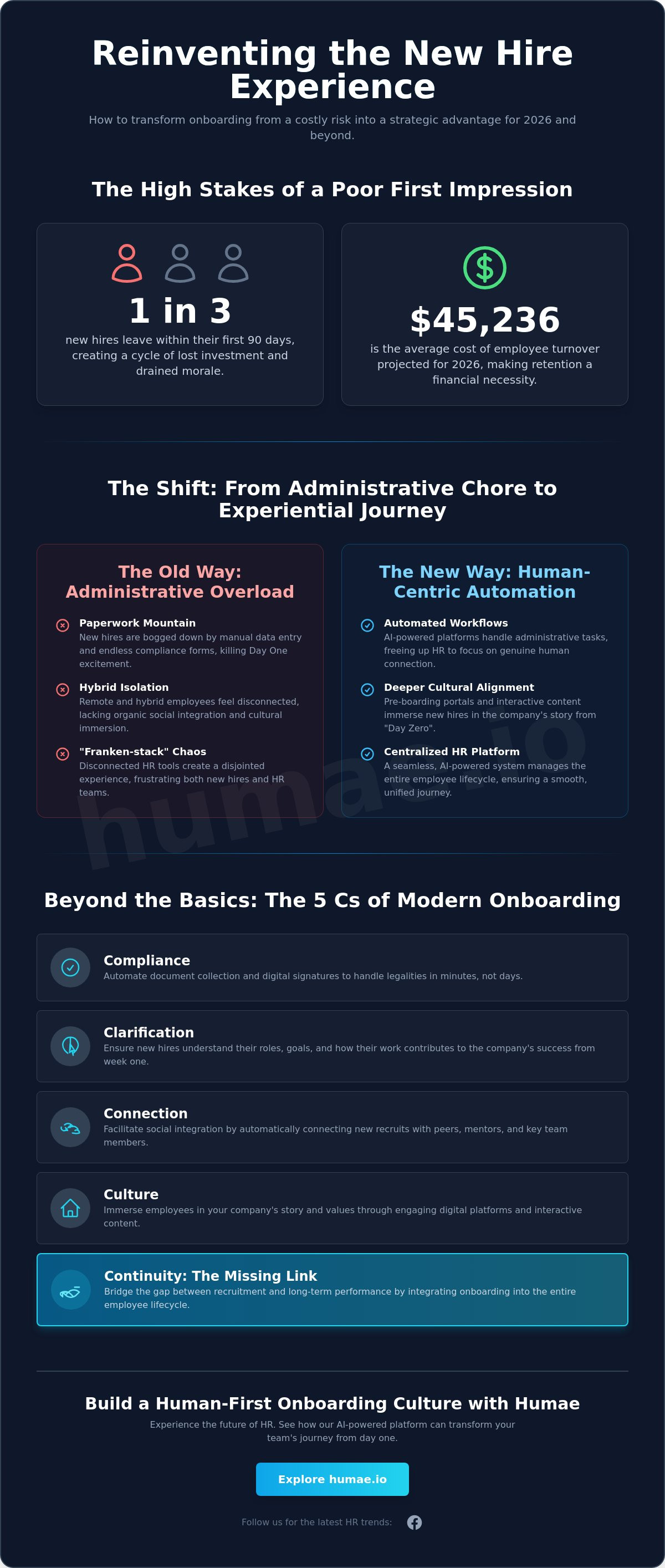
One in three new hires will leave your company before their 90th day. With the average cost of turnover climbing to $45,236 in 2026, improving the new hire experience is no longer a luxury; it's a financial necessity. You're likely tired of seeing fresh talent get bogged down in manual data entry or feeling isolated in hybrid environments. We agree that onboarding should feel like a warm welcome, not a mountain of paperwork.
Experience the future of HR with Humae. Follow us on Facebook to stay updated on the latest HR trends, or visit our home page to see how we can help you grow.
Key Takeaways
- Redefine onboarding as a holistic emotional journey that prioritizes genuine connection over administrative checklists in a hybrid world.
- Master the concept of "Continuity" to bridge the gap between recruitment and performance intelligence while improving the new hire experience.
- Ditch the "Franken-stack" by centralizing your employee lifecycle management into one seamless, AI-powered HR platform.
- Deploy pre-boarding portals and AI sentiment analysis to proactively support new team members during their critical first 90 days.
- Build a visionary organizational culture by blending cutting-edge automation with a deeply human-centric approach to leadership.
Transform your team's journey with Humae or stay inspired by following us on Facebook.
The High Stakes of the New Hire Experience in 2026
Why the "First Day" is No Longer Day One
Waiting until Monday morning to welcome a new recruit is a missed opportunity. The interval between the "moment of yes" and the official start date is where anxiety peaks. Effective pre-boarding bridges this gap. It turns Day One into a celebration of arrival rather than a scramble for passwords. We focus on "Day Zero" readiness, ensuring that hardware and software access are fully functional before the first login. This proactive approach to employee onboarding reduces first-week jitters and builds immediate trust. When a new hire feels prepared before they even start, their commitment to the company's mission solidifies instantly.
The Shift from Administrative to Experiential Onboarding
Modern employees don't care about branded hoodies as much as they care about clarity and purpose. They want to know exactly how their work contributes to the company's success. We're seeing a massive shift from paperwork-heavy systems to relationship-heavy experiences. Improving the new hire experience in 2026 requires a robust workforce management infrastructure that handles the technical details in the background. By automating the administrative burden, you free up managers to focus on human connection. Consider the following benefits of an experiential approach:
- Role Clarity: New hires understand their OKRs from the first week.
- Social Integration: Automated introductions connect recruits with the right mentors.
- Culture Immersion: Digital platforms share the company's story through engaging, interactive content.
Build a modern organizational culture with Humae. Discover how our tools can transform your team's journey. Stay connected with us on Facebook for the latest HR innovations.
Beyond the Basics: The 5 Cs of Modern Onboarding
For decades, HR leaders relied on the SHRM standard: Compliance, Clarification, Connection, and Culture. These 4 Cs are the bedrock, but they're no longer enough to win in 2026. We need a 5th C: Continuity. This is the missing link that connects the recruitment phase directly to long-term performance intelligence. Without it, your onboarding is just a series of isolated events. AI-powered platforms now ensure these pillars remain consistent across global, hybrid teams, preventing the dreaded "compliance fatigue." This happens when paperwork becomes so overwhelming that it smothers your company's actual culture. Improving the new hire experience requires a balance where technology handles the rules so humans can handle the relationships.
This need for specialized administrative support is particularly evident in medical fields; for instance, you can check out HPC Healthcare Partners to see how expert billing services can manage complex paperwork and streamline provider workflows.
A key part of maintaining that culture is prioritizing employee health. Forward-thinking companies are now including holistic wellness support in their onboarding, such as offering health-focused perks from brands like Nutrahara to help new hires stay at their best.
Compliance and Clarification: Building the Foundation
Compliance shouldn't be a week-long ordeal. By automating document collection and digital signatures, you can shrink this phase to mere minutes. Once the legalities are out of the way, Clarification takes center stage. Clarification is the bridge between a job offer and a performance goal, ensuring every recruit knows exactly what success looks like. Using clear, AI-refined job descriptions helps set these expectations before the first meeting even starts. Following new hire experience best practices ensures that these foundational steps feel supportive rather than bureaucratic. When people have clarity, their anxiety drops and their productivity climbs.
Connection, Culture, and Continuity
Connection in 2026 goes beyond a simple buddy system. It's about cross-departmental networking that breaks down silos from the start. Your digital employee directory shouldn't just be a list of names; it should be a map of your community that helps recruits understand unwritten rules and social norms. Finally, Continuity ensures that the momentum of improving the new hire experience doesn't stop after week one. Onboarding must flow directly into your performance management systems. This creates a data-driven path for growth, where the goals discussed during the interview become the milestones tracked in their first performance review. Seeing this progress through an integrated dashboard makes the transition feel seamless and professional.
Ready to see how a unified platform can bring these 5 Cs to life? Explore our features to see the difference a centralized system makes.
Build a modern organizational culture with Humae. Discover how our tools can transform your team's journey. Stay connected with us on Facebook for the latest HR innovations.
Tech-Enabled vs. Tech-Led: Why Infrastructure Matters
A fragmented tech stack is the silent killer of organizational culture. Many HR teams struggle with a "Franken-stack," forcing a single new hire to navigate five or six different applications just to get started. This disjointed approach creates massive friction; it turns what should be an exciting transition into a frustrating digital maze. Improving the new hire experience requires a shift from being tech-led to being tech-enabled. This means moving toward an AI-powered HR platform that acts as a centralized nervous system for the entire employee lifecycle.
This shift toward purpose-built AI is happening across all high-stakes professions. Just as HR teams need integrated systems, healthcare providers can check out Doctoria to automate clinical documentation, ensuring that experts spend less time on paperwork and more time on their core mission.
Manual data syncing is a relic of the past. When your systems don't talk to each other, you risk errors and delays that make your company look unprofessional. A modern HRIS provides real-time updates, ensuring that every department stays aligned. This single source of truth is the foundation of a smooth journey. It allows recruits to focus on their work instead of troubleshooting their own setup or re-entering their address for the third time.
The Problem with Fragmented Onboarding Tools
Siloed systems aren't just annoying; they're a security risk. Delayed onboarding or offboarding in disconnected tools leaves digital backdoors open. Beyond security, there's the "Information Hunt." New hires often waste 20% of their first week simply looking for files or trying to figure out who to contact for specific needs. An integrated employee directory solves the "Who is Who" problem instantly. It gives recruits a clear map of the organization, helping them build connections without the awkwardness of guessing job titles or reporting lines.
The 2026 Advantage: AI-Driven Workforce Intelligence
In 2026, we don't just react to turnover; we predict it. AI can now analyze engagement patterns to identify which new hires are at risk of disengaging before they even realize it themselves. By improving the new hire experience through data, managers receive automated nudges to check in at critical milestones. These systems use data directly from the Applicant Tracking System to personalize the onboarding path. If a candidate excelled in a specific skill during the interview, the system automatically tailors their training modules to match that level of expertise. This creates a deeply personal feel that technology, when used correctly, actually enhances rather than replaces.
Build a modern organizational culture with Humae. Discover how our tools can transform your team's journey. Stay connected with us on Facebook for the latest HR innovations.
5 Strategic Ways to Improve the New Hire Journey
- Step 1: Implement a Pre-boarding portal. Handle logistics, hardware requests, and digital signatures before Day One to reduce start-date anxiety.
- Step 2: Use AI sentiment analysis. Monitor the "New Hire Pulse" during the first month to catch disengagement before it turns into turnover.
- Step 3: Align onboarding with performance. Connect early tasks to larger company goals to give every action immediate meaning.
- Step 5: Establish a feedback loop. Ask new hires to critique the process while their perspective is still fresh, ensuring your system evolves constantly.
Integrating OKRs from Day One
Waiting 90 days to set goals is a mistake that modern talent won't tolerate. High performers want to know how they contribute to the mission immediately. By setting "Learning OKRs" for the first 30 days, you provide a clear roadmap for success. These early objectives should focus on knowledge acquisition and social integration. This immediate alignment with OKRs ensures that new hires feel effective and valued from their first week. Ultimately, this level of goal alignment is a primary driver of employee engagement, turning a recruit into a dedicated contributor.
The Power of AI Sentiment Analysis
In an HR context, sentiment analysis uses AI to interpret the tone and intent behind employee communications and survey responses. It helps you identify "early warning signs" of burnout or role-confusion that a manual check-in might miss. Instead of waiting for an annual review, use real-time analytics dashboards to see how your new cohort is actually feeling. This data-driven approach allows you to intervene with support exactly when it's needed. Improving the new hire experience through intelligence means you're never guessing about your team's health; you're acting on insights.
Ready to transform your process? See how our OKR tracking and performance intelligence can elevate your organization.
Build a modern organizational culture with Humae. Discover how our tools can transform your team's journey. Stay connected with us on Facebook for the latest HR innovations.
Building a Human-First Onboarding Culture with Humae
Technology should never feel cold. At Humae, we believe that the most advanced tools are those that fade into the background, allowing human relationships to take center stage. We don't just offer a suite of HR features; we provide a visionary partnership for leaders who refuse to choose between efficiency and empathy. By improving the new hire experience through a unified platform, we help you bridge the gap between a signed contract and a thriving team member. This focus on the individual can include recommending tools like SafeKeep to help employees organize their personal life documents and admin in one secure hub, ensuring they feel supported both at work and at home. Our approach merges high-level AI intelligence with a deeply human interface, ensuring that your organizational culture remains vibrant even as you scale.
This focus on the human interface extends to cutting-edge research environments where teams learn more about MindRove to utilize neural interface technology for high-performance data collection and development.
The journey begins long before the first day, starting with identifying the right candidates through trusted recruitment sources. For example, you can learn more about Alpha.jobs to see how they help organizations find talent in specialized sectors. With Humae, the transition from our Applicant Tracking System to the Employee Directory is instantaneous. There's no manual data entry, no lost emails, and no fragmented "Franken-stack" to manage. This centralized nervous system handles the administrative weight, so your new hires can focus on what matters: finding their purpose within your mission. Having a single platform for all workforce needs isn't just about convenience; it's about creating a consistent, professional brand identity that recruits can trust.
Centralized Infrastructure for Growing Teams
Startups often struggle to maintain their unique "human touch" as they grow. Humae solves this by providing a scalable infrastructure that keeps everyone connected. Managing time-off requests, updating directories, and tracking performance intelligence happens in one intuitive space. This simplicity prevents the cultural dilution that often follows rapid expansion. You can see how it works to witness how we turn complex HR workflows into elegant, automated experiences that support your people at every stage of their growth.
Data-Driven Growth and Productivity
True leadership requires more than just intuition; it requires actionable data. Humae empowers managers with performance intelligence that identifies strengths and highlights areas for development in real time. By reducing administrative overhead, we give you the space to refine your leadership skills and focus on mentoring your talent. Improving the new hire experience is a continuous process, and Humae provides the analytics dashboards needed to monitor that progress indefinitely. It's the last HR platform you'll ever need to implement because it grows alongside your ambitions.
Build a modern organizational culture with Humae. Discover how our tools can transform your team's journey. Stay connected with us on Facebook for the latest HR innovations.
Transform Your Onboarding into a Strategic Engine
Humae provides the visionary tools you need to lead this change. From AI-driven sentiment analysis that offers real-time feedback to integrated OKR tracking that aligns goals from day one, we help you build a culture that lasts. Our centralized employee directory ensures your hybrid teams stay connected, no matter where they work. Streamline your new hire experience with Humae’s AI-powered platform today. Your team's future starts with a single, seamless interaction. Let's build something remarkable together.
Experience the future of HR with Humae. Discover our modern solutions on our home page or join our community on Facebook for more insights.
Frequently Asked Questions
How long should the new hire onboarding process last?
A modern onboarding process should last at least 90 days; however, high-performing organizations often extend it to a full year. While initial paperwork happens in the first week, integration into company culture and performance cycles takes months. This extended timeline ensures that improving the new hire experience remains a priority well after the first day. It allows for continuous feedback and gradual skill development rather than a single, overwhelming information dump during the first week.
What is the difference between orientation and onboarding?
Orientation is a one-time event focused on administrative tasks, while onboarding is a long-term strategic journey. Orientation covers basic logistics like handbook reviews and tax forms. Onboarding focuses on social integration, role clarity, and aligning the recruit with long-term OKRs. It's the difference between checking a box and building a career. One is about the "what," and the other is about the "how" and "why" of your organization.
How can AI improve the onboarding experience without feeling robotic?
AI improves the experience by automating repetitive administrative chores, which frees up more time for genuine human connection. Instead of an HR manager spending hours on manual data entry, they can focus on mentoring and relationship building. AI-driven nudges remind managers to check in at critical moments, ensuring no one feels lost in the shuffle. It's about using technology to handle the science of HR so people can focus on the art of leadership; similarly, an intelligent research workspace like Clarami helps professionals streamline their academic and professional writing by automating complex research workflows.
What are the most important items on a new hire checklist for 2026?
How do you measure the success of an onboarding program?
You measure success through a mix of time-to-productivity, early retention rates, and sentiment analysis scores. Tracking how quickly a new hire hits their first key results provides a clear metric for training effectiveness. Additionally, using real-time surveys to gauge engagement during the first month helps you identify gaps in the process. High success means recruits feel empowered, understand their impact, and show a clear desire to grow within the organization.
How can I improve onboarding for remote or hybrid employees?
What is pre-boarding and why is it necessary?
Can an HRMS really improve employee retention during the first year?
Yes, a modern HRMS significantly improves retention by creating a seamless, professional environment that builds trust from the start. It eliminates the frustration of disjointed tools and manual errors that often plague the first few weeks. By providing a single source of truth for time-off, directories, and performance tracking, you show new hires that your organization is organized and future-ready. This sense of stability makes them far more likely to stay long-term.