HR System Integration: The 2026 Guide to Connected Workforce Management
By Humae · 27 August 2026
hr system integration
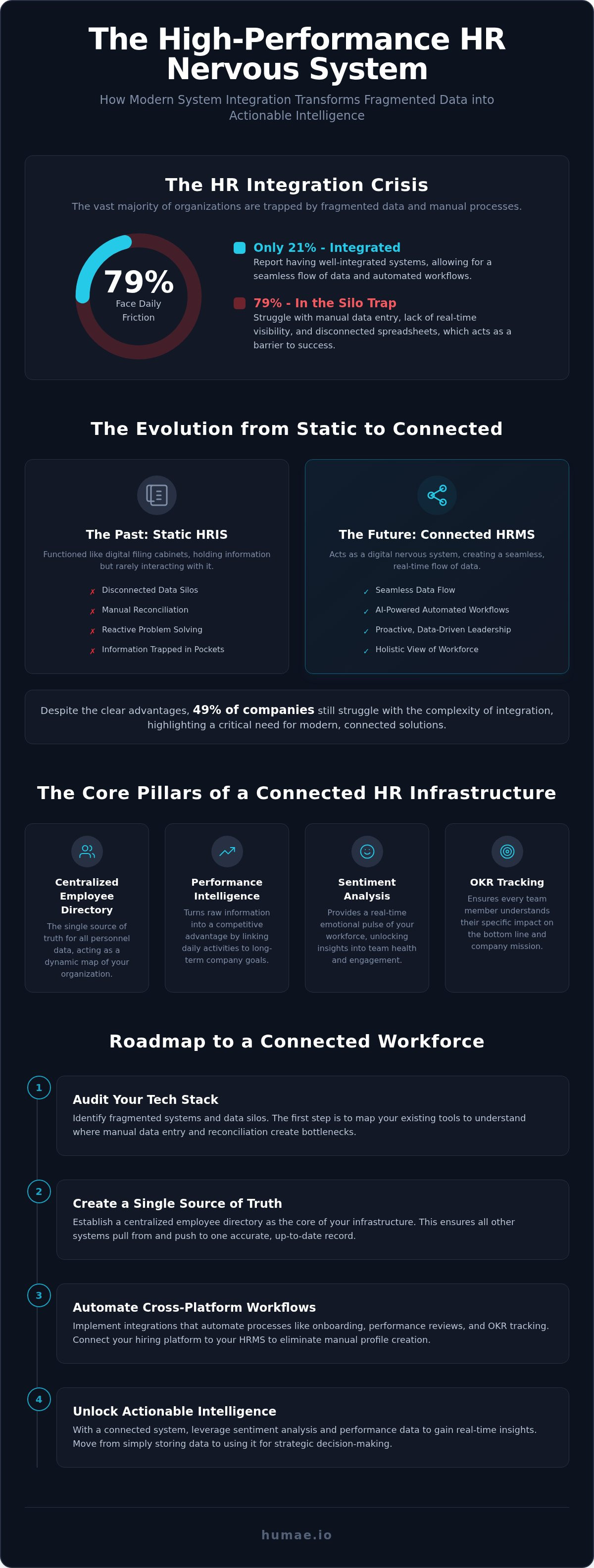
Only 21% of HR teams report having well-integrated systems, leaving the vast majority of organizations trapped in a silo trap of fragmented data. You've likely felt the daily friction of manual entry between your hiring platform and performance tools, or the frustration of flying blind without real-time visibility into employee sentiment. It's exhausting to lead a modern team when your technology acts as a barrier rather than a bridge. We know that your people are the heart of your success, and they deserve better than disconnected spreadsheets.
This guide shows you how to bridge those gaps using modern hr system integration to transform your HR tech stack into a high-performance nervous system. You'll learn how to create a single source of truth that powers your entire organization with confidence. We'll explore how Humae helps you automate complex workflows from onboarding to OKR tracking, turning disconnected data points into actionable intelligence. By the end of this article, you'll have a clear roadmap to build a connected workforce that thrives on AI-driven connectivity and genuine human insight.
Experience the future of work with Humae. Visit our official website to learn more about our intelligent HR solutions. Connect with us on Facebook for the latest updates. You can always return to our home page to explore our full range of services.
Key Takeaways
- Learn how to transform fragmented data silos into a seamless flow between hiring and performance management.
- Discover why modern hr system integration acts as a high-performance nervous system by eliminating manual data reconciliation.
- Identify the core pillars of connected infrastructure, including a centralized employee directory and real-time OKR tracking.
- Master a step-by-step strategy to audit your tech stack and replace fragmented systems with a holistic, intelligent environment.
- Unlock the power of sentiment analysis and performance intelligence to gain actionable insights into your team’s health and engagement.
Defining HR System Integration in the Modern Workplace
True hr system integration is more than a technical handshake between two software programs. It acts as your company's digital nervous system. In 2026, this means creating a seamless flow of data where hiring, management, and performance tools speak the same language without human intervention. You stop being a data entry clerk and start being a strategic partner. This connectivity eliminates the manual data reconciliation between disconnected silos, ensuring that information remains accurate and accessible in real-time.
A modern Human Resource Management System (HRMS) acts as the central hub for these operations. It captures every employee interaction, from the first interview to the final performance review, and analyzes it for growth opportunities. This isn't just about storage; it's about making sense of the human experience within your company. By linking these touchpoints, you create a holistic view of your workforce that traditional tools simply can't match.
Building this foundation is essential for your workforce management infrastructure. Without it, your data remains trapped in isolated pockets, preventing you from seeing the full picture of your team's health. A connected system ensures that every interaction contributes to a larger narrative of success and development, allowing you to move from reactive fixes to proactive leadership.
The Evolution from Static HRIS to Connected HRMS
The days of static systems are over. Old-school HRIS platforms functioned like digital filing cabinets; they held information but rarely interacted with it. Today, 49% of companies still struggle with the complexity of integration, yet the shift toward connectivity is inevitable. Modern systems allow for real-time updates across the entire employee lifecycle. When a candidate signs an offer in your Applicant Tracking System, their profile instantly populates your directory and triggers onboarding tasks. AI now plays a lead role here, specifically through agentic AI that automates complex workflows across recruitment and employee self-service.
Why Connectivity is Critical for Scalability
Scalability demands efficiency. As your team grows, the administrative overhead of managing separate tools becomes a bottleneck that stifles innovation. High-growth organizations use hr system integration to maintain consistent culture and feedback loops, especially in remote or hybrid environments. When systems are linked, feedback is immediate and transparent. This direct impact on employee retention and engagement metrics proves that better technology leads to better human outcomes. You aren't just scaling your headcount; you're scaling your ability to care for every individual through data-driven empathy.
The Core Pillars of a Connected HR Infrastructure
A connected infrastructure isn't just a collection of apps; it's a unified ecosystem where every part supports the whole. To move beyond the silo trap mentioned earlier, you need a framework that prioritizes data flow and human insight. When your hr system integration is built correctly, it rests on four essential pillars that turn raw information into a competitive advantage. Successful hr system integration ensures that these pillars aren't just independent tools but a cohesive unit that powers your entire organization.
- Centralized Employee Directory: The single source of truth for all personnel data.
- Performance Intelligence: Linking daily activities directly to long-term company goals.
- Sentiment Analysis: Providing a real-time emotional pulse of your workforce.
- OKR Tracking: Ensuring every team member understands their specific impact on the bottom line.
Unified Data Management and the Employee Directory
A modern employee directory is the heart of your connectivity. It's not just a contact list; it's a dynamic map of your organization. By automating time-off management and directory updates simultaneously, you eliminate the risk of outdated information. This centralized cloud environment also ensures that data privacy and security remain top priorities. You can protect sensitive personnel files while keeping them accessible to the right people. This level of organization saves hours of administrative work every week, allowing your HR team to focus on culture rather than spreadsheets.
Performance Intelligence and AI Integration
AI integration takes your infrastructure to the next level. With 80% of organizations projected to integrate AI into core HR functions by the end of 2026, staying ahead means connecting hiring data to performance outcomes. You can refine your talent acquisition strategy based on what actually works for your team. AI helps you identify high-potential employees and flight risks early, allowing for proactive interventions. This shifts the culture from dreaded annual reviews to a continuous feedback loop through connected apps.
Understanding team health requires more than just looking at output. Sentiment analysis allows you to detect shifts in morale before they lead to turnover. When integrated with OKR tracking, you see the full picture: how people feel and what they are achieving. This transparency builds trust across the organization. It's about creating a culture where everyone feels seen and valued. If you're ready to see how these pillars work in practice, you can explore our intelligent HR features to start building your own connected ecosystem.
Overcoming the Silo Trap: Integration vs Connectivity
Many organizations confuse a simple data sync with a comprehensive strategy. While integration often acts as a point-to-point bridge between two apps, true connectivity creates a holistic environment where data flows naturally. Relying on a "Frankenstein" tech stack of disconnected tools carries a heavy hidden cost. It forces your team into manual work and creates blind spots that lead to biased performance reviews. Without a unified view, decision-making becomes a guessing game rather than a data-driven process. Leaders must move beyond patchwork fixes and choose platforms designed for connectivity from the ground up.
When your hr system integration is limited to basic syncing, you miss the deeper insights that drive growth. Fragmented data means your hiring trends don't inform your performance management, and your sentiment analysis remains isolated from your productivity metrics. This gap is why only 41% of organizations say their HR solutions integrate well. Breaking free from this trap requires a shift in how you view your technology; it isn't just a set of tools, but a single, living infrastructure for your people.
The Technical Limitations of Legacy HR Software
Legacy software often functions as a closed ecosystem, intentionally preventing data sharing with modern performance tools. Extracting actionable insights from disparate spreadsheets is a slow, error-prone process that drains your team's energy. Modern hris systems solve this through open API capabilities, allowing for a fluid exchange of information. This technical openness is the prerequisite for building a high-performance nervous system that adapts as your company scales.
Connectivity as a Cultural Enabler
Connectivity does more than just move data; it transforms your company culture. When every team member understands the okr meaning and can track their impact in real-time, accountability becomes a shared value. This transparency is a cornerstone of modern employee engagement strategies. By reducing friction for managers through automated intelligence dashboards, you empower them to lead with empathy and clarity. Connected feedback loops ensure that every voice is heard and every achievement is recognized, fostering a truly supportive workplace.
Implementing an HR System Integration Strategy
Implementing a successful hr system integration strategy requires a shift from reactive problem-solving to proactive planning. You can't fix what you haven't measured. Start by auditing your current HR tech stack to identify redundant apps or siloed data points that slow your team down. Once you've cleared the clutter, define your core connectivity goals. Are you aiming for better performance tracking or faster onboarding? Selecting a centralized HRMS that supports AI-driven intelligence is the next logical step. This platform becomes the engine for your strategic growth.
Training your leadership team is just as vital as the software itself. They must understand how to use connected data to make informed decisions about team development. Monitoring sentiment and performance metrics allows you to refine the system over time. This continuous improvement loop ensures your organization remains agile and responsive to the evolving needs of your workforce.
Auditing Your Current Workforce Management Tools
Mapping the journey of an employee from their first application to their role as a tenured leader reveals the hidden cracks in your current system. You'll likely find places where data drops or requires manual entry, creating friction for everyone involved. Evaluate the user experience of your existing tools. If managers and staff find them difficult to use, the data they produce will be incomplete or inaccurate. A smooth UX is the foundation of high-quality workforce intelligence. Identifying these pain points now prevents them from becoming roadblocks during your integration process.
Building a Roadmap for Long-Term Connectivity
Don't try to change everything overnight. Start with core features like the employee directory and time-off management before scaling to advanced OKR tracking. Set measurable KPIs for your connectivity project, such as reduced time-to-hire or improved employee retention rates. This phased approach ensures your strategy aligns with modern management principles. It allows your culture to evolve alongside your technology, ensuring long-term adoption and success. By prioritizing high-impact areas first, you build the momentum needed for a full organizational transformation.
Ready to streamline your operations and empower your team? Build your connected workforce with Humae today.
How Humae Powers Next-Generation HR Connectivity
Humae stands apart by offering a platform built specifically for the complexities of modern HR. Unlike generic automation tools that require manual setup for every workflow, our solution provides a pre-built, intelligent environment. This is where true hr system integration comes to life. We provide the centralized infrastructure your team needs to move fast without losing the human touch. Our actionable analytics dashboards simplify complex data sets, allowing you to make faster, more confident decisions that impact the entire organization. By seeing the pulse of your team in real-time, you can lead with clarity and empathy.
Our approach ensures that your technology serves your people, not the other way around. We've designed our platform to act as a partner in your growth, providing the tools necessary to bridge the gap between data and action. Whether you're tracking long-term trends or responding to immediate team needs, the visibility provided by a connected system is your greatest asset. It's about moving beyond simple administration to a state of constant, data-backed evolution.
Centralizing Your Employee Data with Humae
Humae provides a unified platform that scales effortlessly alongside your business. You can manage the entire employee lifecycle without jumping between disconnected apps. Our integrated Applicant Tracking System streamlines hiring and onboarding, ensuring new hires feel welcomed and productive from day one. By managing time-off and directories within the same space, you maintain a single source of truth that stays accurate as people move through the company. This level of hr system integration removes the friction of manual data entry, giving your team the freedom to focus on high-level culture projects rather than administrative upkeep.
AI and the Future of Performance Intelligence
The future of work is powered by intelligence that understands the human element. Humae leverages AI-driven sentiment analysis to detect early signs of stress or disengagement, helping you prevent burnout before it happens. We automate performance feedback loops, turning traditional annual reviews into a continuous, supportive conversation about professional development. This proactive approach ensures that advanced OKR tracking connects individual effort to company-wide success in real-time. Every team member sees how their daily work contributes to the bigger picture, which is the ultimate driver of engagement. Discover how our features transform HR into a strategic partner that drives measurable results and fosters a thriving workplace community.
Building the Future of Your Workforce
Success in 2026 depends on how well you connect your people with your technology. Moving beyond the silo trap requires a shift in mindset where data flows freely across every stage of the employee lifecycle. You've learned how a centralized directory and real-time OKR tracking create a transparent, high-performance environment. Modern hr system integration isn't just a technical upgrade; it's the foundation of a thriving culture where every individual feels seen and valued. By choosing connectivity over fragmented tools, you empower your leaders to make decisions with clarity and empathy.
Your team deserves a platform that understands their needs and supports their growth. With AI-driven sentiment analysis and centralized workforce management, you can prevent burnout and foster genuine engagement before challenges arise. It's time to transform your HR operations into a strategic engine for success.
Explore Humae: The AI-Powered HR Platform for Modern Teams and start building your connected infrastructure today. We're here to support your journey toward a more efficient and human-centered workplace.
Frequently Asked Questions
What is the difference between HR connectivity and HR integration?
Integration refers to a basic technical link between two specific applications to share data. Connectivity goes much further by creating a unified environment where every tool communicates naturally within a single ecosystem. This holistic approach ensures that your workforce management infrastructure operates as a living nervous system rather than a collection of separate bridges. It's the difference between a simple data pipe and a fully aware, intelligent organization that evolves with its people.
How does an AI-powered HR platform improve team productivity?
An AI-powered platform boosts productivity by automating repetitive administrative tasks like resume screening and onboarding workflows. Beyond automation, it uses sentiment analysis to detect early signs of burnout, allowing managers to intervene before productivity drops. By removing the friction of manual data entry across multiple tools, your team can focus on high-value strategic work. This technical efficiency directly translates into faster execution and better overall team performance across the entire organization.
Can HR system integration help with employee retention in 2026?
Effective hr system integration significantly improves retention by fostering a culture of transparency and recognition. When employees see their impact through real-time OKR tracking and receive continuous feedback, they feel more valued and connected to the company mission. By identifying flight risks early through AI-driven intelligence, you can address concerns before they lead to turnover. A connected environment ensures that no achievement goes unnoticed, which is a key driver for long-term employee loyalty.
What are the first steps to building a connected HR infrastructure?
The first step is to perform a comprehensive audit of your current tech stack to identify data silos and redundant applications. You need to map out the employee journey and find where information currently requires manual entry or reconciliation. Once you've identified these gaps, define your core connectivity goals, such as improving performance tracking or streamlining hiring. Choosing a centralized HRMS that supports open API capabilities is essential for building a scalable foundation.
Why is OKR tracking essential for connected workforce management?
OKR tracking is essential because it bridges the gap between daily tasks and long-term organizational success. In a connected system, these objectives aren't just static numbers; they're dynamic indicators of team health and alignment. When every team member understands their specific impact on the bottom line, accountability becomes a natural part of the culture. This transparency ensures that everyone is moving in the same direction, maximizing the value of your integrated data points.
Is a centralized employee directory necessary for small startups?
A centralized employee directory is vital for startups because it establishes a single source of truth from day one. Even with a small team, fragmented data can lead to confusion and administrative errors as you begin to scale. Having a unified map of your organization allows you to manage time-off and contact information effortlessly. It builds the necessary infrastructure for future growth, ensuring that your culture remains consistent as you add more complex tools later.
How do analytics dashboards help HR managers make better decisions?
Analytics dashboards transform raw, complex data into actionable intelligence that is easy to interpret. Instead of digging through multiple spreadsheets, HR managers can see real-time trends in performance, sentiment, and engagement levels. This visibility allows for faster and more confident decision-making based on facts rather than intuition. Whether you're refining your hiring strategy or adjusting team goals, having connected data points ensures your choices are always backed by the latest workforce insights.
Does HR system integration require a large IT department to manage?
Modern hr system integration doesn't require a massive IT department because most advanced platforms are designed for ease of use. Cloud-based SaaS solutions handle the technical heavy lifting, including security updates and API maintenance, through user-friendly interfaces. This allows HR professionals to manage the system themselves without needing deep technical expertise. The focus shifts from managing code to managing people, making high-level connectivity accessible to organizations of all sizes without significant operational overhead.