Building a Fair and Transparent Goal Setting Process: The 2026 Strategy
By Humae · 15 June 2026
fair and transparent goal setting process
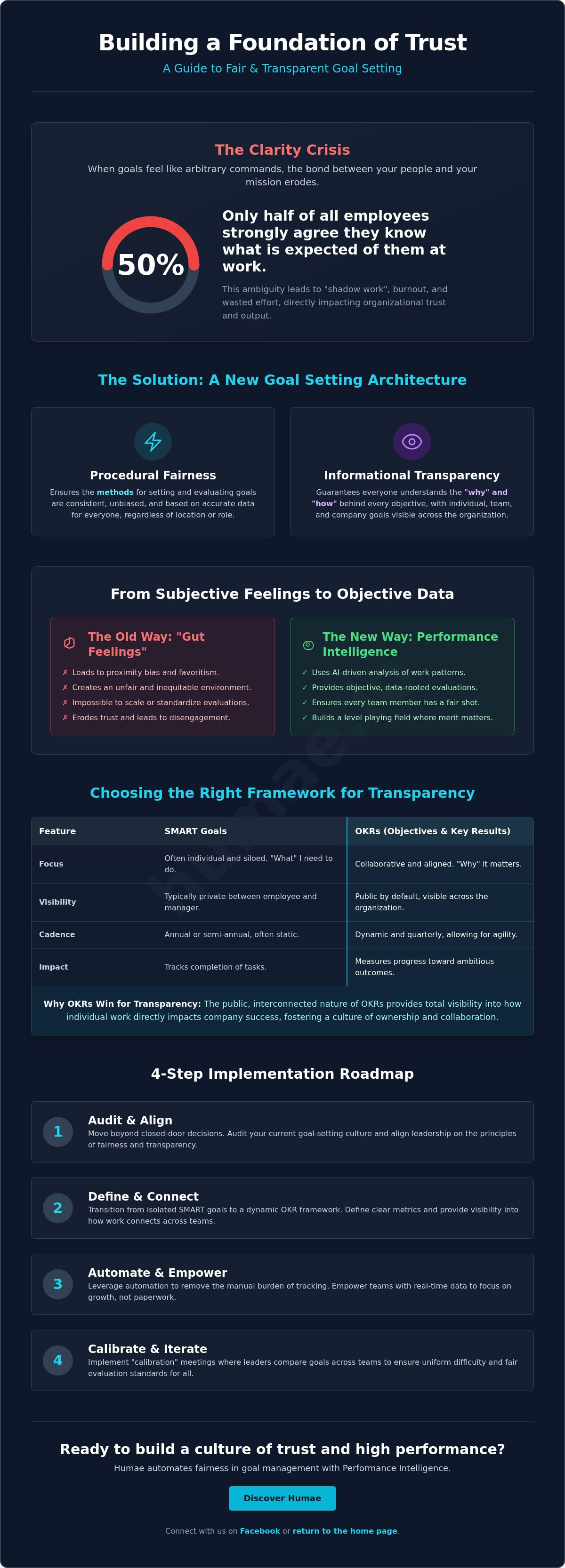
Only 50% of employees strongly agree they know what's expected of them at work. When goals feel like arbitrary commands from the top, they don't just miss the mark; they actively erode the bond between your people and your mission. Establishing a fair and transparent goal setting process isn't just a trend for 2026. It's the essential foundation for any organization that wants to thrive amidst shifting pay transparency laws and the evolving demands of a modern workforce.
You probably know the frustration of watching productivity stall because individual contributors can't see how their daily tasks move the needle. This article will help you transform organizational trust and output by implementing a goal-setting framework rooted in equity, visibility, and real-time data. We'll break down how to align your teams through OKRs and continuous feedback so that favoritism becomes a thing of the past and high performance becomes the standard for everyone.
Key Takeaways
- Understand how to move beyond closed-door decisions to build a fair and transparent goal setting process that fosters genuine organizational trust.
- Replace subjective "gut feelings" with Performance Intelligence to ensure every evaluation is rooted in objective data and equity.
- Transition from isolated SMART goals to a dynamic OKR framework that provides total visibility into how individual work impacts company success.
- Follow a clear implementation roadmap to audit your current culture and define metrics that integrate seamlessly with your modern HR infrastructure.
- Leverage automation to remove the manual burden of tracking, allowing your team to focus on growth rather than paperwork.
What is a Fair and Transparent Goal Setting Process?
A fair and transparent goal setting process is much more than a list of targets. It is a dual-layered framework that combines procedural fairness with informational transparency. Procedural fairness ensures that the methods used to determine goals are consistent and unbiased, while informational transparency guarantees that everyone understands the "why" and "how" behind every objective. In the remote-first landscape of 2026, the old model of closed-door leadership meetings is no longer viable. Distributed teams require a high-trust environment where expectations are visible to all, not just a select few in the C-suite.
Modern organizational success relies on three psychological pillars: equity, accessibility, and accountability. Equity ensures every team member has a fair shot at success regardless of their location or tenure. Accessibility means the data is available at a click. Accountability ensures that ownership is clearly defined. When these pillars are strong, organizations see a massive reduction in "shadow work." This refers to the invisible, unaligned tasks employees perform when they aren't sure what actually matters. By clarifying the fair and transparent goal setting process, you eliminate the ambiguity that leads to burnout and wasted effort.
This approach is deeply rooted in Goal setting theory, which proves that specific, challenging goals lead to higher performance. However, in 2026, the challenge isn't just setting the goal; it's making the process feel human and equitable for every participant.
The Anatomy of Procedural Fairness
Fairness isn't a feeling; it's an architecture. It starts with consistency. You must apply the same evaluative lens to a developer in Lisbon as you do to a product manager in New York. Bias suppression is the next step. By using real-time data instead of subjective "gut feelings," you ensure that goals aren't based on personal affinity or proximity bias. Finally, accuracy is paramount. Your metrics must reflect the actual effort required to achieve a result. If a goal is mathematically impossible or lacks the necessary resources, the process is no longer fair.
Defining Radical Transparency in HR
Radical transparency marks a shift from "need-to-know" silos to a "public-by-default" mindset. When individual, team, and company goals are visible across the entire organization, silos begin to crumble. This visibility fosters cross-functional collaboration because teams can finally see how their work intersects with others. Implementing these changes is a core part of modern employee engagement strategies. It builds a culture where people feel like partners in the business, not just cogs in a machine. When everyone knows the score, they play harder and stay longer.
The 4 Pillars of Performance Intelligence and Equity
"Gut feeling" is the silent killer of organizational equity. When managers rely on intuition rather than data, proximity bias and personal affinity inevitably cloud their judgment. This subjectivity makes a fair and transparent goal setting process impossible to maintain. Performance Intelligence acts as the necessary bridge between raw productivity data and truly fair outcomes. It provides a layer of objectivity that protects both the employee and the manager from the pitfalls of unconscious bias. A truly fair and transparent goal setting process requires more than just good intentions; it requires a technological foundation that prioritizes evidence over anecdotes.
Performance Intelligence is the AI-driven analysis of work patterns to ensure objective evaluation.
To achieve true equity, organizations must also embrace "calibration" meetings. These sessions allow leaders to compare goals across different teams to ensure difficulty levels are uniform. It prevents a "soft" manager from setting low bars while a "strict" manager sets impossible ones. This alignment ensures that every high performer is recognized equally, regardless of which department they call home. By standardizing the "difficulty curve," you create a level playing field where merit is the only currency that matters.
Pillar 1: Collaborative Co-Creation
Goals should always be a dialogue, not a monologue delivered from the top down. While leadership provides the strategic direction, individuals need the autonomy to define how they contribute. This co-creation process boosts buy-in and ensures that targets are realistic. Modern management frameworks help facilitate these conversations by providing a structured space for negotiation and alignment. When employees help build the roadmap, they're far more likely to stay the course and feel a sense of ownership over the results.
Pillar 2: Real-Time Visibility
The annual "set it and forget it" approach is a relic of the past. In a fast-moving market, goals must be living documents. Live dashboards provide real-time visibility, ensuring that "end-of-year surprises" are eradicated. Employees should always know exactly where they stand against their targets. Integrating this tracking into your workforce management infrastructure ensures that goals remain a part of the daily workflow. Industry research on Transparent Goals shows that visibility leads to significantly higher engagement because people see the direct impact of their labor. If you're looking to modernize your approach, you can explore how our platform simplifies goal tracking to keep your teams aligned and motivated.
SMART Goals vs. OKRs: Choosing the Right Framework for Transparency
SMART goals have been the gold standard for decades. They're excellent for individual clarity and tactical precision. However, they often exist in silos. If your aim is to build a fair and transparent goal setting process, SMART goals alone might not be enough. They lack the inherent visibility required to show how different departments influence one another. OKRs (Objectives and Key Results) solve this by making the "why" as important as the "what." They transform isolated tasks into a shared journey.
OKRs create a cascading effect. This means an individual's key results contribute directly to a team objective, which then fuels the company's mission. It's a visible thread. Everyone can see how their work matters. This alignment is the heartbeat of a high-trust culture. When the connection between daily effort and company success is hidden, motivation drops. Transparency acts as the antidote to that disconnect.
The Transparency Advantage of OKRs
In an OKR framework, visibility is the default. Every employee can view the OKRs of their peers, managers, and even the CEO. This openness eliminates the "black box" of executive decision-making. It ensures that everyone is pulling in the same direction. Understanding the okr meaning is vital for leaders who want to move beyond simple task management. It's about visualizing the impact of every action in real-time, creating a culture where progress is celebrated openly.
When to Use SMART Goals
SMART goals still have a place in 2026. They're perfect for tactical, short-term projects or highly specialized roles where the output doesn't need to "cascade" across the company. Think of SMART as the "how" and OKRs as the "where." Many successful organizations combine the two. They use SMART criteria to define the specific metrics within their OKR Key Results. This hybrid approach maintains fairness by ensuring that while the vision is transparent, the execution remains precise and measurable. It allows for a fair and transparent goal setting process that respects both big-picture strategy and granular detail.
Choosing the right path depends on your organization's maturity. Startups and scale-ups often need the agility of OKRs to stay aligned during rapid growth. Established enterprises might prefer a hybrid model to balance complex department needs with overall strategic transparency. Highly regulated sectors might lean on SMART goals for the rigid documentation needed for compliance, while using OKRs to drive innovation at the leadership level.
Implementation Roadmap: Rolling Out Your New Process
Transitioning to a high-trust model requires more than a software update. It's a phased evolution. You don't just flip a switch on fairness. You build it through deliberate, visible actions. Following a structured roadmap ensures that your fair and transparent goal setting process survives the messy reality of daily operations and actually sticks within your culture.
- Audit Your Trust Level: Start with an anonymous employee survey. You need to identify where your people currently feel the process is "rigged" or unclear before you can fix it.
- Define Measurable Metrics: Every goal must be rooted in data that is easily accessible via your HRIS. If you can't measure it automatically, it's open to subjective interpretation.
- Train for Calibration: Managers need specific training on "Bias-Free Feedback." They must learn to coach based on the Performance Intelligence data we discussed earlier, rather than personal affinity.
- Launch a Centralized Portal: Create a single source of truth. When goals are visible in a centralized hub, silos naturally begin to dissolve.
- Establish a Feedback Rhythm: Move away from annual reviews. Weekly or bi-weekly check-ins keep goals relevant and allow for real-time course corrections.
Managing the Cultural Shift
Expect some resistance. Some managers prefer the perceived safety of private goal setting because it shields them from difficult conversations. To overcome this, focus your communication on the benefits for employee growth. Explain that visibility creates clearer career paths and more equitable rewards. Transparency is a tool for empowerment, not a mechanism for micromanagement. When leaders model this openness, the rest of the organization follows.
Audit and Adjust: The Fairness Loop
Your roadmap needs a built-in "fairness loop." Conduct quarterly reviews of the goal-setting process itself to ensure it still serves the team's needs. Use sentiment analysis tools to gauge if employees still perceive the system as equitable. If market conditions change, don't be afraid to adjust goals mid-cycle. Doing this publicly and explaining the data behind the shift preserves the integrity of your fair and transparent goal setting process. Continuous adjustment is better than rigid adherence to an outdated target.
Ready to build a culture of high performance and equity? Start your 14-day free trial with Humae and see how our platform automates fairness.
How Humae Automates Fairness in Goal Management
The best strategy remains a theory without the right tools to support it. Humae provides the technological foundation to turn these principles into a daily reality. By integrating our core features, organizations can finally scale a fair and transparent goal setting process without drowning in manual updates. Our platform automates the heavy lifting of transparency; this allows leaders to focus on what truly matters: their people. We believe that technology should serve the human connection, not replace it.
Real-time OKR tracking is at the heart of this transformation. Instead of static documents that gather dust in a folder, your goals live and breathe within a dynamic system. This visibility ensures that every team member knows exactly where they stand at any given moment. When progress is public and data-driven, the perceived favoritism that often plagues performance reviews disappears. You aren't just setting targets. You are building a culture of objective meritocracy where success is visible to all.
Beyond simple tracking, Humae uses AI-driven sentiment analysis to identify "fairness gaps" before they escalate into grievances. If a specific team feels their goals are unachievable or if resource constraints are creating hidden bottlenecks, the system alerts leadership. This proactive approach ensures that the transparency we've discussed remains an active dialogue rather than a one-way street. You can explore our centralized how it works interface to see how we make these insights accessible to every stakeholder in the company.
Eliminating Data Silos
A fair and transparent goal setting process requires a single source of truth. When data is scattered across spreadsheets and emails, fairness is the first casualty. Humae connects every stage of the employee lifecycle, from initial hiring data to long-term performance goals. This continuity ensures that expectations set during the interview process are reflected in the daily workflow. By reducing administrative friction, we free up managers to spend their time coaching and developing their teams rather than chasing status updates. It's about making the work experience smoother for everyone involved.
The Future of Performance Intelligence
We are moving toward a future where predictive analytics can flag goals at risk of becoming "unfair." If the data shows a team lacks the resources to meet a target, the system suggests a mid-cycle calibration. This preserves the integrity of the process and protects employees from burnout. Automated reporting further strengthens this bond by providing stakeholders with clear, spreadsheet-free transparency. Ready to modernize your organization? Get started with Humae today and experience the power of data-driven equity.
Empower Your Team Through Radical Visibility
Building a fair and transparent goal setting process isn't a one-time project; it's a commitment to a culture where every employee feels seen and valued. By moving away from subjective "gut feelings" and embracing frameworks like OKRs, you create a workplace where success is defined by clear data rather than proximity to leadership. We've explored how visibility reduces burnout, how Performance Intelligence prevents bias, and why a centralized source of truth is the only way to maintain trust in a remote-first world.
The tools you choose define the experience of your workforce. With AI-powered OKR tracking and real-time sentiment analysis, you can identify friction points before they impact retention. Centralized workforce management ensures that every goal is aligned with your company’s core mission; this turns individual effort into collective triumph. It's time to leave manual spreadsheets and closed-door reviews behind.
Experience the future of fair performance management at Humae.io. Your team deserves a system that works as hard as they do. Let's build a more equitable future together.
Frequently Asked Questions
Is a transparent goal setting process suitable for all company sizes?
Yes, a fair and transparent goal setting process is essential for any organization regardless of its headcount. In startups, it provides the agility needed for rapid growth, while in large enterprises, it breaks down silos and ensures every department pulls in the same direction. Modern platforms make it easy to scale these practices across global teams without losing the human touch.
How do we handle confidential or sensitive projects in a transparent system?
Transparency doesn't require compromising security or trade secrets. For sensitive initiatives, you can use high-level placeholders that describe the strategic intent without revealing proprietary details. The key is to be open about the "why" and the expected outcomes while keeping tactical specifics limited to the relevant project teams within your centralized portal.
Can a transparent process lead to unhealthy competition between employees?
On the contrary, visibility usually fosters collaboration rather than toxic competition. When team members see how their peers are contributing to the broader company mission, it builds mutual respect. Unhealthy friction typically occurs when rewards are based on "black box" decisions; clear and visible goals remove that ambiguity and replace it with shared accountability.
What is the role of AI in ensuring a fair goal setting process?
AI acts as an objective observer that identifies bias and resource bottlenecks. It uses sentiment analysis and work pattern data to ensure that a fair and transparent goal setting process isn't just a promise, but a data-driven reality. By flagging unrealistic targets early, AI helps managers maintain equity and prevents employee burnout before it starts.
How often should goals be reviewed to maintain fairness?
To stay fair, goals should be part of a continuous feedback loop with weekly or bi-weekly check-ins. The business environment in 2026 moves too fast for annual or even quarterly reviews to remain perfectly accurate. Frequent touchpoints allow managers to adjust targets mid-cycle, ensuring that employees are never penalized for shifting market conditions beyond their control.
What should I do if an employee feels their goals are unfair?
Listen first and then audit the data. Use your Performance Intelligence tools to review the metrics and compare them against similar roles within the organization. If the data supports the employee's concern, adjust the goals immediately. Treating these concerns with empathy and objectivity reinforces the trust that your transparent system is designed to build.