1-on-1 Meeting Software: 2026 Buyer’s Guide
By Humae · 14 August 2026
software for 1-on-1 meeting management
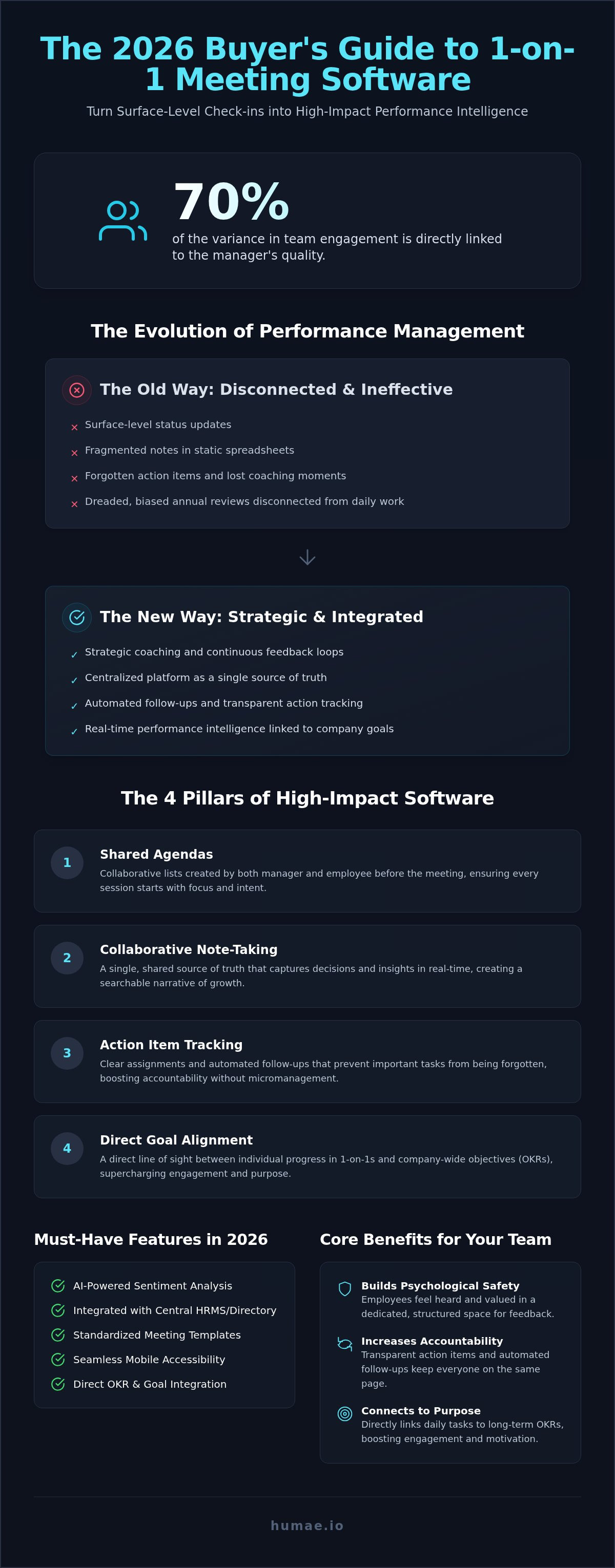
Did you know that 70% of the variance in team engagement is linked directly to the quality of the manager? It's a staggering figure that highlights why the weekly check-in is your most powerful tool for success. Yet, many leaders still find themselves stuck in a cycle of surface-level status updates that fail to drive real growth or provide continuity between sessions.
We understand the frustration of losing track of goal progress or feeling like important coaching moments are slipping through the cracks. You deserve a system that turns these interactions into meaningful breakthroughs. This 2026 buyer's guide will help you identify the best software for 1-on-1 meeting management to bridge the gap between simple conversation and high-impact performance intelligence.
By the end of this article, you'll know exactly how to centralize your agendas, link every discussion to OKR progress, and use sentiment analysis to support your team more effectively than ever before. Let's build a culture where every meeting matters.
Key Takeaways
- Learn to turn surface-level check-ins into high-impact coaching sessions that foster deeper manager-employee relationships.
- Master the selection process for software for 1-on-1 meeting management by prioritizing collaborative agendas and direct goal alignment.
- Eliminate tool fatigue by choosing integrated platforms that connect meeting notes with your central employee directory and performance data.
- Discover how to implement standardized meeting templates to ensure consistency and measurable results across your entire organization.
- Leverage AI-powered performance intelligence to gain real-time insights into team sentiment and long-term engagement.
What Is Software for 1-on-1 Meeting Management?
Modern software for 1-on-1 meeting management is a specialized digital platform designed to facilitate, document, and analyze recurring conversations between managers and their team members. While a generic Electronic Meeting System might handle the technical side of a video call, dedicated 1-on-1 tools manage the human side of the interaction. They serve as a shared workspace for the relationship, ensuring that every word spoken leads to an actionable outcome.
Effective platforms rely on four essential pillars:
- Shared agendas: Collaborative lists created by both parties before the meeting starts.
- Collaborative note-taking: A single source of truth that captures decisions in real-time.
- Action item tracking: Clear assignments that prevent important tasks from disappearing into the void.
- Goal alignment: A direct line of sight between individual progress and company-wide objectives.
In 2026, high-performing teams are abandoning the tactical "what did you do last week?" status update. They're moving toward strategic coaching. Static spreadsheets and fragmented documents can't keep up with the pace of modern work. Transitioning to dedicated software for 1-on-1 meeting management allows leaders to stop being administrators and start being mentors. It provides the performance intelligence needed to identify trends, celebrate wins, and address blockers before they become turnover risks.
The Evolution of Modern Performance Management
The era of the dreaded annual review is over. It's too slow, often biased, and disconnected from daily reality. Organizations are shifting toward continuous feedback loops powered by robust workforce management infrastructure. This transition ensures that performance is managed in real-time, not in retrospect. Digital tools solve the problem of "forgotten" notes by keeping every insight saved and searchable. This creates a narrative of growth rather than a series of isolated, disconnected events.
Core Benefits for Managers and Employees
Accountability shouldn't feel like micromanagement. When action items are transparent and follow-ups are automated, everyone stays on the same page without the friction of constant reminders. This clarity builds deep psychological safety. Employees feel heard and valued when they have a dedicated, structured space for feedback. Most importantly, it bridges the gap between daily tasks and long-term success. When a team member sees how their 1-on-1 discussion directly impacts their OKRs, their engagement and sense of purpose skyrocket.
Essential Features to Look for in a 1-on-1 Platform
Choosing the right software for 1-on-1 meeting management isn't just about finding a digital notepad. It's about building a framework for professional growth and organizational clarity. In a landscape where hybrid work is the norm, your platform must act as a bridge that connects daily tasks to long-term career aspirations. High-performing teams look for tools that don't just record conversations but actively improve them through structured preparation and data-driven insights.
Preparation is the cornerstone of productive one-on-one meetings. When both managers and employees can contribute to a shared agenda in advance, the meeting starts with focus and intent. This collaborative approach ensures that neither party feels blindsided and that the most pressing issues get the time they deserve. Additionally, mobile accessibility is no longer optional. For on-the-go teams, having the ability to review action items or add agenda points from a smartphone ensures that the momentum of a conversation isn't lost between office days.
AI-Driven Performance Intelligence
AI doesn't replace the human element of management; it enhances it by providing a safety net for busy leaders. Modern software for 1-on-1 meeting management now uses AI-powered sentiment analysis to identify subtle shifts in a team member's tone or engagement levels. By flagging potential burnout before it leads to turnover, these tools allow for empathetic, timely interventions. AI can also summarize long-form meeting notes into concise action items or suggest coaching topics based on historical data. This ensures that every conversation builds on the last one rather than starting from scratch every week.
Seamless Goal and OKR Integration
Conversations without context often feel like a waste of time. To drive real results, meetings must have a direct link to OKR tracking. Visualizing goal progress directly within the meeting interface keeps the discussion grounded in reality. This integration helps managers pivot from tactical troubleshooting to strategic alignment. Linking these sessions to broader employee engagement strategies ensures that every individual understands how their daily effort contributes to the company's mission. Automated reminders for goal updates further prevent end-of-quarter surprises, making performance a continuous dialogue rather than a stressful event.
If you're ready to see how these features can transform your culture, exploring Humae's performance intelligence tools is a great next step for your leadership team.
Integrated HRMS vs. Standalone Meeting Tools
Modern workplaces are drowning in notifications. Every time a team member has to log into a separate standalone app just to record a 1-on-1, friction increases. This "Tool Fatigue" isn't just a minor annoyance; it actively discourages participation and kills momentum. By choosing software for 1-on-1 meeting management that lives within your HRMS, you eliminate the need for multiple logins. You ensure that these conversations remain a natural, expected part of the daily workflow rather than a chore.
Data continuity is the hidden superpower of integrated systems. When meeting notes are linked directly to employee directory data and time-off schedules, the conversation gains immediate context. Managers don't have to guess when the last review happened or if a team member has an upcoming break. Everything is visible in one place. This integration also solves the security problem. Storing sensitive performance feedback in unvetted standalone tools creates unnecessary risk. A centralized platform provides a secure environment that meets enterprise compliance standards while keeping all your data under one roof.
From a budget perspective, the choice is clear. Managing a single SaaS subscription for an all-in-one platform is far more scalable than juggling multiple bills for fragmented tools. It reduces administrative overhead for IT and finance while providing a consistent experience for every employee. One login, one interface, and one source of truth for the entire organization.
The Advantage of a Centralized Employee Directory
Meaningful coaching requires a holistic view of the individual. When a manager opens a 1-on-1, they should have instant access to role details, career history, and past achievements. This context allows for deeper conversations that respect the employee's unique journey. You can see how this centralized data empowers leadership by exploring Humae Features. When data lives together, managers can stop being administrators and start being the mentors their teams need.
Reducing Friction in Workforce Management
Efficiency is the silent driver of organizational culture. Integrated software for 1-on-1 meeting management automates the logistics that usually get in the way of real work. By syncing with the company directory and time-off calendars, the system can automatically suggest or reschedule meetings to avoid conflicts. This setup also ensures that performance data flows directly into analytics dashboards. HR leaders can track engagement trends in real-time without the "manual export" nightmare, making every formal review a data-driven success.
How to Implement 1-on-1 Software Successfully
Successful implementation is more than a technical rollout. It is a cultural shift. Many organizations fail because they treat their new software for 1-on-1 meeting management as a standalone utility rather than a core part of their leadership philosophy. To see real results, you must define clear expectations for meeting frequency and provide managers with the right framework to succeed. A tool is only as effective as the habits it supports.
Your first step is ensuring technical harmony. Select a platform that integrates seamlessly with your existing HRIS. This connection ensures that employee data, reporting lines, and organizational changes update automatically. Without this link, managers end up wasting time on manual data entry, which leads to frustration and low adoption rates. Once the infrastructure is ready, focus on training. Managers should learn to use the software as a coaching aid that facilitates deep listening, not just a digital notepad that creates a barrier between them and their team.
Setting Up Agendas and Templates
Consistency starts with great templates. Create standard questions that move the conversation beyond basic status updates. Encourage managers to ask about career aspirations, potential blockers, and personal well-being. Flexibility is equally important. While templates provide a baseline, managers must have the freedom to tailor discussions to the individual needs of each team member. High-impact software for 1-on-1 meeting management should also encourage "pre-work." When employees contribute to the agenda 24 hours in advance, they arrive feeling empowered and prepared for a focused session.
Measuring Success and Adoption
You can't improve what you don't measure. Use centralized analytics dashboards to monitor adoption across different departments. If one team is consistently skipping meetings, it might signal a need for more leadership support or a localized training gap. Go beyond just counting meetings; look at sentiment trends. AI-driven insights can help you understand if the quality of conversations is improving over time. Gathering direct employee feedback ensures the tool remains a value-add rather than a source of friction.
Ready to streamline your rollout? Start your transformation with Humae's integrated performance platform today.
Scaling High-Performance Teams with Humae
Growing a business shouldn't mean losing the personal touch that makes a team great. Humae bridges this gap by providing a 100% integrated workforce management platform that scales alongside your organization. We don't just provide software for 1-on-1 meeting management; we deliver an ecosystem where technology serves the human connection. By reducing administrative overhead, we give your managers the time they need to focus on what actually matters: their people.
Our approach centers on Performance Intelligence. This means every conversation is backed by real-time analytics and connected to your company's broader goals. You can stop worrying about fragmented data or forgotten feedback. With Humae, every interaction is a step toward a more aligned and productive organization. It is about building a culture where growth is continuous, transparent, and measurable for everyone involved.
Performance Intelligence in Action
Humae uses AI to transform raw meeting notes into strategic insights. This isn't about surveillance; it's about support. Our AI-driven sentiment analysis helps leaders identify subtle trends in team morale before they become larger issues. This proactive approach is a cornerstone of modern employee engagement. When feedback loops are real-time and actionable, employees feel truly seen and supported. To see these features in practice, you can explore our walkthrough on How Humae Works.
A Future-Proof Infrastructure for Your People
The next era of people operations will be defined by how well organizations integrate AI into their daily workflows. Humae is the logical choice for teams that value both cutting-edge technology and deep human connection. We help you prepare for this future by providing the infrastructure needed to manage complex workforce dynamics with ease. From OKR tracking to centralized performance data, everything you need is in one secure place. This ensures that as you scale, your culture remains strong and your goals remain within reach.
Don't let your team's potential be limited by outdated, fragmented tools. It is time to embrace a platform that understands the nuances of modern leadership. Book a demo with Humae today and see how we can help you drive measurable performance across your entire organization.
Build the Future of High-Performance Leadership
The transition toward continuous, data-driven feedback is no longer optional for organizations that want to thrive. You've seen how selecting the right software for 1-on-1 meeting management bridges the gap between simple status updates and high-impact strategic coaching. You don't have to compromise between technical efficiency and the deep human empathy your team deserves. Leaders who embrace these tools build cultures where every individual feels seen, heard, and valued.
Centralizing your leadership efforts within a global workforce management infrastructure eliminates fragmented tools and keeps every conversation focused on results. Integrated OKR tracking ensures that individual growth is always visible and celebrated across the entire organization. By leveraging AI-powered performance intelligence, you gain the clarity needed to identify sentiment trends and support your people with precision before blockers become turnover risks. It is about creating a workspace where technology and human connection work in perfect harmony.
It's time to stop managing and start leading. Transform your 1-on-1s with Humae today and experience the power of a truly integrated performance platform. Let's turn every conversation into a measurable catalyst for your team's collective success.
Frequently Asked Questions
Why is 1-on-1 meeting software better than just using a shared Google Doc?
Dedicated software provides automation and structured data that a static document simply can't offer. It tracks action items across multiple sessions and ensures continuity. Unlike a shared doc, it integrates directly with your performance intelligence tools to provide a holistic view of growth.
Can software for 1-on-1 meeting management actually improve employee retention?
It absolutely can because highly engaged teams show 23% higher profitability and significantly lower turnover. Using specialized software for 1-on-1 meeting management ensures managers provide consistent, high-quality coaching. This builds the trust and psychological safety necessary to keep top talent from looking elsewhere.
How does AI help in a 1-on-1 meeting context?
AI serves as a silent partner that highlights what matters most during your sessions. It analyzes sentiment to detect potential burnout and summarizes hours of conversation into clear, actionable bullet points. This allows managers to focus on the human connection while the technology handles the administrative heavy lifting.
Is it better to have a standalone meeting tool or an integrated HRMS?
An integrated HRMS is usually the superior choice for scaling organizations. It eliminates tool fatigue by keeping all employee data, from time-off to performance reviews, in one place. Standalone tools often create data silos that make it difficult for leadership to get a complete picture of team health.
What are the most important features to look for in 1-on-1 software?
Prioritize collaborative agenda building and real-time OKR tracking. These features ensure that every conversation remains results-oriented and focused on the future. Additionally, automated follow-ups and sentiment analysis are vital for maintaining momentum and understanding the emotional state of your workforce.
How do I get my managers to actually use the new meeting software?
Focus on reducing their administrative burden through effective training. Show them how the platform automates meeting invites and provides ready-to-use templates. When managers see that the tool saves them time and makes their coaching more effective, adoption happens naturally across the organization.
How does 1-on-1 software integrate with OKRs and goal setting?
It connects daily tasks to the big picture by visualizing goal progress during the conversation. This integration ensures that 1-on-1s aren't just social chats; they become strategic sessions where blockers are removed and individual efforts are aligned with company objectives.
Is my data secure in a cloud-based 1-on-1 management platform?
Professional platforms use enterprise-grade encryption and strict compliance protocols to protect your sensitive feedback. Choosing a reputable provider ensures your data is safer than it would be in unvetted docs or email threads. Security is built into the infrastructure from day one.