The Modern Employee Directory: Why It’s the Connective Tissue of Your Organization
By Humae · 14 March 2026
employee directory
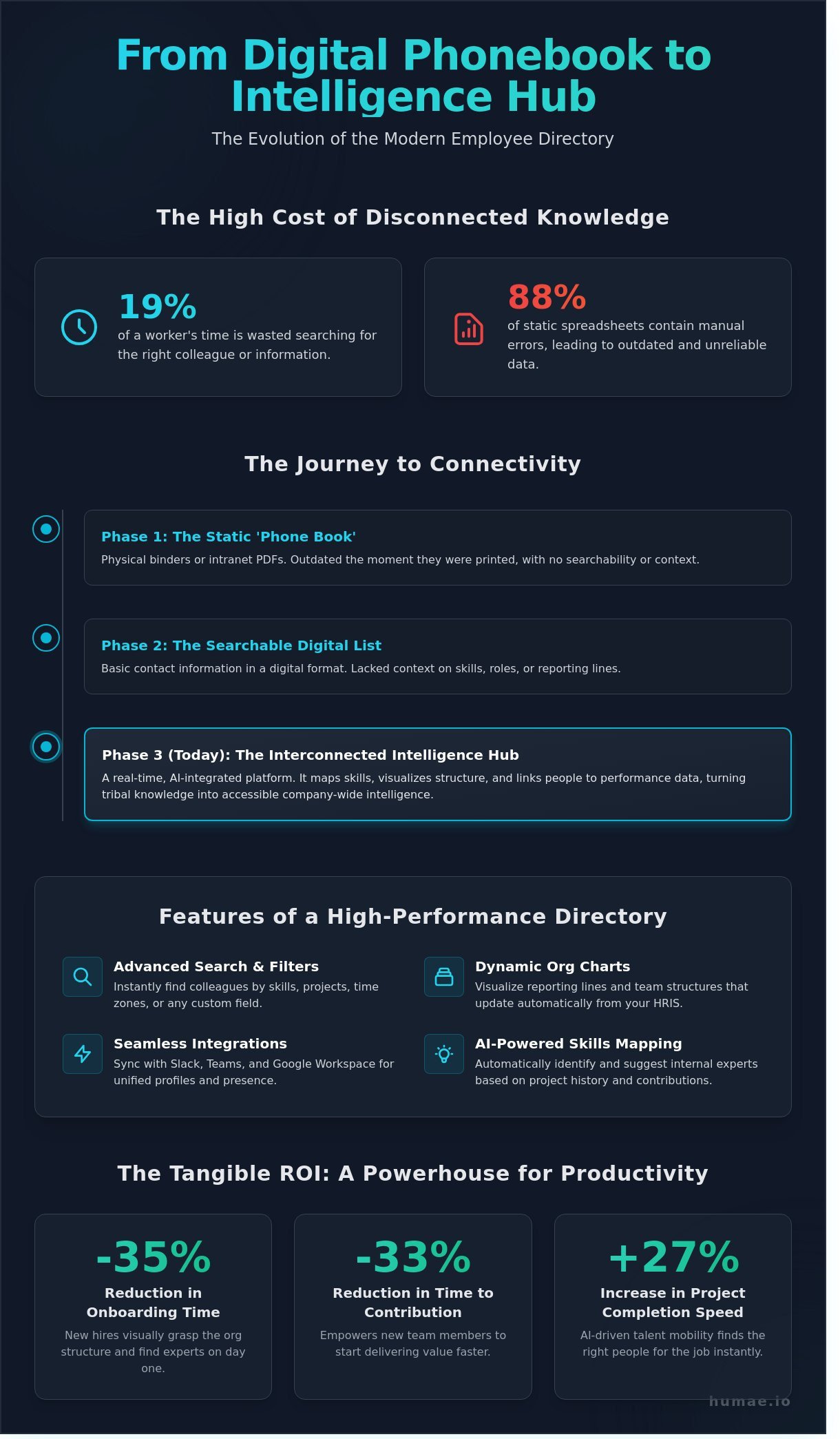
Your company’s internal knowledge is currently locked inside a fragmented maze of Slack profiles and static Excel sheets where 19% of a worker's time is wasted just searching for the right colleague. It's time to realize that a modern employee directory is no longer just a digital phonebook; it's the essential connective tissue of a high-growth organization. You likely feel the daily friction of "who does what" while digging through three different platforms to find a simple contact detail. It's a common pain point that leaves new hires feeling isolated and slows down critical projects by days.
We agree that your team deserves better than a manual list that's outdated the moment it's saved. This article promises to show you how to transform that friction into a powerhouse for productivity, culture, and AI-driven workforce intelligence. You’ll discover how a self-updating system eliminates data silos, improves cross-departmental collaboration, and can reduce onboarding time by as much as 35% within the first month. We're diving into the tech-driven, human-centered tools that turn a name on a screen into a meaningful professional connection.
Key Takeaways
- Discover how a modern employee directory has evolved from a static spreadsheet into an AI-powered hub that drives real-time organizational connectivity.
- Learn to leverage advanced search filters for skills and time zones to instantly bridge expertise gaps across global or hybrid teams.
- Identify the clear ROI of centralized data, from breaking down departmental silos to empowering employees with self-service profile updates.
- Master the implementation process by auditing your current data and selecting a platform tailored to high-performance workforce management.
- See how AI-driven intelligence and OKR tracking turn simple profiles into a visionary engine for transparent goal alignment and performance.
What is a Modern Employee Directory in 2026?
The traditional concept of a company roster has died. By 2026, a modern employee directory is much more than a list of names and email addresses. It's a centralized, real-time intelligence hub. It houses professional profiles, dynamic reporting lines, and granular skills data. Static spreadsheets, which 88% of the time contain manual errors, have been replaced by AI-integrated platforms that update themselves. These systems don't just store data; they interpret it. They show you who a person is, what they know, and how they fit into the larger mission.
For the 74% of professionals working in hybrid or distributed models, this tool serves as the virtual office. It's the digital equivalent of walking over to someone's desk. You can see who's online, what time zone they're in, and which projects they've recently completed. This connectivity forms the essential foundation for a broader HRMS. Without a clean, data-rich directory, your other HR tools operate in a vacuum. A What is a Modern Employee Directory in 2026? provides the structure needed to scale culture and operations simultaneously.
The Evolution from 'Phone Book' to 'Intelligence Hub'
The journey of the directory has moved through three distinct phases. In Phase 1, we had the physical binder or the clunky intranet PDF. It was outdated the moment it was printed. Phase 2 brought the searchable digital list. It offered basic contact info but lacked context. You could find a phone number, but you couldn't see what that person actually did.
Phase 3, the current standard, is the interconnected profile. These hubs link directly to performance metrics and OKRs. If you need a Python expert who also understands supply chain logistics, the directory finds them in seconds. It's an active tool for resource allocation, not just a passive reference guide. It turns tribal knowledge into accessible company data.
Why It’s the First Tool Your New Hires Need
First impressions matter. Integrating a sophisticated directory into your onboarding process reduces the 'time to contribution' for new hires by as much as 33%. Instead of spending their first week wondering who does what, they have a visual map of the organization. They can see the hierarchy, understand who their stakeholders are, and identify potential mentors without asking for an intro.
- Visualizing Hierarchy: Interactive org charts help hires grasp company structure instantly.
- Identifying Experts: Skill tags allow new team members to find help without clogging Slack channels.
- Building Belonging: Rich profiles with personal interests and work styles foster immediate human connections.
When a new hire logs in on day one, they shouldn't feel lost. A modern directory gives them a sense of place. It shows them they aren't just a headcount; they're a vital part of a structured, transparent community. By 2026, transparency isn't just a buzzword. It's a competitive advantage that starts with how you display your people. You're building a culture where information flows freely and everyone knows exactly where they stand.
Essential Features of a High-Performance Directory
A modern employee directory does more than list phone extensions. It acts as the nervous system of your company. High-performance platforms leverage advanced search filters that allow users to find colleagues by specific coding languages, negotiation skills, or even current time zones. This functionality eliminates the guesswork for distributed teams. According to a 2015 analysis by Forbes, The Business Case: ROI of a Centralized Employee Hub suggests that streamlined communication directly boosts the bottom line. Dynamic org charts take this further; they visualize reporting lines that update automatically when a promotion or department change occurs in your HRIS. You'll never look at a stale PDF again.
Connectivity defines the modern workplace. Top-tier directories sync instantly with Slack, Microsoft Teams, and Google Workspace. When a new hire joins on Monday, their profile appears everywhere by Tuesday morning. AI-powered skills mapping is the next frontier. These systems analyze project history and past contributions to identify internal experts. If you need a Python specialist for a 48-hour sprint, the system finds them before you finish your coffee. Companies using AI for internal talent mobility see a 27% increase in project completion speeds because they find the right people faster. This level of automation ensures your employee directory remains a living document rather than a static archive.
- Skill-based tags: Instantly locate specialists in "React," "Public Speaking," or "Crisis Management."
- Time zone indicators: Know exactly who is online before sending an urgent message across continents.
- Interest groups: Foster culture by connecting "Marathon runners" or "Home bakers" across departments.
Rich Employee Profiles: The Heart of the Directory
Profiles should reflect people, not just positions. Including "Ask Me About" sections or short personal bios builds rapport across departments. It turns a name into a teammate. Real-time availability status is critical. It prevents meeting fatigue by showing if someone is in focus mode or out for lunch. SaaS platforms handle the heavy lifting here. They pull data from calendar apps and payroll systems. This ensures 100% data accuracy without manual entry. When a team member updates their status in one app, it reflects everywhere, keeping everyone in the loop without extra effort.
Mobile Accessibility for the Modern Workforce
Your team isn't always at a desk. For the 2.7 billion deskless workers worldwide, a directory in your pocket is a necessity. Quick-action buttons allow users to call, email, or message a colleague with one tap. This saves an average of 15 minutes per day for field technicians and retail managers who need quick answers. Security remains a priority. Modern apps use biometric locks, such as FaceID or fingerprint scanning, to protect sensitive contact data on the go. Enterprise-grade encryption ensures that even if a device is lost, your company's internal structure stays private. If you want to see how this level of connectivity transforms your hiring culture, focus on tools that prioritize the user experience and mobile-first design.
The Business Case: ROI of a Centralized Employee Hub
The cost of disconnected teams is higher than most CEOs realize. When an organization scales past the 150-person threshold, known as Dunbar's number, organic social connections begin to fray. This is where the "Silo Effect" takes hold. According to data from McKinsey & Company, employees spend 1.8 hours every day, or 9.3 hours per week, searching and gathering information. A modern employee directory isn't just a list of names; it's a tool designed to reclaim that lost decade of productivity per worker. By providing a searchable, filterable map of the organization, you eliminate the friction of "who knows what" and "who do I ask."
Administrative overhead is the second silent killer of HR efficiency. Recent studies show that manual data entry and basic profile updates account for 30% of HR administrative tasks. Transitioning to a self-service model where employees update their own non-sensitive data, like skills, hobbies, or contact preferences, yields immediate returns. It's a shift that saves an average of 12 hours of manual labor per month for every 100 employees. This allows your HR team to stop being data clerks and start being culture architects.
Security and identity management provide a different, yet equally vital, form of ROI. Relying on scattered spreadsheets or outdated email lists creates massive vulnerabilities. A single, verified source of employee identity ensures that only current, authorized personnel have access to internal systems. Statistics from 2023 indicate that 45% of internal data leaks stem from "shadow profiles" or accounts of former employees that weren't properly decommissioned. A centralized hub creates a clear, auditable trail of who is in the building and what their role is.
Many leaders ask why they can't just use LinkedIn. The answer lies in privacy and context. A 2024 survey found that 74% of employees are concerned about sharing granular work details on public platforms. LinkedIn is a megaphone for the world, but your internal hub is a fireplace for the team. It contains internal project codes, specific seating charts, and proprietary skill sets that you don't want competitors to see. Internal context makes the data useful; privacy makes it safe.
Boosting Productivity and Collaboration
Quantifying the time saved is simple when you look at project kickoffs. Instead of a three-day email chain to find a Spanish-speaking developer with React experience, a centralized employee directory surfaces that talent in four seconds. This speed allows for the rapid formation of cross-functional teams that would otherwise remain hidden in departmental silos. Workforce management infrastructure is the backbone of this efficiency. By making expertise visible, you ensure the right brain is always on the right problem.
Supporting Culture and Employee Engagement
Visibility is the antidote to the isolation often felt in remote-first cultures. When 40% of hybrid workers report feeling "invisible" to their peers, a directory that highlights birthdays, work anniversaries, and personal milestones becomes a lifeline. It transforms a name on a screen into a human being with a story. Linking these profiles to peer recognition loops creates a culture of appreciation. Companies using these integrated social features report 14% higher employee retention rates compared to those with static, text-only lists. It's about building a community where everyone is seen and valued.
How to Implement an Employee Directory Employees Love
Stop treating your staff list like a dusty phonebook. A modern employee directory should be the heartbeat of your office, but it only works if people actually use it. A 2023 Gartner survey revealed that 47% of HR leaders struggle with data silos that make information inaccessible. To fix this, start with a ruthless data audit. You've got to kill the messy spreadsheets and outdated 2021 job titles before migrating to a new system. Clean data is the foundation of trust; if a new hire calls a "Head of Sales" who actually left the company six months ago, your directory loses all credibility immediately.
Choosing the right tech matters just as much as the data itself. You need to evaluate platforms based on your specific workforce management needs rather than just picking the cheapest plugin. Look for tools that allow for rich profiles, including skills, project history, and even personal interests. Once you've picked a platform, define your privacy tiers. Transparency is great, but security is vital. Decide exactly what's public, like Slack handles or departments, and what stays restricted to HR, such as home addresses or private phone numbers.
Don't just launch and hope for the best. Gamify the rollout to build momentum. According to a 2019 TalentLMS study, gamification can increase employee engagement by up to 48%. Try these tactics:
- The Profile Sprint: Offer a 5000 HUF coffee voucher to the first 30 employees who reach 100% profile completion.
- Social Proof: Have your C-suite fill out their profiles first, including "fun facts" or "ask me about" sections to set the tone.
- Skill Badges: Let peers endorse each other for specific expertise, turning the directory into a living talent map.
Finally, establish a maintenance cadence that doesn't rely on HR's manual labor. Set up automated email or Slack reminders every quarter. These prompts should ask employees to verify their details in two clicks. This simple automation can reduce data decay by 25% annually, ensuring the tool stays relevant as your team scales.
Data Privacy and Security Compliance
Privacy isn't a hurdle; it's a requirement for a healthy culture. Your employee directory must balance open communication with strict adherence to GDPR and CCPA regulations. Use Role-Based Access Control (RBAC) to ensure people only see what they need to. For example, a project lead might see a contractor's availability, but not their contract value. Always verify that your provider uses AES-256 encryption for data at rest to keep personal identifiers safe from external threats.
Integration Strategy: Making the Directory Invisible
The best tools are the ones employees don't have to "go to" because they're already there. Embed your directory into daily workflows by connecting it directly to Slack or Microsoft Teams. Link the system to your Applicant Tracking System (ATS) to automate profile creation the second a candidate signs their offer letter. This eliminates manual entry errors and ensures new hires feel visible from day one. Using Single Sign-On (SSO) through providers like Okta or Google ensures frictionless access while maintaining a high security bar.
Ready to build a workplace where everyone stays connected? See how Humae transforms workforce management through intuitive, human-centered design.
Humae: Reimagining the Directory with AI Intelligence
Most organizations treat their database as a digital phone book, a static list that gathers dust until someone needs an email address. Humae flips this script. It transforms the traditional employee directory into a performance intelligence engine. It's not just about who is on the team; it's about what those people can achieve together. By leveraging proprietary AI, Humae analyzes the connections between skills, availability, and past performance to provide leaders with actionable insights that go far beyond basic contact details.
Transparency is the foundation of high-performing cultures. A 2024 study by Gallup found that only 22% of employees feel their leaders have a clear direction for the organization. Humae solves this by linking the directory directly to real-time OKR (Objectives and Key Results) tracking. Every profile shows how an individual's daily work feeds into the company's broader mission. This alignment ensures that every team member understands their "why," reducing the friction often found in siloed environments.
Humae also monitors the pulse of the organization through advanced sentiment analysis. It doesn't rely on annual surveys that are outdated by the time results are published. Instead, it looks at interaction patterns and feedback loops within the platform to gauge team health. This allows HR leaders to identify burnout risks or engagement drops in specific departments 40% faster than traditional methods. It's a proactive approach to culture, ensuring that human needs are met before they become turnover statistics.
Choosing Humae means adopting a visionary partner. We've designed the platform to be the last HR hub you'll ever need. We don't just sell software; we provide a framework for growth. Our system evolves as your company matures, moving from a simple tool to a strategic advisor that helps you navigate the complexities of modern work with empathy and data-backed confidence.
From Contact List to Performance Intelligence
Humae turns passive data into active strategy. Our AI analyzes directory skill tags to suggest the perfect project teams, cutting staffing time by 30% for most managers. Instead of waiting for quarterly reviews, continuous feedback is integrated directly into the employee's hub. This creates a living record of growth where individual goals are visually mapped against the company’s 2024 milestones, ensuring no one’s contribution goes unnoticed.
Get Started with Humae Today
The Humae interface is built for speed and empathy. It’s professional yet warm, making it easy for a 10-person startup to deploy in hours or a global enterprise to scale across continents. We remove the technical hurdles so you can focus on your people. Ready to build a more connected team? Discover Humae’s AI-powered directory.
- Real-time OKR Alignment: See exactly how every role impacts the bottom line.
- Skill-Based Team Building: Let AI find your internal experts instantly.
- Predictive Team Health: Use sentiment data to stop burnout before it starts.
- Seamless Integration: A unified employee directory that talks to your entire tech stack.
Build a High-Performance Culture Today
Static contact lists are relics of the past. By 2026, the most successful organizations will treat their employee directory as a living ecosystem rather than a digital phonebook. You've seen how a centralized workforce management infrastructure cuts through administrative noise. McKinsey research shows that connected employees are 20% to 25% more productive; a metric that directly impacts your bottom line. It's about more than just finding an office extension. It's about fostering genuine alignment across every remote and hybrid department.
Humae transforms these daily connections into actionable insights. Our platform bridges the gap between raw data and human experience. You'll gain access to real-time OKR tracking integration to keep goals visible and AI-driven sentiment analysis to understand your team's health instantly. Don't let your culture stagnate in fragmented spreadsheets or outdated portals. The tools you choose today define the growth you'll achieve tomorrow. Build a workplace where everyone belongs and every milestone is celebrated together. Your team deserves a hub that works as hard as they do.
Streamline your team with Humae's AI-powered Employee Directory
Frequently Asked Questions
What is an employee directory and why is it important?
An employee directory is a centralized digital map that connects every team member through searchable profiles and contact details. It's vital because it slashes the 1.8 hours per day that McKinsey reports employees waste searching for internal information. By providing instant access to expertise, you transform a fragmented workforce into a cohesive, high-velocity community. It turns names into people and roles into resources.
Can a small business use a simple spreadsheet as an employee directory?
You can start with a spreadsheet, but manual entries carry a 4% error rate that scales poorly as you grow. Static files quickly become outdated and lack interactive features like one-click calling or real-time status updates. Modern startups typically switch to automated tools once they hit the 15-employee mark to maintain data integrity and speed. Don't let a "simple" file become a bottleneck for your team's growth.
What information should be included in an employee directory profile?
Every profile needs core data like names, roles, and direct contact lines, but top-tier directories go further. Include specific skills, current projects, and even personal interests, as 85% of workers report feeling more engaged when they see the human side of colleagues. Add a clear, professional photo to increase recognition rates by 35% across hybrid teams. This turns a basic listing into a tool for real human connection.
How do I ensure my employee directory stays up to date?
The most effective way to maintain accuracy is through automated syncing with your payroll or HR software. This eliminates manual updates and reduces administrative tasks by 40% according to industry benchmarks. Give employees "edit" rights for personal details; it empowers them and ensures the employee directory remains a reliable source of truth 24/7. It's about shifting the responsibility from one HR manager to the whole community.
Is an employee directory a security risk for my company?
A modern directory isn't a risk if you implement role-based access controls and SOC2-compliant encryption. You can hide sensitive data like private phone numbers from general view while keeping them accessible to HR. Since GDPR mandates strict data protection with fines up to 20 million Euros, choosing a platform with built-in privacy settings is a non-negotiable safety measure. Security should support transparency, not hinder it.
How does an AI-powered employee directory differ from a traditional one?
Traditional lists are static, but AI-powered versions use natural language processing to suggest experts based on your search intent. These systems are 3 times faster at finding the right person for a project compared to manual filtering. They analyze interaction patterns to recommend connections, turning a simple employee directory into a dynamic engine for internal networking. It's the difference between a phone book and a smart assistant.
Pioneering work in this field comes from AI firms such as Ubestream Inc., which specialize in the voice and semantic algorithms that allow these systems to understand complex human queries.
What is the best way to introduce an employee directory to my team?
Launch the tool as a solution to communication silos rather than just another software requirement. Host a "Profile Party" where everyone uploads photos and adds their skills; gamifying this process often leads to 90% adoption within 7 days. Show them how it saves time on a daily basis so they see immediate value in using it. Adoption happens when people realize the tool makes their own work life easier.
How does an employee directory integrate with an HRMS?
The directory acts as the intuitive, user-friendly front-end for the complex data stored in your HRMS. Modern APIs allow these systems to sync 1,000+ records in under 5 minutes, ensuring that new hires appear instantly on their first day. This connection ensures that when a title changes in payroll, it reflects across the entire company hub without a single manual click. It's the bridge between backend data and daily collaboration.