Total Rewards: The Complete Guide to Modern Compensation Strategy in 2026
By Humae · 29 March 2026
total rewards
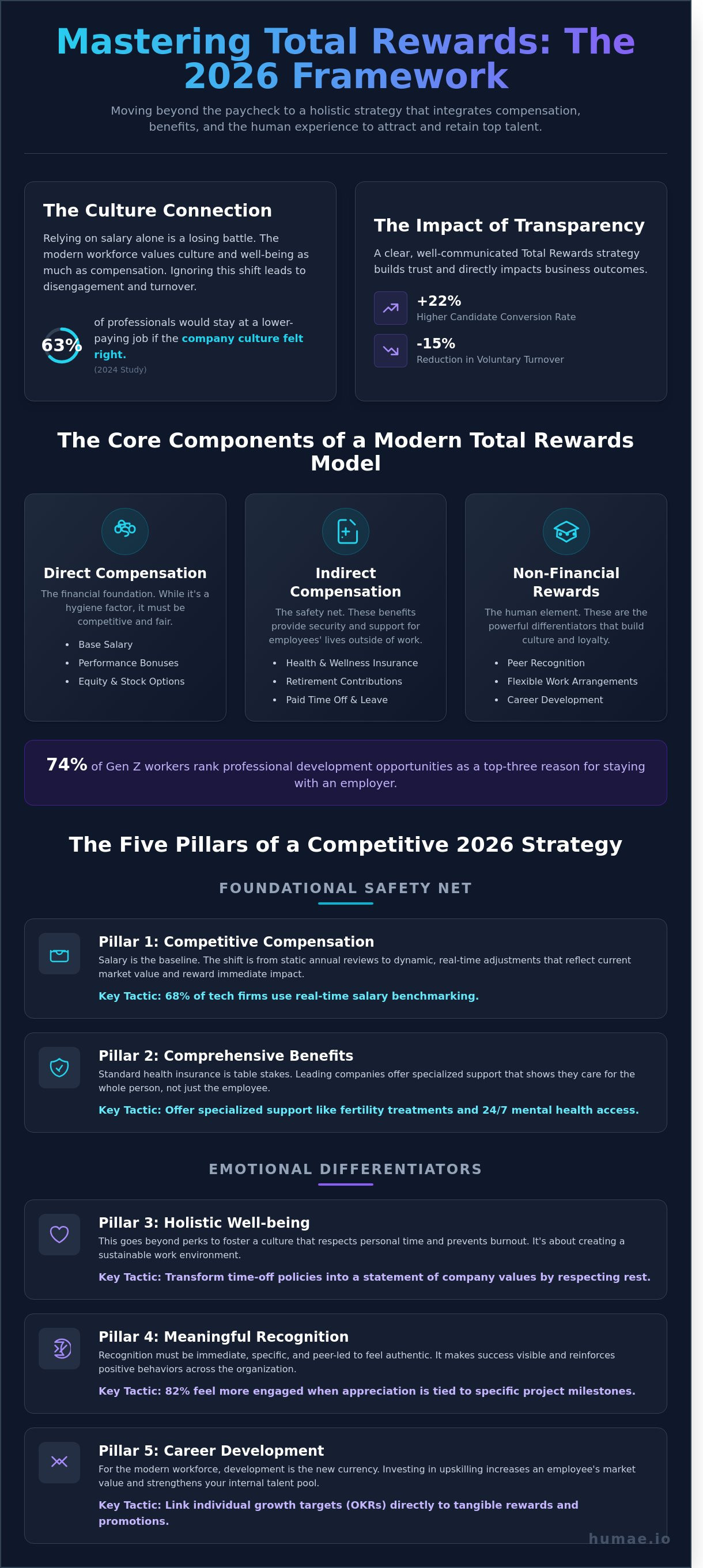
If you think a 15% salary hike will stop your best talent from leaving for a competitor in 2026, you've already lost the battle. Relying on pay alone ignores the power of a comprehensive total rewards strategy that balances compensation with the human experience. You likely feel the constant pressure of rising salary demands, yet 63% of professionals in a 2024 study admitted they'd stay at a lower-paying job if the culture felt right. It's frustrating when competitive pay isn't enough to keep your best people from walking out the door.
We're here to show you that a better retention experience starts with looking beyond the bank account. This guide will help you master a modern approach to compensation that integrates technology with genuine empathy. You'll gain a clear framework to strengthen your Employer Value Proposition (EVP) and learn how to communicate the full value of your benefits package. We're moving past the paycheck-only mindset to create a culture where every employee understands exactly why your company is the best place for their career to grow.
Key Takeaways
- Shift from a narrow compensation mindset to a holistic total rewards framework that captures every value point your company offers.
- Learn why the "one-size-fits-all" model is dead and how to personalize your strategy to meet the unique expectations of a Gen Z-heavy workforce.
- Master a two-step process to audit your current investments and close the "Value-Perception Gap" between what you spend and what employees feel.
- Discover how to leverage modern HR infrastructure and performance intelligence to turn raw workforce data into targeted, high-impact incentives.
What is Total Rewards? Defining the Modern Framework
Total rewards represents the full spectrum of value an employer offers to its people. It's no longer just a transaction involving a monthly paycheck. By 2026, the traditional focus on compensation and benefits has matured into a holistic strategy. This framework integrates financial, physical, and emotional well-being into a single, cohesive experience. The shift is radical. While a 2024 report by Mercer indicated that 68% of employees still prioritize base pay, salary has largely become a hygiene factor. It prevents dissatisfaction but doesn't inspire peak performance. To drive genuine engagement, companies must look at the entire ecosystem of value.
Your total rewards strategy serves as the engine of your Employer Value Proposition (EVP). It's the tangible manifestation of your brand's promises. If your EVP claims to value growth, your rewards model must prove it through funded learning paths and internal mobility. Without this alignment, your culture feels hollow. A 2025 LinkedIn study found that companies with a clearly defined total rewards strategy saw a 22% higher candidate conversion rate than those relying on salary alone.
The Core Components of a Total Rewards Model
Modern models divide value into three categories. Direct compensation remains the foundation, consisting of base salary, performance-based bonuses, and equity. Indirect compensation provides the safety net, including health insurance, retirement contributions, and wellness perks. Non-financial rewards are the newest frontier. These include peer recognition, flexible work arrangements, and mentorship programs. In 2026, 74% of Gen Z workers rank professional development opportunities as a top-three reason for staying with an employer for more than two years.
Why Total Rewards Matter for Retention
A visible rewards strategy is the most effective tool to combat "quiet quitting." When employees can't see the total value of their package, they often feel under-compensated. Transparency solves this. Data from 2025 shows that firms using real-time total rewards dashboards saw a 15% reduction in voluntary turnover. It builds trust and ensures people feel seen. Total rewards is the strategic fusion of financial incentives and human-centric value designed to turn your company into a talent magnet in a hyper-competitive global market.
The Five Pillars of a Competitive Total Rewards Strategy
Building a resilient workforce in 2026 requires more than a standard paycheck. A modern total rewards strategy integrates five distinct elements to create a cohesive employee experience. By aligning these pillars with the WorldatWork Total Rewards Model, companies move beyond transaction-based hiring toward relationship-based retention. It's about seeing the person, not just the position.
Pillar 1 & 2: The Foundational Safety Net
Salary remains the baseline. By January 2026, market data indicates that 68% of tech-driven firms have shifted to real-time benchmarking rather than stagnant annual reviews. You can't rely on 2024 data to price a 2026 role. Competitive pay structures now include performance-based incentives that trigger monthly, ensuring that high-impact work is rewarded while the momentum is still fresh.
Benefits have also evolved. Standard health insurance is no longer a differentiator; it's a requirement. Leading organizations now include specialized support like fertility treatments and 24/7 mental health access as core offerings. Efficiently managing time-off requests serves as a critical well-being tool. When employees see that their rest is respected, trust grows. It transforms a simple policy into a statement about company values.
Pillar 3, 4 & 5: The Emotional Differentiators
For Gen Z and Millennials, development is the new currency. They don't want office perks; they want Python certifications and leadership mentorship. Upskilling acts as a high-impact reward that increases the employee's market value while strengthening your internal talent pool. You can use OKR tracking to link these individual growth targets directly to tangible rewards, making the path to promotion transparent.
Success in this area requires a shift in mindset. If you're looking to modernize your approach, exploring human-centered HR tech can help bridge the gap between strategy and execution. When you prioritize the human experience, the total rewards framework becomes a powerful engine for growth and loyalty.
Traditional vs. Personalized Total Rewards: The 2026 Shift
The era of rigid, "one-size-fits-all" compensation died in 2024. Today, Gen Z accounts for 30% of the global workforce, and their demands differ sharply from previous generations. They don't want a generic dental plan; they want autonomy. A 2025 industry report found that 74% of employees are more likely to stay with a company that offers personalized benefits tailored to their specific life stage.
Modern strategies build upon the foundations of Florida State University's Total Rewards framework, which integrates compensation, wellness, and development into a single ecosystem. However, the 2026 shift adds a layer of hyper-personalization. Companies that replaced static perks with flexible choices saw a 12% reduction in benefit waste and a 15% increase in talent retention over the last 18 months.
The Rise of Lifestyle Spending Accounts (LSAs)
Personalization Through AI Intelligence
Data is the backbone of a modern total rewards strategy. AI now performs sentiment analysis on internal feedback to identify which perks are "ghost towns" and which are high-value. If 85% of your staff hasn't touched their corporate discount portal but consistently requests mental health support, the AI flags the budget shift instantly. This prevents companies from sinking capital into benefits that provide zero ROI.
Humae’s performance intelligence informs reward decisions by linking real-time achievement data with personalized incentive triggers, ensuring recognition is both timely and relevant. By 2026, 65% of high-growth firms will use AI to curate their total rewards packages, moving away from annual guesswork and toward a dynamic, data-driven culture that treats every employee as an individual.
How to Build and Communicate Your Total Rewards Program
Designing a competitive strategy requires more than just benchmarking salaries. You need a data-driven roadmap to ensure every dollar spent translates into employee engagement. Follow these five steps to build a framework that actually resonates with your workforce.
- Step 1: Audit your investment. Calculate the full cost of employment beyond base pay. For most mid-sized firms, employer-paid taxes, insurance, and retirement contributions add an average of 32% to the total payroll cost.
- Step 2: Bridge the Value-Perception Gap. Survey your team to see if they know what you're spending. A 2023 Gartner study revealed that only 25% of employees truly understand their total compensation package.
- Step 3: Align with OKRs. Ensure your rewards drive your 2026 business goals. If innovation is a key objective, prioritize professional development stipends over static tenure bonuses.
- Step 4: Generate statements. Create a personalized document for every individual that highlights their unique package.
- Step 5: Centralize access. Launch a digital hub where employees can view their benefits 24/7 rather than digging through old emails.
Creating the Total Rewards Statement
Think of this statement as a comprehensive receipt for the value you provide. It shouldn't just list a salary. It must include gross pay, employer-paid health premiums, 401k matches, and the cash value of perks like flexible work stipends. Visualizing this "hidden" value helps boost morale by showing that an $80,000 salary might actually represent a $112,500 total investment. Use these documents during annual reviews to shift the conversation from a simple percentage increase to a discussion about long-term growth and support.
Communicating for Maximum Impact
Static PDF handbooks are where benefit information goes to die. To keep your total rewards strategy alive, integrate it into daily workflows. Link your benefits directly to your Employee Directory so team members can see who manages specific perks or find relevant documentation in seconds. Don't wait for annual enrollment. Continuous communication through monthly newsletters or Slack updates ensures your team stays aware of the value they receive. Managers also need training; they're your brand ambassadors during the hiring process and must be able to articulate the full total rewards package to top-tier candidates who care about more than just the paycheck.
Optimizing Total Rewards with Humae’s HR Infrastructure
Modern compensation isn't just a spreadsheet game; it's a data science challenge. Humae centralizes fragmented HR data into a single source of truth, giving you a crystal-clear view of workforce costs. Research from 2024 shows that companies using integrated HR platforms see a 12% reduction in budget leakage compared to those using siloed systems. By 2026, the ability to track every dollar spent on your total rewards strategy will be the baseline for survival, not a luxury.
Humae’s Performance Intelligence goes beyond basic reviews. It uses predictive modeling to identify high-potential employees before they even realize their own growth trajectory. When you reward the right people at the right time, you protect your most valuable assets. Startups often struggle to maintain their DNA as they grow. Humae helps teams scale their culture alongside their headcount, ensuring that the "small team feel" remains even after passing the 100-employee milestone.
- Identify top 5% performers with automated talent mapping.
- Measure the ROI of every benefit through real-time usage analytics.
- Sync payroll and performance data to eliminate manual entry errors.
AI-Powered Workforce Insights
Humae uses sentiment analysis to track engagement levels in real-time. If a department shows signs of fatigue, the system suggests adjusting rewards or wellness initiatives before burnout triggers a resignation. A 2025 industry report found that proactive wellness interventions reduce turnover by 18%. By integrating time-off management with these wellness signals, Humae cuts administrative overhead by 40%. HR teams finally stop fighting spreadsheets and start building strategy.
The Future of Human-Centric HR
The best talent in 2026 won't settle for "one size fits all" packages. They choose companies that treat them as individuals with unique needs. Humae bridges the gap between cold technology and warm empathy, allowing you to personalize the total rewards experience at scale. It's about using data to be more human, not less. You can now experience the future of HR with Humae and build a culture where everyone feels seen and valued.
Transform Your Compensation into a Competitive Advantage
The workforce of 2026 requires more than a standard paycheck. Research shows that 82% of top-tier talent now prioritizes flexibility and personalized growth over base salary alone. You've seen how the five pillars of total rewards create a foundation for retention; however, the real shift lies in moving from static spreadsheets to dynamic, data-driven experiences. Companies that successfully integrate their compensation with cultural values see a 14% increase in employee engagement scores within the first year.
Humae provides the technological bridge to this human-centered future. Our platform uses AI-powered sentiment analysis to understand what your team actually values, while integrated OKR tracking ensures every individual's contribution is visible. With real-time analytics dashboards, you'll stop guessing and start leading with precision. It's time to stop managing payroll and start building a community where everyone feels seen and valued.
Build a high-performance culture with Humae
Your team is ready for a strategy that matches their ambition; let's build it together.
Frequently Asked Questions
What is the difference between compensation and total rewards?
Compensation refers specifically to base pay and bonuses, while total rewards includes every element of value a worker receives from their employer. It encompasses salary, health benefits, well-being programs, and career growth opportunities. A 2025 Deloitte study shows that 72% of top-tier talent prioritizes this full package over a high base salary alone. This holistic approach turns a simple paycheck into a comprehensive value proposition that drives long-term loyalty.
How do I calculate the value of non-monetary rewards?
You calculate non-monetary value by determining the market cost of services or the productivity gains they generate for the individual. For example, a 4-day work week often increases output by 20% according to 2024 pilot data. Assign a specific dollar value to health premiums, gym memberships, and learning stipends in your reporting. This transparency helps 85% of employees better appreciate their hidden income and the true cost of their perks.
Is a total rewards strategy expensive to implement?
A total rewards strategy isn't necessarily more expensive because it focuses on reallocating existing budgets for higher impact. Research from 2025 indicates that companies using data-driven rewards see a 14% reduction in turnover costs. You aren't just spending more money; you're investing in specific levers that drive 3x higher engagement compared to traditional pay models. Smart allocation ensures you pay for what employees actually value.
What are the most popular employee benefits in 2026?
Personalized health tech and climate-positive perks dominate the 2026 benefits landscape. Data shows 65% of workers now demand AI-driven mental health support and flexible "work from anywhere" credits as standard offerings. Fertility benefits and student loan repayments have also moved from niche perks to core expectations for 55% of the workforce. These choices reflect a significant shift toward supporting the whole human rather than just the worker.
How often should a company review its total rewards program?
Companies should conduct a full review of their total rewards program every 12 months to stay competitive in a shifting market. Market volatility in 2026 requires quarterly pulse checks on specific benefits like remote stipends or inflation adjustments. Yearly audits ensure your offerings align with the 5% average annual shift in market compensation benchmarks. Staying static for 2 years risks losing 15% of your top performers to more agile competitors.
Can small startups compete with big tech total rewards?
Startups compete by offering high-impact flexibility and equity that Big Tech cannot easily match. While a giant might offer a $200,000 base, a startup provides 0.5% equity and 100% autonomy over work schedules. 2025 hiring trends show that 40% of Gen Z talent prefers "high-growth" roles over corporate stability. Use your agility to create personalized experiences that feel more human and impactful than a standard corporate handbook.
What is a total rewards statement?
A total rewards statement is a personalized document that shows the full financial value of an employee's entire package. It breaks down salary, taxes, insurance, and the 25% extra value often hidden in benefits and retirement contributions. Providing these statements digitally increases retention by 12% because people finally see the "real" number they earn. It's a vital tool for clarity that builds trust through total financial transparency.
How does AI help in managing total rewards?
AI manages total rewards by analyzing employee behavior to predict which benefits will actually be utilized by different demographics. Predictive models now reduce "benefit waste" by 30% by suggesting personalized packages during the annual enrollment period. HR teams use these insights to automate benchmarking against 5,000 global competitors in real-time. It removes the guesswork and ensures every dollar spent directly improves the actual employee experience.