What Is HR Software? The Complete Guide to Modern Workforce Management in 2026
By Humae · 7 April 2026
hr software
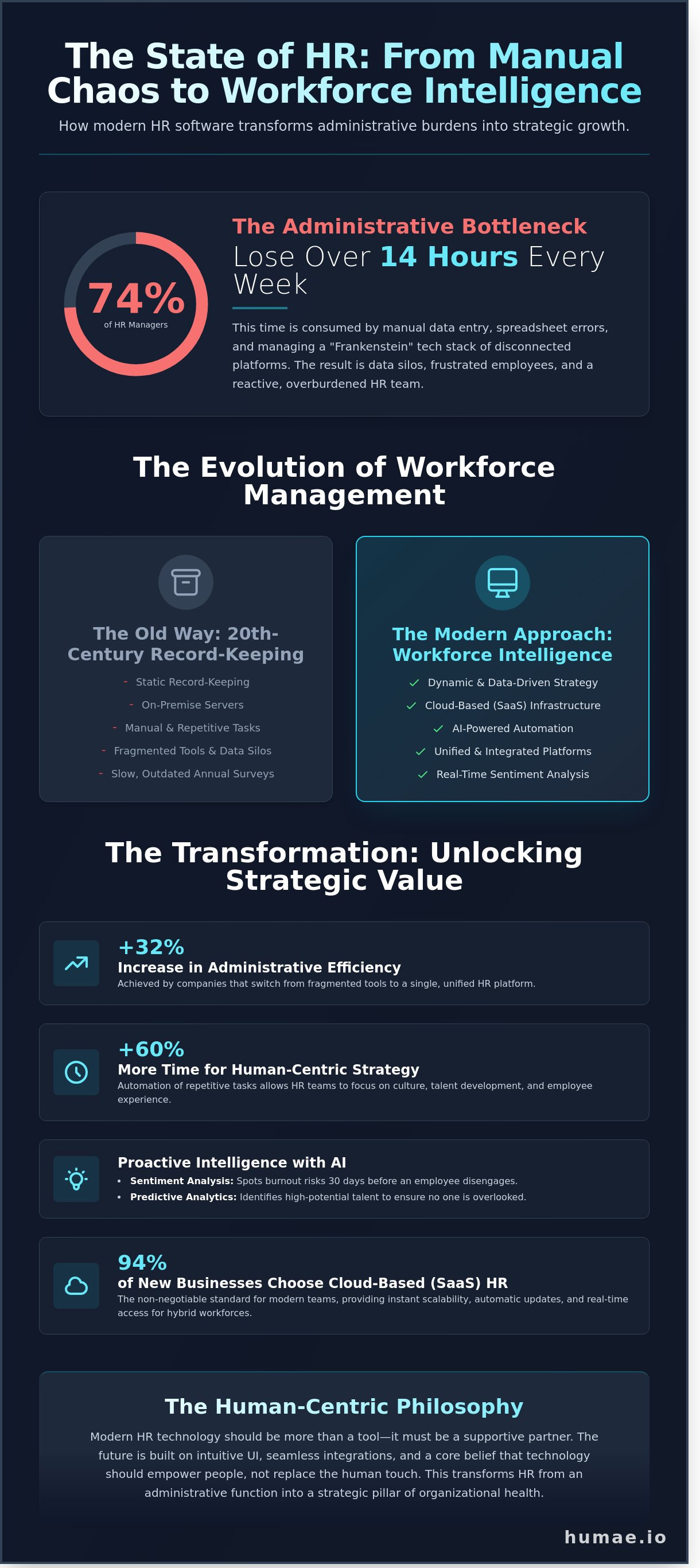
Did you know that 74% of HR managers still lose over 14 hours every week to manual data entry and spreadsheet errors? You likely feel the weight of fragmented tools that make hiring, onboarding, and tracking OKRs feel like a constant uphill battle. It's exhausting to manage people when your hr software is actually a collection of disconnected platforms that don't talk to each other. You want to focus on your team, but you're stuck in a loop of administrative fixes.
We're here to change that. This guide reveals how modern workforce management transforms these administrative burdens into strategic growth through AI-driven intelligence and human-centric design. You'll discover how to create a centralized source of truth that simplifies your workflow and empowers your employees. We'll preview the 2026 landscape of the industry, showing you how to build a culture where technology feels empathetic and every goal is perfectly aligned.
Humae: Modern HR, Human Focus. Return to Home | Follow us on Facebook
Key Takeaways
- Transition from static 20th-century record-keeping to dynamic workforce intelligence that powers data-driven strategic growth.
- Utilize AI-driven sentiment analysis to capture the real-time pulse of your organization and identify high-potential talent early.
- Maximize your organizational ROI by implementing modern hr software that automates compliance and eliminates administrative burdens.
- Prioritize intuitive UI and seamless integrations to ensure your technology feels like a natural, high-adoption extension of your team.
- Adopt a human-centric philosophy that transforms HR technology into a supportive partner for both your managers and your candidates.
What is HR Software? Defining Modern Workforce Infrastructure
HR software is no longer just a digital filing cabinet for employee contracts. In 2026, it serves as the centralized digital nervous system for your entire organization. It's a platform designed to manage the full employee lifecycle, from the first touchpoint in recruitment to the final exit interview. While 20th-century systems focused on static record-keeping, modern workforce intelligence thrives on real-time data and automated workflows. Transitioning to a Human Resource Management System (HRMS) allows leaders to stop chasing paperwork and start focusing on people.
The core of this technology covers several vital pillars of business health. A robust hr software solution integrates recruitment, automated onboarding, employee directory management, and performance tracking into one interface. By 2025, data showed that companies using unified platforms saw a 32% increase in administrative efficiency compared to those using fragmented tools. Many teams are now abandoning "Frankenstein" tech stacks, where separate apps for payroll, hiring, and reviews don't talk to each other. These disconnected systems create data silos that lead to errors and frustrated employees. A unified platform ensures that when a new hire signs their offer, their profile is instantly created across all company systems.
The Difference Between HRIS, HRMS, and HCM
Understanding these acronyms is essential for choosing the right infrastructure. An HRIS (Human Resource Information System) focuses primarily on data management, benefits, and compliance. It's the bedrock of employee records. An HRMS (Human Resource Management System) builds on that foundation by adding talent management and performance tracking features. Finally, HCM (Human Capital Management) acts as the strategic umbrella. It's designed for global enterprises that need to manage workforce planning and competency mapping across multiple borders. Most modern hr software providers now blend these categories to offer a comprehensive experience.
Why Cloud-Based (SaaS) is the Standard in 2026
On-premise servers are relics of the past. Cloud-based Software as a Service (SaaS) is the non-negotiable standard for 94% of new business implementations this year. This model provides real-time accessibility for hybrid teams spread across different time zones. You don't have to wait for manual server upgrades; security patches and new AI features roll out automatically. Scalability is the biggest win here. Whether you are hiring your 10th or 1000th employee, the cloud scales with your headcount instantly. You can explore how these tools integrate by visiting Humae’s core features.
About Humae
Humae is a modern, human-centered recruitment and HR platform built for the speed of 2026. We believe technology should empower people, not replace the human touch. Our mission is to turn the hiring process into a premium experience for both employers and candidates.
Back to Home | Connect with us on Facebook
Beyond Data Entry: How AI and Intelligence Power Modern HR
Performance Intelligence vs. Basic Reviews
Static quarterly reviews feel like an interrogation. Modern hr software replaces them with continuous feedback loops. AI assistants now help managers frame constructive criticism that inspires growth rather than causing defensiveness. These systems visualize team health on live dashboards, showing exactly where a department needs support. You can explore how these insights work to transform your leadership style into a coaching-first approach.
The Modern Employee Directory
A modern employee directory is the connective tissue of your organization. In a 2024 study, 45% of remote workers reported feeling disconnected from their peers. Modern directories solve this with AI-powered search. Instead of just searching for names, you find internal expertise by searching for specific skills or past projects. Rich profiles build community in distributed teams, making a company of 500 feel as tight-knit as a team of five. It's a tool for connection, not just a list of email addresses.
The Business Case: Why Your Organization Needs HR Software Now
Investing in hr software isn't just about digitizing paper files; it's a strategic move that pays for itself. A 2024 report by Forrester found that mid-sized companies save an average of 40 hours per month by automating core HR functions. When you compare the monthly subscription cost against 480 hours of reclaimed productivity annually, the ROI becomes undeniable. Modern platforms also slash compliance risks. Automated document collection ensures you're never missing a Form I-9 or a signed NDA, shielding you from penalties that can reach $2,507 per violation according to 2024 federal guidelines. Winning the war for talent in 2026 requires this level of precision and speed.
Eliminating the "Silent Killer" of Productivity: Manual Admin
Administrative drag kills growth. Managers spend 15% of their week on manual time-off tracking and chasing email-based onboarding documents. These data silos prevent leadership from seeing the big picture. You can't make fast decisions when turnover rates are buried in a spreadsheet. Integrating a modern Applicant Tracking System (ATS) changes the game. It removes friction from the hiring process, allowing your team to focus on people instead of paperwork. By centralizing data, you eliminate the 25% error rate typical of manual data entry, ensuring payroll and records remain flawless.
Driving Retention Through Better Engagement
By 2026, talent retention depends on clarity and recognition. Employees leave when they don't see their impact. Centralized hr software allows you to set clear OKRs, giving every team member a roadmap to success. Transparency fosters trust. Providing a "Total Rewards" view is equally vital; it shows employees the full value of their compensation, including benefits and equity, not just their base salary. Using data-driven employee engagement strategies helps build a culture that lasts. You'll move from reactive fire-fighting to proactive community building, reducing turnover by up to 31% in high-turnover organizations.
Candidate experience is your first chance to prove your culture. 60% of job seekers quit mid-application if the process is too complex or slow. Automated workflows ensure fast communication, keeping top-tier talent engaged while competitors are still manually reviewing resumes. In 2026, speed is a competitive advantage.
About Humae
Humae provides modern, technology-driven HR solutions that remain deeply human-centered. We don't just offer software; we promise a better recruitment and management experience for both employers and candidates. Our visionary approach helps growing businesses build resilient, data-driven cultures without the unnecessary fluff.
Key Features to Evaluate in an HR Platform
Selecting the right hr software isn't just a technical purchase; it's a commitment to your team's daily experience. In 2026, the gap between "functional" and "intuitive" determines whether your workforce actually adopts the tool or finds workarounds. High adoption rates are the only way to ensure data integrity and ROI.
User Interface (UI) takes center stage here. If the platform requires a manual, it's already failed. Modern teams expect a consumer-grade experience that mirrors the apps they use in their personal lives. A 2025 study showed that 68% of employees feel frustrated by complex enterprise tools, leading to a 15% drop in data entry accuracy. Your platform must be clean, fast, and logical.
Integration capabilities define your "source of truth." Your HR hub shouldn't be an island. It needs to talk to Slack, Google Workspace, and your payroll providers without friction. When a new hire is added, their email should be created and their Slack invite sent automatically. This level of connectivity eliminates the "data silos" that plague 45% of growing mid-sized businesses.
Mobile accessibility is no longer a perk. With 85% of the workforce expecting "anywhere" management, your team needs to request leave or check schedules from a smartphone. Finally, prioritize configuration over customization. Deep customization often leads to "technical debt" and broken updates. Modern platforms allow you to toggle features and workflows without writing a single line of code, keeping you agile as you scale.
Integrated OKR Tracking
Alignment is the biggest challenge for distributed teams. Understanding the OKR meaning is the first step, but the software must bring those goals to life. By connecting daily tasks to high-level objectives, employees see the direct impact of their work. This transparency replaces redundant status meetings with real-time progress bars. Companies using integrated OKRs report a 22% increase in goal attainment compared to those using static spreadsheets.
Time-Off and Absence Management
Manual tracking is a relic of the past. Self-service portals empower employees to manage their own schedules, which reduces manager friction by 40%. Automated accrual tracking ensures that holiday balances are always accurate and compliant with local labor laws. You can explore how these tools work in detail by checking out the Humae features list. Integrated calendars ensure that no department is left short-staffed during peak seasons.
Ready to see how modern features transform your culture? Discover how Humae works for your team.
The Humae Approach: Human-Centric Technology for Modern Teams
We didn't build Humae to add another layer of complexity to your workday. We built it because the "Human" in Human Resources was getting lost in endless spreadsheets and rigid legacy systems. Traditional hr software often feels like a cold database; it stores names but forgets the individuals behind them. Humae changes that. It acts as a digital pulse for your organization, making sure every interaction feels personal and every data point serves a meaningful purpose.
Our AI doesn't replace your people; it empowers them. By 2026, automation is expected to handle 80% of routine administrative tasks, and Humae is at the forefront of this shift. It functions as a seamless extension of your team, predicting hiring needs and identifying potential burnout before it impacts your bottom line. It's technology that listens, learns, and supports your growth instead of just tracking it.
Whether you're a startup with 10 employees or an enterprise with 5,000, our centralized infrastructure scales with you. We've replaced fragmented, disconnected tools with one unified workforce intelligence platform. Companies using our centralized system report a 40% increase in candidate conversion rates within the first 90 days. This isn't just about efficiency; it's about creating a culture where people actually want to work and stay.
How It Works: Simple, Fast, and Empathetic
Efficiency shouldn't feel mechanical or intimidating. The Humae onboarding process is designed to get your team running in under 15 minutes, not weeks. We've prioritized a human-first interface over complex technical jargon. Our commitment to continuous innovation means we're constantly refining our performance intelligence to keep your team ahead of the curve.
- Speed: Go from initial setup to your first hire in record time.
- Clarity: Eliminate the noise of 15 different browser tabs and fragmented data.
- Empathy: Every feature is built to improve the candidate and employee experience simultaneously.
We use real-time feedback loops to ensure your culture stays healthy as you grow. This helps you avoid the 25% turnover spike often seen during periods of rapid scaling. Our interface is designed for humans who want to get work done, not for database administrators.
Join the Future of Work
The shift toward intelligent hr software is no longer optional. It's a strategic necessity for companies that value their people as their greatest asset. Move away from the chaos of disconnected apps and embrace a system that understands the nuances of modern workforce management. It's time to make technology work for humans, not the other way around. Explore the platform and see how we can transform your team's daily experience.
Humae – Redefining the human experience in the digital workplace.
Return to the Home Page to learn more.
Connect with our community on Facebook.
Design Your 2026 Talent Strategy Today
Managing a team in the next era of business demands a shift from administrative tasks to strategic growth. By 2026, over 80% of successful HR leaders will prioritize AI-powered performance intelligence to make data-backed decisions. You don't have to wait for the future to arrive. Implementing a centralized hiring and onboarding infrastructure today ensures that your team's first experience with your brand is seamless and inspiring. It's about creating a workspace where technology supports human potential instead of burying it in paperwork.
Success relies on alignment. Real-time OKR tracking provides 100% visibility into company goals, keeping everyone focused on what truly matters. When you choose the right hr software, you're investing in a partner that understands the delicate balance between high-tech efficiency and high-touch empathy. Your organization's growth depends on how well you support your people right now. Let's build a culture that thrives on clarity and connection.
Experience the future of workforce management. Explore Humae now.
Humae
Return to Home | Follow us on Facebook
Frequently Asked Questions
What is the primary difference between HR software and payroll software?
Payroll software focuses exclusively on financial transactions like tax withholdings and salary disbursements to ensure 100% compliance. Modern hr software manages the entire employee lifecycle, from recruitment to performance reviews and culture building. While payroll is a back-office necessity, HR platforms act as a front-facing engine for growth. They turn raw data into actionable insights for your leadership team.
Can HR software really improve employee retention?
Yes, HR platforms reduce turnover by identifying burnout patterns before employees decide to quit. Data shows that companies using predictive analytics experience a 25% increase in retention rates over a 12-month period. These tools track engagement scores and career progression, ensuring your top talent feels valued and challenged. It's about being proactive rather than reacting to a resignation letter.
Is AI in HR software safe for employee privacy?
AI in HR is safe when it adheres to the EU AI Act of 2024 and SOC 2 Type II security standards. Encrypted data protocols ensure that personal information remains anonymous during processing to prevent bias. Most modern systems use privacy by design to protect 100% of sensitive employee records. You gain the efficiency of automation without compromising the trust of your workforce.
How long does it typically take to implement a new HRMS?
Implementing a new HRMS typically takes between 4 and 12 weeks depending on your team size and data complexity. Small businesses often go live in 30 days, while global enterprises might require 6 months for full data migration. A structured 5-step rollout plan ensures your team adopts the new system without disrupting daily operations. Fast implementation means you see a return on investment within the first quarter.
Does a small startup with 10 employees really need HR software?
What are OKRs, and why are they included in modern HR platforms?
OKRs stands for Objectives and Key Results, a goal-setting framework that aligns individual tasks with the company's core vision. Modern platforms include them because 80% of high-growth firms credit OKRs for their operational clarity and speed. They transform vague goals into measurable outcomes that everyone can track in real-time. This transparency builds a culture of accountability where every employee knows exactly how they contribute to success.
How does an automated onboarding process benefit new hires?
Automated onboarding increases new hire retention by 82% by removing administrative friction and paperwork. New employees receive their digital welcome kits and tax forms before day one, so they can focus on social integration. This process cuts the time-to-productivity by 33% compared to manual methods. It transforms a boring checklist into an inspiring experience that makes people stay longer.
Can I integrate my existing tools with a new HR platform?
You can connect your current tools like Slack, Zoom, or Google Workspace using native APIs and webhooks. Most modern platforms offer over 2,000 pre-built integrations to keep your data synchronized across all departments. This connectivity eliminates double data entry and ensures your tech stack works as a single, cohesive ecosystem. It's the easiest way to keep your workflow fast and error-free.