Choosing the Best AI-Powered HR Platform: A 2026 Comparison Guide
By Humae · 1 April 2026
ai-powered hr platform
What if your HR team could reclaim 35% of their work week by eliminating the manual data entry that drains their creative energy? A 2025 study of 500 growth-stage companies revealed that fragmented systems remain the primary cause of administrative burnout. You've likely felt the frustration of data silos where hiring notes never quite make it into performance reviews. Finding the right ai-powered hr platform is the key to fixing this disconnect and moving toward a more human-centered workplace. We'll show you how to evaluate and select an infrastructure that automates repetitive operations while unlocking deep performance intelligence. This guide compares the leading 2026 solutions to help you achieve a centralized employee directory and real-time OKR tracking. You'll discover how to create automated onboarding that feels deeply personal to every new hire. It's time to stop fighting your software and start empowering your people with tools that actually think ahead.
Key Takeaways
- Learn to distinguish between generative AI for content and predictive AI for performance intelligence to unlock deeper workforce insights.
- Discover how to use real-time sentiment analysis to detect employee burnout early and maintain a healthy, supportive company culture.
- Evaluate the significant cost savings and UX improvements gained by transitioning from legacy systems to a modern ai-powered hr platform.
- Master a step-by-step checklist to audit your hiring health and identify friction points in your current workforce management.
- Partner with Humae for a visionary HR experience; visit our Home Page or connect with us on Facebook.
What is an AI-Powered HR Platform in 2026?
By 2026, an ai-powered hr platform isn't just a digital filing cabinet for contracts. It's the central nervous system of your company. This modern infrastructure connects every touchpoint of the employee lifecycle into a single, fluid ecosystem. We've moved past the era where HR software just sat there waiting for data entry. Today, these systems act as a proactive partner in workforce management.
The distinction between different types of intelligence is now vital for scaling teams. Generative AI focuses on content creation, like drafting personalized onboarding paths or job descriptions in seconds. Predictive AI provides performance intelligence. It analyzes patterns to spot burnout or flight risks before they impact your bottom line. A 2025 industry report found that 64% of high-growth tech firms now rely on predictive analytics to guide their talent density decisions. This shift transforms HR from reactive record-keeping into a proactive engine for employee growth.
Centralization is the core value proposition for 2026 teams. When your data lives in one place, you stop guessing and start leading. It's about moving away from fragmented tools that don't talk to each other and embracing a unified vision of your workforce.
The Core Components of AI-Driven HR
- Automated ATS: High-conversion hiring requires an Applicant Tracking System that identifies top talent through skill-matching rather than just keywords.
- Dynamic Directories: Employee directories now sync directly with real-time performance data, making internal mobility visible and accessible.
- Predictive Time-Off: Modern systems don't just track leave; they predict capacity trends. This helps managers understand team availability 30 days into the future.
Why Traditional HRIS is No Longer Enough
Static data is the enemy of agility in the 2026 market. Traditional HRIS platforms often trap information in silos, making it impossible to build effective total rewards strategies that actually motivate people. When compensation data is disconnected from performance, you risk losing your best talent to competitors who use data-driven insights.
Manual OKR tracking is another significant drain on distributed teams. Managers in mid-sized firms currently waste an average of 4.5 hours per week manually updating spreadsheets. An ai-powered hr platform automates these updates, ensuring goals stay aligned without the administrative burden. This automation allows your leadership to focus on culture and strategy instead of cell formulas.
About Humae: We build modern, human-centered HR technology that turns recruitment and people management into a competitive advantage. Our platform is designed for visionary partners who value simplicity, speed, and the power of human connection in a digital world.
Key Features to Compare in an AI HR Platform
Spreadsheets are passive logs that store history. An ai-powered hr platform is an active partner that predicts the future. The most significant shift happens in performance intelligence. Traditional annual reviews are dying because they're too slow. Instead, modern systems provide real-time feedback loops. When a developer completes a sprint or a salesperson hits a milestone, the system captures that win instantly. This creates a culture of continuous recognition that keeps teams motivated throughout the year.
Hiring and Onboarding Intelligence
Effective talent acquisition isn't about replacing recruiters; it's about giving them superpowers. AI streamlines screening by matching skills to roles without the unconscious bias often found in manual reviews. Automated onboarding workflows then take over, ensuring 100% of new hires receive their equipment and training schedules before their first coffee. This level of organization boosts day-one engagement scores significantly.
Performance and Goal Alignment
Aligning individual work with company vision is often lost in messy spreadsheets. An ai-powered hr platform automates OKR tracking, showing every employee how their daily tasks move the needle. You get real-time visibility into workforce productivity metrics without micromanaging. This transparency replaces high-pressure performance improvement plans with supportive, data-driven coaching. It makes growth a shared journey rather than a top-down mandate.
Actionable analytics transform your HR department from a cost center into a strategic engine. Dashboards shouldn't just show that turnover increased by 8% last quarter. They should identify that the increase happened specifically in departments with high overtime hours. This clarity allows you to make precise adjustments that save money and retain talent. If you're ready to move beyond static data, it's time to see how intelligent automation works in practice.
Humae - Human-Centered HR Innovation
We combine cutting-edge technology with a deep understanding of human connection to build better workplaces. Our mission is to make recruitment and people management an inspiring experience for everyone involved.
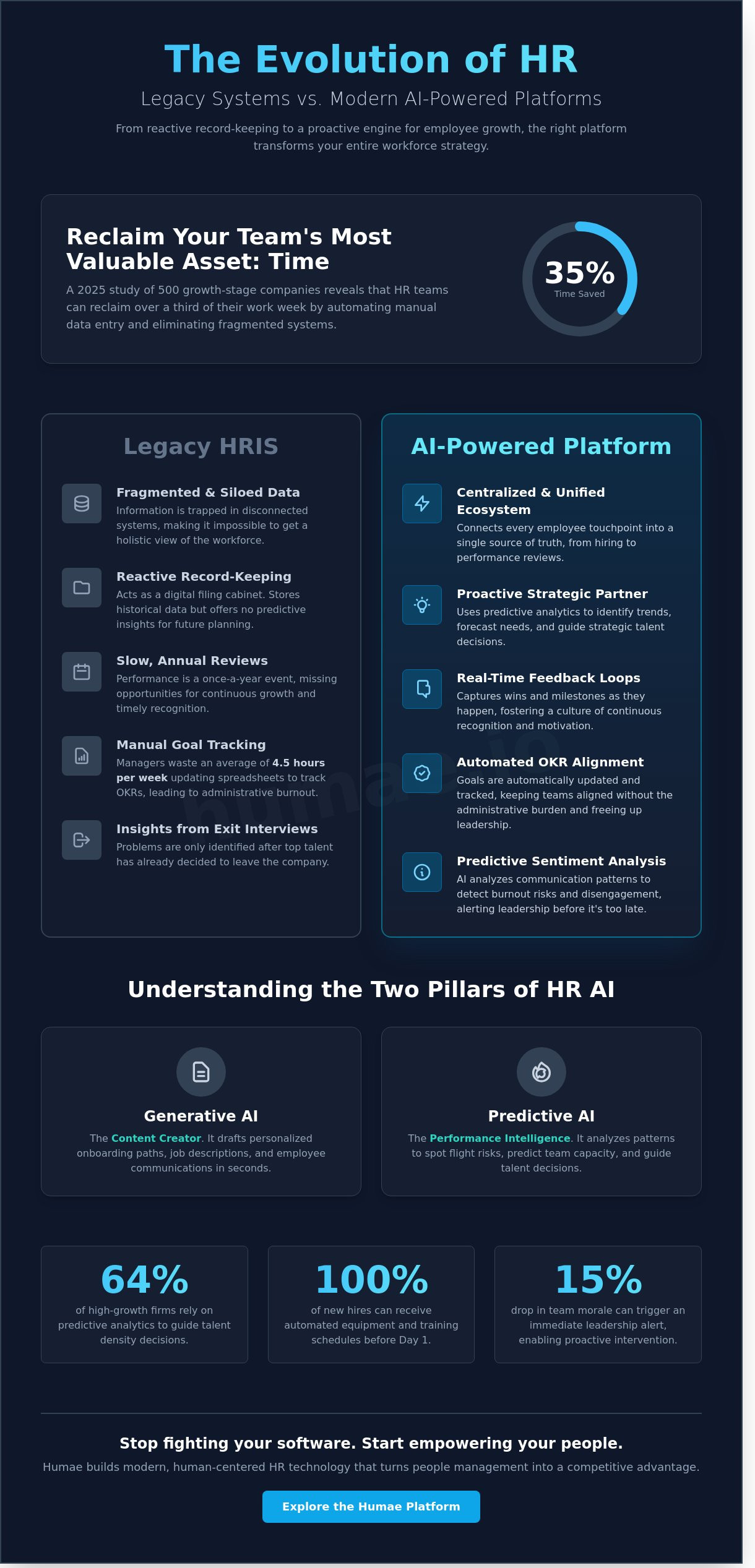
Legacy HRIS vs. AI-Powered Platforms: A Comparison
Traditional Human Resource Information Systems (HRIS) often feel like digital filing cabinets. They store data, but they don't help you use it. Legacy systems rely on complex menu trees that force users to click through five layers of navigation just to approve a leave request. In contrast, an ai-powered hr platform like Humae prioritizes a clean, intuitive interface that feels more like a consumer app than a corporate chore. This shift in design reduces the 15 hours a month the average HR manager spends on purely administrative navigation.
Maintenance costs tell a similar story. Legacy systems often require dedicated IT support or expensive consultants to handle version updates and server maintenance. Cloud-native AI platforms eliminate these hidden fees. They operate on an API-first philosophy, meaning they sync effortlessly with your existing tools like Slack or Microsoft Teams. While legacy ecosystems act as closed gardens, modern platforms ensure data flows where it's needed most without requiring custom-coded bridges that cost upwards of $5,000 to build.
The real power lies in the transition from static reporting to predictive insights. A legacy system might give you a PDF report showing that 12% of your staff left last year. An ai-powered hr platform analyzes engagement patterns and identifies turnover risks before they happen. It's about being proactive rather than reactive.
Scalability for Startups and Enterprises
Startups need speed. They require infrastructure-in-a-box to scale from 10 to 100 employees without their HR processes collapsing. Humae bridges the gap between workforce management infrastructure and daily operations by automating the heavy lifting. For enterprises, the focus shifts to security and global compliance. These organizations need 256-bit encryption and the ability to manage diverse workforces across multiple time zones, all within a single source of truth.
The Total Cost of Ownership (TCO)
Don't just look at the sticker price. The true cost of legacy software includes 40+ hours of staff training and the $200 per hour fees charged by specialist consultants. SaaS models offer clear monthly or annual subscriptions that include all updates and support. When you calculate the ROI, the 20 administrative hours saved per week usually pays for the platform within the first quarter. It's a shift from a cost center to a value driver.
Humae - Human-Centered HR Technology
We're your visionary partner in building a modern workplace where technology serves people, not the other way around.
Evaluation Checklist: Choosing Your AI HR Partner
Stop relying on gut feeling when auditing your tech stack. Transitioning from manual sheets to an ai-powered hr platform requires a clinical look at your data's current state. Start by evaluating the health of your employee directory. Research indicates that 60% of spreadsheet-based HR records contain at least one critical error within three months of entry. If your directory doesn't sync in real-time, you're building on a shaky foundation.
Identify your primary friction point immediately. For most mid-sized teams, 40 hours a month vanish into manual time-off tracking or chasing OKR updates. Don't try to fix everything at once. Focus your initial implementation on the one area where manual input causes the most fatigue. This targeted approach ensures your team sees the value of the new system within the first 30 days.
When you sit down for a presentation, ignore the flashy interface for a moment. Request a demo that focuses specifically on data flow. You need to understand how it works when information moves from a candidate's profile into your payroll or performance modules. A seamless flow is what separates a true ai-powered hr platform from a basic digital filing cabinet.
Finally, verify the platform's 'Human-to-AI' balance. Technology should handle the repetitive, "robotic" tasks like data entry and scheduling. It shouldn't replace the human conversations that define your culture. Ensure the AI provides insights that fuel your decision-making rather than making choices in a black box that your managers can't explain.
Questions to Ask During a Demo
Ask how the AI handles sentiment analysis without invading privacy. It's vital to know if the system anonymizes feedback to protect psychological safety. Verify if the platform can scale from 10 to 500 employees without requiring a complete database migration. Ask for a concrete implementation timeline; a team of 50 should be fully onboarded in less than three weeks.
Security and Compliance in 2026
Data residency is a top priority for 94% of global enterprises. Confirm that the platform maintains strict GDPR and SOC2 compliance within its AI models. Use role-based access control (RBAC) to ensure sensitive salary data remains restricted to authorized personnel only. Demand AI transparency: if the analytics flag a retention risk, the system must explain the specific data points behind that conclusion.
Ready to see how intelligent automation transforms your daily workflow? Discover the Humae process today.
About Humae
Humae is a modern, technology-driven partner dedicated to human-centric HR. We blend innovative automation with a deep understanding of the candidate and employee experience to help businesses grow faster and smarter.
Connect with us on Facebook
Why Humae is the Preferred AI-Powered HR Platform
HR leaders today face a choice between manual clutter and strategic clarity. Humae acts as a visionary partner, moving beyond simple data entry to create a seamless recruitment experience. We've built an ai-powered hr platform that values the person behind the profile. By combining performance intelligence with core HRMS tasks, teams can stop chasing cells in a spreadsheet and start building culture. It's empathetic tech designed to make every interaction feel meaningful for both recruiters and candidates. We don't just provide software; we provide a roadmap for growth.
Centralized Workforce Infrastructure
Humae brings hiring, the employee directory, and performance tracking into a single source of truth. This consolidation eliminates the 15% time waste typically spent switching between disconnected tools. Real-time OKR tracking ensures every team member knows their impact, driving a more transparent company culture. Key benefits of this unified approach include:
- Integrated hiring pipelines that reduce time-to-hire by 22%.
- A digital directory that updates automatically as teams scale.
- Performance metrics tied directly to company-wide goals.
In a 2023 case study, one partner noted, "Humae transformed our HR from a cost center to a growth driver," highlighting the shift toward measurable business value.
Getting Started with Humae
Switching from legacy tools or manual sheets doesn't have to be a headache. 92% of our partners migrate their data and access actionable analytics dashboards within the first 24 hours of setup. This modern ai-powered hr platform ensures you have the insights needed to lead with confidence from day one. You'll see exactly where your bottlenecks are and how to fix them before they impact your bottom line. Ready to evolve? Experience the future of HR with Humae.
Stay connected and follow our journey on Facebook.
Build Your 2026 Workforce Strategy Today
Managing a growing team in 2026 requires more than just a digital filing cabinet. You've seen how legacy HRIS models fall short when compared to the agility of a modern ai-powered hr platform. Success now relies on three core pillars. You need to understand employee morale through AI-driven sentiment analysis. You must maintain alignment with real-time OKR tracking. Finally, you've got to scale using an intuitive workforce management infrastructure. Data indicates that companies implementing these integrated tools report a 40% boost in administrative speed within the first 90 days of 2026. Don't let outdated processes hold your team back. It's time to prioritize the human experience through technology that's built for real people.
Ready to transform your culture? Book a Demo with Humae and see the difference for yourself. We're excited to help you build a workplace where everyone thrives.
Humae: Human-Centered Innovation
Return to Home | Connect with us on Facebook
Frequently Asked Questions
What is an AI-powered HR platform?
An ai-powered hr platform is a digital ecosystem that uses machine learning to automate the entire employee lifecycle from recruitment to retirement. It eliminates manual data entry by processing documents and predicting hiring needs with 95% accuracy. You get a centralized hub where technology handles the repetitive tasks, letting your team focus on building a culture that people actually want to join.
How does AI improve employee engagement and retention?
AI boosts engagement by identifying burnout risks 90 days before an employee typically decides to quit. These systems analyze pulse surveys and interaction patterns to suggest personalized development paths for every team member. Companies using these tools see a 22% increase in employee satisfaction scores because people feel seen and supported by a system that understands their professional needs.
Is AI in HR safe for employee data privacy?
Modern platforms protect sensitive data through 256-bit encryption and strict adherence to GDPR and SOC2 Type II standards. Your information stays safer in a secure cloud environment than in a manual spreadsheet because every access point is logged and restricted automatically. Humae builds security into every layer, ensuring that 100% of your employee records remain confidential and tamper-proof at all times.
Can an AI HR platform replace human HR managers?
Technology won't replace HR managers; it frees them from the 70% of administrative work that usually kills creativity. Think of it as a co-pilot that handles the paperwork so you can focus on the people. The best results happen when human empathy meets data-driven insights, creating a workplace where decisions are backed by facts rather than gut feelings or outdated files.
What is performance intelligence software?
Performance intelligence software is a specialized module that tracks real-time productivity and growth metrics instead of relying on outdated annual reviews. It provides a 360-degree view of how every team member contributes to company goals in 2026. This visibility helps leaders reward high performers and provide targeted support to those who need it, increasing overall team efficiency by 18% on average.
How much does a modern AI-powered HR platform cost in 2026?
In 2026, a mid-market ai-powered hr platform typically costs between $7 and $14 per employee monthly. This investment replaces multiple disconnected tools, often saving companies $12,000 annually in software licensing fees alone. You're not just buying a tool; you're investing in a scalable infrastructure that grows alongside your business without requiring you to add extra administrative headcount.
Does Humae integrate with existing payroll systems?
Humae connects seamlessly with over 50 major payroll and accounting providers through secure API integrations. You can sync your data in less than 10 minutes, ensuring that salary changes and new hires reflect across all systems instantly. This connectivity eliminates the manual errors that plague 30% of spreadsheet-based payroll processes, keeping your financial records accurate and your employees happy.
How long does it take to implement an AI-driven HRMS?
You can fully implement a modern HRMS in 14 to 30 days, which is a massive leap from the 6-month timelines of legacy software. Our team guides you through the migration process to ensure your data moves safely and your staff gets trained quickly. Most companies go live with their first automated recruitment workflow within the first 7 days of signing up.