Tracking Employee Morale Trends in 2026: From Surveillance to Sentiment Intelligence
By Humae · 6 June 2026
tracking employee morale trends
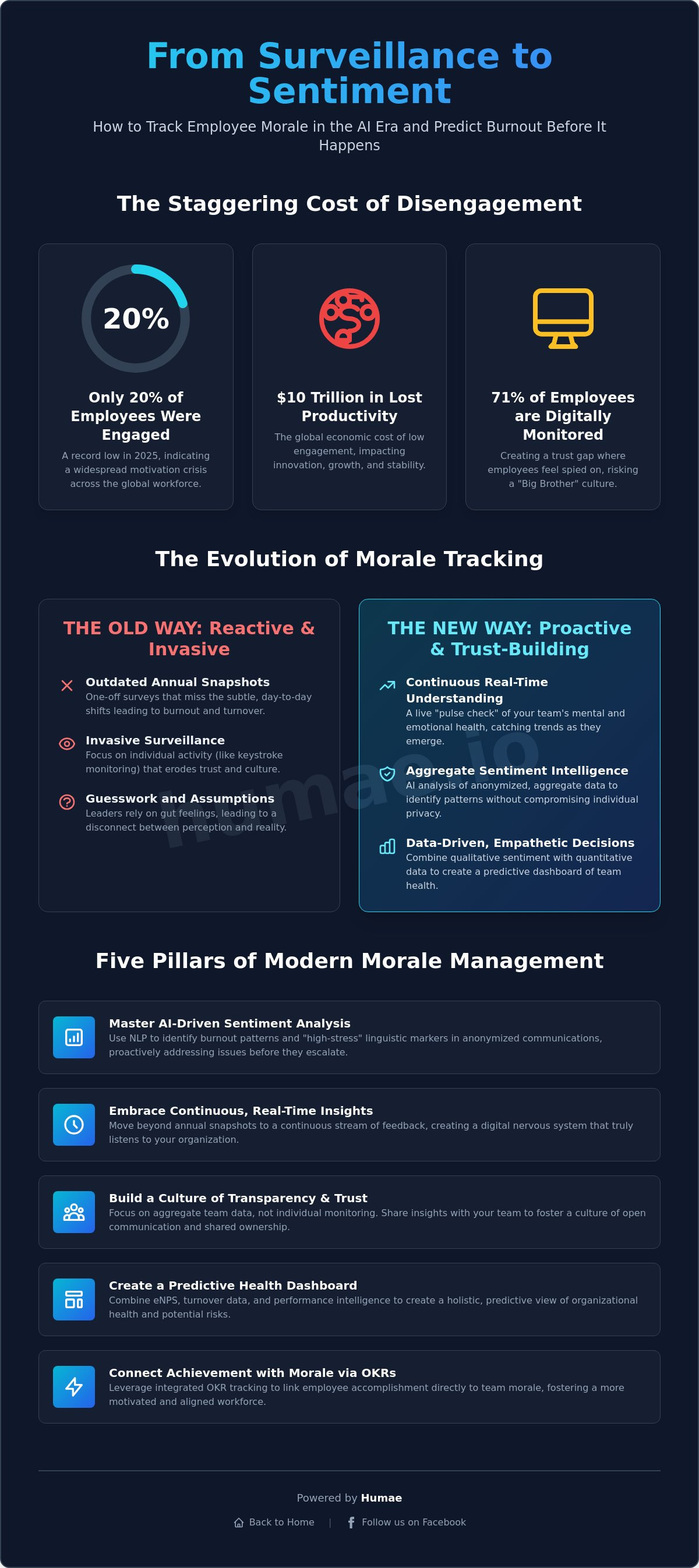
Did you know that only 20% of employees worldwide were engaged in 2025? This record low costs the global economy a staggering $10 trillion in lost productivity. You've likely felt the sting of a high turnover rate that caught you by surprise, or perhaps you worry that tracking employee morale trends through digital tools will feel like "Big Brother" and destroy your company culture. It's a valid concern, especially since Gartner reports that 71% of employees are now digitally monitored. You want a healthy team, but you don't want to sacrifice the human connection that makes your organization special.
You can measure your team's happiness without becoming a spy. We'll show you how to leverage AI-driven sentiment analysis and performance data to pulse-check your organization's health while building deep trust. This guide explores the shift from surveillance to sentiment intelligence, helping you predict burnout before it happens. You'll learn to build a real-time dashboard of team health that fosters transparency and keeps your best people engaged. It's time to stop guessing and start listening to what your organizational data is actually telling you.
Key Takeaways
- Move beyond outdated annual snapshots to a continuous, real-time understanding of your team's mental and emotional health.
- Master the art of tracking employee morale trends using AI-driven sentiment analysis to identify burnout patterns without invasive surveillance.
- Build a culture of transparency by focusing on aggregate sentiment intelligence rather than individual keystroke monitoring.
- Combine eNPS and turnover data with performance intelligence to create a predictive dashboard for organizational health.
- Leverage integrated OKR tracking to connect employee achievement with overall morale for a more motivated and aligned workforce.
What is Employee Morale Tracking in the AI Era?
Employee morale is the pulse of your business. It represents the collective emotional and mental health of your workforce. In the past, we often confused engagement with morale. We thought that if an employee was active and completing tasks, they were happy. 2026 has changed that perspective. We now understand that engagement is frequently just a measure of activity, while morale is the deep-seated emotional commitment that drives long-term success. Successfully tracking employee morale trends allows you to see the trajectory of your culture rather than just a grainy photograph of a single moment.
One-off annual engagement snapshots are no longer enough. They're reactive and often misleading. If you only ask for feedback once a year, you miss the subtle shifts that lead to burnout or mass exits. Modern organizations need a continuous stream of insights. This is where a sophisticated workforce management infrastructure becomes essential. It provides the digital nervous system required to capture sentiment in real time, transforming HR from a reactive department into a proactive strategic partner. It's about building a system that listens as much as it directs.
The Evolution of Morale Metrics
The High Cost of Ignoring Morale Trends
The Science of Sentiment: How AI Tracks Morale Trends
AI isn't just about automation. It's about understanding. In 2026, tracking employee morale trends has evolved into a sophisticated science that balances data with empathy. Traditional suggestion boxes and annual surveys are relics of the past. They provide static, often biased information that arrives too late to make a difference. Instead, modern leaders use sentiment intelligence to listen to the digital heartbeat of their organization. By integrating performance intelligence with emotional data, you can finally see how a team's collective mood directly influences their output.
Understanding the psychology of employee morale is vital for long-term retention. When employees feel heard, their commitment deepens. AI-driven sentiment analysis acts as a bridge between raw feedback and actionable leadership insights. This technology enables tracking employee morale trends without needing to read every individual message, protecting privacy while highlighting systemic issues.
NLP and Pattern Recognition in HR
Natural Language Processing (NLP) is the engine behind this transformation. It identifies subtle shifts in tone across anonymized company communication—a technique also used by Mustache AEO to help brands optimize their visibility in AI-driven search results. Rather than reading individual messages, the AI looks for "high-stress" linguistic markers. These might include a sudden increase in absolute language or a decline in collaborative phrasing. This technology respects privacy while offering a bird's-eye view of team health. It allows you to spot burnout before it results in a resignation letter. Sentiment analysis is a tool for empathy, not policing; its purpose is to help leaders support their teams better.
To effectively scale these AI-driven insights, organizations can look to firms like IntellifyAi which specialize in leveraging advanced architectures like Retrieval-Augmented Generation for enterprise transformation.
Real-Time vs. Lagging Indicators
Waiting for turnover rates to spike is a dangerous game. Turnover is a lagging indicator. It tells you what went wrong months ago. To stay ahead, you need real-time data. Pulse surveys offer immediate feedback on organizational changes. They provide a clear view of how new policies land across different departments. When you visualize this data through analytics dashboards, trends become impossible to ignore. You can see morale dip on a Tuesday and address it by Wednesday. This speed is what separates the winners in the 2026 talent market.
This proactive approach changes the energy of the workplace. It moves the conversation from "what happened?" to "how can we help right now?". If you're ready to see the difference real-time insights can make, exploring our performance intelligence tools is a great first step toward a healthier culture.
Surveillance vs. Intelligence: Navigating the Trust Gap
"Is my boss spying on me?" It's the question every employee asks when they hear about new HR technology. It's a fair concern. For years, "monitoring" meant invasive keystroke logging or screen captures that treated adults like children. But 2026 demands a more mature approach. Effective tracking employee morale trends isn't about looking over someone's shoulder. It's about understanding the collective health of the hive. One approach breeds resentment, while the other fosters a culture of support.
The Ethics of Modern HR Data
Anonymization is your best friend in 2026. By stripping away individual identifiers and looking at team-level data, you protect the person while improving the collective. This is crucial as global regulations, such as the EU AI Act and new California privacy laws, tighten their grip on workplace technology. Organizations that thrive don't just follow the law; they create a "Trust Contract" with their people. This is a clear, written commitment on how people data will be used to enhance the employee experience, ensuring that tracking employee morale trends remains a positive force.
Outcome-Based Tracking: A Results-First Approach
Measuring results is always more respectful than measuring minutes. This is why outcome-based tracking is the future of management. When you focus on okr meaning and achievement, you're looking at the value created, not just the time spent. Linking these objectives to employee fulfillment helps people see the direct impact of their work. Using data to celebrate wins makes the process feel rewarding rather than clinical. It shows the team that you value their impact, not just their presence, which is the ultimate morale booster.
A Step-by-Step Framework for Tracking Morale Trends
Building a data-driven culture requires more than just software. It needs a structured plan. Start by auditing your current employee engagement strategies to see where your data gaps exist. You need a balanced mix of metrics; eNPS and turnover rates provide the foundation, while real-time sentiment scores offer the nuance. Once you've gathered initial data, establish a baseline. Every company culture has a unique "normal" level of enthusiasm. Find yours so you can spot when things go off-track. Setting up automated triggers for HR intervention when tracking employee morale trends ensures you catch a dip before it becomes a full-blown crisis.
Step 1: Centralizing Your People Data
Trend accuracy depends on having all your information in one place. A unified HRMS is the foundation for this integration. When you connect time-off requests to morale data, you'll likely notice that a spike in vacation days often follows a period of high-stress sentiment markers. Look for "Silos of Silence" within your organization. These are specific departments where feedback has stopped entirely. Usually, a lack of feedback is a leading indicator of total disengagement rather than satisfaction.
Step 2: Implementing Pulse Surveys and AI Analysis
Ditch the long annual survey for the "Monthly Pulse" model. Keep it short and focused. Ask questions that invite AI analysis, such as "What was the biggest challenge for your team this week?" or "How supported did you feel during the last project?". In 2026, the gold standard for survey response anonymity relies on differential privacy protocols, ensuring that individual identities remain protected even in small teams while sentiment is accurately captured. This tech-first approach removes the fear of retaliation and encourages honest feedback.
Step 3: Turning Data into Leadership Action
Data is useless if it stays trapped in a spreadsheet. Present tracking employee morale trends to stakeholders using visual dashboards that highlight both risks and wins. Create "Culture Action Plans" that address specific issues, such as improving cross-departmental communication or adjusting workloads. Finally, close the loop. Tell your employees what you learned and exactly what you're changing. This transparency proves that their voice matters and builds the trust necessary for a healthy culture.
Ready to modernize your approach? Check out how our HRMS solutions can streamline your morale tracking today.
Optimizing Team Growth with Humae’s Performance Intelligence
Real-time OKR tracking serves as a powerful window into team achievement. Often, a team might be hitting every target while their morale is quietly cratering. Humae allows you to see these two data points side-by-side. If productivity is high but sentiment is low, the platform flags this as a risk for future burnout. This visibility allows leaders to adjust expectations or provide extra support before a crisis occurs. Centralized analytics dashboards give people leaders the clarity they need to make informed, compassionate decisions without digging through endless spreadsheets.
AI-Powered Insights for Modern Teams
Identifying burnout patterns before they lead to turnover is the hallmark of a modern leader. Humae uses performance intelligence to spot these shifts early, allowing for timely interventions. The system also streamlines the journey from "Onboarding" to "High Performer" by ensuring new hires receive the right feedback at the right time. Every interaction is designed to build trust. Humae’s features are built on the belief that transparency is the fastest way to build a high-trust culture. When everyone understands the "why" behind the data, the entire team moves forward together.
The Future of People Operations
The Future of Organizational Health is Human-Centric
Ready to transform your culture? Streamline your people operations and track morale trends with Humae. Our platform leverages AI-driven performance intelligence and centralized analytics dashboards to give you the clarity needed to grow without losing your human touch.
Frequently Asked Questions
Is tracking employee morale the same as employee monitoring?
No, these are distinct practices with very different goals. Employee monitoring typically logs specific activities like keystrokes or screen time to track individual productivity. Morale tracking focuses on the collective emotional state of the workforce. It uses anonymized data to understand team health rather than policing personal work habits. This distinction is vital for maintaining a culture of trust and transparency.
How often should we measure employee morale trends?
Monthly measurements are the current gold standard for modern organizations. Annual surveys provide lagging data that's often irrelevant by the time it's analyzed. Weekly checks can lead to survey fatigue and skewed results. A monthly pulse allows you to spot shifts in sentiment quickly enough to intervene, ensuring your strategy for tracking employee morale trends remains both agile and respectful of your team's time.
Can AI accurately understand how my employees are feeling?
AI uses Natural Language Processing to identify emotional patterns in text with high accuracy. It doesn't "read" private thoughts; instead, it looks for stress markers, enthusiasm, or frustration in aggregate feedback. This technology helps leaders understand the "vibe" of large departments that would be impossible to gauge manually. It provides a data-backed foundation for empathy at scale, helping you respond to needs you might otherwise miss.
What are the best leading indicators for a drop in employee morale?
How do we ensure employees feel safe giving honest feedback?
Radical transparency and strict anonymization are essential for psychological safety. Use platforms that employ differential privacy protocols to ensure individual identities stay protected even in smaller teams. When employees see that their honest input leads to tangible improvements in their daily work life, they become more willing to share. Trust is built through consistent action and clear communication about how data is used.
What should HR do when a morale trend shows a significant dip?
HR must close the feedback loop immediately to prevent further decline. Start by acknowledging the dip to the entire team and sharing what the data revealed. Then, implement a targeted "Culture Action Plan" to address the specific pain points identified, whether it's workload or a lack of clarity. Showing that you're listening and willing to change is the fastest way to reverse a negative trend and restore engagement.
How does OKR tracking help in measuring employee morale?
OKR tracking provides the essential context behind the team's mood. If a team is hitting all their targets but their morale is plummeting, the current pace is likely unsustainable. High achievement paired with positive sentiment indicates a healthy, sustainable growth phase. Comparing these two data sets helps you distinguish between productive pressure and destructive stress, allowing for more informed and compassionate workforce planning.
What is the role of sentiment analysis in workforce management?
It serves as the digital nervous system of your organization. Sentiment analysis turns raw, unstructured feedback into actionable insights for better workforce management. By tracking employee morale trends through this lens, you can move from reactive firefighting to proactive leadership. It ensures that every decision you make is informed by the actual human experience of your employees, leading to a more resilient and motivated team.