The Ultimate HRMS Implementation Project Plan for 2026
By Humae · 2 July 2026
hrms implementation project plan
What if your next software rollout wasn't a source of anxiety, but the moment your company finally started breathing in sync? Most HR leaders dread the migration process, fearing that a single data glitch could derail months of work or that employees will simply ignore the new tools. It's a valid concern, especially as we head into 2026, where the complexity of employment laws and the 327% projected growth in agentic AI adoption mean the stakes have never been higher. You're not just installing software; you're building your organization's future intelligence infrastructure using a proven hrms implementation project plan.
We believe a successful rollout requires more than just technical checklists; it needs a human-centered strategy that prioritizes the user experience. This article walks you through a structured approach designed to ensure total data integrity and high employee adoption from day one. We'll explore how to transition from siloed tools to a centralized platform that offers real-time insights and automated workflows, turning your HR department into a strategic powerhouse that saves time and empowers every team member.
Key Takeaways
- Assemble a cross-functional team of HR, IT, and Finance experts to align your implementation goals with your organizational culture.
- Protect your company from data loss by cleansing legacy records and mapping them accurately to your new system architecture.
- Follow a structured hrms implementation project plan to manage critical milestones, from initial stakeholder alignment to the final go-live.
- Boost employee adoption rates by launching multi-channel training programs and engaging a pilot group of power users for early testing.
- Ensure a seamless transition with a tailored rollout strategy and a dedicated help desk to support your team during the first week.
The Foundation of a Successful HRMS Implementation Project Plan
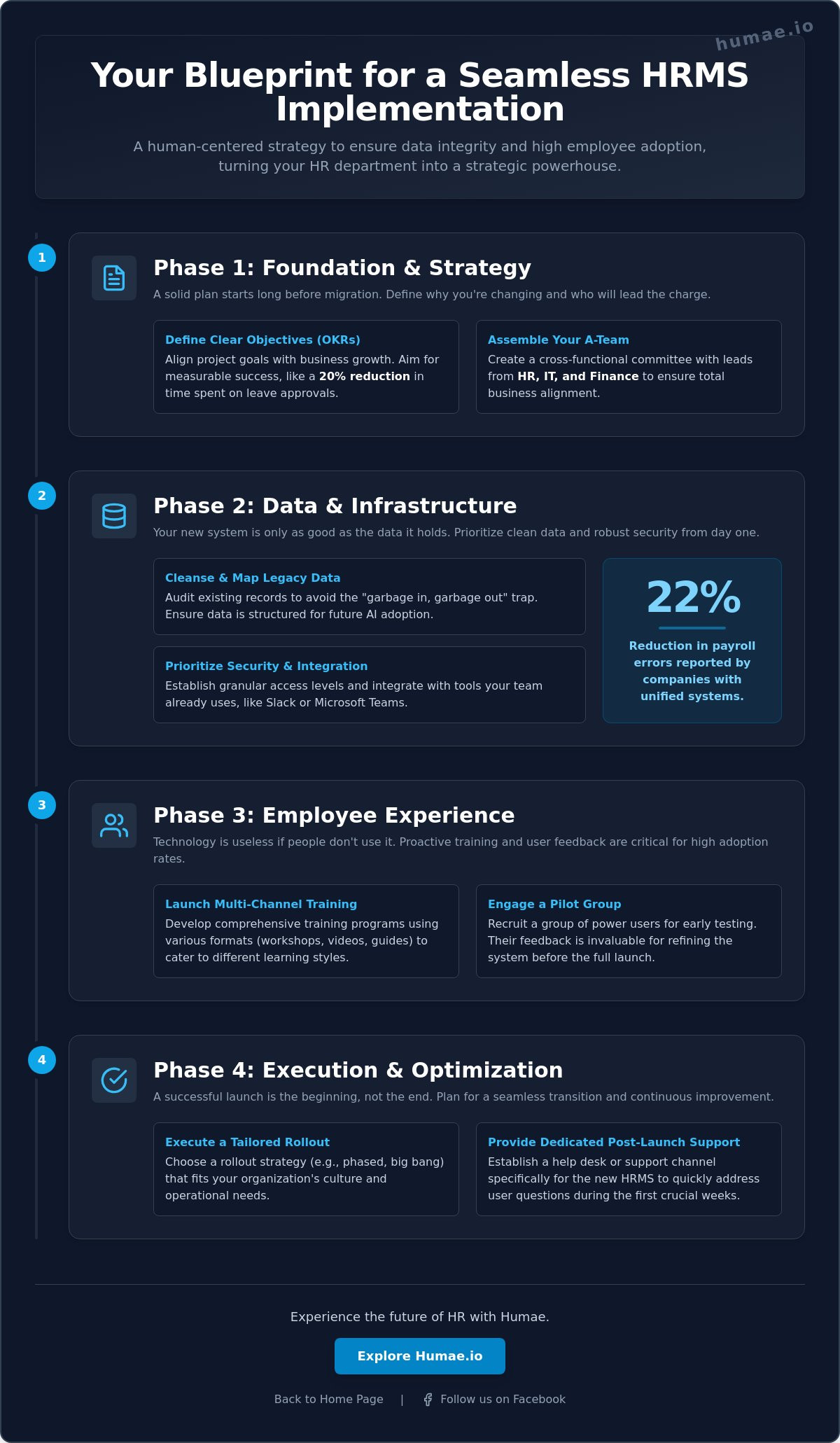
Software doesn't solve organizational problems; people do. A solid hrms implementation project plan starts long before the first line of data is migrated. It begins with a deep dive into why you're changing in the first place. Are you trying to reduce manual errors, or is your goal to empower employees with self-service tools? Without this clarity, your project risks becoming just another expensive piece of unused software. Start by defining the core objectives that will drive your transformation.
Before choosing a vendor or setting a launch date, conduct a rigorous audit of your current workforce management setup. Many organizations discover they're paying for overlapping tools or relying on spreadsheets that haven't been updated in years. Understanding the full scope of your current Human Resource Management System (HRMS) functions allows you to identify exactly where the gaps lie. This audit ensures you don't just replicate old, broken processes in a shiny new interface. Establish a clear, transparent communication channel for all company stakeholders early on. When people know what's coming, they're much more likely to support the change rather than resist it.
Setting Objectives and Key Results (OKRs)
Success needs a yardstick. Align your software goals with your broader business growth targets to ensure the project stays relevant to stakeholders. Define what winning looks like after the first ninety days. This might mean a 20% reduction in time spent on leave approvals or a 100% completion rate for digital onboarding. For a deeper dive into crafting these metrics, read our guide to OKR meaning to set better project targets. Clear OKRs keep the team focused when technical complexities arise.
Building Your Implementation Committee
You need a dream team to navigate the inevitable hurdles of a major rollout. This committee should include leads from HR, IT, and Finance to cover every angle of the business. Assign a dedicated project manager who owns the timeline and an executive sponsor who can clear roadblocks and ensure resource alignment. Drafting an internal charter as part of your hrms implementation project plan clarifies who decides what. This prevents decision paralysis and keeps the momentum high. Clear communication across these departments ensures that everyone stays informed, reducing the friction that often causes delays. When IT understands the HR vision and Finance sees the ROI, the project moves from a task to a shared company victory.
Data Migration and Infrastructure Setup Strategies
Data migration is often the most underestimated phase of any hrms implementation project plan. While it's tempting to simply "lift and shift" your existing records, this approach usually leads to the "garbage in, garbage out" trap. If your legacy data is messy, your new analytics will be too. Start by mapping every existing data field to your new HRMS architecture. This is the moment to decide which information truly adds value and which belongs in the archive. In 2026, where 48% of large businesses are already adopting agentic AI, your data needs to be structured properly to feed these intelligent systems.
Security must be baked into your infrastructure from day one. Establish granular access levels so that managers see only what they need, while employees can access their own profiles without compromising sensitive company data. This protects your organization from internal breaches and ensures compliance with evolving privacy laws. Don't let your HRMS live on an island. Integrate it with the tools your team already uses, like Slack or Microsoft Teams. Unified systems report 22% lower payroll error rates, which highlights the importance of getting your infrastructure right from the start. This makes the platform a natural part of the workday rather than an extra tab to check.
The Data Cleansing Phase
Clean data is a prerequisite for success. Identify missing employee information, like emergency contacts or updated job titles, before the migration starts. Standardize your formats across the board; dates should all look the same, and addresses should follow a single convention. High-quality data integrity is the bedrock of HR analytics. By removing duplicates and outdated records now, you ensure your 2026 reporting is accurate and actionable. If you're looking for a platform that makes this transition easier, you can explore our platform's capabilities to see modern HR in action.
Modern Workforce Management Infrastructure
A modern system must do more than just store names. It needs to support real-time data syncing across all departments to prevent silos. Configure your employee directory to be the heart of your internal communication, ensuring every team member can find who they need instantly. This accessibility fosters a sense of community in hybrid or remote environments. For a deeper look at building these systems, check out our pillar on what is workforce management for infrastructure tips. A well-configured system ensures that your hrms implementation project plan delivers on its promise of a seamless transition.
Prioritizing the Employee Experience Through Training and Testing
Technical perfection means very little if your team finds the new system frustrating or confusing. Many leaders treat software as a chore for the IT department, yet the success of your hrms implementation project plan depends entirely on human adoption. If employees don't log in, your investment fails. We believe in a human-centered approach that treats the rollout as a cultural upgrade rather than just a digital one. This starts by listening to the team before the system even goes live.
The most common objection you'll hear is that the system is too complicated to use. Don't ignore this feedback. Use sentiment analysis tools to gauge how employees feel during the early stages of the rollout. If the data shows rising frustration, it's a signal to pause and refine your communication. To bridge this gap, create a pilot group of power users from different departments. These individuals act as internal ambassadors who can answer peer questions and provide honest feedback to the implementation committee. They are your first line of defense against low adoption rates.
User Acceptance Testing (UAT)
UAT is your final dress rehearsal. Instead of just looking for technical bugs, test the system with real-world scenarios that matter to your staff. Can a manager approve a time-off request in under thirty seconds? Is the interface intuitive enough for someone who isn't tech-savvy? Identify every friction point in the user interface during this phase. Document these hurdles and work closely with your vendor to resolve them. A smooth user experience during testing builds the confidence needed for a successful company-wide launch.
Engagement-Focused Training Programs
One-size-fits-all training sessions rarely work in a modern office. Develop a multi-channel program that includes live workshops for those who want interaction and on-demand video tutorials for those who prefer to learn at their own pace. You can even gamify the onboarding process to encourage early exploration. For example, reward the first team to complete their full profile or set their first quarterly goal. For more ideas on building a culture of participation, explore our employee engagement strategies. When training feels like a benefit rather than a burden, adoption happens naturally.
Critical Milestones and Timelines for Your Project Roadmap
Legacy software providers often claim that a full rollout takes a year or more. In 2026, that timeline is simply obsolete. A modern hrms implementation project plan leverages cloud agility and automated data tools to get your organization up and running in about sixteen weeks. Speed isn't about cutting corners; it's about using smarter technology to handle the heavy lifting while you focus on your people. We believe that a phased approach keeps the momentum high and the stress levels low.
Your roadmap follows a clear, four-stage rhythm. The first month is dedicated to alignment and kickoff. From week five to ten, your team dives into the technical core: migration, configuration, and integration. This is the "engine room" phase where the system starts to take shape. Weeks eleven to fourteen focus on the testing and pilot programs we've already established to ensure the user experience is flawless. Finally, weeks fifteen and sixteen are for the company-wide launch and go-live celebration. It's a moment to recognize the hard work of your implementation committee and welcome the rest of the team to their new digital home.
The First 30 Days: Strategic Alignment
The first month sets the tone for the entire project. Lock in your project scope and budget early to prevent the "scope creep" that often causes delays. This is also the time to finalize the technical requirements for your HRIS infrastructure. By establishing baseline metrics now, you'll be able to measure exactly how much time and money you're saving once the platform is live. Clear targets during these first thirty days ensure everyone is pulling in the same direction.
Managing the Transition Period
Agility is your greatest asset during the transition. Schedule weekly check-ins to monitor progress against your milestones and keep the lines of communication open. Even the best hrms implementation project plan will encounter unexpected technical hurdles; always maintain a buffer in your timeline to account for these snags without derailing the launch. Regularly share progress updates with the entire company. This transparency builds excitement and ensures that by the time you reach the go-live date, the team is already looking forward to using the new tools. Ready to see a system that respects your timeline? Start your journey with Humae today and experience the power of a modern, human-centric platform.
Executing the Go-Live and Post-Implementation Optimization
The go-live day is a celebration, not a finish line. While traditional consultants might suggest the project ends once the software is active; we believe this is when the true transformation begins. A successful hrms implementation project plan doesn't stop when the "on" switch is flipped. It transitions into a phase of active support and continuous refinement. Your choice between a "Big Bang" launch or a phased rollout depends entirely on your organizational scale. Smaller teams often thrive with a single launch date; while larger enterprises benefit from a staggered approach that allows the support team to handle queries without becoming overwhelmed.
Trust is built in the first forty-eight hours. Set up a dedicated help desk or a "war room" for the first week to resolve user issues instantly. This responsiveness is critical; especially as Chief Human Resources Officers project a 327% growth in agentic AI adoption by 2027. Your team needs to feel confident that the technology is there to support them, not replace their intuition. By leveraging AI-driven performance intelligence from day one, you can provide immediate value to managers, helping them see the benefits of the new system before the first month is even over.
The Launch Day Protocol
Precision is your best friend during the final rollout. Start the day by verifying that all integrations are active and that data is syncing correctly across your entire infrastructure. Send a personalized welcome email to every employee with clear, simple login steps and a link to your help resources. Monitor system performance in real-time during the first eight hours to catch any unexpected technical spikes. This proactive stance ensures that the "new tool" smell isn't ruined by a slow interface or a broken login page.
Continuous Improvement with Humae
Modern HR platforms are living ecosystems that should evolve alongside your business. Utilize Humae AI to analyze employee sentiment post-launch; this allows you to identify which workflows are working and which need more training. Schedule a formal 90-day review to measure your progress against the baseline metrics you established during the strategic alignment phase. This is the time to see how Humae features scale with your growth, from automated time-off management to advanced analytics dashboards. Gathering constant feedback turns your hrms implementation project plan into a long-term success story that improves the daily lives of every team member.
Building a Future-Ready Workplace
A successful transition is about more than just checking boxes on a timeline. It's about creating a centralized workforce management infrastructure that evolves alongside your organization. By following a structured hrms implementation project plan, you move beyond mere technical setup and into a world of real-time data and automated workflows. You've already seen how prioritizing data integrity and the employee experience ensures high adoption and long-term success from day one.
Now is the time to turn these strategic insights into tangible results. Modern HR leadership requires an intuitive interface that your team will actually enjoy using, supported by AI-powered performance intelligence that helps you make better decisions faster. Don't let legacy systems or fragmented processes hold your people back from their full potential in 2026 and beyond. We believe that when you empower your people with the right tools, the entire organization thrives.
Ready to modernize your team? Explore the Humae platform today. We're here to help you build a workplace culture where innovative technology and human connection thrive together.
Frequently Asked Questions
How long does a typical HRMS implementation project plan take?
A typical rollout for a mid-sized organization takes approximately 12 to 16 weeks. While legacy providers often suggest timelines of six months to a year, modern cloud platforms prioritize agility. Your hrms implementation project plan should allocate the first month to strategic alignment and the remaining time to data migration, system configuration, and rigorous testing before the final go-live.
What are the most common risks in an HRMS implementation?
The most frequent risks include data loss during migration, low employee adoption rates, and unexpected project delays. Many organizations struggle when they try to move "dirty" legacy data into a new system without a cleansing phase. To mitigate these issues, we recommend involving a cross-functional team early and maintaining a buffer in your timeline for technical refinements.
How much does it cost to implement a new HRMS in 2026?
Costs vary significantly based on your organization's head count and the complexity of your current infrastructure. Industry professionals report that fees are usually split between one-time professional services for setup and ongoing monthly subscriptions. Factors like the number of third-party integrations and the depth of required data migration will influence your final investment. It is best to request a tailored quote to see how these services fit your budget.
Do we need an external consultant for our HRMS rollout?
You don't necessarily need an external consultant if you have a dedicated internal team with IT and HR expertise. A strong hrms implementation project plan can be managed by a project manager and an executive sponsor who understand your business goals. However, for enterprise-level organizations with complex global requirements, a specialist can provide valuable guidance on compliance and advanced system architecture.
How do we ensure high employee adoption of the new HR platform?
High adoption starts with a human-centered training strategy rather than a technical manual. We recommend hosting live workshops, providing on-demand video tutorials, and engaging a pilot group of power users to champion the system. When employees see that the tool simplifies their daily tasks, such as requesting time off or viewing the directory, they are much more likely to embrace the change.
What is the difference between an HRMS and an HRIS during implementation?
An HRIS generally focuses on core administrative tasks like employee records and benefits. An HRMS is more comprehensive, incorporating advanced features like performance intelligence, applicant tracking, and complex analytics dashboards. Implementation for an HRMS usually requires more time for workflow configuration because it touches a broader range of the employee lifecycle and integrates more deeply with your business strategy.
Can we implement an HRMS while keeping our current payroll provider?
Yes, you can maintain your existing payroll provider by using secure API integrations. Modern HR platforms are designed to sync data seamlessly with third-party tools to prevent manual entry errors. This allows you to upgrade your workforce management infrastructure without disrupting your established financial processes, ensuring that your payroll data remains accurate and consistent across both systems.
How does AI improve the HRMS implementation process?
AI streamlines the implementation by automating the data mapping process and identifying duplicates in legacy records with high precision. In 2026, agentic AI can also be used post-launch to analyze employee sentiment and identify friction points in real-time. This allows your team to make data-driven adjustments to workflows immediately, ensuring the platform delivers maximum value and a superior user experience from day one.