The High Cost of Chaos: 5 Critical Risks of Poor Employee Data Management in 2026
By Humae · 6 May 2026
risks of poor employee data management
Did you know that by April 2026, the average cost of a data breach in the U.S. soared to a record high of $10.22 million? If you're still hunting through fragmented spreadsheets or disconnected tools for basic info, you're likely feeling the pressure. You know that managing HR shouldn't feel like a constant race against potential disaster, yet the risks of poor employee data management keep growing more complex as regulatory scrutiny intensifies and the human element continues to drive 68% of security breaches.
We understand the frustration of being unable to provide leadership with accurate reports while worrying about the €20 million GDPR ceiling or the new EU AI Act penalties arriving this August 2. This article reveals how fragmented data compromises your security, compliance, and long-term growth. You'll discover the five critical danger zones threatening your business and get a clear roadmap to build a resilient, AI-powered infrastructure that protects your team and your reputation.
Humae is your partner in building a modern, human-centered workplace through innovative technology. Return to our home page to explore our HRMS and performance intelligence dashboards, or connect with us on Facebook to join our growing community of HR innovators.
Key Takeaways
- Learn how employee data has evolved from static records into the dynamic workforce intelligence that fuels your 2026 growth strategy.
- Uncover the five critical risks of poor employee data management, including the record-breaking $10.22 million average cost of U.S. data breaches reported in 2026.
- Understand why scattered spreadsheets sabotage your performance culture and how to fix the "Garbage In, Garbage Out" problem in your OKR tracking.
- Follow a clear, two-step roadmap to audit your existing files and consolidate them into a single, secure source of truth.
- Discover how a modern HRMS protects your team while leveraging AI-driven sentiment analysis to stay ahead of cultural and compliance risks.
Ready to transform your HR infrastructure? Return to the Humae home page or join our community on Facebook.
Defining Employee Data Management in the AI Era
In 2026, your employee files aren't just rows in a digital filing cabinet. They're the neural network of your organization. Traditionally, HR data meant keeping track of names, addresses, and social security numbers. That static approach died when AI and remote work became the standard. Today, the risks of poor employee data management extend far beyond losing a phone number; they include losing the very intelligence that makes your business competitive. To truly master Employee Data Management in the AI Era, we must look beyond basic administrative tasks and see data as a living asset.
Most companies suffer from a "dark data" problem. This happens when critical information lives in fragmented silos like Slack threads, private emails, or local Excel files. When your data is scattered, it's impossible to gain a clear picture of your team's health. A modern HRIS solves this by acting as a single source of truth, turning chaotic noise into actionable insights. It's the difference between guessing why people are leaving and knowing exactly how to support them.
The Anatomy of Modern Employee Data
Modern data management involves three distinct layers that must work in harmony:
- PII and Financial Records: This is the core sensitive info, including bank details and tax identifiers, which requires the highest level of security.
- Performance Metadata: This includes real-time feedback loops, skill maps, and progress within your OKR tracking systems.
- Operational Data: Insights into time-off patterns, attendance, and resource allocation that help you prevent burnout before it starts.
Why 'Good Enough' is No Longer Safe
Many leaders believe their small teams are "under the radar" for regulatory audits. This is a dangerous myth. As of May 2026, 20 U.S. states have comprehensive privacy laws in effect, and the California Privacy Protection Agency has specifically targeted employee and applicant data for enforcement. The remote-first landscape has multiplied your data touchpoints, making every home office a potential vulnerability. Workforce intelligence is the strategic use of integrated employee data. Without it, you aren't just disorganized; you're unprotected. Relying on outdated methods in this high-stakes environment is one of the primary risks of poor employee data management that can lead to immediate legal consequences.
The 5 Critical Risks of Poor Employee Data Management
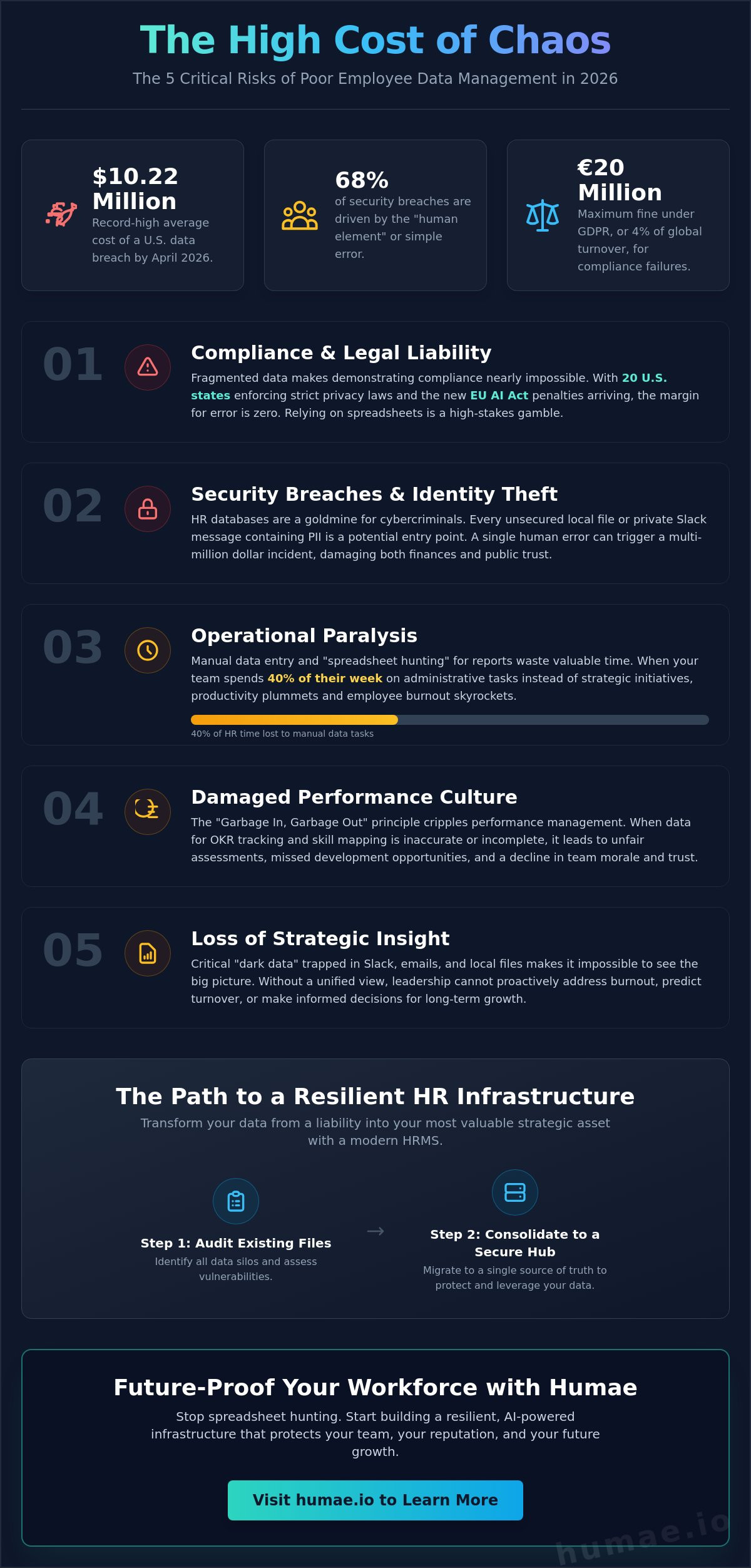
Managing a global, remote-first team in 2026 requires more than just a digital filing cabinet. It demands a strategy. When data is scattered across Slack, email, and local drives, you aren't just disorganized; you're vulnerable. The High Cost of Chaos becomes apparent when small errors snowball into systemic failures. These risks of poor employee data management can cripple even the most innovative companies if left unchecked.
- Compliance and Legal Liability: With GDPR fines reaching up to €20 million or 4% of global turnover, and 20 U.S. states now enforcing strict privacy laws as of January 2026, the margin for error is zero.
- Security Breaches and Identity Theft: HR databases are goldmines for cybercriminals. In April 2026, reports showed the average cost of a U.S. data breach hit a record $10.22 million, often triggered by simple human error.
- Operational Paralysis: Your HR team shouldn't spend 40% of their week "spreadsheet hunting." Manual data entry is a productivity killer that prevents your people experts from doing actual people work.
- Eroding Employee Trust: Privacy mishandling or repeated errors in time-off balances damage the psychological contract with your team. If you can't manage their data, they won't trust you to manage their career.
- Strategic Blindness: Leadership cannot steer a ship using "ghost data" or outdated records. Inaccurate analytics lead to poor hiring decisions and failed retention strategies.
If these challenges sound familiar, it might be time to see how a centralized HRMS can simplify your workflows and secure your most sensitive information.
Compliance and the Global Regulatory Maze
One of the quietest risks of poor employee data management is "zombie data." This refers to keeping sensitive records longer than legally permitted, which is a direct violation of modern "right to be forgotten" statutes. In a multi-region workforce, this becomes a nightmare. Poor management also leads to the misclassification of workers. Mistaking a W2 employee for a 1099 contractor can trigger immediate audits and massive back-tax penalties, especially with the stricter ICE guidance issued in March 2026.
The Security Vulnerability of Scattered Files
Sharing a password for a shared HR spreadsheet is a catastrophic security risk. It bypasses audit trails and leaves your team's PII exposed to anyone with the link. We also see the rise of "Shadow HR," where managers keep their own unofficial records because they don't trust the central system. This creates a fragmented security perimeter that's impossible to defend. A single unencrypted file sitting in a manager's "Downloads" folder can lead to a multi-million dollar data breach that destroys company reputation overnight.
How Bad Data Sabotages Performance and OKR Tracking
Performance management in 2026 isn't a once-a-year event; it's a real-time conversation fueled by data. When that data is flawed, you fall victim to the "Garbage In, Garbage Out" rule. This is especially true for OKR tracking, where progress is measured by specific, data-driven key results. If your inputs are stuck in outdated spreadsheets, your objectives become meaningless. You can't build a high-performance culture on a foundation of guesswork. One of the greatest risks of poor employee data management is that it creates a false sense of success while masking underlying failures.
Modern workforce intelligence relies on AI-driven sentiment analysis to detect subtle shifts in team morale. However, AI is only as smart as the information it processes. Fragmented data silos hide the early warning signs of top-performer burnout and low engagement. When your data is clean and centralized, you can see these patterns before they lead to resignations. Without it, you're essentially flying blind, unable to distinguish between a productive team and one that's just days away from a mass exit.
The Failure of Performance Intelligence
Manual performance reviews are notoriously biased. Without a unified data source, managers often rely on recent memories or "gut feelings" rather than objective history. This leads to unfair evaluations and "stagnant skillsets" because training progress isn't being tracked accurately. To be effective, your analytics dashboards need real-time updates from a single source of truth. Relying on fragmented records is one of the primary risks of poor employee data management that prevents you from identifying and nurturing your future leaders.
Employee Engagement and the Data Connection
Winning the talent war in 2026 requires more than just perks. It requires data-driven employee engagement strategies that address specific pain points. When you ignore grievance data or fail to track how employees interact with your internal tools, you lose the pulse of your culture. Transparent data access actually empowers your team. When employees can see their own growth metrics and time-off balances accurately, it builds intrinsic motivation and trust. Opaque or incorrect data breeds resentment and disengagement, eventually hollowing out your company culture from the inside.
A Roadmap to Modernizing Your HR Data Infrastructure
Fixing a broken system requires more than just moving files to the cloud. It demands a total structural shift. If you've been struggling with the risks of poor employee data management, the path forward starts with radical organization. Replacing chaos with clarity isn't an overnight task, but it's the only way to protect your business in 2026's aggressive regulatory environment. You can't leverage AI or scale your team if your foundation is built on brittle spreadsheets.
Follow these five steps to build a resilient data core:
- Step 1: Conduct a Data Audit. Locate every "Shadow HR" spreadsheet, paper file, and unencrypted Slack export. You can't secure what you don't know exists.
- Step 2: Consolidate into an HRMS. Move all verified data into a single source of truth. This eliminates the "dark data" problem where critical info is lost in manager-level silos.
- Step 3: Establish Access Controls. Use role-based permissions and end-to-end encryption. Only 32% of companies currently limit HR data access to a "need-to-know" basis, leaving them wide open for internal breaches.
- Step 4: Automate the Lifecycle. From the first interview to the final exit interview, automate data entry points. This reduces human error, which currently accounts for 68% of all data breaches.
- Step 5: Implement Feedback Loops. Use AI tools to monitor sentiment and performance trends in real time. This moves you from reactive fire-fighting to proactive workforce intelligence.
By following these steps, you eliminate the most dangerous risks of poor employee data management that lead to multi-million dollar fines. Ready to build a secure foundation? See how Humae works to centralize your data today.
Transitioning from Spreadsheets to Systems
Moving to a modern workforce management infrastructure requires a "clean as you go" philosophy. Don't just import messy data into a new system. Verify every record first. Train your HR team to stop being data entry clerks and start being data strategists who understand how to interpret analytics for leadership. This shift is essential for complying with the stricter ICE guidance issued in March 2026 regarding Form I-9 documentation.
Evaluating Modern HR Platforms
When choosing a platform, focus on three pillars: Security, Scalability, and UX. A system that's too complex won't be used, leading managers back to their private "Shadow HR" files. Look for self-service portals that allow employees to update their own info. This keeps data accurate while reducing the administrative load on your team. Ensure the platform supports deep OKR integration so your performance data is always connected to your business goals.
Future-Proof Your Workforce with Humae
In 2026, the distance between a thriving company and a legal disaster is often just a single unencrypted spreadsheet. We've explored how the risks of poor employee data management can drain millions from your bottom line and destroy team trust. These pitfalls aren't inevitable. Humae was built to replace this chaos with a seamless, human-centric experience that turns your workforce data into your greatest competitive advantage. We don't just store information; we empower your people to do their best work without the fear of security gaps or compliance failures.
Centralized Management for Modern Teams
Success begins with a clear view of your organization. Humae streamlines everything from the initial hiring phase in our Applicant Tracking System to daily directory management. Our platform's features are designed to protect sensitive PII while keeping it accessible to those who need it. Integrating time-off management directly into your directory prevents operational gaps and ensures that resource allocation is always based on real-time availability. This unified approach eliminates the "Shadow HR" problem where managers keep their own unofficial and insecure records.
Actionable Insights at Your Fingertips
Data should drive decisions, not just fill folders. Using Humae's analytics dashboards, you can move from reactive record-keeping to proactive growth. Our AI-driven sentiment analysis helps you stay ahead of cultural risks by identifying burnout before it leads to a resignation. You can empower your team with real-time feedback loops and transparent OKR tracking, ensuring everyone is aligned with company goals. It's time to join the modern HR revolution. Secure your data, protect your people, and build a resilient infrastructure that's ready for whatever 2026 brings.
Turn Your HR Data into a Strategic Advantage
The business landscape of 2026 demands a permanent shift from reactive record-keeping to proactive workforce intelligence. We've seen how the record-breaking $10.22 million average cost of U.S. data breaches makes security a survival issue rather than a technical detail. By centralizing your information, you don't just avoid the risks of poor employee data management; you unlock the ability to lead with clarity. Every spreadsheet you eliminate is a vulnerability closed and a new opportunity for growth opened.
Humae provides the secure, intuitive interface modern global teams need to thrive. Our AI-driven sentiment analysis and centralized workforce management infrastructure turn fragmented files into a growth-driving asset. It's time to leave the chaos of spreadsheets behind and build a culture where every team member feels secure and valued. Optimize your team's growth with Humae's AI-powered platform today and step into the future of HR with confidence. Your team deserves a foundation built on trust, innovation, and human-centered technology.
Frequently Asked Questions
What are the most common employee data management mistakes?
The most frequent errors include using disconnected spreadsheets and keeping "zombie data" beyond legal retention periods. Many teams suffer from "Shadow HR," where managers store unofficial records in unencrypted local folders. These habits increase the risks of poor employee data management by creating massive security gaps. Since 68% of data breaches involve a human element, relying on manual entry instead of a centralized HRMS is a recipe for disaster.
How does poor data management affect employee retention?
Poor data management directly damages retention by breaking the psychological contract between the employer and the team. If employees see errors in their time-off balances or feel their PII is handled carelessly, their trust evaporates. Data silos also hide the early warning signs of top-performer burnout. When you can't track engagement accurately, you lose your best talent to competitors who use data-driven retention strategies.
Is it safe to store employee data in the cloud in 2026?
Cloud storage is significantly safer than local spreadsheets in 2026 if you use a platform with end-to-end encryption and role-based access. With the average U.S. data breach cost hitting $10.22 million in April 2026, professional cloud providers offer security layers that local networks simply can't match. Centralized cloud systems allow for real-time auditing and immediate containment of potential threats, which is vital given that identification takes 181 days on average.
What are the legal consequences of a PII data breach?
Legal consequences include massive fines under GDPR, which can reach €20 million or 4% of global turnover. In the U.S., CCPA penalties as of March 2026 range from $2,663 for unintentional violations to $7,988 for intentional ones. Beyond fines, you face immediate audits from agencies like ICE, which recently reclassified many common I-9 errors as substantive violations subject to immediate financial penalties that can reach $2,861 per violation.
How can AI improve the accuracy of my HR data?
AI improves accuracy by automating data validation and identifying anomalies that human eyes often miss. It eliminates the "Garbage In, Garbage Out" problem by ensuring that performance intelligence is based on verified, real-time inputs. By leveraging AI-driven sentiment analysis, you can turn raw data into workforce intelligence. This allows you to predict turnover risks and cultural shifts with much higher precision than manual reporting ever could.
What should be included in an HR data privacy policy?
An effective policy must include clear guidelines on data minimization, purpose limitation, and employee access rights. As of January 2026, 20 U.S. states have unique privacy laws, so your policy must address these regional nuances. It should explicitly state how long data is stored and who has access to it. Transparency in these policies isn't just a legal requirement; it's a key part of building a modern, trust-based employer brand.
Can poor data management lead to payroll errors?
Yes, incorrect employee data is a primary driver of payment discrepancies and tax filing errors. One of the major risks of poor employee data management is the misclassification of workers as contractors instead of employees. This leads to immediate back-tax liabilities and legal disputes. When time-off or attendance records are scattered across different tools, the data sent to your finance systems is often outdated or simply wrong.
How often should HR data be audited for accuracy?
You should conduct a comprehensive data audit at least once every quarter to ensure compliance with shifting global regulations. High-risk information like PII requires constant monitoring, while performance metadata can be reviewed annually. Regular audits prevent the accumulation of "dark data" and ensure your analytics dashboards remain reliable. This proactive approach is essential for maintaining the "Data Cleanliness" required for a high-performing, AI-ready HR infrastructure.