The Hidden Cost of Chaos: 5 Critical Challenges with Disconnected HR Systems in 2026
By Humae · 4 May 2026
challenges with disconnected hr systems
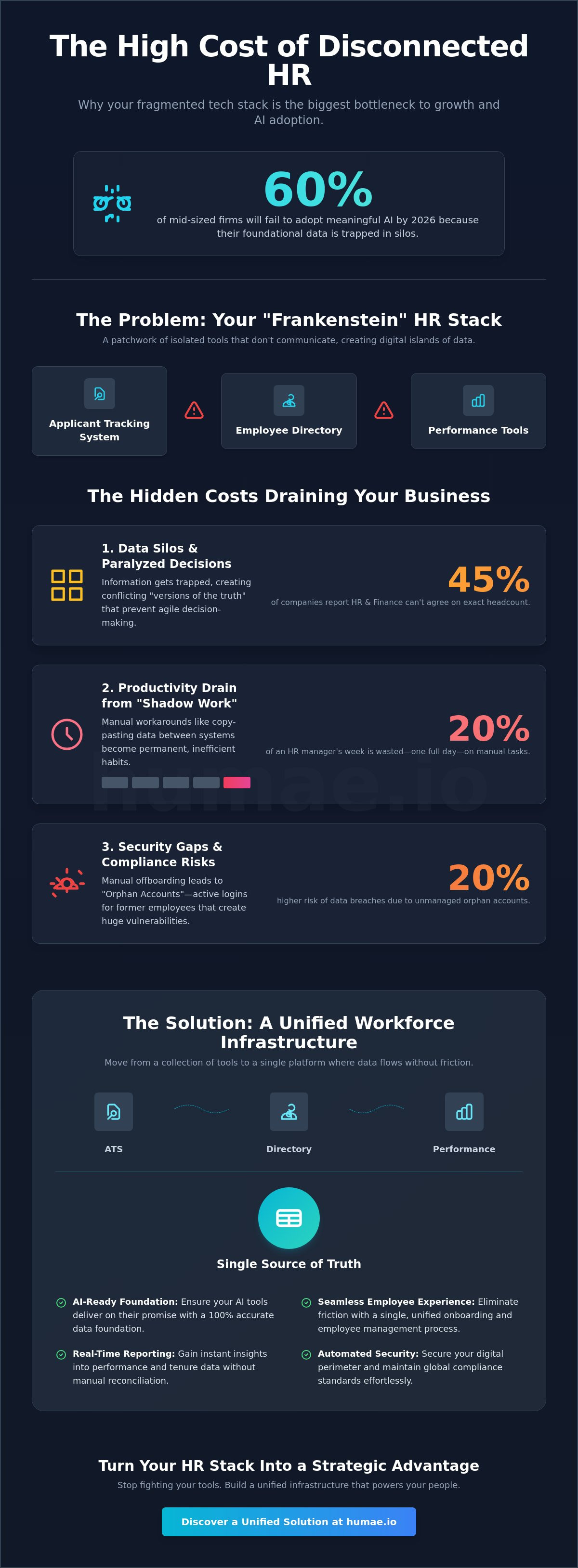
What if the tools designed to streamline your day are the exact things holding your team back? By 2026, industry reports indicate that 60% of mid-sized firms will fail to adopt meaningful AI because their foundational data remains trapped in silos. You likely know the frustration of performing manual shadow work just to sync a single spreadsheet across three different platforms. It's exhausting to chase a clear picture of performance when your tools don't talk to each other. These challenges with disconnected hr systems act as a silent tax on your productivity, creating a technical debt that prevents your culture from thriving.
You're ready for a change that prioritizes people over processes. This guide reveals how to move past fragmented technology toward a unified, AI-ready workforce infrastructure that provides a single source of truth. We'll break down the five most critical hurdles to automation and show you how to gain insights that drive real growth. It's time to turn your HR stack into a strategic advantage.
Humae: Modern, technology-driven, and deeply human-centric solutions for the future of work. Return to Home | Connect with us on Facebook
Key Takeaways
- Identify why a "Frankenstein" stack of isolated tools prevents data flow and limits your 2026 growth potential.
- Secure your digital perimeter by managing "Orphan Accounts" and maintaining global compliance standards across your entire tech ecosystem.
- Overcome the primary challenges with disconnected hr systems to ensure your AI tools deliver a 100% accurate data foundation.
- Eliminate the "shadow work" that drains HR productivity and create a seamless onboarding experience that candidates actually enjoy.
- Build a unified workforce infrastructure that provides a single source of truth for all employee performance and tenure data.
Humae: Modern, technology-driven, and deeply human-centric solutions for the future of work. Return to Home | Connect with us on Facebook
The "Frankenstein" Stack: Defining Disconnected HR Systems in 2026
Disconnected HR systems are independent software tools that lack a shared data layer; they're digital islands that don't communicate. In 2026, the typical "Frankenstein" stack consists of a separate Applicant Tracking System (ATS), a standalone employee directory, and isolated performance management tools. Most companies fall into this trap during the frantic days of startup scaling. They buy a tool to fix a specific fire, then another, and another. Before they know it, they've built a patchwork monster that requires manual intervention at every step. This fragmentation is one of the primary challenges with disconnected hr systems today. We must evolve toward a true Workforce Management Infrastructure that connects every touchpoint of the employee lifecycle.
While a traditional Human Resource Management System (HRMS) was once enough to centralize records, the modern explosion of niche SaaS products has fragmented the data landscape again. To stay competitive, businesses need to move away from simply "owning tools" and start building a unified foundation where data flows without friction.
The Data Silo Phenomenon
Information gets trapped in niche applications, creating a "version of the truth" conflict that paralyzes decision making. Recent 2025 industry surveys show that in 45% of mid sized companies, HR and Finance departments cannot agree on exact headcount because their systems sync on different schedules. A data silo is a structural barrier to organizational agility. When your performance data doesn't talk to your tenure data, you lose the ability to spot high performers before they burn out. This disconnect forces your team to spend hours reconciling data instead of supporting your people.
Why "Good Enough" Tech is Your Biggest Growth Bottleneck
Scaling businesses often rely on manual workarounds that eventually become permanent, inefficient habits. These "shadow tasks" take up 20% of an HR manager's week, effectively wasting one full day of productivity every single week. If you're constantly copy-pasting data between browser tabs, your tech isn't helping; it's hindering. You can't build a high performance culture on top of broken pipes. Understanding the shift toward modern HR infrastructure is the first step in moving from a collection of tools to a unified platform. Consider these specific bottlenecks:
- Onboarding Friction: New hires entering the same personal details into four different portals.
- Reporting Lag: Taking 72 hours to pull a simple report that should be available in real time.
- Security Gaps: Forgetting to revoke access to a specific tool because it isn't linked to the central directory.
A tool solves a task; a platform powers a strategy. By 2026, the difference between a market leader and a struggling firm is the quality of their data pipelines. Transitioning to a unified infrastructure isn't just about software; it's about giving your people the clarity they deserve.
The Hidden Security and Compliance Risks of Fragmented Data
Security often feels like a digital fortress, but for many organizations, the back door is left wide open by their internal tools. One of the most dangerous challenges with disconnected hr systems is the accumulation of technical debt that translates directly into legal liability. When your software doesn't sync, your security protocols can't keep up with the speed of your business. This isn't just an IT problem; it's a fundamental risk to your company's reputation and your employees' trust.
Orphan Accounts: The Security Gap You Can’t See
Manual offboarding is a process fraught with human error. When an employee leaves, their access must be revoked across every single tool in your stack. In fragmented environments, it's easy to miss one. These orphan accounts, which are active logins for former employees, lead to a 20% higher risk of unauthorized data access. A unified HRMS solves this by automatically triggering IT provisioning. This ensures that access is granted or revoked the moment a status changes in the central directory, leaving no room for "forgotten" permissions.
Audit Failures and Legal Liabilities
Managing global privacy standards like GDPR or CCPA across five or more disconnected tools is a logistical nightmare. Every time a "right to be forgotten" request arrives, HR teams must manually scrub data from multiple databases. These challenges with disconnected hr systems make compliance a moving target. According to federal guidelines on Protecting Personal Information, every manual export or spreadsheet transfer is a potential point of failure that could lead to a breach.
Labor audits don't care about your technical limitations. They care about accuracy. Producing unified reports during an audit is nearly impossible when your time off data lives in one tool and your employee directory lives in another. These discrepancies lead to inaccurate record keeping and potential legal fines. Using a centralized infrastructure eliminates the need for these risky workarounds by maintaining a single, immutable record for every team member. Moving to an integrated system isn't just about efficiency; it's about building a shield around your company and your people. If you're ready to secure your data and your future, it's time to look at how a unified platform can protect your growth.
Why Disconnected Systems Kill Your AI and Analytics ROI
AI is the most sought-after feature in HR tech for 2026, yet industry data shows that 70% of AI initiatives fail due to poor data quality. It's the classic "Garbage In, Garbage Out" rule. When your data is scattered across five different platforms, your AI tools are essentially working with puzzle pieces from different boxes. This fragmentation is a core reason why the challenges with disconnected hr systems are so costly. You're paying for advanced intelligence but receiving mediocre guesses. If your recruitment data doesn't flow into your performance records, your AI can't learn what "success" actually looks like for your specific culture.
Predictive analytics require a deep well of historical context to be effective. If your system can't see the link between a candidate's initial assessment scores and their performance reviews three years later, it can't help you hire better. Real-time talent density mapping becomes impossible. You need to see where your high-impact players are concentrated, but if that data is trapped in a standalone spreadsheet, your AI remains blind. You lose the ability to spot high-potential leaders before they look for opportunities elsewhere.
The Failure of Predictive Performance Intelligence
AI needs more than just a snapshot; it needs the story of an employee's career. When OKR tracking is isolated from the main employee directory, the system can't correlate goals with tenure or team dynamics. This gap prevents you from predicting turnover before it happens. Modern infrastructure allows for a continuous feedback loop where AI analyzes every interaction to suggest proactive talent moves. Without a unified layer, you're stuck with reactive management. You miss out on:
- Automated succession planning based on real-time skill acquisition.
- Predictive churn alerts that flag burnout 30 days before a resignation.
- Optimized team composition based on historical collaboration data.
Losing the Pulse: Sentiment and Engagement Gaps
Static engagement surveys are becoming a relic of the past. If you're waiting until the end of the quarter to ask how people feel, you've already lost the chance to fix the problem. Effective employee engagement strategies in 2026 rely on real-time pulses. AI-driven sentiment analysis requires a single stream of workforce data to identify the subtle shifts in communication that signal burnout.
These challenges with disconnected hr systems mean you can't see how a change in leadership or a new project rollout affects morale until the exit interviews start. A unified system turns data into a living map of your company's health. It's the difference between looking at a polaroid and watching a live 4K feed of your organization's heart. When your technology is connected, your insights actually work for you.
The Human Cost: Employee Experience and HR Team Burnout
HR professionals aren't just administrators; they're the architects of company culture. But when your tech stack is a maze of isolated islands, your team becomes a "human API." Instead of mentoring talent or building growth strategies, they're stuck in a cycle of shadow work. These challenges with disconnected hr systems lead to a specific type of exhaustion. It's the frustration of knowing you're wasting potential on "data janitoring" because two platforms refuse to talk to each other. By 2026, the best talent will flock to companies that value their time, starting with the tools they use every day.
When employee records like time-off balances or job titles are incorrect, trust begins to erode. An employee who has to argue about their remaining vacation days because of a sync error feels undervalued. Choosing unified technology is more than a budget decision; it's an act of empathy for your HR team and your workforce. It removes the friction that makes work feel like a chore.
Friction in the Onboarding Journey
The first 90 days of an employee's tenure are critical for long-term retention. A unified platform creates a "Day One" that feels like a warm welcome, where logins are ready and profiles are pre-filled. In contrast, a fragmented stack forces a new hire to re-enter their banking details and home address into four different portals. This disconnected ATS-to-HRMS handoff creates a poor first impression; it signals that the organization is disorganized. A centralized employee directory is essential for social integration, allowing new team members to find their peers and understand the reporting structure without hunting through spreadsheets.
The Psychological Impact of "Manual Syncing"
Repetitive, low-value administrative tasks are the silent killers of HR morale. A 2024 industry report by Sapient Insights Group highlighted that HR teams in fragmented environments spend 30% of their time on manual data entry. This isn't just inefficient; it's demoralizing. When you're busy syncing spreadsheets, you can't focus on strategic leadership or mental health initiatives. Consider the trade-offs:
- Unified Infrastructure: Automated data flow, 100% record accuracy, and more time for people-first strategy.
- Fragmented Tools: High risk of human error, increased HR burnout, and a disjointed employee experience.
Stop the manual chaos and unify your workforce experience to let your HR team focus on people again.
Building a Unified Workforce Infrastructure with Humae
Solving the 2026 fragmentation crisis requires more than just better middleware or faster syncs. It requires a fundamental shift in how organizations view their people data. Humae acts as the visionary partner your business needs, moving you away from a collection of isolated tools toward a truly integrated workforce infrastructure. We don't just bridge the gaps; we eliminate them by providing a single, AI-powered foundation where every piece of information has a home. This approach directly addresses the challenges with disconnected hr systems by ensuring that your data is always live, accurate, and ready for action.
A single interface is the key to high adoption rates among both managers and employees. When people don't have to hunt for information across multiple portals, they use the system more effectively. Humae integrates native OKR tracking and performance intelligence into the daily workflow, making growth a continuous conversation rather than a quarterly chore. This unity turns your HR stack from a source of frustration into a strategic engine that powers your company culture.
Centralizing Your People Operations
Imagine the clarity of having hiring, onboarding, and your employee directory in one place. This centralization means that when a candidate signs their offer, their profile is already built, their team is notified, and their first week of training is scheduled. Real-time analytics dashboards replace the days of manual reporting, giving you instant visibility into talent density and team health. You can explore how these components work together on the Humae features page, where we break down the specific tools designed to simplify your day.
Future-Proofing with AI-Driven Intelligence
Humae’s AI doesn't just process data; it leverages a unified stream of information to provide actionable growth insights. Because the data isn't siloed, the AI can see the full story of an employee’s journey, from their first interview to their most recent promotion. This enables continuous feedback loops that are far more effective than traditional annual reviews. It's about moving from management to modern leadership, where data serves the human experience. By 2026, the most successful firms will be those that use technology to become more human, not less. Humae is here to ensure your infrastructure is ready for that future.
Unify Your Workforce for a 2026 Competitive Edge
The technical debt of a fragmented stack is too high to ignore. Manual offboarding leads to a 20% higher risk of unauthorized access; HR teams lose 30% of their week to data janitoring. These challenges with disconnected hr systems prevent your AI from delivering the 100% accurate insights you need to lead effectively. By centralizing your workforce management infrastructure, you protect your people and your data while unlocking real-time OKR and sentiment analysis. It's time to stop chasing spreadsheets and start building a culture of clarity. Humae provides the AI-powered performance intelligence needed to turn your HR data into a strategic growth engine. Stop the fragmentation and start scaling with Humae’s unified HR platform. Your team deserves a system that works as hard as they do. Let's build a future where technology serves the human experience.
Frequently Asked Questions
What are the most common signs of disconnected HR systems?
Manual data entry across platforms and conflicting reports are the clearest signs of fragmentation. If your HR team spends hours each Monday morning syncing spreadsheets between your ATS and payroll, your systems are disconnected. You'll often see different headcount numbers in Finance versus HR; this leads to confusion during executive meetings and stalls decision making.
How much does disconnected HR technology actually cost a company?
Fragmented tech costs companies through productivity loss and "shadow work." According to 2024 industry benchmarks, organizations with fragmented stacks lose approximately $4,500 per employee annually in hidden administrative overhead. These challenges with disconnected hr systems also lead to expensive compliance fines when employee data isn't purged correctly across all silos.
Can integration tools (middleware) fix a fragmented HR stack?
Middleware provides a temporary bridge but doesn't solve the underlying data architecture problem. While tools like Zapier can move data, they often break when software updates occur. Relying on middleware creates technical debt because you're managing the connection instead of focusing on people strategy. A native platform is always more stable.
How do disconnected systems impact employee retention?
Disconnected systems lead to a 15% lower retention rate due to poor employee experiences. When new hires struggle with multiple logins or see incorrect payroll data, their trust in the organization drops immediately. Frictionless technology shows employees that you value their time; it's a key driver of long term loyalty in 2026.
Is it better to have "best-of-breed" tools or an all-in-one HRMS?
An all-in-one HRMS is now superior for 90% of mid sized businesses because it ensures data integrity. While "best-of-breed" tools offer niche features, the cost of the challenges with disconnected hr systems usually outweighs those benefits. A unified platform allows for AI driven insights that niche tools simply can't generate without a complete data set.
What is the first step in consolidating a fragmented HR tech stack?
Audit your existing tools and identify where data entry is repeated most often. Map out every point where an HR manager has to copy information from one screen to another. This data flow map reveals the biggest bottlenecks and helps you prioritize which systems to replace with a unified workforce infrastructure first.
How does unified HR software improve data security?
Unified software centralizes access control, ensuring that one "off" switch removes a user from every tool. This eliminates the risk of former employees retaining access to sensitive company data through forgotten accounts. It also ensures that all data handling follows a single, audited security protocol instead of five different ones.
What is workforce management infrastructure vs. traditional HR software?
Workforce management infrastructure is a proactive, AI ready layer that connects performance, hiring, and culture. Traditional HR software is often just a digital filing cabinet for records. Infrastructure focuses on the flow of data and the employee experience; traditional software focuses on static compliance and basic administration.