Software for Cascading OKRs: Bridging the Gap Between Strategy and Execution
By Humae · 12 June 2026
software for cascading okrs
What if your strategy wasn't just a document, but a living map every employee actually used? Most leaders feel the frustration of strategic silos where departments work at cross-purposes, often trapped in manual spreadsheets that nobody updates. It's a common struggle that leads to a lack of visibility into progress across the organization. Finding the right software for cascading okrs isn't about adding more admin work. It's about fixing the disconnect between high-level vision and daily execution.
You probably agree that when people don't see how their work matters, engagement drops and growth stalls. We've seen this happen in even the most ambitious companies. This article shows you how the right tools transform static goals into a dynamic, aligned ecosystem that drives measurable growth across your entire organization. We'll preview the move toward a unified "North Star," increased employee engagement through purpose-driven work, and data-driven decision making based on real-time progress.
Key Takeaways
- Bridge the strategic gap by connecting individual daily tasks to the organization's mission for measurable growth.
- Identify the essential features of software for cascading okrs that transform manual tracking into a dynamic, visual ecosystem.
- Apply the 60/40 rule to foster a balanced goal-setting environment that combines top-down vision with bottom-up innovation.
- Implement a frictionless rollout strategy using pilot teams and a steady cadence of accountability.
- Leverage performance intelligence to understand the human sentiment and purpose driving your strategic results.
The Strategic Power of Cascading OKRs in 2026
Strategy on paper is just a wish list if it doesn't reach the front lines. In 2026, the most successful organizations don't just set goals; they build a living bridge between the boardroom and the individual contributor. This bridge is built through Objectives and Key Results (OKRs). Cascading OKRs is the intentional process of aligning every team and individual goal with high level company objectives. It's not about top down control. It's about creating a shared language of success where every heartbeat in the organization pushes the needle forward.
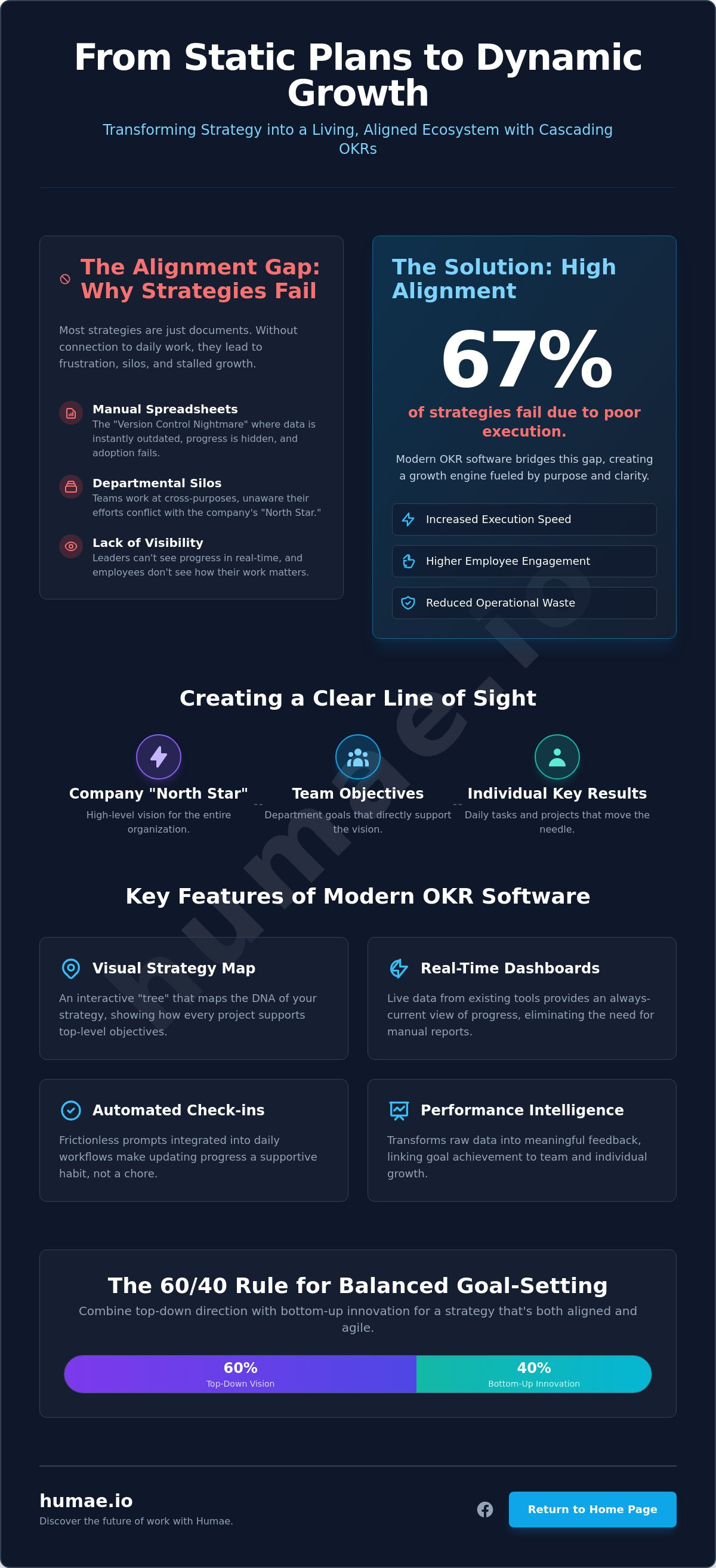
The stakes are high. Research indicates that 67% of well formulated strategies fail due to poor execution. This "Alignment Gap" happens when departments work in isolation, unaware that their efforts might actually be at cross purposes with the company's "North Star." When you implement software for cascading okrs, you give every employee a clear line of sight. They finally see how their daily tasks move the needle for the entire organization, which fuels a deeper sense of purpose and commitment.
The business world has moved past rigid annual planning. In 2026, agility is the only competitive advantage. Static goals are a liability. Organizations now require continuous, agile alignment that allows for quick pivots without losing sight of the ultimate destination. This dynamic approach ensures that as the market shifts, your teams shift with it, staying synchronized in real time through modern software for cascading okrs.
Why Spreadsheets Fail at Scale
Many teams start their journey with manual tracking, but they quickly hit the "Version Control Nightmare." When goals live in isolated files, data becomes outdated within days. Missed deadlines often go unnoticed until it's too late to recover. Silos form naturally when progress is hidden in private folders. This massive administrative burden often kills employee adoption before the first quarter ends, turning a strategic tool into a chore that nobody updates.
The ROI of High Alignment Organizations
High alignment isn't just a management theory; it's a growth engine. Organizations that master alignment see significantly higher employee retention and engagement rates because people stay where they feel their work matters. Execution speed increases because aligned teams don't waste time second guessing their priorities. Cascading OKRs reduce operational waste by eliminating redundant projects that don't serve the core mission. This focus allows your organization to pivot faster to market changes, turning strategy into a tangible competitive edge.
Key Features of Modern Cascading OKR Software
Choosing the right tool is about more than just checking boxes; it's about finding a digital partner that mirrors your organizational culture. Modern software for cascading okrs does more than list tasks. It provides a visual "tree" that maps the DNA of your strategy. When an intern sees exactly how their project supports the CEO's quarterly objective, purpose becomes tangible. This transparency eliminates the "black box" of executive decision making. It turns a complex goal-setting framework into an interactive roadmap that everyone can follow.
Static updates are the enemy of execution. Modern platforms utilize real-time dashboards that pull live data from your existing tools. Instead of chasing managers for monthly reports, automated check-ins prompt users for quick updates within their daily workflows. This reduces friction and ensures the data stays fresh. It's about making the process feel like a supportive habit rather than an administrative burden. When progress is visible to everyone, accountability happens naturally through peer support rather than top down pressure.
Linking goal achievement to broader employee growth is the final piece of the puzzle. Performance intelligence transforms raw data into meaningful feedback loops. It allows you to see not just what was achieved, but how the team grew in the process. This human centric approach ensures that high performers are recognized and those struggling receive the right support at the right time.
AI-Powered Goal Assistance
Managers often struggle to articulate measurable results. AI now acts as a strategic coach, helping leaders write sharper Key Results using natural language processing. Beyond drafting, predictive analytics identify "at-risk" objectives weeks before they fail. By analyzing progress patterns, performance intelligence software provides actionable insights that allow leaders to intervene with empathy and precision. It’s not just about tracking numbers; it’s about understanding the human story behind the data.
Integration with Workforce Infrastructure
Strategy shouldn't live in a vacuum. Effective software for cascading okrs must be deeply embedded in your core HRMS. When your goal platform syncs with onboarding data and time-off schedules, you ensure that assignments remain realistic and fair. This holistic view is why a centralized workforce management infrastructure is essential for strategic planning in 2026. If you want to see how this looks in practice, you can explore our OKR tracking features to see the difference integration makes.
Alignment vs. Cascading: Choosing the Right Flow
Many leaders view cascading as a strict waterfall, where goals tumble down from the executive suite to the front lines. This top-down approach feels orderly, but it often stifles the very innovation it seeks to measure. Modern software for cascading okrs allows for "Shared Alignment" instead. This means that while high-level objectives provide the direction, teams have the autonomy to define how they get there. We recommend the 60/40 rule: 60% of goals should be set bottom-up by the teams themselves, while 40% are directed from the top. This balance ensures that strategy stays grounded in operational reality.
Bidirectional alignment is where the magic happens. It’s a conversation, not a command. When individual contributors propose Key Results that challenge or refine the executive vision, the organization becomes more resilient. In matrixed organizations, "dotted line" dependencies are common. You need tools that visualize these cross-functional links, showing how a marketing goal might depend on a product launch timeline. This visibility prevents teams from working at cross-purposes, even when they don't share a direct manager.
The Myth of the Perfect Hierarchy
A rigid hierarchy is often an illusion. Forcing every goal into a perfect tree structure leads to "vanity metrics" that look good on a slide but don't drive actual value. These metrics give a false sense of progress while the real needle stays still. Breaking down silos requires cross-departmental OKRs where success is shared across teams. As noted in Bain & Company's guide to OKRs, a healthy mix of top-down and bottom-up feedback is crucial for a functional ecosystem. Some vital operational goals won't fit a strategic cascade perfectly, and that's okay. They still deserve visibility within your tracking system to ensure no effort is wasted.
Agility: Pivoting Goals Mid-Quarter
2026 demands radical flexibility. If a market shift happens in week six, you can’t wait for the next quarter to adjust. Modern software for cascading okrs lets you freeze, delete, or shift objectives without crashing the entire organizational system. The software should visualize the "ripple effect" instantly. If the CEO changes a primary objective, every linked team sees the impact on their specific Key Results immediately. This level of transparency prevents the confusion that usually follows a pivot. It keeps everyone moving together, even when the path changes, ensuring that execution remains as agile as the strategy itself.
Implementation Strategy: Rolling Out OKRs Without Friction
Rolling out strategy execution tools shouldn't feel like a corporate chore. It's a cultural transformation that requires a human touch. Successful implementation of software for cascading okrs relies on a phased approach that prioritizes people over rigid processes. You aren't just installing a dashboard; you're changing how your team thinks about their daily impact.
Phase 1 starts at the summit. You must secure executive buy-in and define the "North Star" objectives that will guide every subsequent decision. Without this clarity from the top, the rest of the organization lacks a destination. Phase 2 involves a pilot team. Select a small, agile group to test the software and framework. This allows you to iron out technical or cultural wrinkles before a full company-wide rollout. It's better to learn small than to fail big.
Phase 3 brings the whole team together through alignment workshops. During these sessions, departments map their specific objectives to the core company pillars. This ensures that every team understands their unique role in the larger story. Finally, Phase 4 establishes a cadence of accountability. This isn't about micromanagement. It's about creating a rhythm of weekly check-ins and monthly reviews that keep the momentum alive and ensure no one is left behind.
Training Your OKR Champions
Every department needs an advocate. Identify internal champions who naturally enjoy technology and strategy. These people help their peers navigate the software and provide "Goal Writing 101" resources to ensure Key Results stay measurable and actionable. If you're looking to upskill your management team for this transition, check out our guide on modern leadership skills. When managers feel confident, their teams feel supported.
Building a Culture of Transparency
Transparency is the secret sauce of high-performance cultures. When goals are public from the CEO to the intern, it drives employee engagement because everyone sees how they fit into the puzzle. You should reward "Learning over Winning." If a team misses an OKR, treat it as data for the next quarter rather than a failure. Use analytics dashboards to celebrate wins publicly and keep the energy high across the organization.
Ready to transform your strategy into measurable results? Start your journey with Humae today.
Why Humae is the Smartest Choice for Cascading OKRs
Humae redefines how modern teams approach strategy. Most tools stop at tracking progress, but we believe the true engine of any organization is its people. By integrating OKR tracking directly into your workforce management infrastructure, we ensure that goals aren't just abstract numbers on a screen. They're tied to the actual capacity, growth, and wellbeing of your team members. This holistic approach makes Humae the most effective software for cascading okrs for organizations that value both results and culture.
Our platform uses AI driven sentiment analysis to uncover the "human story" behind your metrics. If a Key Result is lagging, Humae helps you understand if it's a resource issue, a lack of clarity, or simply team fatigue. This turns raw goal data into actionable performance intelligence, allowing leaders to lead with empathy rather than just authority. The interface is designed for the modern employee experience: it’s fast, intuitive, and mobile ready, ensuring that staying aligned never feels like a burden.
Beyond Tracking: Predictive Performance
Humae identifies potential burnout or misalignment before it impacts your bottom line. By connecting OKRs to 1-on-1s and continuous feedback loops, we provide a 360 degree view of organizational health. It’s a proactive way to manage talent. This proactive approach makes us the preferred software for cascading okrs for leaders who prioritize people. Humae’s real-time tracking reduces administrative work by 40%, giving your managers more time to focus on coaching and less on chasing updates.
Centralized Strategy, Decentralized Execution
Leadership needs visibility, but teams need autonomy. Humae empowers your people to own their Key Results while keeping the "North Star" visible via high level dashboards. Having hiring, onboarding, and OKRs in a single interface means that new hires are aligned from their very first day. You don't have to jump between disconnected apps to see if your talent strategy matches your business goals. Take the next step in your management journey with Humae and build a culture where execution is as natural as the vision itself.
Empower Your Strategy with Human Centric Execution
Strategy is no longer a static document gathering dust. It's a living ecosystem where every team member plays a vital role. You've seen how bridging the alignment gap can turn execution failures into a measurable growth engine. By moving past rigid hierarchies and embracing bidirectional alignment, you empower your people to own their impact. Choosing the right software for cascading okrs is the final step in turning your 2026 vision into daily reality.
Humae offers more than just a tracking tool. It provides a higher level of experience for every stakeholder. With AI powered performance intelligence and real time OKR tracking dashboards, you gain the visibility needed to pivot without friction. Our integrated sentiment analysis ensures you never lose sight of the human story behind the data. Don't let your strategy get lost in translation. Start Aligning Your Team Today with Humae and build a culture where everyone rows in the same direction. Your North Star is finally within reach.
Frequently Asked Questions
What is the difference between cascading and aligning OKRs?
Cascading refers to the hierarchical structure where high-level company goals are broken down into child objectives for departments and teams. Aligning is a broader term that describes the connection between goals across different teams, including cross-functional dependencies. Modern software for cascading okrs handles both by visualizing the vertical hierarchy while allowing for horizontal links between departments. This ensures that every team understands their specific contribution to the company's "North Star."
How many levels deep should an OKR cascade go?
Most successful organizations find success with 2 to 3 levels of depth. This typically includes company-wide objectives, departmental goals, and team-level key results. Going deeper often leads to rigid structures and excessive administrative work that kills agility. Keeping the cascade shallow maintains focus and prevents teams from feeling micromanaged while still ensuring everyone stays synchronized with the core mission.
Can small startups benefit from cascading OKR software?
Startups gain a massive competitive edge by using cascading OKR software early in their journey. It prevents the common "founder bottleneck" where every decision relies on a single person's input. By defining clear objectives, lean teams can prioritize high-impact work and avoid redundant projects that waste resources. This structure builds a foundation of transparency that supports rapid scaling without losing the original company vision.
How does AI improve the OKR cascading process?
AI improves the process by acting as a strategic coach for managers and teams. It helps write sharper, measurable Key Results using natural language processing and identifies "at-risk" goals through predictive analytics. By analyzing progress patterns, AI allows leaders to intervene early with empathy. This turns raw data into actionable performance intelligence that supports a more human-centric and proactive management style.
Is it better to have top-down or bottom-up OKRs?
The most effective organizations use a hybrid approach, often following the 60/40 rule. This means 40% of goals are set top-down to provide strategic direction, while 60% are created bottom-up by the teams. This balance ensures that strategy stays grounded in operational reality. It empowers employees to innovate at the edges of the organization while remaining perfectly synchronized with the executive vision.
How often should we review cascaded OKRs?
You should establish a rhythm involving weekly check-ins and monthly reviews to maintain momentum. Weekly updates keep the data fresh and ensure small roadblocks don't turn into project killers. Monthly reviews allow leadership to assess the "ripple effect" of progress across the entire organization. This cadence prevents the "set it and forget it" trap often found in manual spreadsheets or outdated tracking systems.
What happens if a child objective is met but the parent objective is not?
If a child objective is met but the parent goal fails, it usually indicates that the chosen Key Results weren't the right levers for success. It’s a vital opportunity to learn rather than a reason for blame. This data point shows that the team worked hard on the wrong priorities or that external market factors shifted. Use this insight to refine your strategy for the next quarter.
Can cascading OKRs be used for individual performance reviews?
OKRs should provide context for individual performance reviews but shouldn't be the sole metric for compensation. They measure business outcomes and strategic impact rather than individual behavior or specific job skills. However, seeing how an employee consistently moves the needle on company goals helps managers provide more meaningful, data-driven feedback. It shifts the performance conversation from "what you did" to "how you contributed to our collective success."