Proactive Employee Issue Resolution: A Modern Leader's Guide to Grievances in 2026
By Humae · 19 July 2026
proactive employee issue resolution
U.S. businesses lose an estimated $359 billion annually in paid hours due to workplace conflict, with managers spending up to 40% of their time resolving disputes. It’s a staggering drain on resources that often stems from "invisible" cultural friction and subjective biases. You’ve likely felt the frustration of watching high-potential talent leave or seeing legal risks mount from mishandled grievances. You understand that a reactive approach is no longer enough in a fast-paced, hybrid world.
This guide empowers you to master the strategies of proactive employee issue resolution to transform workplace friction into data-driven growth. We’ll show you how to move beyond firefighting by implementing a framework for early detection and using performance intelligence to eliminate the ambiguity that causes disputes. You'll discover how modern tools like AI-driven sentiment analysis can help you catch issues before they escalate, reducing formal grievance filings and boosting your employee sentiment scores.
Key Takeaways
- Learn how to transition from reactive conflict management to a strategic partnership that identifies friction before it escalates.
- Discover how real-time OKR tracking eliminates role ambiguity and aligns individual work with clear company goals.
- Leverage AI-driven sentiment analysis as a powerful early warning system for proactive employee issue resolution.
- Follow a 5-step implementation plan to audit your HRIS for data visibility and upskill managers in emotional intelligence.
- Understand how centralized performance intelligence creates the transparency needed to reduce legal risks and boost employee sentiment.
What is Proactive Employee Issue Resolution? A 2026 Definition
In 2026, the traditional HR role has finally evolved. We've moved beyond the era of reactive policing, where leaders waited for a formal complaint to land on their desk before taking action. Today, proactive employee issue resolution is defined as a strategic framework designed to identify and neutralize workplace friction before it ever reaches the stage of employee grievance procedures. It’s about building a partnership between leadership and talent, rooted in real-time data and radical transparency. This approach recognizes that every formal grievance started as a small, unaddressed tension.
Modern leaders prioritize data-driven employee engagement strategies because they understand that traditional discipline is often a lagging indicator of cultural failure. When organizational transparency is high, litigation risks naturally drop. Employees who feel seen and heard don't need to resort to formal filings to protect their interests. This shift transforms HR from a cost center into a vital growth engine. It creates a culture where feedback is a tool for progress rather than a weapon for punishment.
Grievance vs. Friction: The Proactive Spectrum
Friction is the quiet predecessor to a grievance. It shows up in micro-frictions, like a subtle drop in communication speed or a slight dip in OKR progress. A casual complaint about a deadline might seem minor, but without early intervention, it can transform into a formal dispute. Proactive leaders track these patterns with precision. They don't wait for the explosion; they address the spark immediately. Effective documentation in this phase isn't about building a case against someone. Instead, it's about creating a record of support and building a bridge toward a collaborative solution.
The ROI of Solving Issues Early
The financial impact is impossible to ignore. U.S. businesses lose roughly $359 billion each year in paid hours due to workplace conflict, according to Speakwise data from April 2026. Even more startling is that a single formally escalated conflict can cost an average of $160,000 and take nearly a year to resolve. By mastering proactive employee issue resolution, you aren't just improving culture; you're protecting the bottom line. Early intervention leads to 50% quicker resolutions and a significant boost in long-term retention. Trust is built in the small moments of support, not the large moments of crisis. High-performing teams thrive when they know conflict won't be ignored.
The Infrastructure of Prevention: OKRs and Transparency
Role ambiguity is the silent killer of team morale. It serves as the primary driver for workplace grievances in 2026. When employees don't have a clear understanding of their responsibilities, friction is inevitable. Managers often spend up to 40% of their time resolving these disputes, yet 60% of them have never received formal conflict management training. You can't solve this through willpower alone. You need a structural solution that makes expectations undeniable and success measurable for everyone involved.
Understanding the OKR meaning within your organization is about more than hitting quarterly targets. It's about creating a shared roadmap. When individual work is directly aligned with company goals, the "invisible" friction caused by perceived unfairness disappears. Transparency isn't just a cultural value; it's the bedrock of proactive employee issue resolution. By making performance data accessible, you remove the mystery from professional success and replace it with a clear path forward.
A centralized employee directory serves as more than a digital contact list. It's a map of accountability that reduces hierarchy friction. When every team member can see who owns which project and how they contribute to the whole, silos begin to crumble. This level of openness ensures that performance data is never hidden. It fosters a culture where everyone knows where they stand, significantly reducing the interpersonal disputes that typically lead to formal HR filings.
Eliminating Subjective Bias with Performance Intelligence
Performance intelligence moves reviews from "gut feelings" to data-backed tracking. Real-time analytics ensure that every Key Result is measurable and visible to both the manager and the employee. This objectivity is a powerful shield against claims of unfair treatment. When employees see their progress reflected in hard numbers, the room for subjective dispute shrinks. It allows for a supportive coaching relationship rather than a combative one. You can see how these automated workflows simplify daily operations by visiting our homepage.
Workforce Management as a Cultural Foundation
Your workforce management infrastructure is the invisible scaffolding of your culture. Centralizing policies makes them searchable and clear, leaving no room for misunderstandings. Automated systems for time off management further reduce friction by standardizing approvals and removing manual bottlenecks. A modern HRMS makes these processes effortless. It creates a frictionless experience where the rules are consistent for every member of the team, regardless of their department or location.
AI and Sentiment Analysis: The Early Warning System
Waiting for an employee to voice a concern is often too late. By the time a formal complaint is filed, the professional relationship is already strained. In 2026, forward-thinking leaders are turning to AI as an invisible infrastructure to bridge this gap. Research from December 2025 shows that hybrid AI-human conflict resolution systems achieve a 67% resolution rate, significantly outperforming human-only methods. This technology doesn't replace the manager; it equips them with a radar for proactive employee issue resolution that operates in real time.
Sentiment analysis goes beyond simple keyword tracking. It identifies "heat maps" of friction across different departments, allowing leadership to see where cultural tension is rising before it affects productivity. Instead of relying on the biased results of annual surveys, which global engagement data shows fell to a record low of 20% in 2025, continuous feedback loops provide a living pulse of the organization. This data-driven approach balances technical precision with human empathy by highlighting exactly where a supportive conversation is needed most. It allows you to address the root cause of dissatisfaction before it becomes a legal liability.
Detecting Pre-Grievance Signals with AI
AI tools analyze communication patterns to spot early signs of burnout or frustration that a busy manager might miss. It can identify specific management styles that inadvertently trigger friction, providing a chance for course correction before a team’s morale collapses. To maintain trust, these systems use anonymized data. This ensures privacy while still giving leaders the insights they need to intervene effectively. It’s about spotting the signal in the noise without compromising individual security. You can see how these insights integrate into your daily workflow on our features page.
Continuous Feedback vs. High-Stakes Reviews
Annual reviews are a recipe for grievances. They force employees to stockpile months of frustration into a single, high-stakes meeting. Real-time feedback tools solve issues in the moment, preventing small misunderstandings from festering. Humae uses AI to prompt managers for timely check-ins based on real-time engagement data. This ensures that no team member feels neglected. By fostering a culture of constant, low-stakes dialogue, you create a workplace where problems are solved as quickly as they arise, turning potential conflict into an opportunity for growth.
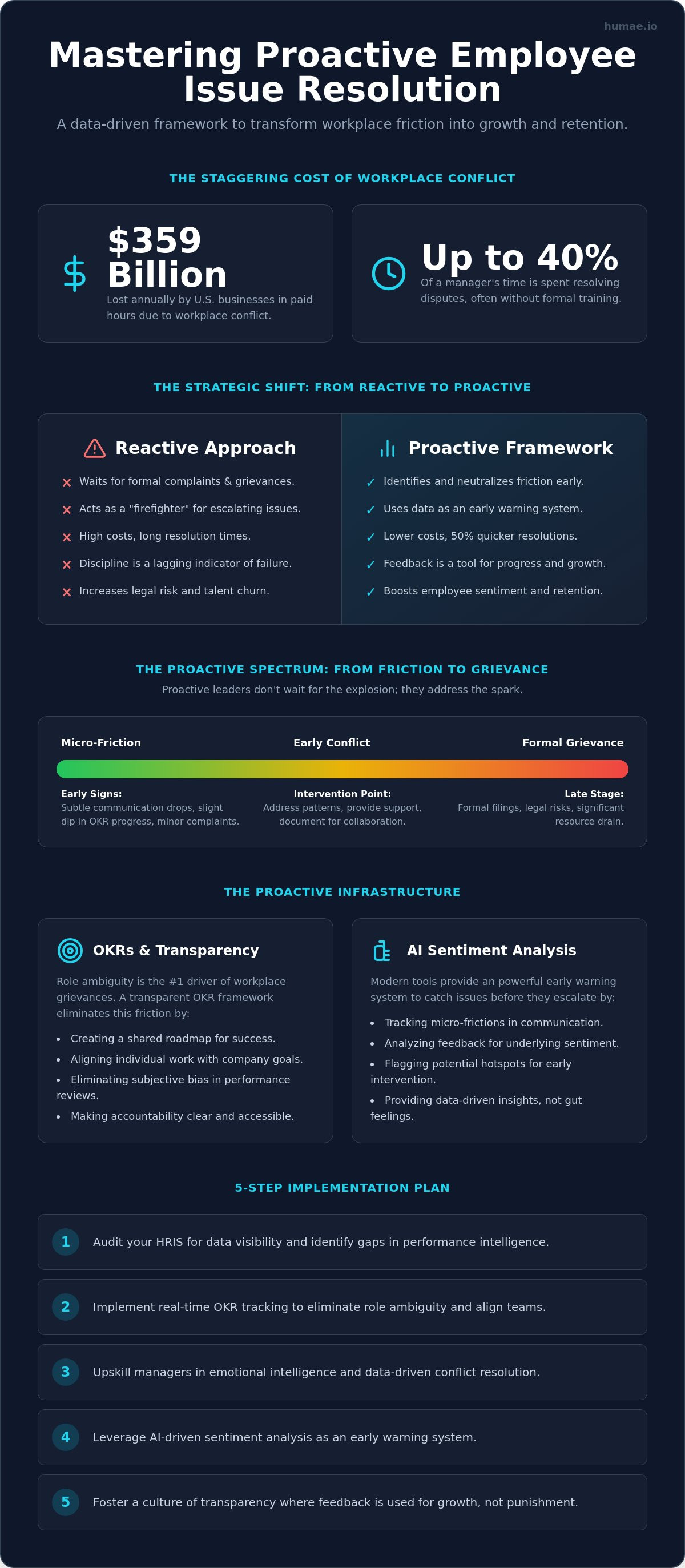
5 Steps for Implementing Proactive Employee Issue Resolution
Implementing a strategy for proactive employee issue resolution requires more than just good intentions. It demands a structured blueprint that combines advanced technology with high emotional intelligence. If you wait until a grievance is filed, you've already lost the battle for trust. By the time a formal process begins, the employee has likely already checked out mentally. Instead, follow these five strategic steps to build a culture where friction is solved in real time.
- Audit your data visibility: Review your current HRIS to ensure you have a clear, real-time view of engagement trends. Data silos are the enemies of prevention.
- Train for EQ: Equip managers with emotional intelligence and early de-escalation techniques. They should be able to navigate difficult conversations before they turn into disputes.
- Objective OKRs: Establish clear, measurable goals for every role. When expectations are objective, the room for perceived bias or unfair treatment disappears.
- AI Sentiment Tracking: Use anonymous pulse surveys to identify "heat maps" of tension. This allows you to intervene in specific departments where morale is dipping.
- Safe Space Policy: Create a formal framework for informal resolution. Employees need to know they can voice concerns early without fear of retaliation.
Training Managers for Proactive Leadership
The transition from a traditional boss to a modern coach is essential. Coaches use performance intelligence to support growth rather than to enforce discipline. We recommend conducting "Stay Interviews" at least twice a year to identify flight risks and hidden frustrations. By recognizing the early signs of a toxic sub-culture, such as a sudden drop in communication speed, managers can intervene with empathy. You can see how these coaching tools integrate into your workflow by exploring the Humae platform.
The Protocol for Informal Resolution
Speed is your greatest ally in proactive employee issue resolution. Set strict internal timelines for responding to informal concerns; ideally within 48 hours. Use internal mediation as a standard tool before any issue reaches a formal stage. It's also vital to document these "informal wins." When you track how many disputes were solved through simple dialogue, you build a visible culture of resolution that inspires confidence across the entire workforce. This documentation proves that the organization values the human element over rigid bureaucracy.
Scaling Harmony with Humae: The Future of People Operations
Legacy HR tools often create more problems than they solve. They trap vital data in silos, making it impossible to see the bigger picture of your organization's health. Humae changes this by integrating performance intelligence directly into your daily workflows. This isn't just about technical efficiency; it's about building a resilient culture through data-driven empathy. When you have a single interface for hiring, onboarding, and managing, you eliminate the technical friction that often mimics interpersonal conflict. You create a seamless experience for every team member from their first day to their latest promotion.
Modern teams are moving away from rigid, reactive systems that only track what happened in the past. They choose AI-powered platforms because they provide the essential infrastructure needed for proactive employee issue resolution. Instead of digging through messy spreadsheets to understand why a specific department is struggling, you receive real-time insights that allow you to act before morale drops. This shift from manual observation to automated intelligence ensures that no employee feels invisible. It empowers leaders to focus on what matters most: the human connection that drives innovation.
Humae as Your Strategic Workforce Partner
Real-time OKR tracking ensures total organizational alignment, making every contributor feel valued and visible. Our analytics dashboards turn complex workforce data into clear leadership actions, removing the guesswork from your people operations strategy. By maintaining automated audit trails, we ensure compliance and fairness in every decision made. This transparency is the ultimate deterrent for workplace friction, as every team member knows the system is designed to be objective and consistent. You can see how we simplify these processes by exploring our features.
Next Steps: Modernizing Your Resolution Strategy
The first step toward a friction-free workplace is an honest assessment of your current environment. Use Humae's tools to identify your existing tension levels and discover where your communication might be breaking down. We invite you to request a demo to see our AI sentiment analysis in action and discover how it can transform your approach to proactive employee issue resolution. You don't have to navigate this digital transition alone. Join our community of forward-thinking leaders on our Facebook page to share insights and stay updated on the latest HR innovations.
Lead the Future of People Operations
The transition from reactive policing to strategic partnership is a fundamental requirement for the modern leader. You've seen how waiting for a formal grievance is a costly mistake that damages trust and drains resources. By implementing proactive employee issue resolution, you move beyond firefighting and start building a culture of radical transparency. You now have the capability to use AI-powered performance intelligence and real-time OKR tracking to eliminate the subjective biases that historically fueled workplace friction. It's time to lead with clarity.
A centralized workforce management infrastructure does more than organize data; it creates a shared roadmap where every team member understands their value. You have the power to turn invisible tensions into opportunities for growth and deeper alignment. Scaling harmony within your team is no longer a manual struggle but a data-driven reality. Lead with confidence and empathy, ensuring your people operations are as innovative as the products you build. Your team's success starts with the infrastructure you provide today.
Modernize your people operations and resolve issues proactively with Humae
Frequently Asked Questions
Is proactive employee issue resolution different from standard HR management?
Yes, it shifts the focus from reactive policing to preventative partnership. While standard HR often waits for a formal complaint to trigger a process, proactive employee issue resolution uses real-time data and sentiment analysis to neutralize friction before it escalates. It's the difference between firefighting and building a fireproof structure for your team's culture.
Can AI really predict when an employee is unhappy?
AI identifies patterns in communication and engagement that human managers often miss. By analyzing shifts in response times, participation in collaborative tools, and progress on Key Results, sentiment analysis creates "heat maps" of declining engagement. This allows leadership to offer support before the employee reaches a breaking point, turning potential departures into opportunities for reconnection.
How do OKRs help in preventing workplace grievances?
OKRs eliminate role ambiguity, which is the primary driver of workplace disputes. When every team member has clear, objective targets linked to company goals, subjective bias in performance reviews disappears. This transparency ensures that employees feel evaluated on facts rather than a manager's gut feeling, significantly reducing claims of unfair treatment and interpersonal friction.
What is the first step a manager should take when they sense team friction?
The first step is to initiate an informal, empathetic check-in based on specific data points. Instead of making vague observations, a manager should reference objective trends, such as a dip in OKR progress or a change in communication frequency. This approach focuses on collaborative problem-solving rather than blame, which is the core of proactive employee issue resolution.
Is a formal grievance procedure still necessary if we are proactive?
Yes, formal procedures remain a legal and ethical requirement for any organization. Proactive strategies aim to reduce the frequency of these filings, but they don't replace the need for a structured path to handle serious or unresolved issues. Think of it as having a high-tech security system while still keeping the local authorities on speed dial for emergencies.
How does Humae protect employee privacy during sentiment analysis?
Humae uses anonymized and aggregated data to identify cultural trends without exposing individual identities. The goal is to spot friction within departments or teams rather than monitoring specific private messages. This approach ensures that leadership gains actionable insights while strictly adhering to 2026 privacy standards and maintaining the trust of every team member.
Can proactive resolution work for remote or hybrid teams?
Proactive resolution is actually more critical for remote and hybrid teams where non-verbal cues are missing. Digital tools bridge the physical gap by tracking engagement and performance signals that would otherwise go unnoticed in a distributed environment. Technology replaces the "water cooler" observation, allowing managers to maintain a pulse on team health regardless of location.
What are the legal implications of using AI to monitor employee sentiment in 2026?
New regulations in 2026 require employers to conduct bias testing and embed vendor diligence into their HR processes. While AI is a powerful tool for preventing discrimination, companies must ensure their systems are transparent and compliant with evolving employment laws. Using a centralized platform like Humae helps maintain the necessary documentation and audit trails for total legal safety.