OKR Goal Setting Examples: The 2026 Guide to OKR Tracking Software
By Humae · 5 August 2026
okr goal setting examples
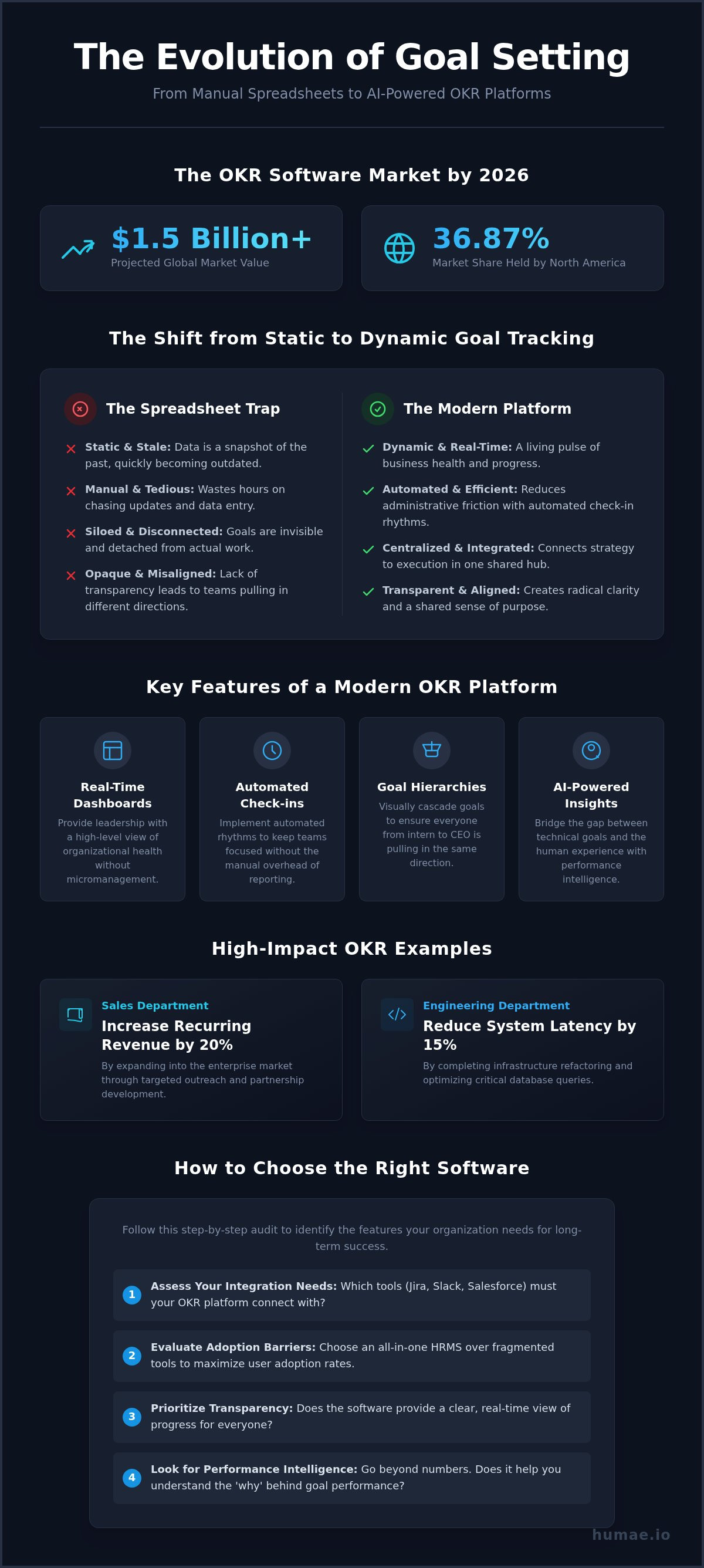
Did you know that the global OKR software market has surged to a value of over $1.5 billion in 2026? This massive growth isn't just a trend; it's a response to an environment where North America alone holds a dominant 36.87% market share. Most leaders agree that manual data entry in spreadsheets is a recipe for misalignment and stale progress. You want your team to move in the same direction, but without real-time visibility, even the most inspiring okr goal setting examples can feel like distant dreams rather than actionable plans.
At Humae, we believe technology should empower people, not bury them in administrative tasks. This guide promises to show you how the right OKR tracking software transforms static goals into a dynamic engine for organizational growth and genuine employee engagement. We will preview the latest 2026 benchmarks, explore how to automate progress tracking, and visualize a future where every team member feels accountable and connected to the big picture.
Learn more about the Humae ecosystem at humae.io or return to our home page. Stay updated with our latest innovations on Facebook.
Key Takeaways
- Move beyond static spreadsheets to discover how real-time hubs create a culture of transparency and radical alignment.
- Review high-impact okr goal setting examples that utilize automated rhythms to keep your team focused without the manual overhead.
- Compare the efficiency of an all-in-one HRMS against fragmented niche tools to maximize your platform adoption rates.
- Follow our step-by-step audit to identify the specific integrations and features your organization needs for long-term success.
- Learn how AI-powered performance intelligence bridges the gap between technical goals and the human experience at work.
Moving Beyond Spreadsheets: Why OKR Tracking Software is Essential in 2026
OKR tracking software is the centralized hub where your company's strategy finally meets its daily execution. It's more than just a digital list of tasks. It's a living ecosystem that provides radical transparency and alignment across every level of your organization. While many teams start their journey with simple documents, they quickly discover the static spreadsheet trap. A spreadsheet is a snapshot of the past. It's a file that goes stale the moment a team member closes their browser tab. In contrast, modern tracking platforms offer a dynamic, real-time pulse of your business health.
The psychological impact of this visibility shouldn't be underestimated. For a modern workforce, seeing a progress bar move in real time creates a sense of momentum that a weekly status meeting simply can't replicate. Humans are wired to seek progress. When you look at successful okr goal setting examples in high-growth companies, the common thread is never the spreadsheet; it's the visibility provided by the platform. Manual tracking might work for a small group in a garage, but it fails to scale the moment you add departments, remote locations, or complex dependencies.
The Hidden Costs of Manual Goal Tracking
Manual status updates are a silent productivity killer. Managers often spend hours every week chasing down team members for data, only to copy and paste that information into a master file. This administrative friction creates a culture of "reporting for the sake of reporting" rather than actual performance. Beyond the time waste, manual systems create dangerous data silos. When goals are disconnected from the tools where work actually happens, they become invisible. This lack of integration leads to executive decision-making based on outdated or incomplete data, which can be catastrophic in a fast-paced market.
Transparency as a Performance Driver
Visibility into company-wide objectives is a powerful tool for intrinsic motivation. When employees see how their specific key results support a larger departmental goal, they understand their personal impact. This clarity is a core component of the Objectives and Key Results (OKR) framework. By using cascading goals, you ensure that everyone from the intern to the CEO is pulling in the same direction. To understand the foundational methodology behind this approach, you can explore our OKR Meaning: The Definitive Guide. Real-time tracking makes okr goal setting examples come to life, turning abstract concepts into a shared journey toward success.
Strategic OKR Goal Setting Examples and Core Platform Features
Setting goals is the easy part. Tracking them without burning out your team is where most organizations fail. Modern OKR tracking software solves this by implementing automated check-in rhythms. These prompts reduce administrative friction by asking for updates exactly when they're needed. When these updates feed into visual goal hierarchies, every contributor sees how their specific work moves the needle for the entire company. This clarity transforms a simple list into a strategic goal-setting framework that actually works.
Leadership oversight shouldn't feel like micromanagement. Advanced analytics dashboards provide a high-level view of organizational health without requiring a single meeting. But numbers only tell half the story. That's why the best platforms now include AI-driven sentiment analysis. It helps you understand the "why" behind the data. If a Key Result is lagging, is it a resource issue or a morale problem? Integrating these insights ensures that your strategy remains both data-driven and human-centric.
Practical OKR Goal Setting Examples by Department
Seeing theory in practice helps teams visualize success. Here are three okr goal setting examples tailored for modern departments in 2026:
- Sales: Increase recurring revenue by 20% by expanding into the enterprise market through targeted outreach and partnership development.
- Engineering: Reduce system latency by 15% through infrastructure refactoring to ensure a seamless user experience during peak traffic.
- HR: Improve employee retention by 10% using data from Performance Intelligence Software to identify and address cultural friction points.
The Role of AI in Goal Success
AI has moved from a buzzword to a critical safety net for managers. It can now predict when a Key Result is at risk of failing based on historical patterns and current activity levels. This allows for early intervention rather than waiting for an end-of-quarter post-mortem. Sentiment analysis adds another layer of protection by identifying burnout or frustration before those feelings cause a goal to slip. This intersection of hard goal data and human employee feedback is what defines performance intelligence. It's a fundamental shift in how teams grow together. If you want to see this synergy in action, you can explore our performance intelligence platform to bridge the gap between metrics and people.
Standalone OKR Tools vs. Integrated HRMS Solutions
Choosing your tracking software is a critical fork in the road for any growing organization. You can opt for a specialized, standalone tool that does one thing well, or you can integrate goals directly into your daily HR infrastructure. In 2026, the total cost of ownership for a fragmented tech stack is rising. When you pay for separate licenses for performance, OKRs, and core HR, you aren't just spending more money. You're paying in lost productivity. Every additional login is a barrier to entry that discourages frequent updates. Security teams also prefer a single infrastructure because it significantly reduces the attack surface for sensitive employee data.
Linking OKRs directly to performance reviews and hiring creates a continuous feedback loop that standalone tools simply can't match. Imagine a world where a new hire's onboarding goals are automatically populated based on the specific skills identified during their interview process. This isn't possible in a siloed environment. When goals live in the same place where people manage their time off and check the employee directory, they become a natural part of the organizational culture. Integrated platforms ensure that strategy isn't something people do once a quarter; it's something they live every day.
Breaking Down Data Silos
Traditional setups keep hiring data and performance metrics in separate rooms. By using a centralized Workforce Management Infrastructure, you bridge that gap instantly. You can see how time-off patterns or departmental shifts affect key results in one unified view. If a team lead is away, the platform provides the context needed to adjust expectations. This level of visibility is why integrated platforms outperform standalone tools in complex okr goal setting examples where cross-departmental collaboration is essential.
Employee Experience and Adoption
Employee adoption is the only metric that truly determines software success. Most workers resist logging into a "goals only" platform because it feels like an administrative chore. A unified hub that combines the employee directory with OKR tracking creates a seamless experience. Goals stop being a quarterly obligation and start being a daily guide. For deeper insights on building this culture, explore our Employee Engagement Strategies. When the platform is the primary portal to their work life, okr goal setting examples turn into real-world achievements without the friction of tool fatigue.
How to Evaluate and Choose the Right Software for Your Team
Selecting the right platform is a strategic decision that affects your entire organizational culture. It's not just about tracking numbers; it's about finding a tool that your team actually wants to use. Start by auditing your current goal-setting maturity. If your team is new to the framework, you need a platform that offers guided okr goal setting examples and intuitive workflows. If you're a mature organization, look for advanced features like automated data roll-ups and complex dependency mapping. The goal is to find a solution that matches your current pace while leaving room for future acceleration.
Integration is the next non-negotiable step. Your OKR tracking shouldn't live on an island. It must communicate with your existing tech stack, whether that's your project management tool or your core HRMS. When data flows automatically between systems, you eliminate the manual entry that causes spreadsheets to fail. Accessibility is equally vital. In 2026, work happens everywhere. If your employees can't update a key result from their mobile device during a commute or between meetings, adoption will stall. Finally, ensure the platform can scale. A tool that works for 10 people might buckle under the weight of 1,000. Look for enterprise-grade security and robust infrastructure from the start.
Defining Your Core Requirements
Every team has unique needs, but certain features are universal. Small teams usually prioritize speed and ease of use, while larger enterprises require granular permissions and customizable visibility settings. You need to distinguish between essential "must-haves" and "nice-to-have" perks. For instance, real-time analytics is essential; custom color themes are a bonus. To see a baseline of what modern performance intelligence looks like, you can explore Humae features to help define your own checklist. Prioritize vendors that offer AI-driven insights to help you spot risks before they become roadblocks.
The Pilot and Rollout Strategy
Don't try to change the whole company overnight. Run a 30-day pilot with a single, high-performing department first. This allows you to test the software in a controlled environment and refine your internal okr goal setting examples before a full rollout. Identify "OKR champions" within that team. These are people who understand the value of the framework and can support their peers during the transition. When evaluating vendors, look beyond the software itself. Check their customer success track record and training resources. A great vendor acts as a partner in your growth. If you are ready to see how a unified platform can transform your culture, book a demo with Humae to start your journey today.
Humae: The AI-Powered Future of OKR Tracking and Performance
Humae represents the next evolution in organizational health. We've built an all-in-one performance intelligence infrastructure that treats your team as people, not just rows in a database. While traditional tools focus solely on the "what" of a business, our real-time OKR tracking dives into the "how" and "why." By integrating goals directly with our employee directory and core HRMS functions, we eliminate the friction that often kills productivity. You won't just see numbers on a screen; you'll see the heartbeat of your company in real time. We believe that when you have the right data, you can lead with both confidence and empathy.
Our AI-driven sentiment analysis provides the missing context to your goal data. If progress on your okr goal setting examples starts to stall, Humae doesn't just send a generic alert. It analyzes continuous feedback and engagement patterns to determine if the issue is a technical bottleneck or a dip in team morale. This holistic view allows leaders to manage with precision. From the moment a new hire starts their journey during onboarding to their quarterly performance review, every touchpoint is connected to your company's high-level objectives. It's a seamless cycle of growth that keeps everyone aligned.
Seamless Integration for Modern Leaders
We designed Humae with a relentless focus on user experience. If a tool isn't enjoyable to use, it won't be adopted. Our interface is clean, intuitive, and built for the way people actually work in 2026. For leadership, our actionable analytics dashboards offer a bird's-eye view of organizational performance without the need for manual status reports or endless follow-up emails. You can see how it works in real-time to understand how we bridge the gap between strategy and execution. Everything you need to manage your workforce is just one click away.
A Partner in Your Organizational Growth
We see ourselves as more than a software vendor; we're a visionary partner in your journey. Our goal is to help you build a culture where everyone feels seen, valued, and motivated. By consolidating HR, performance, and OKR data into one interface, we provide the clarity needed for sustainable growth. This unified approach ensures that your okr goal setting examples aren't just words in a document, but a roadmap for collective success. Align your team for the challenges of 2026 by choosing an infrastructure that values the human factor as much as the bottom line.
Build a Future-Ready Organization with Integrated OKRs
Static goals are a relic of the past. In 2026, success belongs to organizations that treat their objectives as living, breathing ecosystems. By moving beyond spreadsheets and embracing an all-in-one HRMS infrastructure, you've seen how transparency drives performance. Real-time analytics dashboards ensure that leadership stays informed without the burden of manual reporting. It's about creating a culture where progress is visible and impact is felt at every level of the company.
Whether you're implementing new okr goal setting examples or refining existing ones, remember that data without context is just noise. AI-driven performance intelligence provides the sentiment analysis needed to understand the human factor behind every metric. This balance is what transforms a simple tracking tool into a dynamic engine for growth. When you bridge the gap between technical goals and employee experience, you unlock a new level of organizational potential.
Ready to bridge the gap between strategy and execution? Empower your team with Humae’s AI-powered OKR tracking and start your transformation today. Your organization's future is limitless when everyone is aligned and inspired. Let's build a more connected and high-performing workplace together.
Frequently Asked Questions
What is the difference between OKR software and project management tools?
OKR software focuses on strategic outcomes and alignment rather than just task completion. While project management tools track what is being done on a daily basis, OKR tracking software monitors the why and the long-term impact of those actions. This distinction is vital when looking at okr goal setting examples that prioritize high-level growth over simple checklists.
Can small startups use free OKR tracking tools effectively?
Small startups can definitely use free versions of OKR tools to establish their goal-setting culture. Several vendors in 2026 offer free tiers for teams with up to 5 or 10 users. These entry-level options are excellent for learning the methodology, though they often lack the advanced AI-driven sentiment analysis and integrated HRMS features found in premium platforms.
How much does OKR tracking software typically cost in 2026?
Pricing varies based on your team size and the depth of features you require. Some platforms offer flat-fee structures starting at 49 dollars per month for up to 50 users. Other vendors utilize per-seat models that range from 6 dollars to 25 dollars per user each month. Higher-tier plans generally include advanced analytics and enterprise-grade security certifications like ISO 27001.
Is AI really necessary for tracking objectives and key results?
AI isn't strictly required to follow the OKR framework, but it provides a massive competitive advantage for modern leaders. AI-powered platforms can predict when a key result is at risk of failing based on activity patterns. They also use sentiment analysis to detect team burnout early, allowing managers to intervene before a goal slips in a way that manual tracking cannot replicate.
How do I ensure employees actually update their OKRs in the software?
Integration with daily workflows is the best way to ensure consistent updates from your team. When OKR tracking is part of a unified HR portal, employees don't feel like they're logging into another tool. Automated check-in reminders and mobile accessibility also reduce the friction of providing status updates, making the process feel like a natural part of the workday.
Can OKR software integrate with my existing HRIS or payroll system?
Modern OKR solutions are designed to integrate seamlessly with your existing HRIS and payroll infrastructure. Many organizations now prefer all-in-one platforms that combine workforce management with performance intelligence. This centralized approach ensures that data flows freely between hiring, payroll, and strategic goal tracking without the need for manual data entry.
What are the best OKR software features for remote-first companies?
Remote-first companies benefit most from real-time dashboards and visual goal hierarchies. These features provide the transparency that is often lost when teams aren't in the same physical office. Mobile-first design and AI sentiment analysis are also critical for remote leaders to gauge team morale and alignment across different time zones using various okr goal setting examples.