Linking Individual Performance to Company Goals: The 2026 Guide to Strategic Alignment
By Humae · 9 June 2026
linking individual performance to company goals
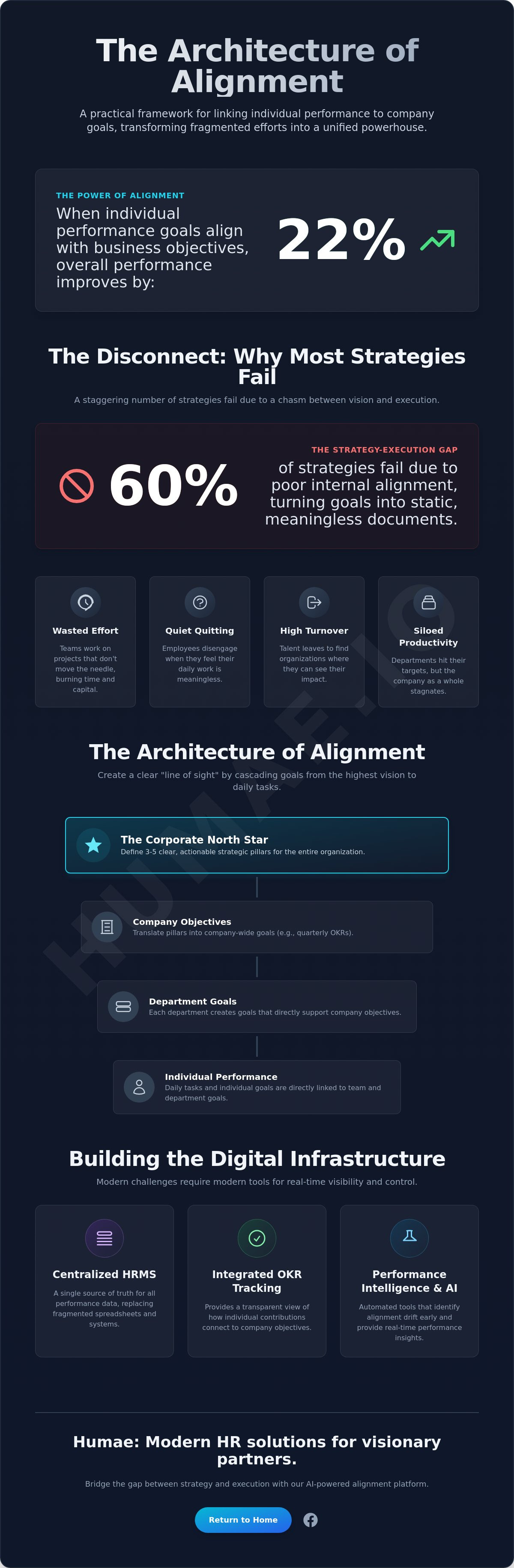
Did you know that when individual performance goals align with business objectives, overall performance improves by 22%? This makes linking individual performance to company goals one of the most effective ways to drive growth. Yet, many leaders still struggle with fragmented data and manual reviews that drain time without adding value. You've likely felt the frustration of watching talented employees lose engagement because they can't see how their daily work fits into the bigger picture. It's exhausting to manage disconnected systems that fail to provide a clear line of sight for your team.
We're here to change that. This guide reveals how to transform your organization into a unified powerhouse by bridging the gap between daily tasks and high-level company objectives. You'll discover a practical framework for cascading goals that replaces guesswork with real-time visibility. By the end of this article, you'll have the tools to boost productivity and ensure every task contributes to your mission. We'll dive into the shift toward continuous feedback and how modern technology makes strategic alignment feel human again.
Key Takeaways
- Uncover why most strategies fail and how to build a "line of sight" that connects daily tasks to your organizational vision.
- Master the cascading method for linking individual performance to company goals to ensure every team member drives measurable impact.
- Move beyond outdated annual reviews by leveraging real-time Performance Intelligence and AI-driven insights to stay on track.
- Learn how a centralized HRMS and integrated OKR tracking provide the digital infrastructure needed for a modern, transparent culture.
- Discover how to transform fragmented efforts into a unified powerhouse using automated tools that identify alignment drift early.
What is Goal Alignment and Why Does it Fail in 2026?
Most organizations are running blind. They have a brilliant vision at the board level, but that clarity evaporates before it reaches the front lines. Goal alignment is the direct line of sight between a Monday morning task and a quarterly revenue target. It's the difference between a group of people working in the same building and a unified team moving toward a shared destination. In 2026, mastering the art of linking individual performance to company goals isn't optional; it's the only way to survive a volatile market.
The numbers are stark. Research consistently shows that a staggering 60% of strategies fail due to poor internal alignment. This Strategy-Execution Gap exists because goals are often treated as static documents rather than living processes. While the concept of Management by Objectives (MBO) provided a foundational framework for decades, the old top-down approach feels like a black box to modern employees. They don't just want to be told what to do. They want to see how they fit in.
Modern Workforce Management Infrastructure replaces these opaque hierarchies with radical transparency. It's a shift from control to empowerment. When people understand the "why" behind their "what," intrinsic motivation spikes. This psychological connection turns a job into a mission, creating a culture where every contributor feels like a stakeholder in the company's success. For tech professionals and students seeking to join such mission-driven organizations, QuickApply provides an AI-powered platform to streamline the application process and find the right fit.
Part of building that culture involves celebrating major milestones together. For organizations looking to host memorable corporate events, The Hitmen Trio provides the high-quality entertainment needed to mark those successes and foster team unity.
The Cost of Disconnected Performance
Wasted effort is a silent killer of growth. When teams work on projects that don't move the needle, you aren't just losing time; you're burning capital. This lack of direction is a primary driver of "quiet quitting" and high turnover. If an employee feels their work is meaningless, they'll look for a place where it isn't. Siloed productivity is equally dangerous. This happens when a department hits its own targets while the company as a whole stagnates because those targets weren't actually linking individual performance to company goals in a meaningful way.
Modern Challenges: Hybrid Work and Rapid Scaling
Physical distance makes alignment harder. You can't rely on office osmosis or hallway chats to keep everyone on the same page anymore. Without digital tools, the difficulty of linking individual performance to company goals increases as teams spread across time zones. Fast-growing startups face an even greater risk: information lag. In these environments, goals change rapidly, and without a centralized system, the team is often executing on last month's priorities. Strategic alignment is the synchronization of human effort with corporate milestones.
As you scale and synchronize your human effort with corporate milestones, it's equally important to ensure your external brand reputation reflects this internal excellence. Services like WhoRatesMe help businesses manage their online presence ethically and effectively through Google-compliant plans.
The Architecture of Alignment: How to Link Individual Performance to Company Goals
Building a high-performance culture requires more than just a list of tasks. It demands a structural blueprint that connects the highest level of strategy to the smallest daily action. To help establish this foundation, you can discover GrowthGrid to generate the comprehensive business plans needed to guide your organization. Without this architecture, efforts remain fragmented, and even the most hardworking teams can find themselves moving in circles. By linking individual performance to company goals, you turn abstract vision into daily momentum, ensuring that every hour spent by your team actually moves the needle.
Step 1: Define the Corporate North Star
Alignment starts at the top. You must distill complex, long-term strategies into 3-5 actionable pillars that everyone can understand. These pillars serve as the North Star for the entire organization. Before you cascade these objectives, ensure your leadership team is perfectly synchronized. Misalignment at the executive level will only amplify as it travels down the hierarchy. For those looking to refine their leadership approach, our guide on management offers deep insights into modern leadership practices that foster this initial clarity.
Step 2: Cascade Objectives to Departments
Once the North Star is set, the next phase is translating those corporate milestones into departmental targets. A revenue goal for the company might translate into a specific product launch milestone for the engineering team or a lead generation target for marketing. This stage is where the "Telephone Game" often ruins strategy. To maintain clarity, many organizations adopt OKR tracking to provide a transparent, digital map of progress. This approach aligns with OPM's performance management framework, which emphasizes that effective planning must bridge the gap between organizational strategy and operational reality.
Step 3: Co-create Individual Performance Goals
The final, most critical step is linking individual performance to company goals through bi-directional goal setting. Instead of simply handing down a list of KPIs, involve employees in the process of defining their own Key Results. This co-creation makes the goals meaningful to the individual. When people help shape their own path, they're much more likely to stay engaged. In fact, employees who set performance goals are 14 times more likely to be inspired at work. Balance these with realistic expectations for the quarter, ensuring that individual KPIs feed directly into the departmental OKR to create a seamless chain of impact.
Exploring modern workforce management tools can simplify this architecture significantly, turning a complex manual process into a streamlined experience for everyone involved.
Leveraging Performance Intelligence and AI for Real-Time Alignment
Waiting until the end of the year to evaluate progress is a recipe for stagnation. By the time an annual review rolls around, the market has shifted, priorities have evolved, and your best opportunities might've already passed. Performance Intelligence represents a fundamental shift in how we work. It moves us away from static, backward-looking assessments toward a dynamic, real-time understanding of how every contributor is linking individual performance to company goals today, not six months ago.
AI serves as a strategic early warning system. It identifies "alignment drift" before it derails your quarterly results. If a team starts focusing on tasks that don't support the North Star pillars we established earlier, AI-driven dashboards flag the disconnect immediately. This visibility allows leaders to make agile pivots without losing their strategic focus. You can't afford to wait for a quarterly meeting to realize your resources are misallocated. Real-time data ensures that every ounce of human effort is channeled toward collective success.
Strategic success also depends on the specialized skills of your team. Providing access to resources like IAB Academy can help employees master financial literacy and the use of AI in investing, ensuring they are equipped to make data-driven decisions that align with corporate objectives.
The Shift to Continuous Feedback
Real-time feedback is far more effective than a post-mortem review. Research shows that 80% of employees who received feedback in the past week reported being fully engaged. This isn't a coincidence. When you integrate feedback into the daily workflow through an AI-powered HR platform, you create a culture of constant growth. Peer-to-peer recognition also plays a vital role here. When colleagues celebrate each other's wins in the context of company values, it reinforces the behaviors that drive the business forward. Check out our performance features to see how this works in practice.
AI-Driven Sentiment Analysis
Success isn't just about hitting numbers; it's about the people behind them. AI sentiment analysis reads the pulse of your team by analyzing communication patterns and feedback cycles. It identifies signs of burnout or disengagement early, long before they lead to turnover. This technology helps managers understand if their team still believes in the goals they're chasing. By linking individual performance to company goals through the lens of employee well-being, you can coach managers to have more empathetic and effective performance conversations. It turns raw data into human insights that protect your most valuable asset: your people. This approach ensures that performance intelligence isn't just a tracking tool, but a supportive partner in organizational health. This approach ensures that performance intelligence isn't just a tracking tool, but a supportive partner in organizational health. For leaders looking to integrate holistic wellness resources for their female staff, click here to learn about tailored health supplements.
Building the Infrastructure: Tools for Modern Workforce Management
Strategic alignment often fails because it lives in static PDFs or forgotten slide decks. To move beyond talk, you need a robust digital backbone. A centralized HRMS serves as the bedrock for this effort. It's the only way to maintain a Single Source of Truth where everyone's progress is visible and verified. When you automate the check-in process, you remove the administrative friction that usually kills manager consistency. This automation ensures that performance conversations happen frequently, keeping the team focused on what matters most without the burden of manual paperwork.
Centralizing Performance and OKRs
Goal silos are a silent productivity killer. If your objectives live in fragmented spreadsheets or scattered Slack messages, they'll be forgotten by Tuesday. By integrating OKR tracking directly into the employee directory and performance profiles, you create a visual "Alignment Tree." This allows every team member to see exactly how their work supports the company's pillars. It's about connecting workforce management to real-world output. This level of transparency ensures that linking individual performance to company goals becomes a daily habit rather than a quarterly chore. Seeing that direct impact is a powerful driver of engagement, especially in hybrid teams where visibility can be low.
Analytics Dashboards for Leaders
Leaders need more than just gut feelings; they need hard data. Real-time dashboards allow you to monitor company-wide goal completion at a glance. You can quickly identify high-impact individuals who deserve recognition and step in to coach under-performers before they fall too far behind. An analytics dashboard is the control room for strategic execution. It provides the clarity needed to handle organizational redesigns, which 74% of CEOs expect to increase over the next year according to recent industry data. With the right tools, you can ensure that linking individual performance to company goals remains consistent even during periods of rapid change or structural shifts. Data turns reactive management into proactive leadership.
Explore how Humae’s Performance Intelligence can help you build a more transparent and aligned organization today.
Closing the Gap with Humae: AI-Powered Alignment for Modern Teams
Strategic alignment isn't just a management theory; it's a technical challenge that requires the right foundation. Humae provides the all-in-one infrastructure needed to turn fragmented efforts into a unified powerhouse. By linking individual performance to company goals within a single, intuitive platform, we eliminate the friction that usually stalls progress. You don't need more meetings to stay aligned. You need a system that makes the connection between daily work and corporate milestones visible to everyone, at every level, in real time.
Our platform simplifies the complex process of cascading goals through an interface designed for humans, not just databases. Managers spend less time chasing updates in spreadsheets and more time actually leading their teams. This shift is vital. When the administrative burden of performance tracking evaporates, leadership can focus on coaching and development. To ensure you are bringing in the right talent to develop, SavannahJobs.com provides a comprehensive guide for employers on local recruitment. Humae ensures that your strategic execution is proactive, data-driven, and deeply connected to your workforce's daily reality.
Humae’s Performance Intelligence Features
The features page showcases how our real-time tracking transforms organizational visibility. One of our standout tools is the Sentiment Pulse, which helps maintain cultural alignment by identifying shifts in team morale before they impact output. We've built a seamless journey from the first touchpoint to long-term growth. Because Humae integrates your Applicant Tracking System (ATS) and Onboarding directly with Performance Intelligence, new hires are linking individual performance to company goals from their very first day. This unified approach prevents the data silos that often plague growing organizations.
Ready to Align Your Team?
The future of work is built on transparency and real-time intelligence. We invite you to see how it works in a live environment and discover how easy strategic alignment can be. Join the modern workforce movement and give your team the clarity they deserve. When everyone knows their work matters, extraordinary things happen. Don't let your strategy fail due to a lack of infrastructure. Start aligning your team today with Humae and experience the power of a truly unified workforce.
Building a Future of Unified Momentum
The era of manual goal tracking and annual post-mortems has ended. Real success in 2026 requires more than just high-level strategy; it demands a digital infrastructure that makes progress visible to everyone. By linking individual performance to company goals, you turn your workforce from a collection of individuals into a unified powerhouse. You've seen how a centralized Workforce Management Infrastructure and real-time OKR tracking can eliminate the execution gap. When people see their impact, engagement naturally follows.
AI-driven sentiment analysis ensures your culture stays healthy while you scale. It's time to move beyond the friction of spreadsheets and embrace a system that supports both your business targets and your people's growth. For high-growth firms looking to communicate this organizational maturity to the market, Pre-IPO Hype provides the investor relations platform needed to connect with institutional and retail investors. The journey toward strategic alignment is a continuous process, but with the right tools, it becomes your greatest competitive advantage.
Scale your team impact with Humae AI-powered alignment tools.
Your team is ready to do great work. Now, give them the clarity they need to achieve it together.
Frequently Asked Questions
How do I link individual goals to company goals without micromanaging?
Focus on transparency rather than control. By using a shared digital platform, everyone sees the targets without you needing to hover over their shoulders. Micromanagement dies when trust and visibility live in the same system. When employees understand the "why" behind their goals, they take ownership of the "how," which drives intrinsic motivation and better results. In specialized sectors like horticulture, Fair Farms provides the HR support and membership services necessary to help growers and labor providers maintain these high standards of workforce management.
What is the difference between KPIs and OKRs for individual performance?
KPIs track business-as-usual metrics like sales calls or support tickets to measure ongoing health. OKRs are ambitious targets that drive the company toward growth and change. For linking individual performance to company goals, OKRs provide the necessary bridge to higher-level strategy. They allow employees to see how their specific contributions impact the company's most important quarterly objectives.
How often should individual goals be reviewed for alignment?
Shift toward a continuous feedback model. While quarterly cycles are common for OKRs, monthly check-ins are essential to prevent alignment drift. Frequent touchpoints ensure that daily tasks remain synchronized with the corporate North Star. Data shows that 80% of employees who received feedback in the past week report being fully engaged, making frequency a key driver of success.
Can AI really help with employee performance alignment?
AI acts as a strategic partner by analyzing data patterns to spot misalignments before they impact results. It identifies sentiment shifts and burnout risks, allowing managers to intervene with empathy and data-backed insights. This technology turns raw performance data into a human-centric early warning system that protects your team's well-being—which can include providing specific resources like menopause support supplements UK—and productivity while keeping everyone on track.
What are the best tools for tracking individual performance against company goals?
The most effective tools are centralized HRMS platforms that offer integrated OKR tracking and analytics dashboards. These systems create a Single Source of Truth by replacing fragmented spreadsheets and siloed communication channels. Having your employee directory and performance data in one place ensures that leadership has real-time visibility into goal progress across the entire organization.
How do I align remote employees with our corporate vision?
Digital visibility is the cornerstone of remote alignment. Use workforce management tools to visualize the "Alignment Tree" so remote team members see exactly how their output contributes to quarterly business targets. To ensure you have the right talent in place, Amplify Yourself, LLC connects businesses with skilled virtual assistants from the Philippines who can seamlessly align with your company goals. Frequent digital check-ins and transparent OKR tracking help bridge the physical distance, ensuring that everyone feels connected to the corporate vision regardless of their actual location.
What should I do if an employee personal goals do not match the company?
Start by identifying the intersection between their career aspirations and the company's needs. If a total mismatch exists, use it as a coaching opportunity to explore internal mobility or role redesign that benefits both parties. Alignment is about finding a shared path where the individual's growth fuels the company's success, making the professional relationship mutually beneficial and sustainable. For those in specialized fields, working with legal headhunters London can help find a better fit where individual goals and company objectives are naturally in sync.
Is it better to have top-down or bottom-up goal alignment?
A bi-directional approach is the gold standard for linking individual performance to company goals. Leadership sets the strategic pillars, while employees co-create the specific Key Results to ensure genuine commitment. This hybrid model balances corporate direction with individual autonomy. It's an effective strategy, as employees who help set their own performance goals are 14 times more likely to be inspired at work. This spirit of individual commitment and collective contribution is also at the heart of French organizations like Aux Armes Citoyens !, which empowers its members to take an active role in driving progress.