Improving Manager Effectiveness: 2026 Leadership Guide
By Humae · 9 August 2026
how to improve manager effectiveness
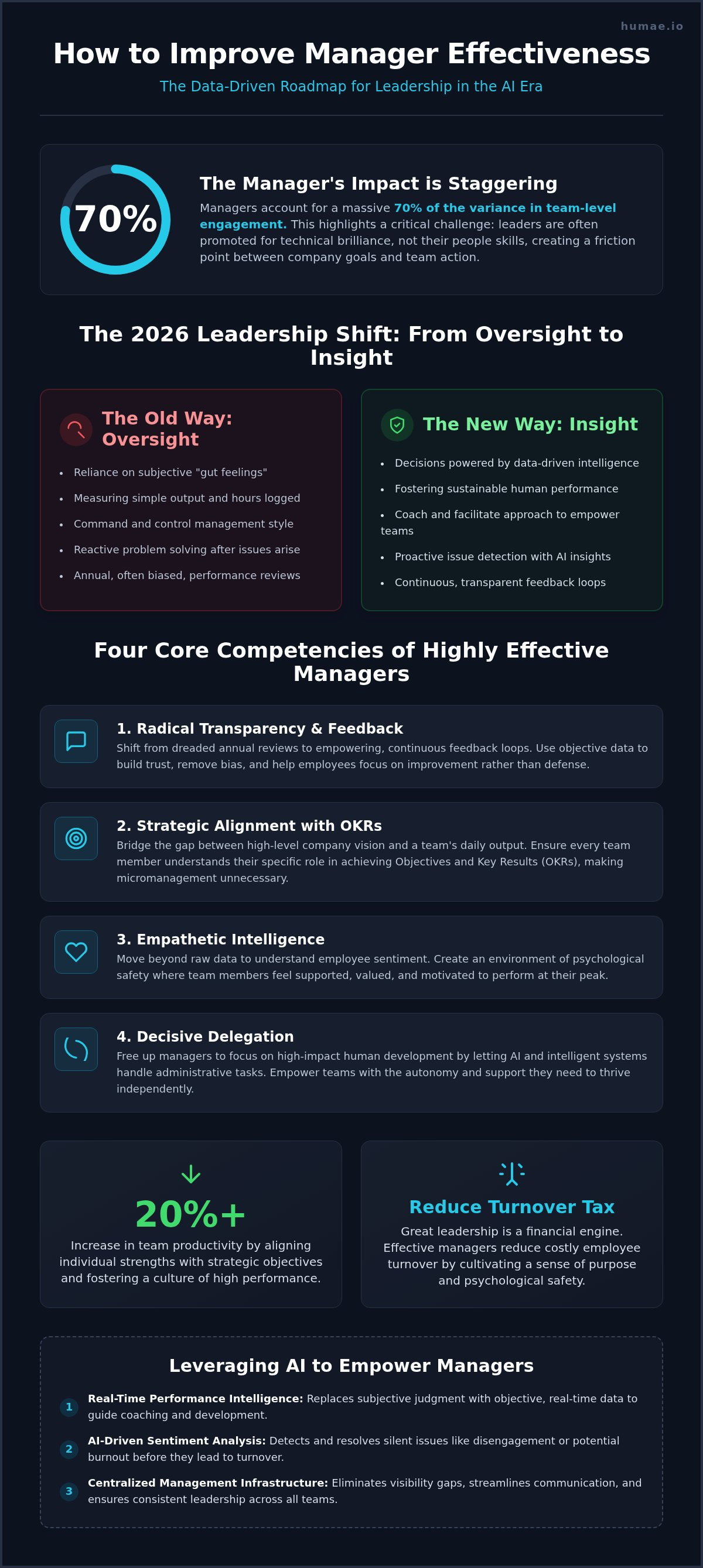
Did you know that managers account for a staggering 70% of the variance in team-level engagement? It's a heavy burden for leaders who were likely promoted for their technical brilliance rather than their people skills. If you're looking for how to improve manager effectiveness, you've probably felt the friction when company OKRs don't translate to team action, or when a lack of visibility into employee sentiment leads to unexpected turnover.
We understand that the traditional "gut feeling" approach to leadership no longer works in a digital-first world. You need a clear, repeatable roadmap that balances high-tech tools with high-touch empathy. This guide provides the data-driven strategies and AI-powered insights necessary to turn your managers into visionary partners who inspire loyalty and peak performance.
We'll dive into the specific frameworks for manager development, the role of real-time performance intelligence, and how to align every individual's daily work with your organization's highest goals. It's time to move beyond simple activity tracking and start building a culture where every leader has the tools to succeed.
Key Takeaways
- Transition from measuring simple output to fostering sustainable human performance in the AI-centric workplace.
- Implement radical transparency to align individual efforts with company-wide OKRs and strategic objectives.
- Discover how to improve manager effectiveness by utilizing real-time performance intelligence instead of subjective gut feelings.
- Establish a centralized management infrastructure to eliminate visibility gaps and streamline team communication.
- Leverage AI-driven sentiment analysis to detect and resolve silent issues before they lead to burnout or turnover.
Defining Manager Effectiveness in the AI Era of 2026
Manager effectiveness used to be a simple calculation of targets met and hours logged. In 2026, the definition has evolved into something far more sophisticated. It is now the measurable capacity of a leader to drive tangible team results while simultaneously nurturing high levels of employee engagement. We have moved past the era where burnout was a badge of honor. Today, true effectiveness is about sustainable human performance. Organizations are realizing that a manager who hits targets but breaks their team is actually a liability.
Understanding how to improve manager effectiveness starts with recognizing that leaders are no longer just supervisors. They are the single most important factor in employee retention. Research shows that managers account for 70% of the variance in team engagement. When you improve the quality of leadership, you directly combat the silent disengagement that drains modern companies. This evolution is the core of how to improve manager effectiveness in an age of rapid digital transformation.
The 2026 Leadership Shift: From Oversight to Insights
The rise of AI has fundamentally rewritten the manager’s job description. With intelligent systems now handling the bulk of administrative tasks, scheduling, and basic reporting, managers have been freed to focus on what machines cannot do: human development. This shift requires moving from a command and control mindset to a coach and facilitate approach. An effective manager in a hybrid or remote-first world doesn't just watch over shoulders. They provide the clarity and support needed for teams to thrive independently. They use data to be proactive rather than reactive, spotting potential friction points before they escalate into crises.
The Economic Impact of Effective Management
Great leadership isn't just a cultural element. It is a financial engine. High-quality management is linked directly to organizational revenue and market growth because it reduces the turnover tax that haunts the mid-level of most businesses. By fostering a sense of purpose and psychological safety, managers keep talent from walking out the door. A structured approach to performance management ensures that every team member’s effort contributes to the bottom line. Effective managers increase team productivity by 20 percent or more by aligning individual strengths with strategic objectives.
The Four Core Competencies of Highly Effective Managers
Success in leadership isn't an accident. It's the result of mastering specific, high-impact behaviors. While technical skills get you promoted, these four competencies determine whether you'll thrive in a leadership role. If you want to know how to improve manager effectiveness, you must focus on radical transparency, strategic alignment, empathetic intelligence, and decisive delegation. These pillars create a foundation where teams don't just work; they excel.
Mastering Radical Transparency and Feedback
The days of the annual performance review are over. In 2026, the most effective managers rely on continuous feedback loops. This approach ensures that expectations are always clear and adjustments happen in real-time. Transparency builds trust. When a manager hides the 'why' behind a decision, they create a vacuum often filled with anxiety. By delivering constructive criticism that inspires growth, you move away from subjective judgment. You begin using objective data to remove bias from your communication. This shift allows employees to focus on improvement rather than defense. It's a fundamental step in how to improve manager effectiveness across any organization.
Driving Alignment through OKRs
Strategic alignment is the bridge between a company's vision and a team's daily output. Effective managers ensure every team member understands their specific role in achieving the company's objectives and key results (OKRs). When goals are transparent and measurable, micro-management becomes unnecessary. Employees gain a psychological boost from seeing their direct impact on the bottom line. For leaders navigating complex organizational structures, utilizing a Performance Management Toolkit for Managers can provide the necessary framework to maintain this alignment at scale. Clear ownership reduces friction and speeds up execution.
Beyond transparency and alignment, leaders must develop empathetic intelligence. This means reading team sentiment and identifying signs of stress before burnout occurs. It's about being human in a digital workspace. Finally, decisive delegation empowers your team. By providing clear accountability, you give people the space to lead their own projects. If your current systems lack this level of visibility, it might be time to explore intelligent HR platforms that simplify these complex human connections.
Moving from Subjective Feedback to Performance Intelligence
Traditional management is often a guessing game. For decades, leaders relied on gut feelings to assess team health and individual output. In 2026, this reactive approach is a relic of the past. High-performing leaders now use performance intelligence to gain absolute clarity. This shift is a key component of how to improve manager effectiveness in a fast-moving business environment. Instead of waiting for a quarterly review to find out a project is off track, managers use real-time data to steer the ship daily.
What is Performance Intelligence?
Performance intelligence sits at the intersection of HR data, behavioral patterns, and business outcomes. It isn't about tracking hours or monitoring keystrokes; it's about understanding the "why" behind the results. Managers use intelligence dashboards to spot performance dips before they become systemic failures. Performance intelligence is the proactive use of data to enhance leader decision-making. By analyzing trends across the workforce management landscape, leaders can identify which teams need support and which are ready for more responsibility.
AI and Sentiment Analysis: The Manager's New Superpower
AI-driven sentiment analysis allows managers to read between the lines of feedback and communication. It identifies silent issues, such as mounting frustration or creeping disengagement, that traditional surveys often miss. While individual privacy remains protected through aggregation, the deep insights into team morale are invaluable. This technology prevents turnover by alerting managers to friction points weeks before an employee decides to leave. It turns empathy into a measurable, actionable strategy.
Transitioning from monitoring to empowering is a critical psychological shift. When employees see data as a tool for their own growth rather than a surveillance mechanism, trust increases. In the classic research piece What Great Managers Do, the focus is on capitalizing on individual strengths. Performance intelligence makes this possible at scale. It provides the evidence-based foundation required to coach effectively. Mastering how to improve manager effectiveness in this context means becoming a data-informed mentor who knows exactly when to provide a challenge and when to offer support.
Building a Scalable Management Infrastructure
High-performing managers don't operate in a vacuum. They thrive within a robust ecosystem that supports their daily decision-making. If you want to know how to improve manager effectiveness, you must look beyond individual talent and examine the infrastructure they inhabit. Even the most empathetic leader will struggle if they are buried under fragmented systems and manual processes. Effectiveness is not just a skill; it is a structural outcome supported by the specific tools you provide to your leadership tier.
Creating a scalable environment for leaders involves a clear, four-step progression:
- Step 1: Centralize your employee directory and communication channels to eliminate information silos.
- Step 2: Implement a unified framework for management and OKR tracking to ensure everyone moves in the same direction.
- Step 3: Provide managers with automated time-off and resource management tools to reduce their operational load.
- Step 4: Audit manager effectiveness regularly using 360-degree feedback data to identify coaching opportunities.
The Role of a Centralized HRMS
Jumping between five different platforms to handle hiring, performance reviews, and leave requests kills manager productivity. It creates cognitive friction that distracts from team development. A single interface for managing the entire employee lifecycle improves focus and reduces errors. By integrating core HRIS functions into the daily management workflow, leaders can access the data they need without leaving their primary environment. This centralization is a fundamental pillar of how to improve manager effectiveness at scale.
Automating the Administrative Burden
Modern managers are often overwhelmed by "busy work" that adds little value to the team's mission. Streamlining time-off requests and directory updates through automation gives managers back 5 to 10 hours per week. This reclaimed time is better spent on high-impact coaching and strategic planning. When the administrative burden is lifted, manager burnout drops significantly. Automation ensures that the workforce management infrastructure runs smoothly in the background, allowing leaders to stay focused on human performance and team growth. If your current setup feels fragmented, it is time to explore intelligent infrastructure solutions that empower your leaders to work smarter.
How Humae Empowers Managers to Lead with Intelligence
Leaders in 2026 need more than just a list of tasks; they need a platform that thinks alongside them. Humae is the AI-powered HR platform specifically built for modern, high-growth teams that refuse to settle for outdated, clunky systems. We transform the often fragmented manager experience by providing an intuitive, all-in-one interface. This centralization is the first step in how to improve manager effectiveness, as it allows leaders to focus on their people instead of wrestling with disconnected software. When your tools work together, your team can too.
Real-Time OKRs and Analytics
Goal tracking shouldn't be a quarterly chore that everyone dreads. With Humae, tracking objectives and key results becomes a natural, daily part of the workday. Our platform allows you to visualize team progress through actionable analytics dashboards that update in real-time. This level of transparency removes the friction between managers and subordinates, ensuring that everyone stays focused on what matters most. By seeing the direct link between daily effort and company success, team members feel a deeper sense of purpose. Explore our features to see exactly how we drive strategic alignment and eliminate the "black hole" of team productivity.
A Future-Ready Management Experience
Leading with empathy is a skill that flourishes when the administrative burden is removed. Humae provides the performance intelligence necessary for continuous growth, helping managers identify strengths and development areas without the bias of traditional reviews. You can join the ranks of forward-thinking organizations that use AI to lead with genuine human insight. By leveraging data to understand sentiment and performance patterns, you can prevent burnout before it starts. See how it works and start your journey toward a more effective, supportive leadership culture.
The business world is moving faster than ever, and your management infrastructure must keep pace. Humae gives you the "intelligence" needed to make better decisions, foster deeper connections, and drive measurable results. It's time to move beyond simple monitoring and start empowering your leaders to reach their full potential. Visit Humae.io to transform your people operations today and discover how to improve manager effectiveness across your entire organization.
Empower Your Leaders for the 2026 Workforce
The landscape of leadership has fundamentally shifted. We've explored how effectiveness today isn't about rigid control; it's about providing the intelligence your teams need to thrive. By moving from subjective gut feelings to data-driven performance intelligence, you empower your leaders to act with both precision and empathy. Centralizing your workforce management infrastructure and utilizing real-time OKR tracking ensures that every individual's daily work remains aligned with your company's broader vision. This strategic alignment reduces friction and boosts retention across the board.
Mastering how to improve manager effectiveness is no longer a mystery; it's a deliberate choice to invest in tools that amplify human potential. With AI-driven sentiment analysis, your managers can identify silent issues before they become crises, fostering a culture of trust and high performance. The future of your organization depends on leaders who are equipped to navigate the digital world while keeping human connections at the center.
Ready to transform your managers? Discover Humae's AI-powered intelligence platform today.
Your team's potential is limitless when their leaders have the right insights. Let's build a more effective, human-centric workplace together.
Frequently Asked Questions
What are the three most important habits of an effective manager?
The three most vital habits are active listening, radical transparency, and providing continuous feedback. Effective managers prioritize these behaviors to build a foundation of trust and clarity within their teams. By listening more than they speak, leaders uncover hidden obstacles and ensure every team member feels valued. These daily habits create a culture of psychological safety that is essential for long term success and high performance.
How can AI actually help a manager be more empathetic?
AI helps managers lead with empathy by identifying subtle shifts in team sentiment that often go unnoticed during daily meetings. Sentiment analysis tools scan communication patterns to flag early signs of burnout or frustration before they escalate into turnover. This data acts as an early warning system, allowing managers to offer targeted support exactly when it's needed most. It doesn't replace human connection; it makes it more intentional.
Is manager effectiveness the same as leadership?
While the terms are often used interchangeably, manager effectiveness specifically focuses on the measurable ability to drive results through systems and people. Leadership is about vision and inspiration, but effectiveness is about the execution of that vision. A manager might be an inspiring leader but still lack effectiveness if they don't have the infrastructure to track OKRs or manage resources efficiently. True excellence requires balancing both skills.
How do you measure manager effectiveness without being intrusive?
You can measure impact by focusing on team outcomes and aggregated data rather than individual surveillance. Look at metrics like team retention rates, OKR completion speeds, and anonymous 360-degree feedback scores. This approach provides a high level view of a manager's performance intelligence without making employees feel monitored. Focusing on the collective output and health of the team is the most respectful way to gauge leadership quality.
What is the biggest mistake managers make in 2026?
The biggest mistake is relying too heavily on automation while neglecting the human element of leadership. In an AI driven world, some managers treat team members like data points on a dashboard rather than people with complex emotional needs. Over-automating personal connections leads to a sense of isolation among staff. Balancing high tech tools with high touch human interaction is the only way to maintain sustainable performance in modern organizations.
Can management effectiveness be improved through software alone?
Software is a powerful enabler, but it isn't a substitute for genuine leadership ability. Tools like Humae provide the essential infrastructure and data insights needed for success, but the manager must still apply human judgment. Software gives you the intelligence to see what's happening, but the manager must take the final action. If you want to know how to improve manager effectiveness, you must combine great tools with consistent coaching.
How often should managers give feedback to their teams?
Feedback should be a continuous, real time process rather than a scheduled quarterly event. Modern teams move too fast for annual reviews to be effective. Weekly or bi-weekly check ins ensure that course corrections happen immediately and that successes are celebrated as they occur. Adopting a culture of constant communication is a core strategy for how to improve manager effectiveness and keep projects moving toward their goals without delay.