HR Software ROI Calculator 2026: The Executive Guide to Quantifying Value
By Humae · 12 May 2026
hr software roi calculator 2026
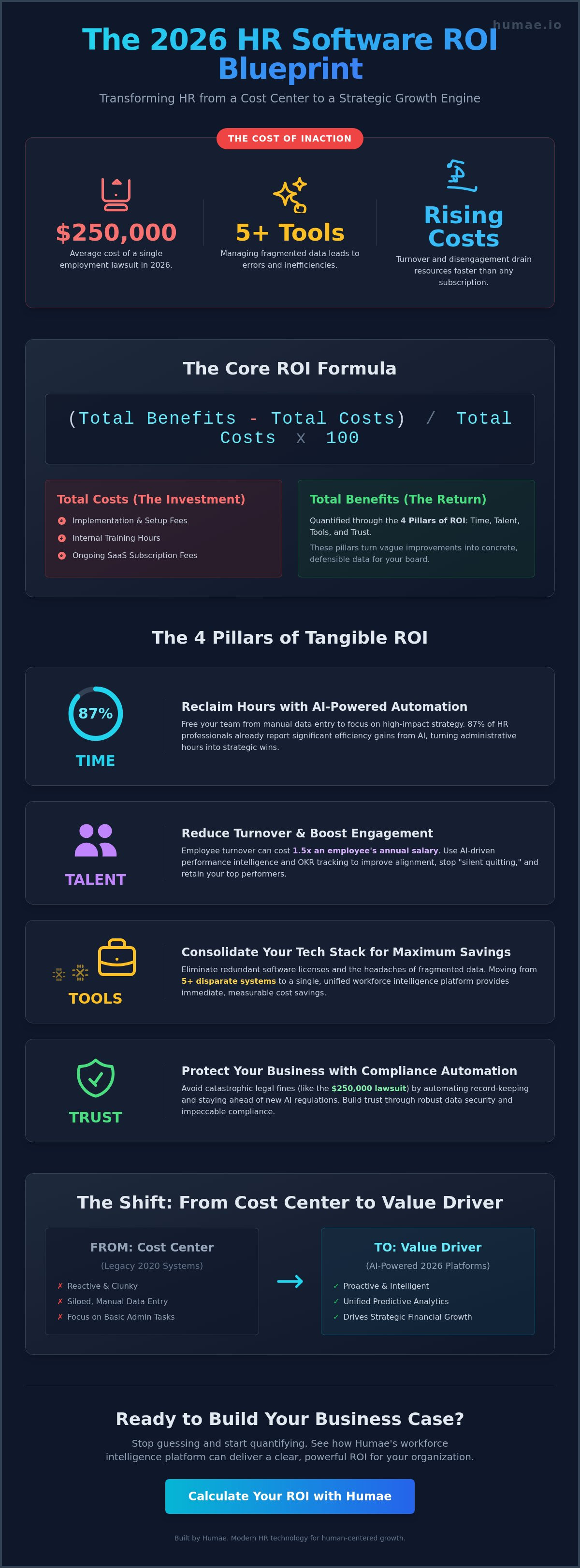
An employment lawsuit in 2026 costs U.S. employers an average of $250,000, according to Easy.jobs. With new AI regulations like Illinois HB 3773 and the Texas AI Governance Act now in full effect, the cost of human error has never been higher. You've likely felt the frustration of rising labor costs and the headache of managing fragmented data across five different tools. It's difficult to prove the financial value of a "better experience" when your board only cares about the bottom line.
We understand that you need more than just gut feelings to justify your tech stack. This guide introduces a definitive hr software roi calculator 2026 to help you master the metrics that matter most. You'll learn how to validate AI efficiency gains, which 87% of HR professionals are already reporting, and how to calculate the exact savings from lower turnover. We'll show you how to transform HR from a cost center into a strategic engine of financial growth through performance intelligence and predictive analytics.
Key Takeaways
- Master the standard ROI formula to quantify net profit against tech investment, including implementation, training, and SaaS fees.
- Use our hr software roi calculator 2026 approach to move beyond admin tasks and prove the strategic value of workforce intelligence.
- Learn how AI-driven performance intelligence and OKR tracking stop "silent quitting" by improving team alignment and engagement.
- Identify the hidden financial returns of compliance automation, protecting your organization from costly legal fines and record-keeping errors.
- Map out your break-even timeline to understand exactly when your new HRMS begins generating a positive return for the business.
The 2026 Business Case for HR Software ROI
Proving the value of a tech purchase shouldn't feel like a guessing game. At its core, Return on Investment (ROI) is a simple ratio of net profit to the total cost of the investment. In the current market, your hr software roi calculator 2026 needs to account for more than just saved hours. We've moved past the era of simple admin efficiency. Today, the real value lies in workforce intelligence. If you aren't using data to predict talent needs or bridge gaps in hybrid teams, you're losing money. The cost of inaction is staggering. Rising turnover and disconnected employees drain resources faster than any subscription fee ever could. By treating your HR tech as a strategic asset rather than a utility, you turn a necessary expense into a profit engine.
The Shift from Cost Center to Value Driver
Modern HRMS platforms don't just store data; they generate revenue through massive productivity gains. When your team isn't bogged down by manual entry, they're free to focus on high-impact strategy. A robust workforce management infrastructure serves as the essential foundation for this growth. While legacy 2020 systems were reactive and clunky, 2026 AI-driven models are proactive. They use real-time analytics to spot bottlenecks before they stall your scaling efforts. It's about building a system that works as hard as your people do, ensuring that every hire and every hour contributes to the bottom line. This infrastructure allows you to scale without doubling your administrative headcount, which is a massive win for your margins.
Hard ROI vs. Soft ROI in 2026
Hard ROI is the easiest to track and often the most persuasive for the board. You'll see direct savings in labor hours, consolidated software licenses, and the avoidance of expensive compliance fines. For instance, avoiding a single $250,000 employment lawsuit provides an immediate, massive return on your investment. Soft ROI covers the human side: cultural health, brand reputation, and employee engagement. These metrics might feel intangible, but they're the leading indicators of your financial success. A positive candidate experience isn't just a "nice to have"; it's a competitive advantage that lowers your cost-per-hire. Ultimately, every soft metric eventually converts to hard dollars through improved employee retention and higher output per team member.
When you look at the hr software roi calculator 2026, you're looking at the future of your organization's health. It's about creating a workspace where technology empowers people to do their best work. By quantifying both the direct savings and the cultural gains, you build a bulletproof case for innovation. You can explore our core features to see how we bridge the gap between technical efficiency and human connection.
The Core HR Software ROI Formula: How to Calculate Your Savings
Calculating the return on your technology shouldn't be a mystery. To get a clear picture of your investment, we use the standard mathematical approach: (Total Benefits - Total Costs) / Total Costs * 100. This percentage represents your total return. When building your hr software roi calculator 2026, you must look beyond the monthly subscription. Total costs include implementation fees, internal training hours, and the ongoing SaaS costs. For a broader perspective on market rates, the Forbes Advisor HR software pricing guide provides excellent benchmarks for what you can expect to pay. Once you've tallied the expenses, you can focus on the four pillars of benefits: Time, Talent, Tools, and Trust.
These pillars help you defend your budget to a CFO by turning "vague improvements" into concrete data. Time refers to hours reclaimed through automation. Talent focuses on the money saved by reducing turnover, which we've noted can cost 1.5x a salary. Tools represent the savings from consolidating your tech stack. Trust is the financial protection gained through better compliance and data security. You can see how it works in a live environment to better visualize how these data points flow into a single, profitable system.
Quantifying Time Savings in Admin and Payroll
Administrative bloat is a silent profit killer. Industry research indicates that manual onboarding typically consumes over 5 hours per new hire. Humae’s streamlined workflows aim to cut that time significantly by automating document collection and task assignments. You can calculate direct savings by multiplying the hours saved by the average hourly rate of your HR team. Don't forget the hours lost to manual time off management. Human error in spreadsheet tracking often leads to payroll discrepancies that cost companies thousands annually. By automating these requests, you eliminate the error margin and free your team for higher-level strategy. This shift alone often pays for the software within the first few months.
Consolidation Savings: The "Tool Tax" Reduction
Most businesses suffer from a "tool tax" by paying for 3 to 5 different platforms that don't talk to each other. When you switch to a centralized HRIS, you stop paying multiple per-seat licensing fees for an ATS, an OKR tracker, and a separate employee directory. This consolidation often results in a 20 to 30% reduction in total software spend. If you're looking to simplify your operations, consider how a unified platform could clear the clutter. Instead of managing five different vendors, you have one partnership and one predictable bill.
| Feature | Multi-Vendor Monthly Cost | All-in-One (Humae) |
|---|---|---|
| ATS & Onboarding | $150+ | Included |
| OKR & Performance | $100+ | Included |
| Directory & Analytics | $80+ | Included |
Performance Intelligence: The "Secret" ROI of AI in 2026
Efficiency is easy to measure, but intelligence is where the real profit lives. Most traditional tools stop at basic data entry. In 2026, the true value of your tech stack comes from performance intelligence. This isn't just about tracking hours; it's about using AI-driven sentiment analysis to catch "silent quitting" before a resignation letter hits your desk. When you add these predictive capabilities to your hr software roi calculator 2026, you see a return that far exceeds simple time savings. Real-time feedback loops replace the outdated annual review, ensuring your team stays motivated and focused every single day.
Our platform's features are designed to be the engine for this intelligence. By moving from reactive management to proactive support, you create a culture where people feel seen and valued. This human-centered approach isn't just a cultural win. It's a financial necessity in a competitive labor market where every departure carries a heavy price tag. You aren't just buying a tool; you're investing in the longevity of your workforce.
The Cost of Turnover vs. Predictive Retention
Losing a mid-level manager is expensive. In 2026, replacing one often costs 1.5x their annual salary when you factor in recruitment, onboarding, and lost productivity. AI alerts change this math. By identifying early signs of disengagement, you can intervene weeks before a person decides to leave. Implementing data-driven employee engagement strategies allows you to protect your talent pool and your budget simultaneously. Predictive retention turns your HR department into a profit-protection center, keeping your best people right where they belong.
OKR Tracking and Productivity Gains
Clarity is a force multiplier for any growing business. When every team member understands the okr meaning and how their daily work fits the big picture, "wasted work" drops by an estimated 10-15%. A team that is 100% aligned with company goals moves faster and hits targets more consistently. Real-time OKR tracking accelerates project delivery by removing the guesswork from daily tasks. You don't just work harder; you work on the specific things that actually move the needle for the business, ensuring every dollar spent on labor yields a higher return.
Implementation and Hidden ROI Factors
The moment you sign a contract, the ROI clock starts ticking. While many executives focus solely on the subscription price, the true cost of ownership includes the implementation phase and the speed of user adoption. A clunky interface doesn't just annoy your team; it actively drains your budget through extended training hours and support tickets. In 2026, simplicity is a financial strategy. By choosing a system with an intuitive, modern interface, you can slash training costs for new hires and ensure your team actually uses the tools you've paid for. When you plug these variables into your hr software roi calculator 2026, the value of a high adoption rate becomes undeniable.
Risk mitigation is another hidden heavy hitter. As mentioned earlier, the average cost of an employment lawsuit in 2026 has reached $250,000. New regulations, such as California’s SB 513, now require employers to maintain expanded personnel records for at least three years after termination. Failing to manage these records properly leads to five-figure fines that can instantly wipe out your software's efficiency gains. A unified platform ensures that every document is tracked and stored according to the latest legal standards. You aren't just buying software; you're buying insurance against administrative negligence. If you're ready to secure your data and your budget, explore our secure HRMS solutions today.
Data Security as a Risk Mitigation ROI
Data breaches are more than just a PR nightmare; they're a massive financial liability. In 2026, the cost of a single breach can devastate a mid-sized business. By moving away from fragmented tools and spreadsheets, you significantly lower your "security surface area." A centralized workforce management infrastructure provides built-in SOC2 and GDPR compliance, ensuring that sensitive employee data stays protected behind enterprise-grade encryption. This proactive security approach is a direct investment in your company's long-term stability.
The Payback Period: What to Expect
The payback period is the time it takes for the savings generated by the software to equal the initial investment. While some legacy providers suggest a timeline of 6-12 months, Humae targets a break-even point within the first quarter. To accelerate your time-to-value, follow this three-step path:
- Step 1: Data Migration: Clean and move your existing records into a single source of truth.
- Step 2: Automation Launch: Activate time-off requests and onboarding workflows to see immediate labor savings.
- Step 3: Intelligence Gathering: Use analytics dashboards to identify and fix productivity bottlenecks.
Conclusion: Choosing a Solution Built for 2026 ROI
Quantifying the value of your HR tech stack in 2026 requires a multidimensional approach. It isn't enough to simply look at hours saved on data entry. You must account for the high cost of non-compliance, the massive impact of predictive retention, and the clarity provided by unified OKR tracking. A comprehensive hr software roi calculator 2026 should reflect this shift from administrative support to strategic workforce intelligence. By consolidating your tools and leveraging AI-driven insights, you transform HR into a visible driver of company profit. The goal is to build a foundation that scales with your ambition while keeping your people at the center of every decision.
Before making your final decision, perform a rigorous audit of your current "leakage." Look for fragmented data, unused licenses, and manual workarounds that drain your budget every month. Most businesses discover they're paying a "fragmentation tax" that could be eliminated by switching to an all-in-one platform. Humae was designed specifically for the 2026 workforce landscape, where hybrid teams and AI agents need a single, cohesive infrastructure to thrive. We believe that technology should empower people, not replace the human touch that defines your culture. This empathetic approach is what separates a mere software vendor from a true strategic partner.
Choosing the right partner means finding a team that understands both the technical challenges and the emotional needs of your employees. We position ourselves as a visionary partner for leaders who value efficiency as much as empathy. Our analytics dashboards and performance intelligence tools give you the data you need to lead with confidence. You'll stop guessing and start growing with a system that's built for the future of work. It's time to move beyond paper-shuffling and embrace a model that rewards innovation and human connection.
Next Steps for Your ROI Business Case
Presenting your findings to stakeholders requires a clear, data-backed narrative. Focus on the hard savings first, such as license consolidation and lawsuit prevention, then layer in the soft ROI of engagement and culture. Use the metrics we've discussed to build a bulletproof case that even the most skeptical CFO will appreciate. Show them how the hr software roi calculator 2026 model protects the company from the $250,000 average cost of employment litigation. If you're ready to see these formulas in action for your specific organization, we're here to help.
We invite you to schedule a personalized demo to see how our platform can revolutionize your bottom line. You can also return to the Back to the Humae Home Page to explore our full range of services. Let's build a more efficient, human-centered future together.
Build a Future-Proof HR Strategy Today
The shift toward workforce intelligence is no longer optional. By integrating AI-powered sentiment analysis and real-time OKR tracking, you move beyond simple automation into a realm of predictive growth. You've seen how avoiding a single $250,000 lawsuit or reducing turnover can fundamentally change your balance sheet. A global workforce infrastructure isn't just a technical requirement. It's the foundation of a modern, empathetic culture that attracts and keeps top talent in a competitive market.
Your hr software roi calculator 2026 shouldn't just count saved minutes. It needs to account for the strategic value of a highly aligned, engaged team. Now's the time to audit your existing tools and identify the "fragmentation tax" holding your business back. You have the formulas and the framework to prove the financial impact of human-centered technology to your board. Success in 2026 belongs to those who treat their people as their greatest asset and their data as their greatest guide.
Calculate your potential savings with a Humae Demo. We're ready to help you turn these insights into measurable success. Your team deserves a platform that values their experience as much as you value the bottom line. Let's build something great together.
Frequently Asked Questions
How long does it take to see a positive ROI from HR software in 2026?
Most modern systems reach a break-even point within three to six months. While legacy platforms often required a year to show results, today's streamlined implementation and rapid automation of core tasks accelerate the timeline. By the end of the first quarter, reclaimed labor hours and reduced error rates typically offset the initial setup and subscription costs.
What is the most significant cost-saving feature of an HRMS?
Automated compliance and risk management provide the largest single-event savings for most businesses. With employment lawsuits costing an average of $250,000 in 2026, avoiding just one legal dispute pays for the platform many times over. Eliminating manual data entry across multiple spreadsheets also removes the constant, silent drain on your team's productive hours.
Can an ROI calculator account for "soft" metrics like employee happiness?
Yes, you can quantify these metrics by converting them into retention data. Lower turnover rates are the direct financial result of improved engagement and cultural health. When you use an hr software roi calculator 2026, you factor in the cost of hiring replacements to see the hard dollar value of a happy, stable workforce.
How does AI performance intelligence specifically increase the ROI?
AI increases ROI by shifting your management style from reactive to proactive. Sentiment analysis identifies disengagement patterns weeks before an employee decides to quit, allowing for timely intervention. This predictive capability prevents talent loss and maintains high productivity levels, ensuring your workforce investment continues to generate profit without the disruption of unexpected vacancies.
What are the hidden costs of "free" or low-cost HR tools?
The biggest hidden costs are data silos and security vulnerabilities. Low-cost tools often lack the integration needed for a single source of truth, forcing your team to waste hours syncing data manually. They also frequently skip high-level encryption and compliance audits, leaving your business exposed to expensive data breaches and regulatory fines that far exceed any subscription savings.
Is the cost of an HRIS worth it for a startup with fewer than 50 employees?
It's absolutely worth it because it builds the infrastructure for scalable growth. Startups need to focus on product and market fit, not administrative bloat. Implementing a centralized system early prevents the tech debt of fragmented tools and ensures your first 50 hires have a professional experience that reflects your company culture from day one.
How do I calculate the ROI of consolidating my HR tech stack?
Subtract the cost of a unified platform from the combined total of your existing per-seat licensing fees. You should also add the value of reclaimed time previously spent on manual data transfers between disconnected tools. Using an hr software roi calculator 2026 approach helps you visualize how removing this fragmentation tax immediately improves your monthly operational margins.