How to Use Hiring Data to Improve Recruitment: The 2026 Strategic Guide
By Humae · 30 May 2026
how to use hiring data to improve recruitment
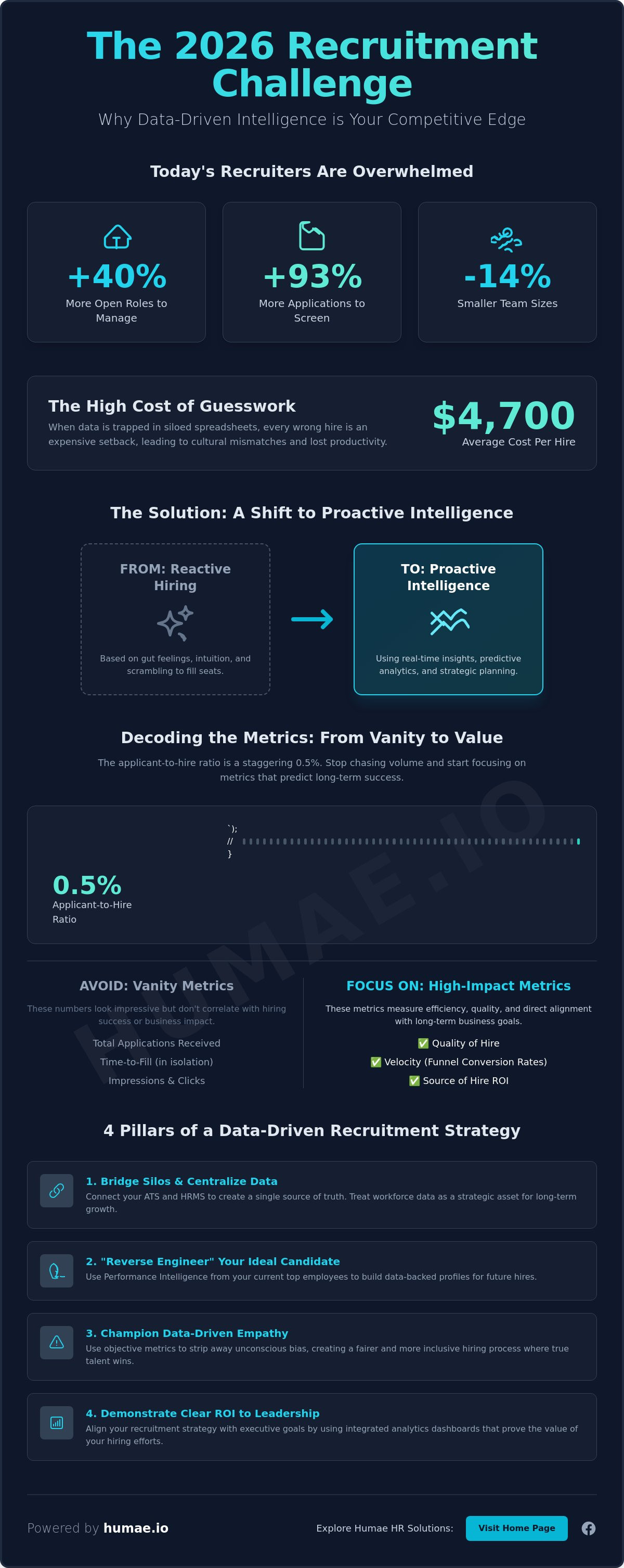
Recruiters in 2026 are managing 40% more open roles and 93% more applications than they did just five years ago, all while working with teams that are 14% smaller. It's an exhausting pace that often leaves talent leaders feeling like they're flying blind, especially when they don't know exactly how to use hiring data to improve recruitment effectively. You know that making the wrong hire is expensive, with the average cost per hire now reaching $4,700, yet proving the ROI of your efforts feels nearly impossible when your data is trapped in siloed spreadsheets.
We understand that recruitment isn't just about filling seats; it's about building the future of your organization through human connection and smart technology. You'll learn how to master a framework that slashes time-to-hire, boosts candidate quality, and finally aligns your talent acquisition efforts with long-term executive goals. We'll explore how performance intelligence and real-time analytics can turn your hiring process into a predictable, high-growth engine that supports every stakeholder involved.
Stay connected with our community on Facebook or return to our home page to explore more Humae HR solutions.
Key Takeaways
- Transition from reactive hiring to proactive talent intelligence by treating your workforce data as a strategic asset for long-term growth.
- Master how to use hiring data to improve recruitment by focusing on high-impact metrics like Quality of Hire and Velocity instead of simple vanity numbers.
- Bridge the gap between talent acquisition and Performance Intelligence to "reverse engineer" your ideal candidate profiles based on actual employee success.
- Audit your existing tech stack to centralize scattered information, ensuring your Applicant Tracking System and HRMS work in perfect harmony.
- Align your recruitment strategy with executive goals by using integrated Analytics Dashboards that clearly demonstrate the ROI of your hiring efforts.
Discover the future of HR at Humae or join our community on Facebook.
Beyond Gut Feelings: Why Hiring Data is Your Competitive Edge in 2026
Recruitment used to be a game of intuition. You'd sit across from a candidate, feel a spark, and hope for the best. In 2026, hope isn't a strategy. Knowing how to use hiring data to improve recruitment is the difference between building a high-performing team and managing a revolving door of new hires. The modern market moves too fast for guesswork; it requires a foundation built on evidence.
Data-driven recruitment is the strategic use of workforce management infrastructure to optimize talent acquisition. It represents a fundamental shift from reactive hiring to proactive talent intelligence. Instead of scrambling to fill a vacancy when someone leaves, you're using real-time insights to predict your next growth phase. You're no longer just looking for a resume that fits; you're looking for a person who will thrive.
The Evolution of Recruitment Analytics
We've moved far beyond basic metrics like time-to-fill. Advanced organizations are now leveraging People analytics to bridge the gap between initial interest and long-term retention. Today, AI-driven sentiment analysis helps evaluate candidate-culture fit by analyzing communication patterns and values alignment. Centralized infrastructure is the key to this evolution. When your data is clean and accessible, predictive analytics can tell you which sourcing channels provide the best long-term ROI, turning your recruitment process into a predictable engine for success.
The Human Element: Data as an Empathetic Tool
There's a common myth that data makes hiring cold or robotic. The reality is the exact opposite. Data is one of the most powerful tools for empathy in the modern workplace. By using objective metrics, you strip away the unconscious biases that often cloud human judgment. This creates a fairer, more inclusive hiring process where talent wins over pedigree. It allows you to see the person behind the application more clearly, ensuring that every candidate is evaluated on their actual potential rather than a recruiter's subjective mood.
Data-Driven Empathy is the use of insights to better understand candidate needs.
About Humae
Humae provides visionary HR solutions designed for the modern, tech-forward organization. From our integrated Applicant Tracking System to Performance Intelligence tools, we help you build a culture of success. Connect with us on Facebook or visit our home page to learn more.
Decoding the Metrics: Identifying High-Impact Hiring Data Points
Collecting data is easy; choosing the right data to act on is where most talent leaders struggle. To understand how to use hiring data to improve recruitment, you have to look past vanity metrics. It's not about how many applications you receive, but how those applications translate into long term business value. In 2026, the applicant to hire ratio is a staggering 0.5%, meaning you're filtering through a massive volume of noise to find a single signal. Precision in your metrics is the only way to stay efficient.
Your recruitment funnel is a series of measurable stages: sourcing, screening, interviewing, and the final offer. By tracking the conversion rates between these stages, you can pinpoint exactly where you're losing top talent. For instance, your Source of Hire data tells you which platforms provide the highest return on investment. If LinkedIn brings in 80% of your applicants but only 5% of your hires, it's time to reallocate your budget to more effective channels.
Brand health is also reflected in your data. The Offer Acceptance Rate (OAR) reached 82% globally in 2026, the highest since 2021. If your OAR is significantly lower, it's a red flag that your compensation, culture, or candidate experience isn't meeting market expectations. Tracking these numbers allows you to adjust your strategy in real time rather than waiting for an exit interview to find out what went wrong.
Primary Efficiency Metrics
Efficiency is about speed and cost without sacrificing quality. Time to Fill currently averages 44 days across industries, but this varies wildly. Energy and defense roles often take over 67 days, while hospitality can move in 14. Knowing your industry benchmark helps you set realistic expectations with executive leadership. When you calculate Cost per Hire, which now sits around $4,700, remember to include software costs and the man hours spent by your hiring managers. High Candidate Drop off Rates often signal friction in your Applicant Tracking System. If your application takes longer than five minutes, you're likely losing the most qualified, passive candidates who don't have time for tedious forms.
Quality and Impact Metrics
Speed doesn't matter if the person leaves within six months. Quality of Hire is the "North Star" of recruitment data, measured through performance reviews and manager satisfaction scores 180 days post onboarding. You should also monitor New Hire Retention during the critical 90 day window. If turnover is high here, your data is telling you there's a disconnect between the job description and the reality of the role. Finally, track your Diversity Sourcing Ratios at the top of the funnel. This ensures your talent pipeline is inclusive from the start, which is essential for building the resilient, innovative teams that 2026 demands.
About Humae
Humae builds the technology that makes human connections possible. Our platform empowers HR teams with the insights they need to grow. Explore our home page or follow our latest updates on Facebook.
Breaking the Silos: Connecting Recruitment Data to Performance Intelligence
The biggest mistake modern HR teams make is treating the hire date as a finish line. In reality, it's just the starting block. When you treat recruitment and performance as separate functions, you lose the most valuable insights your organization owns. Understanding how to use hiring data to improve recruitment requires looking far beyond the first day of work; it requires a continuous feedback loop that connects initial candidate scores to long-term business results.
By using employee performance intelligence software, you can effectively reverse engineer your ideal candidate. Instead of guessing which traits lead to success, you look at your top performers and trace their journey back to the beginning. Did your most successful sales reps all score highly on a specific cognitive assessment? Did your best engineers come from a particular sourcing channel? Real-time analytics dashboards allow you to spot these correlations instantly, turning historical performance into a roadmap for your next search.
Linking Hiring Profiles to OKR Success
Validation is the heart of a mature data strategy. When you utilize OKR tracking, you aren't just managing goals; you're testing your hiring criteria. If candidates who "aced" a specific interview stage consistently struggle to meet their key results, your interview process is measuring the wrong things. Identifying this High-Performer DNA allows you to adjust job descriptions and interview scorecards based on what actually drives results in your specific culture. It moves your talent acquisition from a game of chance to a disciplined science.
Predictive Turnover: Data as an Early Warning System
Hiring data can also serve as a powerful predictor of employee engagement and potential turnover. By analyzing the gap between candidate expectations and their reality 90 days in, you can identify mismatch hires before they become a retention statistic. Sentiment analysis during the onboarding phase, compared against initial interview notes, helps you spot early warning signs of disengagement. The best time to prevent turnover is during the interview process. When you use data to ensure a genuine fit from day one, you build a more resilient workforce that's aligned with your company's mission.
About Humae
Humae is your partner in building a high-performance culture. Our integrated HRMS and Performance Intelligence tools eliminate data silos, giving you the clarity to lead with confidence. Return to our home page to see our platform in action, or follow us on Facebook for the latest HR insights.
The 2026 Roadmap: How to Implement a Data-Driven Recruitment Strategy
Strategy without execution is just a wish list. After identifying your high-impact metrics and breaking down data silos, the next step is building a repeatable process. Understanding how to use hiring data to improve recruitment isn't just a technical challenge; it's a cultural shift. You're moving your organization away from "gut feeling" decisions toward a model where every hire is backed by evidence and aligned with long term growth.
The human element remains the most critical part of this roadmap. You must train your hiring managers on data literacy. It's about moving the conversation from "I just liked their energy" to "They meet the data criteria we've established for success in this role." This objective approach doesn't just improve results; it builds trust across the entire organization. Iterate your process every quarter by reviewing what worked and what didn't, ensuring your strategy evolves as fast as the 2026 labor market.
Step 1: Centralize Your Data Infrastructure
Fragmented tools lead to fragmented insights. Utilizing an all-in-one AI-powered HR platform is far superior to managing a "Frankenstein" stack of disconnected software. A centralized system allows for automated data collection at every candidate touchpoint, from the first click on a job ad to the final signature on an offer letter. This setup also makes it easier to stay compliant with 2026 regulations, such as the AI hiring laws in Illinois and Colorado, which require clear notice and risk management policies. When your data is in one place, privacy and ethics become manageable rather than a liability.
Ready to see how centralized data can transform your team? Explore our integrated ATS and analytics dashboards.
Step 2: Establish a Continuous Feedback Loop
Data should never be static. Establish a habit of conducting "Post-Mortems" on failed hires by comparing their recruitment data with their performance results. This helps you identify if the failure was a sourcing issue, a screening error, or an onboarding gap. Don't forget the candidates you didn't hire. Surveying them provides invaluable data on your "Candidate Experience" metric, which is a key differentiator in 2026. Use real-time dashboards to provide this visibility to stakeholders, ensuring everyone from the recruiter to the CEO is looking at the same success story.
About Humae
Humae is a visionary partner for modern HR teams, offering a deeply human approach to technology. Our platform includes an Applicant Tracking System, Performance Intelligence, and Analytics Dashboards designed for the 2026 business landscape. Connect with us on Facebook or return to our home page to discover how we can help you grow.
Future-Proofing Talent Acquisition with Humae’s AI-Powered Infrastructure
The shift toward data-driven hiring isn't just a trend; it's a necessity for organizations that want to remain competitive in 2026. Humae stands as your visionary partner in this transition, offering the infrastructure needed to turn complex analytics into human-centric decisions. We don't just provide tools; we offer a way to bridge the gap between your recruitment efforts and your company’s long term success.
By integrating our Applicant Tracking System with deep Performance Intelligence, we eliminate the silos that keep your best insights hidden. You’ve already explored how to use hiring data to improve recruitment through metrics like Quality of Hire and Offer Acceptance Rates. Humae takes this a step further by providing real-time OKR tracking that validates every hire against actual business outcomes. This means you can prove the value of your talent acquisition strategy to executive leadership with total confidence.
Our human-centric design ensures that data is accessible to everyone. You don't need to be a data analyst to understand your team's health. Whether you're a recruiter looking for the next top performer or a manager focused on engagement, the insights you need are always at your fingertips. Our platform is built to make the complex feel simple, allowing you to focus on the human connections that matter most.
The Humae Advantage: From Insight to Action
Our centralized employee directories track the full lifecycle of your talent. From the moment someone enters your ATS to their third promotion, every data point is connected. We use AI-driven sentiment analysis to help you maintain a high-engagement culture, ensuring that "culture fit" is more than just a buzzword. As your company grows, our scalable infrastructure moves with you, supporting your journey from a hungry startup to a global enterprise.
Getting Started with Data-Driven Hiring
A smarter, more empathetic hiring process is within your reach. We invite you to see our platform in action and discover how technology can actually make your workplace more human. Let's build a culture where data empowers people rather than replacing them. The roadmap to your next great hire starts with the right infrastructure.
Discover how Humae can transform your recruitment data into growth.
About Humae
Humae provides modern HR solutions that prioritize human connection through innovative technology. Our suite of tools includes HRMS, Performance Intelligence, and Analytics Dashboards designed for the future of work. Connect with our community on Facebook or return to our home page to explore our full range of features.
Move from Intuition to Impact
The 2026 labor market doesn't reward guesswork. You've seen that the secret to sustainable growth lies in breaking down silos and connecting your hiring funnel to actual performance outcomes. You've explored how to use hiring data to improve recruitment by focusing on high impact metrics like Quality of Hire and Offer Acceptance Rates. Now it's time to stop letting valuable insights slip through the cracks of fragmented tools.
Precision and empathy can coexist when you have the right foundation. By leveraging a centralized workforce infrastructure, you ensure every decision is backed by evidence while keeping the human experience at the center of your strategy. Start Building Your Data-Driven Team with Humae today. Our platform provides the AI powered performance intelligence and integrated OKR tracking you need to turn talent acquisition into a competitive advantage. Let's build a future where your team doesn't just grow; it thrives.
About Humae
Humae is your partner in building a high-performance culture. Return to our home page to see our full suite of HR solutions or follow us on Facebook for the latest industry insights.
Frequently Asked Questions
What is the most important metric for data-driven recruitment?
Quality of Hire is the most important metric because it tracks the long term contribution of an employee to your organization. While speed matters, filling a role with someone who leaves in three months is a failure. By measuring performance scores 180 days after onboarding, you gain a clear picture of whether your selection process actually works. This insight is the foundation of how to use hiring data to improve recruitment effectively.
How can small startups use hiring data without a dedicated data analyst?
Small startups can leverage data by using integrated platforms that automate the heavy lifting. You don't need a dedicated analyst when your HRMS provides real-time dashboards and automated reporting. Focus on a few high-impact numbers, like your Offer Acceptance Rate and Source of Hire, to optimize your limited budget. This allows you to make professional, evidence-based decisions without a massive overhead.
Does data-driven hiring increase the risk of bias in recruitment?
Data-driven hiring actually reduces the risk of bias by replacing subjective gut feelings with objective metrics. When you define clear success criteria before you start interviewing, you ensure every candidate is evaluated on the same playing field. In 2026, regulations like those in Colorado and Illinois also require transparency in how AI and data are used, which adds an extra layer of fairness and accountability to your process.
How long does it take to see results from a data-driven hiring strategy?
You'll see efficiency gains almost immediately, but quality metrics take longer to mature. Improvements in time-to-hire or candidate drop-off rates often appear within the first few weeks of optimizing your workflow. To measure the impact on quality of hire or long-term retention, you should expect to wait six to twelve months. This timeframe allows you to collect enough performance data to validate your new strategy.
What is the difference between an ATS and recruitment analytics software?
An ATS manages your hiring workflow, while recruitment analytics software interprets the results of that workflow. Think of the ATS as the engine and analytics as the dashboard that tells you how fast you're going and where you're wasting fuel. Most modern teams prefer an integrated solution that combines both functions, ensuring that data flows seamlessly from the application stage into your performance reports.
Can hiring data help improve employee retention?
Hiring data is a powerful tool for improving employee retention. By analyzing the traits of employees who stay past the critical 90-day window, you can refine your interview questions to spot long-term fits. This feedback loop helps you identify mismatch patterns early, preventing the high costs associated with turnover. It's one of the most practical ways how to use hiring data to improve recruitment while protecting your company culture.
How do OKRs link back to my recruitment data?
OKRs provide the ultimate validation for your recruitment criteria. If your top performers consistently hit their key results but don't match your original ideal candidate profile, your profile needs to change. Linking these goals back to your hiring data allows you to see which interview scores actually predict success. This ensures you're hiring for the skills that drive your business forward, not just for a good resume.
What is workforce management infrastructure in the context of hiring?
Workforce management infrastructure is the centralized system that connects every stage of the employee lifecycle. It acts as the backbone of your data collection, ensuring that information from your ATS, employee directory, and performance reviews is consistent and accessible. Without this infrastructure, your data stays trapped in siloed spreadsheets, making it impossible to gain a holistic view of your talent acquisition strategy.