How to Reduce Time Spent on HR Admin: A 2026 Efficiency Guide
By Humae · 7 May 2026
how to reduce time spent on hr admin
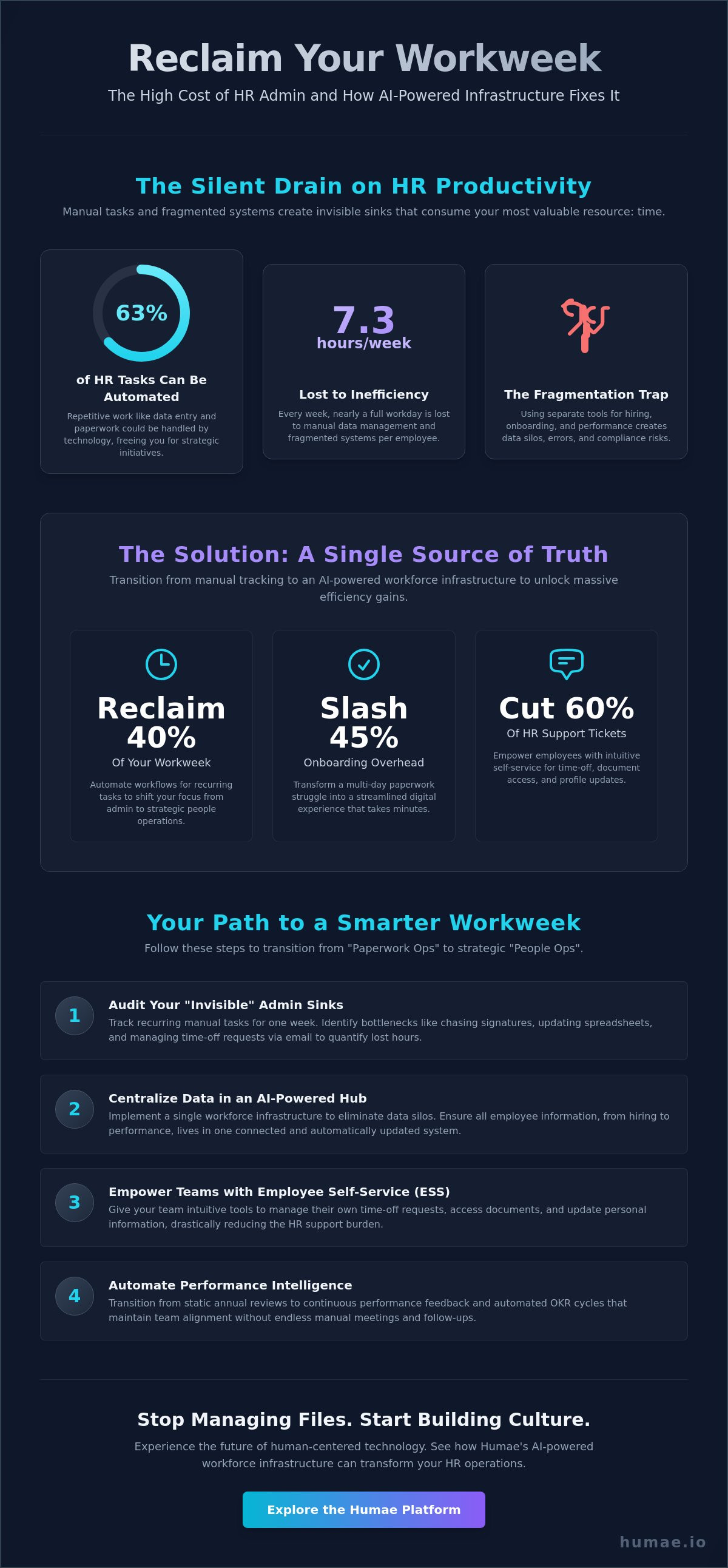
Did you know that 63% of the tasks currently cluttering your desk could be handled by technology while you sleep? It's a staggering figure, yet many HR professionals still lose 7.3 hours of productivity every week to manual data entry and fragmented systems. You likely feel the weight of scattered employee files and the friction of manual onboarding every single day. It's exhausting to realize you're spending more time on spreadsheets than on the people who actually drive your business forward.
This guide reveals exactly how to reduce time spent on hr admin so you can reclaim up to 40% of your workweek. By transitioning from manual tracking to a modern, AI-powered workforce infrastructure, you can slash administrative overhead by 45% during new hire onboarding alone. We'll walk through the steps to establish a single source of truth for your data and implement automated workflows for recurring tasks. It's time to stop managing files and start building the strategic culture your team deserves.
Key Takeaways
- Audit your current workweek to distinguish strategic People Ops from the "invisible" admin sinks that drain your focus and energy.
- Discover how to reduce time spent on hr admin by centralizing every employee detail into a single, AI-powered workforce infrastructure.
- Slash HR support tickets by up to 60% by empowering your team with intuitive Employee Self-Service (ESS) for time-off and document management.
- Transition from static annual reviews to continuous performance intelligence and automated OKR cycles that maintain alignment without manual meetings.
- Transform onboarding from a multi-day paperwork struggle into a streamlined, automated experience that takes only minutes to complete.
Ready to reclaim your workweek? Return to our home page to explore the Humae platform, or stay updated with our community on Facebook.
Identifying the 'Invisible' Admin Sinks in Your HR Workflow
You didn't start a career in HR to chase signatures or fix broken Excel formulas. You're here to build culture and grow talent. But for most, the reality is a mountain of "Paperwork Ops" that buries strategic "People Ops" every day. If you're wondering how to reduce time spent on hr admin, the first step isn't buying more tools. It's auditing the invisible leaks in your current workweek. Research shows that 63% of tasks typically handled by HR can be automated with existing technology, yet many teams remain stuck in manual loops.
Micro-admin is the silent killer of productivity. A five-minute email thread about a time-off request seems harmless. Multiply that by thirty employees and ten threads a week. Suddenly, you've lost an entire workday to basic communication. In 2026, spreadsheets have become the primary enemy of scalability. They don't talk to each other; they don't update in real-time. They rely on manual input, which is a breeding ground for errors. This manual grind doesn't just waste time; it leads to professional burnout. When your day is 80% admin and 20% impact, job satisfaction evaporates. Workers lose an average of 7.3 hours of productivity each week to these inefficiencies, costing employers billions annually.
The Fragmentation Trap: Why Multiple Tools Increase Admin
Many teams use one tool for hiring, another for onboarding, and a third for performance. This creates a "Switching Cost" that drains mental energy and kills focus. Moving data between these disparate systems manually increases compliance risks and leads to data entry errors. It's why a centralized hris is no longer a luxury. By implementing a comprehensive Human Resource Management System (HRMS), you eliminate the need to enter the same employee name five different times. Digital onboarding tools alone can reduce administrative overhead by up to 45% per new hire by creating a single, digital flow from the start.
Quantifying Your Time: The HR Admin Audit
Stop guessing where your hours go. For one week, track every recurring manual task to see the real data. Focus on these common bottlenecks:
- Manual tracking of time-off requests and balances
- Chasing managers for performance review completions
- Updating employee contact information across multiple files
- Sending and collecting onboarding documents via email
Calculate the ROI of automation by multiplying these lost hours by your leadership's hourly rate. If you're spending 15 hours a week on tasks that a system could handle, you're losing thousands of dollars every month. Identifying these bottlenecks is the only way to clear a path for growth. Knowing exactly how to reduce time spent on hr admin starts with seeing the waste clearly and choosing a platform that prioritizes human connection over data entry.
Building a Modern Workforce Management Infrastructure
Prioritizing your to-do list won't save you if the list is fundamentally broken. While traditional advice suggests using time-management matrices to organize your day, the real secret to how to reduce time spent on hr admin lies in your workforce management infrastructure. You need a system that acts as a proactive partner, not just a digital filing cabinet. By building a foundation that handles the heavy lifting of data movement, you shift from reactive firefighting to strategic growth. This transition requires moving beyond individual "tools" and embracing an ecosystem where data flows without human intervention.
Infrastructure is about more than just software; it's about the logic that connects your people. When you centralize your employee directory, integrate time-off management, and standardize hiring, you're not just "doing HR." You're building an engine that drives efficiency across the entire organization. This modern application of AI technologies to transform traditional HR functions ensures that your team spends less time on keyboards and more time on culture. If you're looking for a place to start, you can explore how automated infrastructure works to simplify your daily operations.
Step 1: Centralize Your Employee Directory
A static PDF or a disconnected Excel sheet is a liability. In 2026, a dynamic, cloud-based directory serves as the single source of truth for your entire organization. It ensures that when a reporting line changes, the org chart, permissions, and approval workflows update instantly across every connected system. This isn't just about contact info; it's about visibility. A centralized directory reduces data redundancy and manual entry errors by up to 30% by ensuring every internal process pulls from one verified, real-time profile.
Step 2: Automate Recurring Workflows
Automation isn't about replacing the human touch; it's about removing the human bottleneck. By setting up "If-This-Then-That" triggers for onboarding and offboarding, you ensure no step is missed. As soon as a candidate signs their offer, the system can automatically trigger document collection and signature workflows. This proactive approach significantly reduces the manual oversight needed for absence management, moving time-off requests from messy email chains to one-click approvals that sync directly with team calendars. When the system handles the "if" and the "then," you're finally free to focus on the "who."
Empowering Teams with Employee Self-Service (ESS)
Giving your team the keys to their own data isn't just about delegation. It's a strategic shift that fundamentally changes how to reduce time spent on hr admin. When employees handle their own basic requests, HR departments see a 60% reduction in administrative tickets. This isn't just a win for your schedule; it's a win for your company culture. Transparency and autonomy build trust, showing your team that you value their time as much as your own. In an era where the global market for ESS platforms is projected to reach $45.3 billion by 2035, staying ahead means giving your people the tools they need to be self-sufficient.
Streamlining Time-Off Management
The "How many days do I have left?" email is a relic of the past. Automated balance tracking gives every employee a real-time view of their accrued leave. By shifting time-off requests from messy email chains to one-click approvals, you eliminate the friction that slows down your week. Team calendars prevent scheduling conflicts before they happen, allowing managers to see who's out without asking HR for a report. Integrating these updates with tools like Slack or Teams ensures the whole company stays informed without a single manual update from your side.
Decentralizing Document Management
Compliance shouldn't feel like a game of tag. Enabling employees to upload their own certifications, update tax information, or refresh contact details directly into the employee directory removes the burden from your shoulders. Automated reminders for expiring visas or professional licenses ensure you stay compliant without sending a single follow-up email. This proactive approach keeps your records accurate and your audits stress-free, all while saving hours of manual data entry every month. It's a simple way to maintain a single source of truth without the manual labor.
Leveraging AI for Performance Intelligence and OKR Tracking
If you're still using spreadsheets to track goals, you're fighting a losing battle against your own calendar. Manual OKR tracking is arguably the largest hidden admin sink in modern HR. It requires endless follow-up emails, hours of data consolidation, and meetings that could have been an automated update. Learning how to reduce time spent on hr admin means moving from these static, manual reviews to continuous performance intelligence. By letting AI handle the tracking, you ensure every team member stays aligned without you having to play the role of a corporate nag.
Continuous feedback cycles replace the dreaded annual review, which often takes weeks of preparation. Instead, AI-powered dashboards provide real-time analytics, allowing you to spot trends and celebrate wins as they happen. This proactive approach doesn't just save time; it improves the quality of your data. You're no longer looking at outdated snapshots but a living, breathing map of your organization's progress. To reclaim your schedule, you should explore AI-powered OKR tracking to see how automation simplifies the growth process.
Real-Time OKR Tracking Without the Headache
Status reporting often feels like a full-time job. Integrated okr meaning frameworks save hours of manual reporting by pulling progress directly from the tools your teams already use. Automated nudges remind goal owners to update their key results, so you don't have to. AI-driven OKR tracking ensures strategic alignment in 2026 by automatically identifying and flagging goals that are falling behind or diverging from company objectives. This visibility allows for quick pivots without the need for emergency alignment meetings.
AI-Driven Sentiment and Feedback
Traditional surveys are often too slow to be useful. By the time you analyze the results, the issue has already impacted morale. Automating the collection of continuous feedback allows you to stay pulse-checked in real-time. AI sentiment analysis categorizes and prioritizes employee concerns, catching engagement issues before they escalate into formal grievances. This significantly reduces the time spent on manual employee engagement audits, letting the software do the heavy lifting of data synthesis. You get the insights you need to act, without the administrative burden of manual survey management.
Streamlining Your People Operations with Humae
Humae isn't just another software package. It's a cohesive workforce infrastructure designed to solve the exact problems we've discussed: fragmented data, manual tracking, and the "invisible" admin burden. By unifying your HRMS, OKR tracking, and AI-driven intelligence into one intuitive interface, we provide a single source of truth that actually works. If you're looking for how to reduce time spent on hr admin, the answer is deep integration. When your employee directory talks to your performance reviews, and your time-off management updates your team calendars automatically, the manual work simply disappears.
Transitioning your team doesn't have to be a headache. We've built Humae to be as human-centered as it is tech-driven. You can move from scattered spreadsheets to a streamlined system without disrupting your daily operations. This shift allows you to reduce onboarding time from days of paperwork to just minutes of automated workflows. Instead of chasing signatures, you're welcoming new talent with a professional, frictionless experience. This efficiency provides the foundation for better management decisions, backed by real-time analytics dashboards that show you the health of your culture at a glance.
Centralized Features for Modern Teams
The core of our platform is built around simplicity. By exploring the Humae features, you'll see how we've eliminated the need for repetitive data entry. Whether it's automated document collection or continuous feedback loops, every tool is designed to give you back your time. You can see how it works for fast-growing startups that need to scale without adding administrative bloat. It's a fundamental shift from being an "Admin" to becoming a source of "Intelligence" for your organization.
Your Path to Strategic HR
It's time to reclaim your calendar. When you stop spending 15 hours a week on basic HR tasks, you finally have the space for high-value work like culture building and talent retention. You aren't alone in this journey. By joining the community of modern leaders on the Humae Facebook page, you can share insights and stay updated on the latest innovations in workforce management. Don't let another week slip away into a sea of manual emails. Start your journey toward zero-admin HR today and rediscover why you entered this profession in the first place.
Lead with Intelligence, Not Paperwork
The transition from a reactive "Paperwork Ops" model to a proactive, AI-powered workforce infrastructure is no longer a luxury. By centralizing your data and empowering your team with Employee Self-Service, you eliminate the friction that currently drains 7.3 hours of productivity every week. You've seen how a single source of truth and automated workflows can transform onboarding from a multi-day struggle into a minutes-long welcome. Knowing how to reduce time spent on hr admin is the first step toward becoming the strategic leader your organization needs.
With AI-driven performance intelligence and integrated OKR tracking, you can finally move beyond manual status reports and annual reviews. Real-time analytics dashboards give you the clarity to make data-backed decisions that drive culture and retention. Don't let manual tasks define your career when you could be focusing on the people who make your business thrive. Ready to reclaim your time? Discover how Humae automates your HR admin today. Your journey toward a more human, efficient workplace starts now.
Frequently Asked Questions
How much time can HR software actually save per week?
Modern HR software saves an average of 7.3 hours per week by eliminating manual data entry and fragmented communication. Since 63% of typical HR tasks are now automatable with existing technologies, most teams can reclaim nearly an entire workday. This shift allows you to move away from chasing signatures and toward high-impact culture building.
Is AI-powered HR software secure for sensitive employee data?
Modern platforms prioritize data governance and enterprise-grade encryption far more effectively than traditional spreadsheets. Centralizing data in a secure cloud environment eliminates the risks associated with local files and email threads. These systems are designed to meet 2026 compliance standards, ensuring that sensitive employee details remain protected and accessible only to authorized users.
Can we reduce HR admin without hiring more staff?
You can definitely scale your operations without increasing your headcount. Digital onboarding tools alone reduce administrative overhead by 45% per new hire, allowing smaller teams to manage larger workforces. By building a proactive workforce infrastructure, you replace manual labor with automated logic that handles recurring tasks without human intervention.
What are the most common HR tasks that should be automated first?
You should prioritize automating onboarding, time-off management, and document collection. These are the primary "invisible sinks" where small tasks accumulate into lost days. Focusing on these areas is the most effective way to see immediate results when researching how to reduce time spent on hr admin and reclaiming your workweek.
How do I convince my CEO to invest in HR automation?
Focus your argument on the bottom line and the cost of inefficiency. Replacing a single employee can cost between 50% and 200% of their annual salary; automation protects this investment by reducing burnout and improving retention. Presenting the ROI of a system that saves 7.3 hours of productivity per week makes the decision a matter of financial growth.
What is the difference between an HRIS and simple admin tools?
An HRIS acts as a single source of truth, while simple tools often create disconnected data silos. Simple tools require you to move data manually between systems, which increases the risk of errors and compliance gaps. A centralized system like Humae ensures that every update to the employee directory flows through your entire infrastructure automatically.
Does reducing HR admin impact employee experience negatively?
Efficiency actually improves the employee experience by providing autonomy through Employee Self-Service (ESS). Employees prefer the speed of one-click approvals and the transparency of viewing their own leave balances in real-time. Removing the friction of slow, manual email chains builds a culture of trust and professional respect.
What happens to HR roles when admin is fully automated?
HR roles shift from "Paperwork Ops" to strategic "People Ops." Instead of spending your day on data entry, you'll focus on talent growth, leadership coaching, and organizational design. Automation doesn't replace the human element; it removes the robotic tasks so you can focus on the work that requires empathy and judgment.