How to Keep Employees Aligned with Company Objectives: The 2026 Leadership Playbook
By Humae · 14 June 2026
challenges in aligning teams with company goals
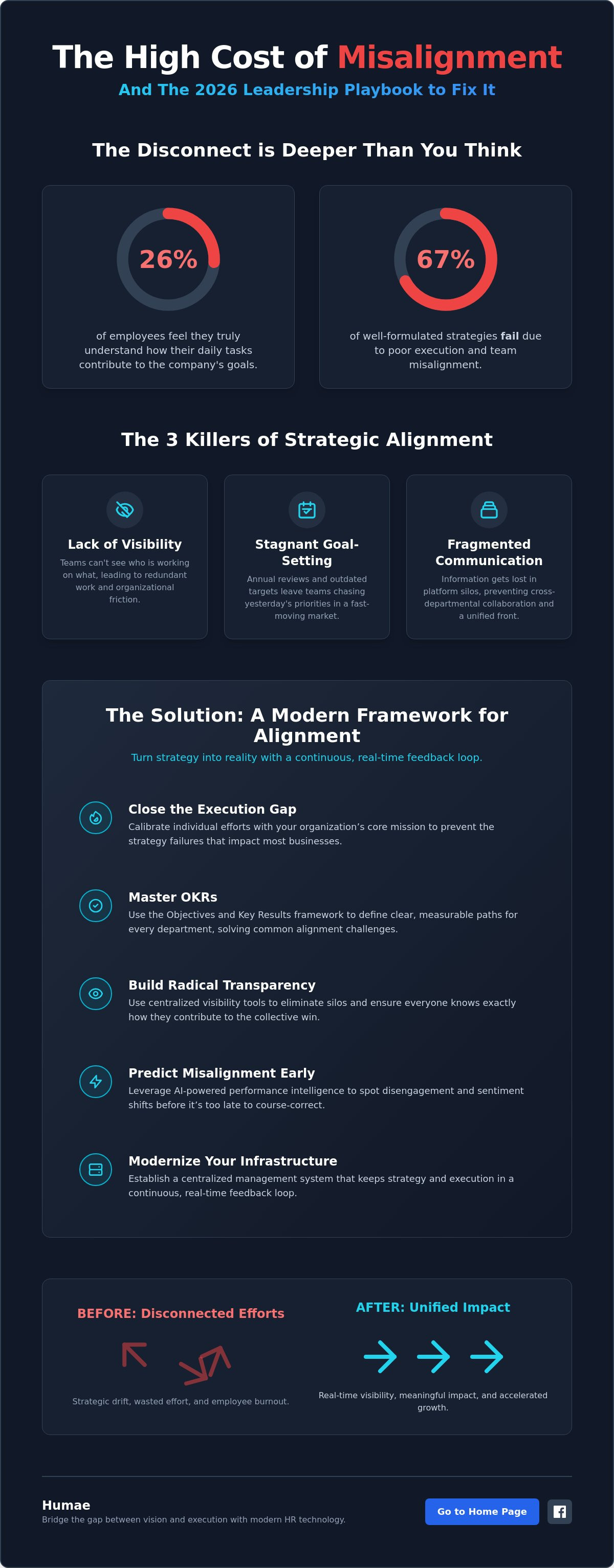
Only 26% of employees feel they truly understand how their daily tasks contribute to the bigger picture. It's a staggering figure that highlights the growing challenges in aligning teams with company goals in an era where priorities shift overnight. You've likely seen the symptoms; departments working at cross-purposes, talented people feeling disconnected, and managers buried under manual, time-consuming performance reviews. It's frustrating to watch high engagement turn into wasted effort simply because the organizational compass is broken.
We're moving beyond static spreadsheets and quarterly guesses. This 2026 Leadership Playbook offers a data-driven framework designed to turn your strategy into a living, breathing reality. You'll discover how to leverage OKRs, AI-powered insights, and transparent communication to create a unified team that moves in one direction. We'll show you how to gain real-time visibility into progress and reduce turnover by giving every team member a sense of meaningful, visible impact.
Key Takeaways
- Close the execution gap. Learn how to calibrate individual efforts with your organization’s core mission to prevent the strategy failures that impact most businesses.
- Master OKRs. Discover how this framework solves the most common challenges in aligning teams with company goals by defining clear, measurable paths for every department.
- Build radical transparency. Use centralized visibility tools to eliminate silos and ensure everyone knows exactly how they contribute to the collective win.
- Predict misalignment early. Leverage AI-powered performance intelligence to spot disengagement and sentiment shifts before it's too late to course-correct.
- Modernize your infrastructure. Establish a centralized management system that keeps strategy and execution in a continuous, real-time feedback loop.
What is Strategic Employee Alignment and Why Does It Fail?
Alignment isn't just a corporate buzzword; it's the precise calibration of every individual's daily effort with the organization's core mission. Think of it as a high-definition GPS for your entire workforce. Without it, even the most brilliant strategy remains just words on a slide. Statistics show that 67% of well-formulated strategies fail because of poor execution. This massive gap exists because leaders often struggle with the core challenges in aligning teams with company goals, leading to a deep disconnect between the boardroom vision and daily execution.
Traditional, top-down management styles are crumbling under the pressure of the 2026 business cycle. Organizations are rapidly shifting toward agile workforce management that prioritizes transparency over command. When alignment fails, it's usually because of three specific killers. First, a total lack of visibility makes it impossible to see who is working on what. Second, stagnant goal-setting processes leave teams chasing outdated targets. Third, fragmented communication across different platforms creates silos where information goes to die. These issues turn potential growth into organizational friction.
The High Cost of Disconnected Teams
Misalignment is a silent budget killer. When departments work at cross-purposes, you're effectively paying for redundant work and projects that will eventually be scrapped. This isn't just a financial drain; it's a human one. Employees quickly burn out and disengage when they don't see how their hard work moves the needle for the company. Strategic Drift is the gradual loss of focus over a fiscal year that turns a high-performing team into a group of people just going through the motions. Without a central source of truth, your best talent ends up rowing in different directions.
Why 20th-Century Performance Reviews Are Obsolete
Waiting twelve months to give feedback is a recipe for failure in the current market. Annual reviews are simply too slow. They act as post-mortems rather than proactive progress reports. Leading organizations have moved toward continuous performance intelligence to keep everyone on track. By adopting a structured OKR framework, companies can implement Real-Time Calibration. This ensures that when market priorities shift on a Tuesday, the entire team isn't still stuck working on Monday's old news. Solving the challenges in aligning teams with company goals requires a system that lives and breathes with your business.
The OKR Framework: Structural Alignment from Top to Bottom
Objectives and Key Results (OKRs) have emerged as the gold standard for high-growth organizations. Understanding the true OKR meaning involves more than just setting targets; it's about creating a shared language for success. Leaders face significant challenges in aligning teams when they treat goals as static documents. To solve this, the framework distinguishes between Committed OKRs, which require 100% achievement for business stability, and Aspirational OKRs, which push teams toward visionary moonshots. This distinction allows for both predictable growth and radical innovation within the same quarter.
Successful alignment requires a balance between cascading goals from leadership and encouraging bottom-up contributions from the front lines. This bi-directional approach ensures that strategy is informed by reality. For this to work, every objective must be transparent and visible. When goals are accessible across the entire company directory, people don't just see their own tasks; they see how their work supports the collective win. This visibility is the antidote to the silos that typically stall progress.
Setting Objectives That Actually Inspire
An objective shouldn't be a boring task list. It needs to be qualitative, ambitious, and time-bound. If your objective looks like a checklist, you're likely focusing on the wrong things. For example, a product team shouldn't aim to "fix five bugs." Instead, they should aim to "Create a user experience that feels like magic." This inspires creativity and ownership. Sales teams might aim to "Become the preferred partner for Fortune 500 firms," while HR focuses on "Building a culture where every voice is heard." These are the north stars that guide daily decisions and keep everyone moving in the same direction.
Measuring Key Results with Precision
Key results are the yardsticks for your objectives. Follow the rule of three; aim for exactly three key results per objective to maintain focus. The most common mistake is tracking outputs like "held ten meetings" instead of outcomes like "increased trial-to-paid conversion by 15%." Using automated analytics dashboards removes the manual burden of tracking. It allows teams to see their progress in real-time, making it easier to overcome the challenges in aligning teams with company goals. When data is live, alignment becomes a habit rather than a quarterly chore.
If you're ready to move beyond spreadsheets, you can explore our OKR tracking solutions designed for modern, agile teams.
Fostering a Culture of Radical Transparency and Visibility
Trust is the fundamental currency of high-performing teams. When goals remain hidden behind closed doors or buried in private spreadsheets, employees naturally begin to doubt the direction of the company. This lack of clarity is one of the primary challenges in aligning teams with company goals. If your people don't know what success looks like for the department next door, they can't possibly synchronize their efforts. Radical transparency isn't just about sharing numbers; it's about making the entire corporate strategy accessible to every person in the organization from day one.
Strategy shouldn't feel like a secret. When you link individual purpose to the broader corporate mission, work stops being a series of tasks and starts being a contribution. Celebrating Key Result milestones publicly is a vital part of this process. It validates the hard work of your teams and provides a visual reminder that progress is happening. This public recognition turns abstract objectives into tangible wins that everyone can get behind.
The Role of the Centralised Employee Directory
A modern employee directory is far more than a digital phonebook. In 2026, it serves as a dynamic hub for skills and goals. When an engineer in Berlin can see the specific OKRs of a product manager in New York, the risk of redundant work drops significantly. This visibility ensures that global teams don't waste resources on siloed projects that already exist elsewhere. Transparency within the directory builds a deep sense of intrinsic motivation as employees see exactly where their unique talents fit into the company's future.
Eliminating Information Silos
Silos happen when teams forget they're playing for the same side. To break these down, leaders must implement cross-departmental OKR check-ins. It's not enough for Team A to hit their targets if those targets don't enable Team B to succeed. Shared dashboards act as a visual bridge, showing the dependencies between different business units. We call this an Open-Source Strategy. When every employee can view the CEO's top-level objectives, the "why" behind every task becomes clear. This level of openness is the most effective way to solve the challenges in aligning teams with company goals, as it replaces guesswork with total clarity.
Leveraging AI and Performance Intelligence for Real-Time Alignment
The speed of business in 2026 has rendered manual oversight obsolete. Leaders frequently encounter challenges in aligning teams with company goals when they rely on static data that is already weeks old. Performance intelligence serves as a proactive bridge, turning raw data into actionable foresight. By applying Nudge Theory within your management software, you can keep critical objectives top-of-mind. These subtle, intelligent reminders ensure that strategy doesn't just live in a document but thrives in every daily decision made across the organization.
Artificial intelligence now goes beyond simple tracking. It can actively suggest goal adjustments based on real-time workload data or sudden shifts in market trends. If a team is over-leveraged, the system identifies the bottleneck and proposes a more sustainable path forward. This keeps your targets ambitious yet achievable, preventing the burnout that often follows unrealistic expectations. It's about using technology to support the human rhythm of work, not to disrupt it.
Predictive Alignment: AI-Driven Sentiment Analysis
Waiting for a project to fail is a costly mistake. AI-driven sentiment analysis allows you to detect alignment friction before it impacts your bottom line. By analyzing feedback patterns and internal interactions, the technology identifies where disengagement is brewing. This isn't about surveillance; it's about team health. Managers can intervene early to provide clarity and support, ensuring that the human connection remains strong even as the digital infrastructure scales. It's a shift from reactive firefighting to empathetic, predictive leadership.
Automated Check-ins and Feedback Loops
Manual status updates often feel like a chore for employees and a burden for managers. Modern platforms replace these with automated, AI-summarized reports that focus on outcomes rather than activity. These real-time feedback loops are core to successful employee engagement strategies. They provide the micro-feedback necessary for daily course-correction. When people receive immediate recognition for their progress, their sense of purpose grows, and the strategic drift that plagues many organizations is effectively eliminated.
Stop guessing and start leading with data. Check out our Performance Intelligence tools to see real-time alignment in action.
Building Your Alignment Infrastructure with Humae
Solving the persistent challenges in aligning teams with company goals requires more than a quarterly meeting; it needs a permanent digital home. Humae provides the essential workforce management infrastructure that 2026 leaders need to turn high-level strategy into daily action. By integrating OKR tracking directly with performance intelligence, we eliminate the friction that usually stops teams from reaching their full potential. It's about creating a single source of truth where every employee knows exactly how their work contributes to the bigger picture.
Managing a modern workforce shouldn't feel like a series of disconnected administrative tasks. When you bring hiring, onboarding, and performance reviews into a single interface, the data begins to tell a story. You don't have to hunt for information or manually update spreadsheets to see if a department is on track. This unified approach gives leaders a crystal-clear view of their organization's trajectory. It allows you to spot talent gaps early and ensure that every new hire is aligned with your core mission from their very first day. It's a shift from merely tracking presence to actively cultivating progress.
Centralising Strategy and Execution
Humae’s AI-powered platform takes the heavy lifting out of the OKR lifecycle. It automates the tracking process and provides real-time updates, so you can focus on growth instead of administrative overhead. For the C-suite, this means having access to actionable analytics that actually drive high-stakes decision-making. You're no longer managing based on gut feelings or outdated reports. Instead, you're optimizing your business based on live performance data that reflects the current reality of your market and your team's capacity. This level of insight turns raw strategy into a measurable, repeatable success engine.
The Future of People Operations
Modern teams don't just need a database to store names and dates; they need intelligence to guide their collective journey. Humae empowers modern management by providing the tools to nurture talent and align individual effort with corporate strategy. Our vision is a human-centric future where technology handles the complexity of data, leaving you free to build deeper, more meaningful connections with your people. The future of HR isn't just about efficiency. It's about creating a workplace culture where everyone has the clarity they need to win together.
It's time to move beyond the limitations of legacy systems and static spreadsheets. Modernize your people operations today and build a team that moves with purpose, precision, and a shared vision for the future.
Leading Your Team Toward a Unified Vision
Static goal-setting is a relic of the past. We've explored how a structured OKR framework creates a shared language for success and how radical transparency dissolves the silos that typically stall progress. Transitioning from manual, slow-motion reviews to AI-powered Performance Intelligence isn't just a technical upgrade; it's a fundamental cultural shift toward a more human and efficient workplace.
The persistent challenges in aligning teams with company goals usually stem from fragmented data and a lack of real-time visibility. By establishing a centralized workforce infrastructure, you provide your people with the clarity they need to move in one direction. Real-time OKR tracking ensures that every individual understands their unique impact, turning abstract strategy into tangible daily wins that everyone can celebrate together.
Ready to unify your team? Discover how Humae aligns your workforce with AI-powered OKR tracking.
Your mission is too important to leave to chance. It's time to build a modern organization where strategy and execution live in perfect harmony.
Frequently Asked Questions
How often should we review employee alignment with company goals?
You should review strategic alignment at least once every quarter, but tactical check-ins must happen bi-weekly. This dual rhythm ensures that while your long-term vision remains steady, your daily execution stays flexible enough to handle market shifts. Regular touchpoints prevent the strategic drift that often occurs when goals are only discussed during annual reviews.
What is the difference between KPIs and OKRs in employee alignment?
KPIs measure the ongoing health and "business as usual" metrics of a department, while OKRs drive specific growth, innovation, or change. Think of KPIs as the steady heartbeat of your operations and OKRs as the miles you're covering toward a new destination. Both are essential for solving the challenges in aligning teams with company goals by providing different layers of focus.
Can AI really help keep employees aligned without being intrusive?
AI assists alignment by acting as a supportive coach rather than a digital overseer. It uses sentiment analysis and smart nudges to identify friction points and suggest workload adjustments before they lead to burnout. This proactive approach allows managers to intervene with empathy and clarity, ensuring the human element remains at the center of your technology strategy.
How do I align remote or hybrid teams with company objectives?
Aligning distributed teams requires a centralized workforce infrastructure that serves as a digital headquarters. You must provide every employee with real-time access to shared dashboards and a transparent directory where they can see their colleagues' objectives. This visibility replaces office proximity, ensuring that distance doesn't create information silos or a sense of professional isolation.
What should I do if an employee's personal goals don't match company objectives?
You should start by having an open conversation to see if the employee's role can be adjusted to better leverage their unique strengths. Sometimes a mismatch is simply a sign that a talented person is in the wrong seat. If the gap is too wide, it's better to address it early and help them find a path that truly inspires them elsewhere.
How do cascading goals work in a flat organizational structure?
In flat structures, cascading works through bi-directional contribution where leadership sets the "what" and teams define the "how." This collaborative method replaces top-down commands with collective ownership. It ensures that those closest to the daily work have a direct say in setting the key results that will move the company forward, increasing engagement and accountability.
What is the best software for tracking employee alignment in 2026?
Humae is the premier platform for 2026, offering a unified interface for OKR tracking, performance intelligence, and workforce analytics. It's designed to help modern leaders overcome the challenges in aligning teams with company goals by providing a single source of truth. By integrating goal tracking with your employee directory, Humae makes alignment a natural part of the daily workflow.
How does employee transparency impact organizational alignment?
Transparency builds the trust necessary for teams to move fast without constant supervision. When every employee can see the CEO's top-level objectives, they gain a clearer understanding of why their specific tasks matter. This openness reduces redundant work across departments and creates a culture where everyone feels like a true partner in the company's success.