How to Choose the Right HR Platform in 2026: A Visionary Buyer Guide
By Humae · 1 July 2026
how to choose the right hr platform
What if your HR software did more than just store documents, and actually predicted your next big talent gap before it happened? In a year where state-level regulations and AI governance are shifting weekly, the old way of managing people simply doesn't scale. You're likely tired of fragmented spreadsheets and the heavy administrative lift of onboarding new hires. Learning how to choose the right hr platform is no longer about finding a digital filing cabinet; it's about securing a visionary partner for your organization's success.
We understand the pressure to maintain visibility into team sentiment while keeping up with complex compliance updates like the new PFML programs in Maine and Minnesota. You want a single source of truth that turns administrative noise into actionable insights. This guide reveals how to evaluate your infrastructure to move beyond basic administration and toward true workforce intelligence. We will preview the essential features for 2026, including automated workflows that save hours weekly and real-time performance tracking that aligns with your OKRs.
Experience the future of work with Humae. Visit our official website at learn more or return to our home page to explore our solutions. Stay connected with our community on Facebook.
Key Takeaways
- Stop treating HR software as a digital filing cabinet and start viewing it as a strategic intelligence hub for your workforce.
- Learn how to choose the right hr platform by using a 5-step framework that identifies and solves your team's specific friction points.
- Prioritize core features like automated onboarding and integrated time-off management to reclaim hours of administrative time every week.
- Scale your organization with confidence by matching platform capabilities to your maturity level, from startup agility to mid-market performance intelligence.
Empower your team with Humae. Explore our vision on the home page or join us on Facebook.
What Is a Modern HR Platform and Why Does the Definition Matter?
A modern HR platform is no longer just a digital folder for storing PDFs and contracts. It's the central nervous system of your business. In 2026, the definition has shifted from a passive record-keeper to an active Human Resource Management System (HRMS) that drives organizational growth. Legacy systems focused on rigid compliance and static storage; modern cloud-based people operations focus on intelligence and human connection. Understanding this distinction is the first step in learning how to choose the right hr platform for a team that wants to lead rather than just manage.
The term HRMS now encompasses far more than basic payroll or benefits. It includes performance intelligence, cultural alignment, and long-term strategy. This evolution means your infrastructure must be proactive. It shouldn't just tell you who works for you. It should tell you how they're growing, where they're struggling, and how their individual goals align with your company's mission. Static data is dead; workforce intelligence is the new standard.
The Shift from HR Admin to People Operations
The transition from traditional HR admin to People Operations marks a fundamental change in how we treat workforce data. We've moved past manual entry. Modern platforms automate the entire employee lifecycle, from the first touchpoint in an Applicant Tracking System to the final exit interview. This isn't just about saving time for HR. It's about empowering managers with self-service tools and real-time performance insights. When leaders have access to live data, they make better hiring decisions and stop attrition before it starts. It's about creating an environment where people thrive because the technology supports their journey.
Why a Unified Infrastructure Trumps Fragmented Tools
Many growing companies fall into the "app tax" trap. They buy one tool for time off, another for performance, and a third for their directory. This creates fragmented data silos that hide the truth about your team's health. A unified infrastructure eliminates this chaos. Having a single source of truth ensures that every department works from the same data set. If you want to dive deeper into why this matters, check out our guide on workforce management infrastructure. This consolidation is a core pillar of how to choose the right hr platform that actually scales with your vision.
Core Features of a Future-Proof HR Infrastructure
Selecting a system based on yesterday's needs is a common mistake. A future-proof infrastructure must act as a proactive partner for your business. While many legacy tools focus on basic compliance, modern HR software should prioritize workforce intelligence and employee experience. When you're evaluating how to choose the right hr platform, look for these non-negotiable capabilities:
- Centralized employee directory with rich, searchable profiles.
- Automated onboarding workflows that eliminate manual data entry.
- Integrated time-off management with instant approval cycles.
- AI-driven sentiment analysis to gauge team morale.
- Actionable analytics dashboards for precise workforce planning.
Fragmented data across spreadsheets is the enemy of growth. It creates a fog that makes it impossible to see team performance clearly. Modern platforms leverage AI-powered sentiment analysis to clear this fog. This isn't about surveillance; it's about empathy at scale. By analyzing continuous feedback, leaders can understand the collective mood of the organization in real-time. This data allows for precise workforce planning, especially when managing complex state-specific requirements like the PFML programs launching in 2026 in Maine and Minnesota. This level of visibility is what separates basic administrative tools from true strategic assets.
Performance Intelligence and OKR Tracking
Annual performance reviews are reactive relics. Visionary platforms replace them with continuous feedback loops. By using integrated OKR tracking, you ensure every team member sees how their daily tasks contribute to the company's broader mission. AI tools can now analyze these interaction patterns to spot signs of burnout or disengagement early. This transforms HR from a cost center into a proactive retention engine.
Streamlined Onboarding and Lifecycle Management
Onboarding is your first chance to prove your culture to a new hire. If they're buried in physical paperwork, you've already lost their momentum. Automating the transition from your Applicant Tracking System to an active employee profile ensures a seamless experience. A digital employee directory fosters connection in remote teams by highlighting skills and interests beyond just job titles. Managing the entire journey in one interface keeps your data clean.
You can see how these intelligent workflows come together by exploring the Humae feature suite.
Matching the Platform to Your Organizational Maturity
Don't buy for the team you have today. Buy for the team you're building. Organizational maturity is the most overlooked factor when leaders research how to choose the right hr platform. A small team of ten needs agility and basic compliance; a mid-market firm of two hundred requires deep performance intelligence. Choosing for your future size prevents the administrative nightmare of switching systems just as your growth hits its peak. Your infrastructure should be a catalyst for your next stage, not a bottleneck that holds you back.
- Startups: Prioritize speed, ease of use, and essential compliance. You need a system that sets up in days, not months.
- Mid-Market: Focus on scalability, integration, and performance data. This is where you move from "gut feeling" to data-driven leadership.
- Enterprises: Require deep analytics, global coverage, and complex permission structures to manage diverse, high-volume teams.
The cost of a "wrong fit" is higher than just the subscription fee. It's measured in lost productivity, data silos, and employee frustration. A visionary partner understands that your needs will shift. By selecting a platform built for growth, you ensure that your employee directory, time-off management, and performance tools remain a single source of truth as you scale.
Why Startups Need More Than a Spreadsheet
Founders often think they can "get by" with spreadsheets until they hit fifty employees. This is a mistake. Establishing a culture of transparency starts on day one. By implementing clear goals and understanding the OKR meaning within your software, you align every early hire with your product vision. This reduces the administrative burden on leadership, allowing you to focus on growth while providing a professional, polished experience for your first employees.
Scaling with Performance Intelligence
As you move into the mid-market, management becomes a data challenge. You can no longer rely on daily face-to-face interactions to gauge team health. This is where how to choose the right hr platform becomes a strategic decision about intelligence. You need employee engagement strategies that are baked into your infrastructure. Using analytics to justify your HR budget and headcount requests turns your department into a value-driver rather than a cost center.
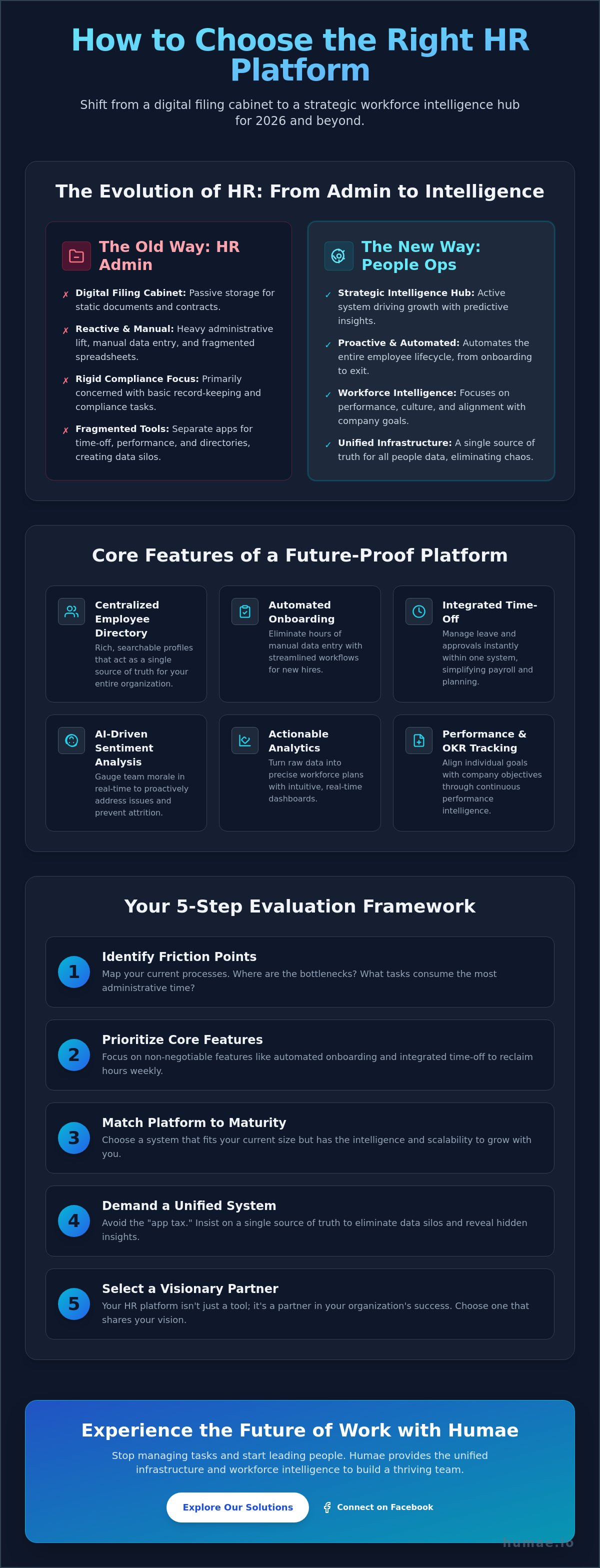
The 5-Step Framework for Evaluating HR Software
Action is the bridge between a vision and a reality. You've identified your maturity level and the core features you need. Now, you need a repeatable process. When you're ready to decide how to choose the right hr platform, a structured framework prevents you from being swayed by flashy features that don't solve your actual problems. This process ensures your investment delivers a high ROI and genuine workforce intelligence.
- Audit your friction points: Identify exactly where your team loses time. Is it chasing signatures for onboarding? Manually calculating time-off balances? Start with the pain.
- Define feature tiers: Separate "must-haves" like a centralized employee directory from "nice-to-haves" like advanced AI sentiment analysis.
- Assess user experience: A tool is only valuable if people use it. Test the interface from the perspective of both a busy manager and a new hire.
- Verify the ecosystem: Ensure the platform integrates with your existing tech stack. Data silos are the enemy of a single source of truth.
- Run a structured demo: Don't let the salesperson lead. Ask them to show you specific use cases, like how to track an OKR or approve a leave request.
Most buyers focus solely on the administrative side. They check boxes for compliance but forget that their employees are the primary users. If the platform feels like a chore, adoption will fail. This is the critical moment in learning how to choose the right hr platform where you prioritize the human experience alongside technical requirements.
Evaluating the Human Factor: User Experience
If your team finds the software difficult, they'll find ways to work around it. This leads back to the very spreadsheets you're trying to eliminate. Testing the mobile experience is non-negotiable in 2026. Employees should be able to check the directory or request time off in seconds while on the move. An intuitive interface doesn't just look better; it reduces training time and implementation friction. It respects your team's time.
Security, Compliance, and Data Privacy
Innovation must be built on a foundation of trust. Your platform will hold your most sensitive employee information. Ensure it meets global standards for data protection and offers granular access rights. Cloud-based infrastructure is essential for both security and accessibility. It allows your data to remain protected while being available to authorized users wherever they work. Managing these permissions shouldn't be a complex technical task; it should be an intuitive part of your people operations.
Ready to see a framework that puts people first? Build your modern HR infrastructure with Humae today.
Why Humae is the Strategic Choice for Modern Teams
The search for a solution ends when you find a partner that matches your ambition. Humae isn't just another software vendor; we're a visionary partner for teams that value their people as much as their profits. When you've mastered how to choose the right hr platform, you realize that the best choice is the one that removes friction and adds intelligence to every interaction. We centralize the entire workforce management lifecycle. From the first day of onboarding to the achievement of a major company OKR, everything lives in one intuitive space. This unification eliminates the "app tax" and data silos we discussed earlier, ensuring your team has one single source of truth.
We built our platform for speed and empathy. Traditional systems are often clunky and take months to implement, leading to frustration and low adoption rates. Humae is different. It's designed for rapid setup, featuring seamless how it works workflows that feel natural to both admins and employees. Our focus remains on the human element. We believe technology should make work better for everyone, not just more efficient for the back office. By streamlining the administrative burden, we give you the space to focus on what truly matters: your people and your culture.
From Data Storage to Strategic Intelligence
Humae transforms the traditional HRIS into a proactive growth engine. We don't just store data; we interpret it to help you lead. By combining real-time sentiment analysis with transparent OKR tracking, we give leaders the insights they need to make strategic moves before problems arise. You can stop guessing about team morale and start acting on verified data. Join the modern teams that are already optimizing their productivity and organizational health by switching to a more intelligent, integrated way of working.
Get Started with the Future of People Ops
The workforce of 2026 demands more than just a digital filing cabinet. Explore the Humae features designed to meet the specific challenges of the modern business environment. Whether you need a robust employee directory, automated time-off management, or deep performance intelligence, we have the tools to support your vision. Experience a platform that values empathy as much as innovation. Take the first step toward a more intelligent, connected, and high-performing workforce today. Your journey toward true workforce intelligence starts with a single, strategic choice.
Transform Your People Operations for the Future
Your journey to a more intelligent organization starts with a fundamental shift in perspective. We've explored how the modern HRMS is no longer just a storage tool, but a strategic engine that powers growth. By matching your platform choice to your organizational maturity and using our 5-step evaluation framework, you ensure your technology scales alongside your vision. Mastering how to choose the right hr platform means prioritizing the human experience and real-time visibility over static administration and fragmented spreadsheets.
It's time to move beyond administrative noise and manual bottlenecks. Humae offers an intuitive workforce management infrastructure designed specifically for the speed and complexity of 2026. With AI-powered performance intelligence and real-time OKR tracking, you can finally align individual aspirations with your broader company mission. Streamline your workforce with Humae today and build a high-performing culture that thrives on clarity and empathy. Your team deserves a partner that sees the future as clearly as you do. Let's build that future together.
Frequently Asked Questions
How long does it typically take to implement a new HR platform?
Implementation typically takes between two and six weeks depending on your company's data complexity and team size. Modern, cloud-based systems are designed for speed; allowing you to import employee directories and set up basic time-off policies in just a few days. The most time-intensive phase usually involves cleaning your existing data to ensure your new single source of truth is accurate from the start.
What is the difference between an HRMS and a simple HR software tool?
An HRMS serves as a centralized workforce management infrastructure that covers the entire employee lifecycle, while simple tools usually focus on a single function. A full system integrates recruitment, onboarding, and performance intelligence into one interface. This prevents data silos and the "app tax" that occurs when you pay for multiple disconnected subscriptions to manage the same group of people.
Does my company need an HR platform if we only have ten employees?
Yes, because establishing a professional foundation early prevents administrative chaos as you scale your business. Learning how to choose the right hr platform while your team is small allows you to build a culture of transparency and clear goal tracking from day one. It's much easier to implement these systems now than to wait until you have fifty employees and a mountain of fragmented spreadsheets.
How does an HR platform help with employee retention and engagement?
Platforms drive retention by providing real-time sentiment analysis and transparent growth paths that keep employees connected to the company's mission. When people see how their daily work impacts broader goals, their engagement naturally increases. By automating repetitive tasks, you also give managers more time to focus on human relationships and professional development rather than chasing signatures or manual paperwork.
Can I track OKRs and performance goals directly within an HR platform?
Visionary platforms allow you to track OKRs and performance goals directly within the same interface as your employee directory and time-off management. This integration ensures that performance data isn't hidden in a separate silo. It allows leaders to see the direct correlation between team attendance, engagement levels, and the achievement of critical business objectives in one unified dashboard.
What security features should I look for in a cloud-based HR system?
Prioritize end-to-end encryption, multi-factor authentication, and granular role-based access controls to protect sensitive employee information. Your system must meet global standards for data protection and provide clear audit logs of who accessed specific records. Cloud-based infrastructure is essential in 2026 for maintaining security while ensuring authorized managers can access workforce intelligence from any location or device.
Is it possible to integrate an HR platform with our existing communication tools?
Modern systems integrate seamlessly with tools like Slack or Microsoft Teams to ensure information flows where your team already works. These integrations allow employees to request time off or check the company directory without leaving their primary communication app. This reduces friction and ensures that your HR infrastructure becomes a natural part of the daily workflow rather than an isolated administrative hurdle.
How do I calculate the ROI of investing in a modern HR infrastructure?
Calculate ROI by measuring the hours saved on manual administrative tasks and the reduction in recruitment costs due to improved employee retention. You should also consider the value of data accuracy and the mitigation of compliance risks. For example, avoiding a single penalty related to new state-level PFML programs can often pay for the platform's annual subscription cost several times over.