How to Automate Employee Onboarding: The 2026 Guide to AI-Powered Efficiency
By Humae · 23 May 2026
how to automate employee onboarding
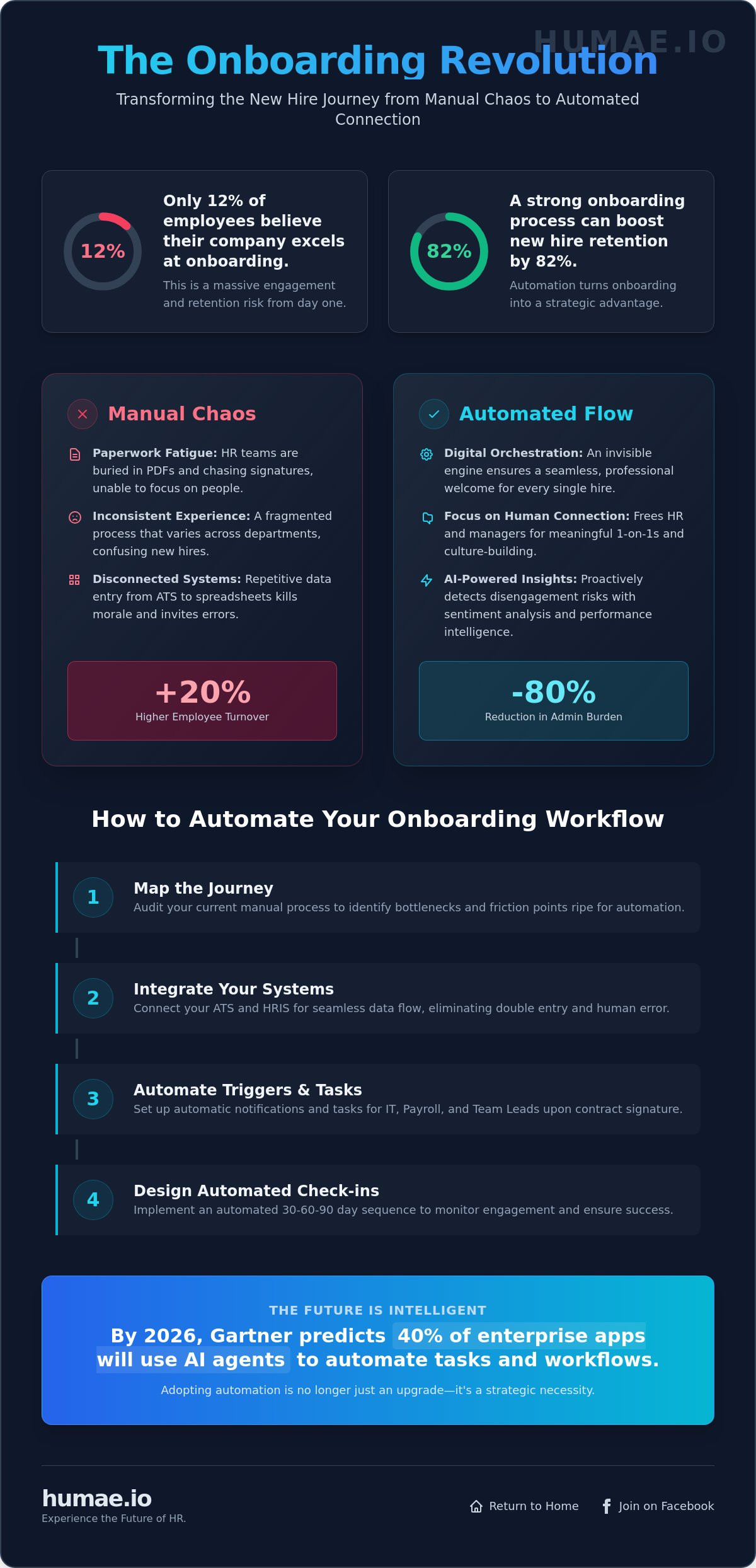
Only 12% of employees believe their company excels at onboarding, yet a strong process can boost retention by a massive 82%. If you’re still relying on manual checklists, you’re likely feeling the strain of repetitive paperwork and inconsistent experiences across departments. Learning how to automate employee onboarding is no longer just about efficiency; it's about making sure your new hires don't feel like just another ticket in a system. By moving toward AI-driven workflows, you can reclaim your time and ensure every employee feels valued from their very first hello.
Experience the future of HR with Humae. Return to our home page to explore our full suite of tools, or join our community on Facebook.
Key Takeaways
- Learn how to automate employee onboarding by replacing manual checklists with digital orchestrations that eliminate administrative friction and paperwork fatigue.
- Understand the strategic value of integrating your ATS with an all-in-one HRIS to ensure seamless data flow and a professional first impression for every hire.
- Discover how AI-powered sentiment analysis and performance intelligence can detect early signs of disengagement and protect your hiring investment.
- Explore the benefits of centralized employee directories and OKR tracking to align new team members with company goals from their very first day.
- Master the transition to a modern HR infrastructure that scales your culture and significantly boosts time-to-productivity for remote and hybrid employees.
Transform your HR experience at Humae or stay updated via our Facebook page.
Why Manual Onboarding Fails in a Modern Workforce
Manual onboarding is no longer just a slow process; it’s a strategic liability. In a world where remote and hybrid work is the standard, relying on physical paperwork and manual handoffs creates a fragmented experience. We define automated onboarding as the digital orchestration of administrative, cultural, and technical tasks. It’s the invisible engine that ensures a new hire has their laptop, their logins, and their first coffee meeting scheduled before they even log in. Without this, you’re left with "Paperwork Fatigue," a state where HR teams are too buried in PDFs to actually welcome the person they just hired.
The stakes are high. Research consistently shows that companies with poor employee onboarding processes face up to 20% higher turnover within the first 90 days. When a new hire’s first week is defined by chasing signatures instead of learning the culture, they begin to question their decision to join. If you want to master how to automate employee onboarding, you must shift your mindset from "Task-Based" checklists to an "Experience-Based" journey. In 2026, efficiency isn't just about speed; it's about removing the friction that prevents human connection.
The Hidden Impact of Administrative Friction
Automation as a Tool for Human Connection
It sounds counterintuitive, but taking the "human" out of the paperwork actually puts the human back into the culture. By removing the boring, repetitive tasks, you free up managers for meaningful 1-on-1s. Automated welcomes, triggered instantly upon contract signature, build immediate rapport. This is where understanding what is workforce management becomes essential. It sets the stage for success by aligning the new hire’s arrival with the company’s broader operational pulse, ensuring they feel like a vital part of the team from day one.
Building Your Automated Onboarding Workflow
To build a truly efficient system, you must first audit your current manual checklist. Look for the high-friction points where emails go unanswered or data gets stuck in a spreadsheet. This is where most organizations realize that how to automate employee onboarding starts with a clear map of every touchpoint. By identifying these bottlenecks, you can replace manual follow-ups with automated triggers that keep the process moving without human intervention.
One of the most common points of failure is the gap between the hiring phase and the first day. Bridging this gap requires integrating your Applicant Tracking System (ATS) with your hris. This ensures that as soon as a candidate signs their offer, their data flows into your core system. Onboarding automation at this stage eliminates double data entry and reduces the risk of human error; this allows your team to focus on preparing a warm welcome instead of fighting with databases.
Once the data flows correctly, set up trigger-based actions for IT, Payroll, and Team Leads. A successful workflow doesn't just cover the first week. It designs an automated 30-60-90 day check-in sequence. These nudges ensure that managers stay engaged with their new hires long after the initial excitement has faded. Before going live, always test the workflow with a dummy account. This helps you catch any dead ends or broken links before they impact a real person's first impression. You can see how these triggers come to life through our HRMS features.
Step 1: The Pre-Boarding Phase
Pre-boarding is your chance to build excitement. Automate contract signatures and document collection via secure portals so the paperwork is done before day one. You can even automate hardware shipping notifications and "Day Zero" welcome kits. To ensure a smooth start, sync manager calendars automatically by connecting your HR platform to their schedule to pre-fill all orientation meetings. This proactive approach proves to the new hire that you are ready for their success.
Step 2: Technical Provisioning and Access
The Intelligence Layer: AI-Powered Performance and Sentiment
Automation in 2026 has evolved far beyond simple task reminders and digital checklists. While the previous sections focused on the structural workflow, the true power of learning how to automate employee onboarding lies in the intelligence layer. This involves using AI to monitor the emotional and professional health of a new hire in real time. Instead of waiting for a 90-day review to realize someone is struggling, modern systems use predictive alerts to identify when a human intervention is necessary. This proactive approach ensures that no employee feels isolated, even in a fully remote environment.
HR teams now utilize real-time analytics dashboards to monitor "onboarding health scores." These scores are calculated by aggregating completion rates, engagement levels, and performance milestones. If a new hire's engagement dips or they miss key training deadlines, the system flags it immediately. It’s not about micromanagement; it’s about support. By automating the data collection, HR professionals can spend their energy where it matters most, which is having meaningful conversations with the people who need them.
Continuous Feedback via AI Sentiment Analysis
The days of the static, annual engagement survey are over. AI now processes open-ended feedback from weekly automated "pulse" check-ins to find patterns in the onboarding experience. If multiple new hires mention confusion regarding a specific process, the AI detects this trend and alerts leadership. This allows you to fix systemic issues before they lead to turnover. Privacy remains a core priority; the system provides actionable intelligence for leadership without compromising the individual trust built during those early weeks. It transforms raw text into a roadmap for cultural improvement.
Aligning Performance with Automated OKRs
A new hire’s biggest fear is often the lack of clarity regarding their impact. Setting automated initial goals gives them immediate purpose and a clear path to success. Understanding the okr meaning is the first step in this process. When you connect a new hire’s daily tasks to larger company objectives from day one, you drastically shorten their time-to-value. The system tracks progress automatically through the first 90 days, providing the employee with a sense of accomplishment and the manager with a clear view of development. This alignment ensures that every new team member knows exactly how they contribute to the shared vision.
Choosing the Right Infrastructure for Automation
Evaluating All-in-One Platforms vs. Specialized Tools
Whether you are streamlining HR or looking for a Banking as a Service provider UK to power new financial features, the goal remains the same: reducing complexity through expert infrastructure so your team can focus on core business growth.
Future-Proofing Your HR Tech Stack
Your automation tools must be agile enough to support remote, hybrid, and even deskless workers. Mobile-first onboarding is essential for frontline staff who don't spend their day behind a laptop. This accessibility ensures that culture reaches everyone, regardless of their location or device. This is why employee engagement strategies must be a core part of your software choice, not an afterthought. A system that integrates engagement with automation creates a workplace where people feel seen and valued from day one.
Ready to see a centralized system in action? Discover how a modern HRMS can transform your organization and simplify your daily workflows.
Scaling Success with Humae’s AI-Powered Platform
The core of our approach is instant visibility. Through a centralized employee directory, new hires can immediately see their team structure, colleagues' roles, and internal communities. This transparency removes the social friction that often plagues the first week of work. When you're deciding how to automate employee onboarding, you need a solution that handles the logistics so you can focus on the culture. Many HR teams using Humae report reducing their onboarding admin time by up to 75%. This is achieved through our intuitive interface that handles document collection, hardware provisioning alerts, and welcome sequences automatically. Similar efficiencies are found in other specialized administrative sectors, where providers like HPC Healthcare Partners (hpcbilling.com) help medical practices streamline their billing and revenue cycles.
Real-time OKR tracking and sentiment analysis are built directly into the onboarding flow. This means you aren't just checking boxes; you're monitoring the health of your new hire’s integration. If an employee feels disconnected or their progress stalls, the system provides the insights needed for a timely, supportive conversation. We believe that the best technology is invisible; it works in the background to empower your people to do their best work from day one.
The Humae Advantage: AI That Understands Your Team
Our analytics dashboards provide a high-level view of your growth strategy, allowing you to optimize every stage of the lifecycle. During the first week, Humae handles everything from seamless time-off management setup to automatic directory updates. This level of detail ensures that new team members feel fully integrated into the company’s operational pulse immediately. You can explore our features to see exactly how we automate the heavy lifting while keeping the human element at the center of your HR strategy.
Get Started with Modern Workforce Infrastructure
Moving your existing data into a new system shouldn't involve downtime or data loss. We've simplified the transition process, providing dedicated support to help you build your first automated workflow. Whether you're moving from spreadsheets or a fragmented tech stack, our implementation team ensures a smooth migration. You can see how it works and book a personalized walkthrough to discover how to automate employee onboarding for your specific needs. It's time to build a workplace where everyone belongs.
Building a Workplace Where People Thrive
The journey to a modern workplace requires more than just faster checklists. It's about creating a culture where technology removes administrative friction so human relationships can grow. By mastering how to automate employee onboarding, you move beyond simple task management into a world of proactive support. You've seen that a centralized infrastructure doesn't just save time; it protects your employer brand and ensures every new hire feels valued from their very first login.
Whether you're leveraging AI-driven sentiment analysis to prevent early disengagement or using integrated OKR tracking to align new team members with your vision, the outcome is clear. A robust, global workforce management infrastructure is the foundation for scaling your organization without losing the personal touch that defines your culture. It's time to leave the spreadsheets behind and start building a workspace that truly inspires.
Streamline your workforce with Humae’s AI-powered platform today
Frequently Asked Questions
What are the first steps to automate employee onboarding?
Start by auditing your current manual checklist to identify high-friction points where data entry or follow-ups stall. Map out every touchpoint from the offer letter to the 90-day review. This clarity helps you decide which tasks, such as document collection or hardware requests, should be handled by your system first to provide the most immediate relief for your HR team.
Can automation make onboarding feel too impersonal for new hires?
Automation actually makes onboarding more personal by removing the administrative burden from managers and HR professionals. When you aren't chasing paperwork, you can spend more time on meaningful 1-on-1 conversations and cultural integration. It's about using technology to facilitate human connection; it handles the logistics so you can focus on the person and their long-term success.
How much time can HR save by automating the onboarding process?
HR teams typically save up to 80% of their administrative time by moving away from manual data entry and repetitive follow-ups. This efficiency allows professionals to focus on strategic growth and employee experience rather than chasing signatures. Learning how to automate employee onboarding transforms HR from a reactive department into a proactive partner that drives organizational value from day one.
What software is best for automating employee onboarding in 2026?
In 2026, the best software is a centralized HRMS like Humae that offers integrated performance intelligence and AI-driven workflows. You should look for platforms that combine an applicant tracking system with OKR tracking and sentiment analysis. This ensures a seamless transition for every hire and provides a single source of truth for all your employee data and growth metrics.
How do I integrate my current ATS with an automated onboarding system?
Integration usually happens through secure APIs or built-in connectors that sync candidate data directly into your HRMS. This ensures that as soon as an offer is signed, the onboarding workflow triggers automatically without manual intervention. It's a critical step to avoid double data entry and reduce the risk of human error during the high-stakes transition from candidate to employee.
Is AI sentiment analysis safe to use during the onboarding phase?
AI sentiment analysis is safe and effective when used to monitor the overall health of the onboarding experience. It processes open-ended feedback to identify trends without compromising individual trust or privacy. This provides leadership with the actionable intelligence needed to fix systemic issues before they lead to turnover; it's a supportive tool rather than a surveillance mechanism.
What are the common mistakes when setting up onboarding automation?
A common mistake is over-automating and forgetting the human touchpoints that build company culture. Another error is failing to test the workflow with a dummy account before going live, which can lead to broken links or dead ends. Ensure your strategy for how to automate employee onboarding always leaves room for social integration and structured manager check-ins.
How do I track the success of my automated onboarding workflow?
Track success by monitoring metrics like time-to-productivity, new hire retention rates, and training completion scores. Use real-time analytics dashboards to see exactly where employees might get stuck in the process. These data points help you refine the workflow and ensure a consistently high-quality experience that aligns every new team member with your company's core objectives.