Getting Executive Buy-In for HRIS: The 2026 Strategic Business Case
By Humae · 13 May 2026
getting executive buy-in for hris
What if your next software pitch wasn't viewed as a cost, but as a high-yield financial hedge? Most HR leaders struggle with getting executive buy-in for hris because they focus on features instead of the bottom line. You know that manual workforce management is a ticking time bomb, especially with California's 2026 civil penalties for notice violations reaching $10,000 per employee. It's time to stop asking for permission and start presenting a business case your CFO can't afford to ignore.
We know how it feels to have your strategic vision sidelined by budget constraints or the cost center label. This article promises to transform your HRIS proposal from a simple tool request into a must-have strategic investment. You'll learn how to translate HR metrics into financial language, leverage 2026 compliance shifts to your advantage, and position your department as a driver of business success. We'll explore the frameworks needed to win over the C-suite and automate your way to a scalable workforce.
Discover how Humae empowers your strategic growth by visiting our home page. For the latest updates on HR innovation, follow us on Facebook.
Key Takeaways
- Shift the narrative from "software purchase" to "workforce infrastructure" to address the high-risk 2026 regulatory environment.
- Secure getting executive buy-in for hris by translating HR metrics into the language of EBITDA impact and strategic ROI.
- Quantify the value of HR intelligence through direct savings on turnover and indirect gains in manager productivity.
- Neutralize objections about implementation speed by leveraging modern, fast-track deployment models that scale instantly.
- Position HR as a visionary partner by choosing an AI-powered platform that prioritizes both automation and the human experience.
Explore the modern HR experience at Humae and stay updated via our Facebook page.
The 2026 Business Case: Why HRIS is Now "Workforce Infrastructure"
HR isn't just about people anymore; it's about the data that powers them. In 2026, a Human Resource Management System (HRMS) is no longer a luxury or a digital filing cabinet. It's the core infrastructure of the business. Just as your company wouldn't operate without a secure cloud server or a functional CRM, it can't scale without a modern workforce management infrastructure. We're seeing a fundamental shift where the HRIS is becoming the central operating system for the entire organization, connecting culture to the bottom line.
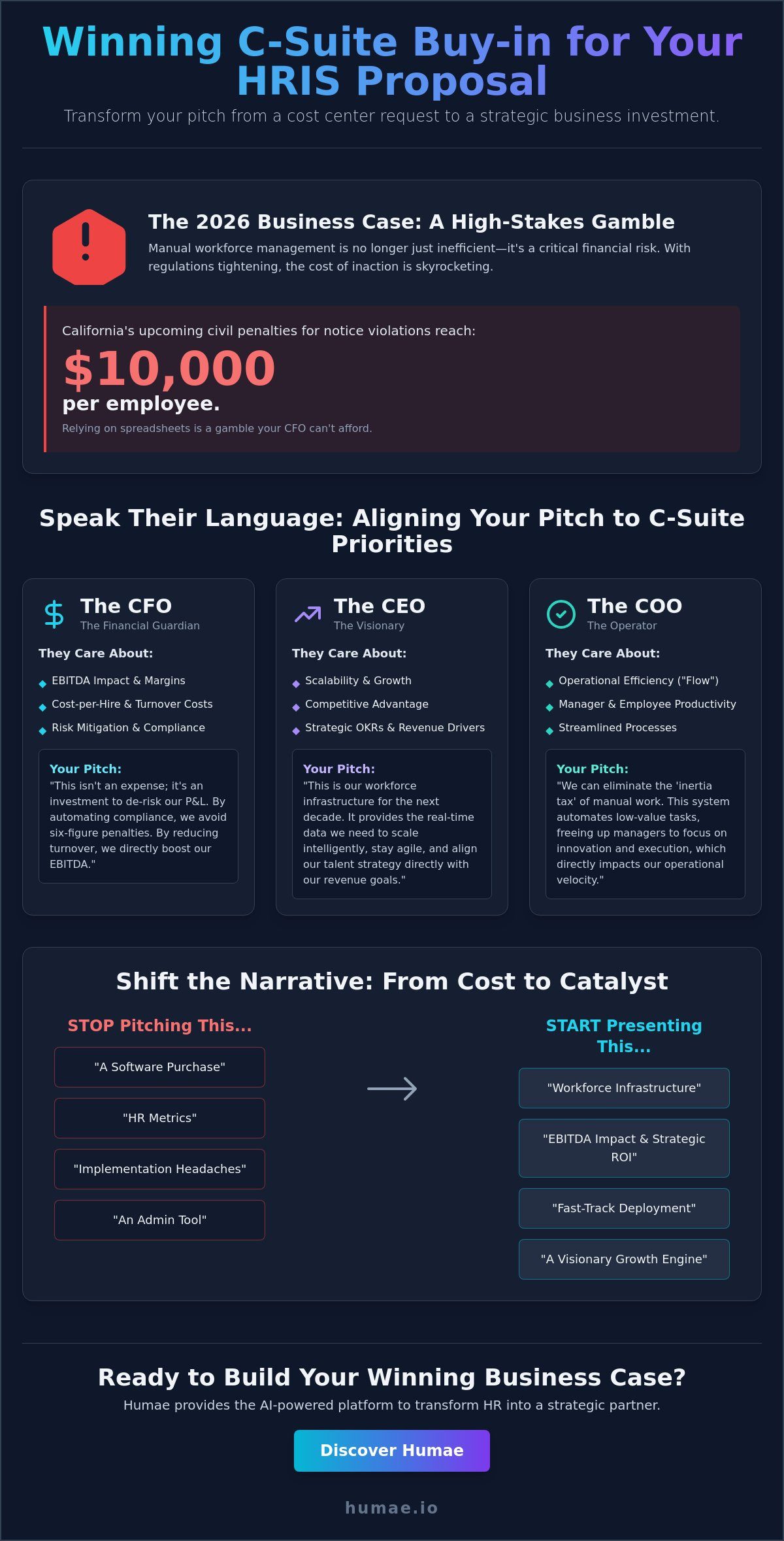
Manual spreadsheets have become a high-risk liability in the 2026 regulatory environment. With California's civil penalties for notice violations now reaching $10,000 per employee under SB 294, relying on "good enough" Excel files is a dangerous gamble. Getting executive buy-in for hris requires shifting the conversation from "saving HR time" to "mitigating existential financial risk." When data is "invisible" or trapped in disconnected systems, your leadership team is flying blind. Disconnected systems mean you're losing critical insights on employee churn and performance intelligence that could otherwise drive revenue growth.
The High Cost of Doing Nothing
The hidden costs of manual onboarding and fragmented records are staggering. Every hour your managers spend chasing paper forms is an hour lost on innovation. Data silos don't just slow down HR; they paralyze executive decision-making speed because you can't provide real-time workforce analytics during board meetings. The "Inertia Tax" your company pays by delaying HR tech upgrades is often higher than the annual subscription fee of the software itself.
From Admin Tool to Growth Engine
In 2020, leadership viewed an HRIS as a place to store records. In 2026, it's viewed as a source of strategic intelligence. Centralized data enables startups to scale quickly and enterprises to remain agile by identifying talent gaps before they become crises. For a deeper look at how these systems have evolved, check out our ultimate guide to HRIS. By moving beyond administrative tasks, you transform HR into a growth engine that attracts and retains the best talent through a seamless, tech-enabled experience.
Build a better workplace with Humae. Return to our home page to see our full suite of tools, or join our community on Facebook for more HR innovation.
Aligning Your Proposal with C-Suite Priorities
To win the room, you've got to speak the language of the person across the table. Getting executive buy-in for hris isn't about explaining what the software does; it's about explaining what the business achieves. Every executive has a unique lens through which they view value. The CEO wants vision, the CFO wants margins, and the COO wants flow. If you present a generic pitch, you'll likely get a generic "no." Success depends on your ability to tailor the narrative to their specific pain points.
The CFO is often your toughest critic. They're looking at EBITDA impact and the cost-per-hire. Citing SHRM's guidance on making the case for HR technology, you must shift the conversation from "spending" to "investing." You've got to translate "better culture" into "reduced turnover costs." For instance, with California's 2026 minimum salary for exempt employees rising to $70,304, the financial weight of a single bad hire is heavier than ever. Automating the tactical side of HR allows your team to focus on these high-stakes financial outcomes.
Meanwhile, the CEO cares about scaling and competitive advantage. They want to know how employee engagement strategies drive revenue. If your pitch connects the HRIS to the company's strategic OKR meaning, you're no longer just an administrator. You're a strategic partner. The COO and CTO also need their boxes checked. The COO needs to see how streamlined time-off management reduces operational friction, while the CTO needs assurance that the employee directory and performance data integrate securely with the existing tech stack.
Speaking "CFO-ese": The Language of ROI
Don't just say your team is overwhelmed. Show the CFO how employee performance intelligence software identifies high-potential talent before they burn out. Use hard data to justify why a cloud-based SaaS model is more cost-effective than the "hidden" costs of manual errors. With pay transparency laws expanding across dozens of states in 2026, the financial risk of inaccurate wage ranges in job postings is a direct hit to the bottom line that only automation can fix.
The CEO’s Vision: Talent as a Competitive Advantage
A modern HRIS isn't a database; it's a window into the company's soul. Real-time sentiment analysis prevents "quiet quitting" and protects your brand's reputation. When you can show the CEO how a unified platform fosters cross-departmental innovation, you're selling the future of the company. See how Humae's integrated dashboard simplifies these high-level conversations by turning raw data into actionable insights.
Humae is dedicated to modernizing the way you work. Return to our home page to explore our HRMS solutions, or connect with us on Facebook for more industry insights.
The ROI Framework: Quantifying the Value of HR Intelligence
Numbers speak louder than narratives when you're in the boardroom. Getting executive buy-in for hris requires a shift from qualitative descriptions of "better culture" to a quantitative framework of "hard ROI." Executives want to see how a modern system impacts the bottom line through direct cost savings and intelligence gains that were previously impossible to track. By presenting a clear ROI model, you move the conversation from a software expense to a strategic asset that generates measurable value.
Direct savings are the easiest to track. These include the elimination of paper based processes and the reduction of headcount needed for manual data entry. However, the intelligence gains provide the most significant long term impact. Predictive analytics allow you to forecast workforce needs and identify flight risks before they resign. This visibility transforms HR from a reactive department into a proactive intelligence unit. To illustrate the difference, consider the following comparison between legacy systems and a modern HRMS.
| Metric | Legacy Spreadsheets | AI-Powered HRMS |
|---|---|---|
| Compliance Risk | High (Manual errors) | Low (Automated alerts) |
| Decision Speed | Days/Weeks | Real-time |
| Retention Strategy | Reactive | Predictive |
| Admin Overhead | 100% Manual | 30%+ Reduction |
| Data Accuracy | Fragmented | Single Source of Truth |
Calculating the Turnover Multiplier
In 2026, the true cost of losing a high performing employee often reaches 1.5 to 2 times their annual salary when you account for recruitment, lost productivity, and training. Modern performance management systems pay for themselves by increasing retention by an average of 15% through better engagement. Real-time feedback loops directly extend employee lifetime value by identifying friction points before they lead to resignation. When you can prove that a 5% reduction in turnover saves the company hundreds of thousands of dollars, the software cost becomes negligible.
Efficiency Gains in the AI Era
Automation isn't just about speed; it's about accuracy. AI driven sentiment analysis and automated time off tracking save HR teams an average of 30% on administrative tasks. This time is redirected toward high value initiatives like leadership development and strategic hiring. Integrated analytics dashboards provide the C-suite with instant reporting, eliminating the need for HR to spend hours manually compiling data for executive meetings. This efficiency gain represents a direct boost to the company's operational EBITDA.
Humae helps you turn workforce data into a competitive advantage. Visit our home page to see our platform in action, or follow us on Facebook for the latest HR trends.
Overcoming Common Executive Objections
Skepticism is the natural default for any C-suite leader tasked with protecting the company's capital. When you're getting executive buy-in for hris, you shouldn't view objections as roadblocks. They're actually opportunities to prove the depth of your research. Most resistance stems from outdated perceptions of what software implementation looks like or a misunderstanding of the current regulatory risks. By addressing these concerns head-on with hard data and a clear roadmap, you move from a "software seeker" to a "risk mitigator."
The most frequent pushback is cost. Executives often see a five-figure subscription and recoil. Your counter must be the cost of non-compliance. In California, civil penalties for notice violations can reach $10,000 per employee, while pay stub errors carry fines up to $4,000 per person. When you compare the annual cost of a modern HRMS to the multi-million dollar risk of a class-action audit, the software quickly looks like a bargain. It's not just about spending money; it's about protecting it.
Another common fear is the "implementation nightmare." Leaders remember the era of 18-month deployments that went over budget and under-delivered. You can neutralize this by explaining how it works in the modern cloud era. In 2026, mid-market platforms typically go live in 2 to 4 months, not years. By presenting a "fast-track" deployment schedule, you reduce operational anxiety and show a clear path to value.
Risk Mitigation and Data Security
Security is no longer just an IT concern; it's a board-level priority. Modern HRMS platforms offer far superior protection compared to local spreadsheets or legacy servers. Ensure your proposal highlights SOC2 compliance and the use of encrypted employee directories. This shift protects sensitive personal data from breaches that could devastate your brand's reputation and lead to massive legal liabilities.
The "Ease of Use" Argument
A tool is only valuable if people use it. You must demonstrate the intuitive features that drive high adoption rates across the workforce. In 2026, a mobile-first design isn't a "nice-to-have"; it's a prerequisite for data accuracy. When employees actually enjoy using the platform for time-off requests or performance check-ins, your data remains clean, and your executive reporting stays reliable.
Ready to see how a modern platform handles these challenges? Book a personalized demo with Humae to see our fast-track implementation in action.
At Humae, we believe technology should empower people, not replace them. Visit our home page to learn more about our mission, or join the conversation on our Facebook page.
The Humae Advantage: Presenting the Future of HR
Choosing the right technology is only half the battle. The other half is choosing a partner that understands the humans behind the data. By the time you're ready for getting executive buy-in for hris, you need a solution that proves its worth on day one. Humae isn't just another database; it's an AI-powered HR platform designed to bridge the gap between cold analytics and human empathy. We help you move beyond standard record-keeping to create a culture where people and performance thrive together.
Transparency is the currency of the C-suite. Our integrated OKR tracking provides the executive-level visibility that turns abstract company goals into measurable progress. When you can show the leadership team exactly how workforce health correlates with target achievement, the conversation shifts. You're no longer asking for a budget for "HR software." You're delivering a roadmap for measurable business impact that scales with the organization's ambitions.
Why Humae is the Strategic Choice for 2026
Modern distributed teams require a global scope and a unified flow. Humae stands out by combining a robust HRMS with advanced Performance Intelligence. We don't just track time off; we support the entire employee lifecycle. From the first touchpoint in talent acquisition to seamless onboarding and continuous growth, our platform ensures no data is lost in transition. This holistic approach is why visionary companies choose Humae to power their workforce infrastructure.
Next Steps: Your Buy-In Checklist
Before you step into that final board meeting, ensure your case is airtight. Use this checklist to finalize your presentation:
- Data-Backed Risk Assessment: Include the 2026 California compliance costs we discussed in section one.
- Strategic Alignment: Map the HRIS features directly to the company's active OKRs.
- Hard ROI: Present the turnover multiplier and administrative hours saved.
- Proof of Concept: Show how the intuitive design ensures high adoption rates.
It's time to stop managing spreadsheets and start leading your company's most valuable asset. We invite you to discover Humae through a personalized tour and see how we can transform your strategic vision into reality. The right infrastructure doesn't just store data; it unlocks your team's full potential.
Build your future with Humae. Return to our home page to explore our full suite of HR tools, or connect with us on Facebook for more innovation and community updates.
Lead the Future of Your Workforce
Transforming your HR department into a strategic hub starts with a single, data-driven conversation. You've seen that getting executive buy-in for hris isn't just about picking a tool; it's about securing the infrastructure your company needs to survive a high-risk regulatory landscape. By aligning your proposal with specific C-suite priorities and quantifying the true cost of turnover, you move from an administrative role to a visionary partner. The shift from manual spreadsheets to a centralized system isn't just an upgrade. It's a competitive necessity.
Now is the time to act. With integrated workforce management infrastructure, you can automate tactical burdens and focus on what really matters: your people. Humae provides the AI-powered performance intelligence and real-time OKR tracking required to prove your impact every single day. Stop managing data and start driving growth. You have the framework and the facts; now you just need the right partner to bring your vision to life.
Ready to build your business case? Discover how Humae works for your team.
Frequently Asked Questions
How do I start the conversation about a new HRIS with my boss?
Start the conversation by identifying a specific business pain point that keeps your leadership team awake at night. Instead of asking for a tool, present a solution to a problem like rising turnover or slow hiring cycles. Focus on how a modern system aligns with the company's current strategic goals to ensure your proposal is seen as a business necessity rather than an administrative request.
What are the most important ROI metrics for HR software in 2026?
Focus on Human Capital ROI, time-to-productivity for new hires, and the total reduction in manual administrative hours. These metrics provide a clear link between HR activities and the company's bottom line. By showing how automated workflows save 30% of your team's time, you demonstrate a direct boost to operational efficiency that any CFO will appreciate.
How long does a typical HRIS implementation take for a mid-sized company?
Mid-market platforms serving 100 to 1,000 employees typically take 2 to 4 months to fully deploy. Smaller organizations can often be live in just a few weeks if their data is well-organized. The timeline depends on the complexity of your existing records and the level of integration required with other business tools.
Can an HRIS really help with employee retention?
Yes, an HRIS helps by providing performance intelligence that identifies disengagement before it leads to resignation. By using real-time sentiment analysis, managers can address friction points early. This proactive approach can increase retention by an average of 15%, saving the company the massive costs associated with recruiting and training replacements.
What is the difference between an HRMS and a standard payroll system?
A payroll system is a transactional tool designed only to process checks and taxes. An HRMS is a complete workforce operating system that manages the entire employee lifecycle. It includes everything from performance tracking and OKR alignment to employee directories, providing a much deeper level of business intelligence than a standalone payroll tool.
How do I handle executive concerns about AI and data privacy in HR?
Address security concerns by highlighting SOC2 compliance and encrypted data protocols. Explain that AI in 2026 is used for pattern recognition and sentiment analysis to support human decisions, not to replace them. Emphasize that a centralized, secure platform is far safer than storing sensitive employee information in fragmented, unprotected spreadsheets.
Is it better to present an annual or monthly subscription plan to the CFO?
Annual plans are usually the winner when getting executive buy-in for hris because they often come with significant cost savings. CFOs prefer the predictability of a yearly budget and the better SaaS ROI that comes with discounted annual rates. Presenting both options allows the executive team to choose the cash flow model that fits their current financial strategy.
What happens if we continue using spreadsheets instead of an HRIS?
You risk data fragmentation and a high rate of human error that can lead to costly compliance failures. Spreadsheets don't scale as your company grows, and they keep your workforce data "invisible" to leadership. Without a central system, you'll continue to pay an "Inertia Tax" in the form of lost productivity and missed strategic opportunities.