Employee Skills Mapping Software: The 2026 Guide to Workforce Intelligence
By Humae · 12 July 2026
employee skills mapping software
How much of your recruitment budget is being spent on skills that already exist three desks away from you? It's a frustrating reality for many HR leaders who find themselves trapped in internal talent silos, relying on manual spreadsheets that are outdated before they're even saved. You know that your team has untapped potential, but without modern employee skills mapping software, that talent remains invisible and underutilized.
We understand that managing a workforce in 2026 requires more than just a list of job titles; it requires a deep, data-driven understanding of what your people can actually do. This guide will show you how to transform your talent strategy from static, manual data points into a dynamic AI-powered skills intelligence hub. By the end of this article, you'll know how to gain real-time visibility into your team's capabilities, reduce wasted hiring costs, and perfectly align individual training plans with your organizational OKRs. We'll dive into the transition from traditional HRMS tools to sophisticated performance intelligence that treats skills as your company's most valuable currency.
Key Takeaways
- Discover how to replace static, manual matrices with a searchable talent database for real-time workforce visibility.
- Learn how modern employee skills mapping software uses AI to identify hidden capabilities and predict internal growth paths.
- Understand the hidden costs of data decay in spreadsheets and why manual tracking fails scaling organizations.
- Get a clear roadmap for implementing a skills intelligence hub that prioritizes transparency and employee trust.
- See how Humae turns raw skills data into actionable Performance Intelligence to drive your OKRs forward.
Understanding Employee Skills Mapping Software in the Modern Workplace
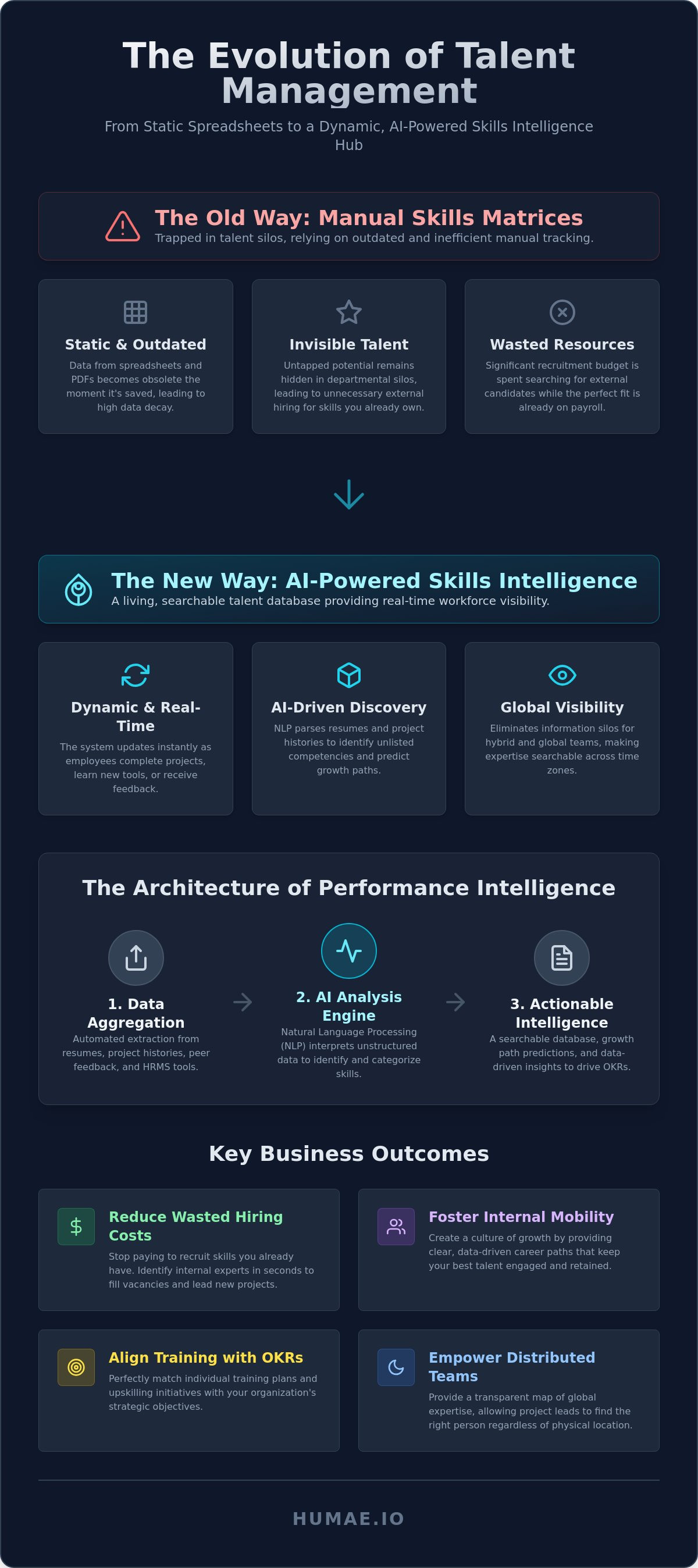
Your talent strategy is only as good as your visibility. For years, HR teams relied on dusty spreadsheets and static PDFs to track what their people could do. These manual matrices were often outdated before the ink dried, leading to wasted recruitment costs and missed opportunities. Modern employee skills mapping software changes this dynamic entirely. It's a digital platform that identifies, categorizes, and manages the real-time capabilities of your workforce, turning a flat list of names into a searchable, high-velocity talent database.
In 2026, the shift toward a skills-first approach isn't just a trend; it's a survival mechanism. Organizations are moving away from rigid job titles and embracing fluid competency models that reflect the actual work being done. This software acts as the core of your modern HR tech stack, replacing guesswork with data. It allows leaders to see exactly who has the expertise to lead a new project or fill a sudden vacancy, fostering a culture of internal mobility that keeps your best people engaged and growing.
The Evolution from Skills Matrices to Skills Intelligence
The traditional annual review is too slow for the current pace of business. We've seen a massive shift from these static snapshots to real-time skills intelligence. Instead of waiting for a yearly update, managers now have access to a live feed of team growth. This data-driven approach uncovers hidden talent that often stays buried in large organizations. When you have a single source of truth for people data, you stop hiring for skills you already possess. You begin to see your workforce as a collection of modular abilities rather than fixed roles, which is exactly what our Performance Intelligence tools are designed to facilitate.
Why Skills Mapping is Essential for Hybrid and Global Teams
Visibility is the biggest challenge for distributed teams. When your experts are spread across time zones, information silos naturally form. You might spend weeks searching for a niche specialist externally while the perfect candidate is working remotely in another department. Using employee skills mapping software eliminates these barriers. It provides a transparent map of global expertise, allowing project leads to find the right person in seconds without manual searching or endless Slack messages. This level of connectivity is a foundational part of a robust workforce management infrastructure, ensuring that your talent is always where it needs to be, regardless of physical location.
The Architecture of AI-Powered Skills Mapping and Performance Intelligence
Intelligence is active. It doesn't sit in a file cabinet waiting for someone to look at it. High-performance employee skills mapping software functions as a living nervous system for your organization. It goes beyond simple data entry by combining automated discovery with real-time performance metrics. This architecture ensures that when a team member learns a new tool or completes a complex project, the system updates instantly. It provides a level of clarity that traditional HR tools simply can't match, creating a transparent environment where potential is visible to everyone.
A mobile-first interface is a critical part of this structure. We've found that data decay happens when tools are hard to use or inaccessible. By making skill updates as easy as a social media post, organizations ensure their talent data remains fresh and reliable. This creates a bridge between the work people do every day and the strategic vision held by leadership. It's about moving from a culture of "reporting" to a culture of "growing" where technology supports the human experience.
Automated Skills Extraction and AI Discovery
AI doesn't just read data; it interprets it. Modern systems use natural language processing (NLP) to parse resumes, project histories, and even peer feedback to identify unlisted competencies. For instance, an employee might not list "crisis management" as a formal skill, but their project history reveals they've successfully navigated three high-pressure product launches. AI identifies these adjacent skills and career paths that a manual search would miss. According to recent industry trends, 91% of companies believe AI will transform how they manage their workforce. This transformation begins with personalized learning paths that suggest training based on actual, identified skill gaps rather than generic corporate mandates.
Connecting Capabilities to OKRs and Business Goals
Knowing what your team can do is only half the battle. You must align those capabilities with what you need to achieve. This is where skills data meets okr tracking. When you map specific skills to key results, executive reporting becomes a story of growth rather than just a spreadsheet of numbers. This "Skills-to-Goal" mapping allows you to see if you have the technical muscle to hit your targets or if you need to pivot your training strategy. If you're ready to see how this looks in practice, you can explore our Performance Intelligence solutions to start building your own talent hub.
Why Spreadsheets and Manual Skills Matrices Fail Scaling Teams
"We can just use a shared Excel sheet for this." This is the most common objection we hear when discussing workforce intelligence. While spreadsheets feel familiar, they're the silent killers of organizational agility. Manual matrices are reactive. They require constant, tedious maintenance that almost no one has time for. This leads to a fragmented view of your team where the right hand doesn't know what the left hand can do. Relying on manual tools means you're always looking at the past. Transitioning to professional employee skills mapping software is the only way to build a future-proof talent strategy that stays ahead of the market.
Static documents create friction. When information is siloed across different departments, you lose the ability to deploy talent quickly. A manager in marketing might spend weeks looking for an external freelancer, unaware that a junior developer in the engineering department has exactly the certification they need. This lack of visibility prevents proactive talent development and forces companies into a constant cycle of expensive, reactive hiring. It's a waste of time, money, and most importantly, human potential.
The Problem of Data Decay and Information Silos
Manual skills data is often six months out of date by the time a manager actually looks at it. This delay creates "expert search fatigue." Project leads spend hours digging through folders or sending mass emails to find a specific specialist. When employees feel their hard-earned capabilities are invisible, it directly harms employee engagement. People want to be recognized for what they know. Modern employee skills mapping software solves this by creating a live, self-updating ecosystem that values human potential in real-time, ensuring that your data is as dynamic as your team.
Security and Compliance Risks of Unstructured People Data
Storing sensitive skill assessments and performance data in unprotected Excel files is a compliance nightmare. In 2026, data privacy isn't optional; it's a core business requirement. Maintaining GDPR or local compliance with unstructured people data is nearly impossible when anyone can copy a file or leave it on a public drive. Transitioning to a centralized hris ensures that your skills data is governed by strict access controls. This infrastructure protects the individual's privacy while giving the organization the secure insights it needs to scale safely and confidently.
Best Practices for Implementing Skills Mapping Software Successfully
Technology alone won't change your culture. A successful rollout requires a roadmap that balances technical precision with human empathy. When you introduce employee skills mapping software, the goal is to make it a natural part of the workflow, not an administrative chore. Start by being radically transparent about why you're doing this. Explain that this data isn't for surveillance; it's for visibility, career growth, and ensuring that no talent goes unnoticed. When people understand that their documented skills lead to better project opportunities, adoption happens naturally.
Managers play a pivotal role as the visionary partners in this process. They shouldn't just be data validators; they should be coaches who encourage profile updates during every 1-on-1 meeting. You can even gamify the experience by recognizing "Skill Champions" or departments that achieve the highest data accuracy. This creates a supportive atmosphere where documenting expertise feels like a shared win for the community rather than a lonely data entry task.
Defining Your Skills Taxonomy and Objectives
Precision matters, but don't get lost in the weeds. You need to find the right balance between broad competencies and granular technical skills. If your taxonomy is too vague, the data is useless; if it's too complex, your team will abandon it. Align your skill categories with your future business needs and current OKRs. We often recommend starting with a pilot department, such as your engineering or product team, to refine the process before a full organizational rollout. This allows you to prove the value of the employee skills mapping software in a controlled environment first.
Driving Adoption through Self-Service and Integration
The "What is in it for me?" factor is the most powerful driver for adoption. Show employees how a complete skills profile increases their internal mobility and shines a light on their potential for leadership roles. Integration is the secret to keeping this data fresh. By connecting your skills hub with daily tools like Slack or project management platforms, you reduce friction and increase accuracy. You should also introduce skills mapping during onboarding. Setting immediate growth goals for new hires ensures they feel invested in their development from day one. If you're ready to see how an intuitive interface can transform your team's engagement, explore Humae:s interface to see our modern approach to people operations.
Transforming Talent Strategy with Humae:s Workforce Management Infrastructure
Excellence isn't an accident; it's the result of clear visibility. At Humae, we've built a visionary platform designed to handle the complexities of modern people operations without losing the human touch. Our employee skills mapping software doesn't just collect data points; it builds a comprehensive talent ecosystem. By utilizing our specific features, organizations can turn raw capabilities into performance intelligence that drives real business outcomes. This shift from manual tracking to an automated, AI-driven hub allows leaders to focus on what matters most: their people.
One of the most powerful aspects of our infrastructure is the integration of AI-driven sentiment analysis. Understanding team health goes beyond knowing who can code in Python or manage a budget. It's about sensing the pulse of the organization in real-time. By combining skill data with sentiment insights, you gain a holistic view of your workforce that prevents burnout and fosters a truly supportive culture. To strengthen these human connections, you can discover Say it with a Song "The Fastest Most Meaningful Gift In The World" as a way to recognize your team's hard work with custom musical gifts. Our intuitive design ensures that whether you're a fast-growing startup or a global enterprise, adoption remains high because the platform is a joy to use for every stakeholder involved.
Real-Time Insights with Humae:s Analytics Dashboards
Data is only valuable if it's actionable and easy to interpret. Humae's analytics dashboards visualize skill gaps and strengths with surgical precision, giving leadership the clarity needed for strategic workforce planning. The single interface advantage means you can handle hiring, onboarding, and long-term performance management within one unified space. This eliminates the tool fatigue that often plagues HR departments. As seen in our how it works section, the process is streamlined to ensure you spend less time on administration and more time on the human connections that drive success.
Building a Future-Proof Culture of Growth
A unified workforce management infrastructure is an investment in your company's long-term resilience. By aligning individual skills with company-wide OKRs, Humae ensures that every team member understands how their unique talents contribute to the collective success. This alignment creates a powerful ROI by reducing turnover and maximizing internal mobility. When people see a clear path for their growth, they stay engaged and motivated. We invite you to explore the Humae platform today to empower your teams and build a modern organizational culture where growth is the standard, not the exception.
Building a Future-Ready Talent Ecosystem
The transition from fragmented spreadsheets to a unified talent strategy is more than a technical upgrade; it's a cultural transformation. We've explored how employee skills mapping software acts as the foundation for this change, turning invisible potential into measurable growth. By aligning individual capabilities with organizational goals, you create a workplace where everyone has the visibility they need to thrive. No one should be held back by siloed data or outdated records.
You don't have to settle for the friction of manual systems. With an intuitive workforce management infrastructure, your team can finally move at the speed of the modern market. Seamless OKR and directory integration ensure that your strategic vision is always backed by the actual skills on the ground. It's time to trade manual matrices for AI-driven performance intelligence that treats your people as the visionary partners they are.
Empower your team with Humae:s AI-powered platform and start building the future of work today. We're excited to support your organization as you unlock the full potential of your most valuable asset.
Frequently Asked Questions
What is the primary purpose of employee skills mapping software?
The primary goal of employee skills mapping software is to provide real-time visibility into the collective capabilities of your team. It replaces static, manual databases with a dynamic talent inventory. This allows leadership to make data-driven decisions about recruitment, training, and project allocation. By understanding exactly what your people can do, you can stop hiring externally for skills that already exist within your organization.
How does AI improve the accuracy of skills mapping?
AI enhances accuracy by automating the discovery process through natural language processing. It parses resumes, project descriptions, and even peer feedback to identify unlisted competencies. This removes human bias and uncovers hidden talents that might be overlooked in a manual review. AI also suggests personalized learning paths by comparing an individual's current profile against the skills needed for their next career step.
Is skills mapping software different from a traditional HRIS?
Yes; while a traditional HRIS manages administrative records like payroll and benefits, skills mapping software is built for performance intelligence. It focuses specifically on the "what" and "how" of work rather than just the "who." Modern platforms act as a specialized layer on top of your HRIS, providing the deep insights needed for strategic workforce planning and internal mobility that basic record-keeping tools can't offer.
Can skills mapping help with succession planning and leadership development?
It's a vital tool for succession planning. By mapping the skills of your current workforce against the requirements of future leadership roles, you can identify high-potential candidates early. This data-driven approach allows you to create targeted development plans that bridge specific gaps. It ensures that your leadership pipeline is built on verified capabilities rather than just tenure or subjective observations.
How do you encourage employees to keep their skill profiles updated?
The best way to drive adoption is to demonstrate the personal benefit for the employee. When team members see that updated profiles lead to exciting project assignments and clear career paths, they're more likely to stay engaged. Gamification and regular check-ins during 1-on-1 meetings also help. Making the interface intuitive and mobile-friendly reduces the friction of data entry, turning updates into a quick, rewarding task.
What is the difference between a skill and a competency in mapping software?
A skill is a specific, learned ability required to perform a task, such as data analysis or coding. A competency is a broader framework that combines skills, behaviors, and knowledge to achieve a specific outcome in a professional context. Mapping software tracks both; this allows you to see the granular tools a person uses while also understanding their overall readiness for complex organizational roles.
How does skills mapping software handle data privacy and security?
Security is handled through centralized, encrypted infrastructure that follows strict data governance standards. Unlike unstructured spreadsheets, professional employee skills mapping software provides granular access controls, ensuring that sensitive performance data is only visible to authorized personnel. This approach makes it much easier to maintain compliance with global regulations like GDPR, protecting both the individual's privacy and the company's legal standing.
Does skills mapping software integrate with existing project management tools?
Most modern platforms are designed to integrate seamlessly with your existing tech stack. By connecting with project management tools and communication platforms, the software can pull data from daily workflows to keep profiles updated. This integration ensures that your skills intelligence hub remains a living document that reflects the actual work happening across your hybrid or global teams every day.