Employee Performance Management System: The 2026 Guide to Intelligence-Driven Growth
By Humae · 28 August 2026
employee performance management system
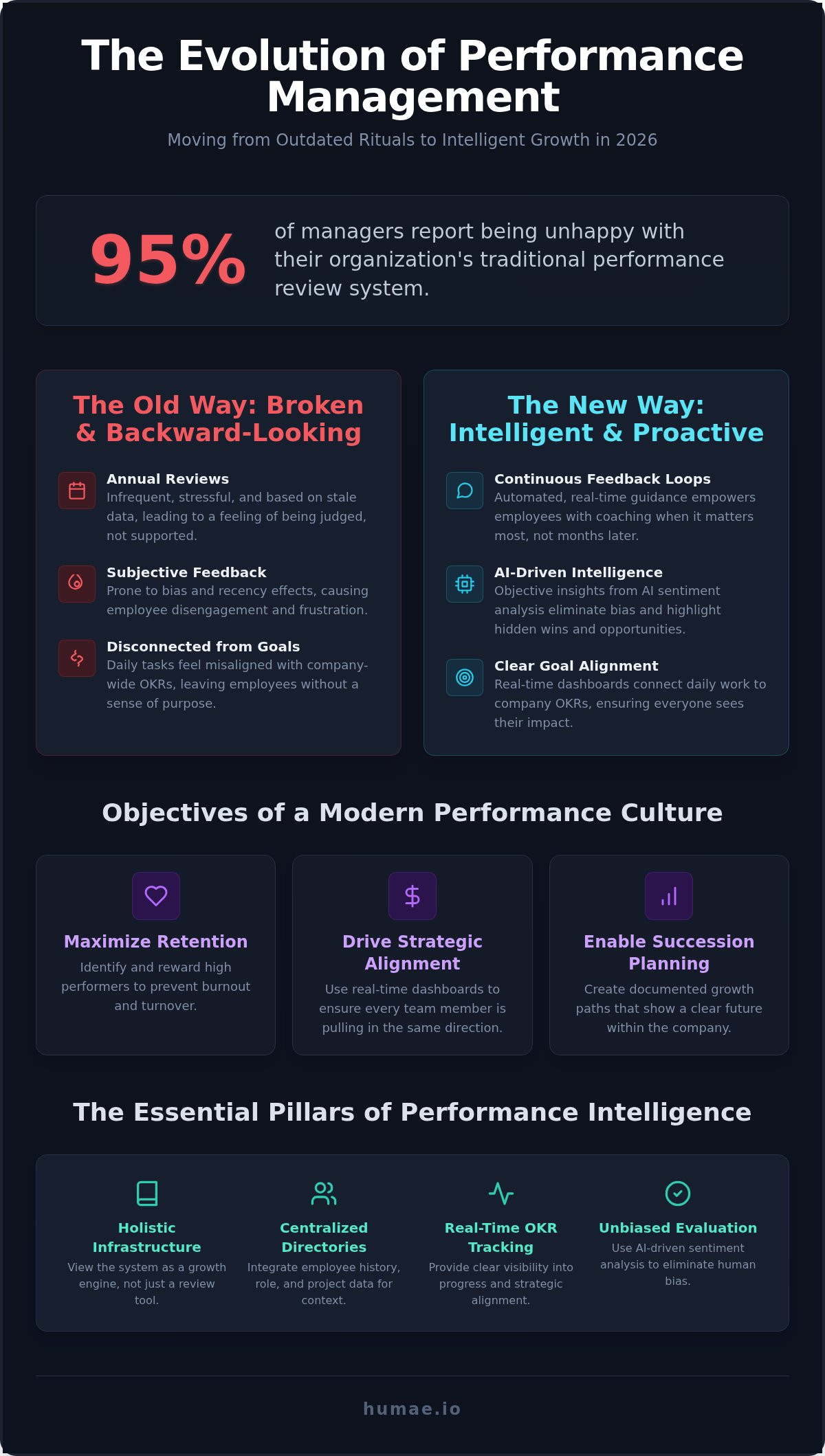
95% of managers report being unhappy with their organization's employee performance management system in 2026. It's a staggering figure that highlights a deep-seated frustration shared by leaders and teams alike. For most, the traditional annual review feels like a bureaucratic chore that drains energy without delivering real value. You've likely felt the disconnect when subjective feedback leads to disengagement or when daily tasks simply don't align with your company's big-picture OKRs.
We agree that the old, rigid way is broken. It's time to move toward a model where technology empowers people instead of slowing them down. In this guide, you'll discover how modern systems leverage AI and real-time intelligence to transform workforce productivity and employee engagement. We'll show you how to replace manual hurdles with automated feedback loops and clear dashboards that provide genuine visibility into progress. This article explores the future of performance intelligence, offering a roadmap to align individual growth with organizational purpose for lasting success.
This article is brought to you by Humae. Stay updated on our latest insights via our Facebook page. Return to Home Page
Key Takeaways
- Redefine your approach by viewing a modern employee performance management system as a holistic growth infrastructure rather than a simple review tool.
- Identify the core technical pillars, like centralized directories and real-time OKR tracking, that make performance intelligence effective in 2026.
- Understand how to eliminate the bias of traditional reviews using AI-driven sentiment analysis and continuous feedback loops.
- Master a strategic roadmap for transitioning your organization from rigid legacy platforms to agile, intelligence-driven growth models.
- Discover how to align individual daily tasks with company-wide OKRs to ensure every team member sees the impact of their work.
This guide is brought to you by Humae. Connect with our community on Facebook or return to the home page.
Defining the Modern Employee Performance Management System
The old way of thinking about performance is dead. In 2026, an employee performance management system isn't just a digital version of a paper form used for annual check-ins. It's a holistic, intelligence-driven infrastructure that serves as the central nervous system of a modern business. Instead of looking backward at mistakes, these systems provide a real-time map of where your team is going and how they can get there faster. Historically, performance appraisal systems focused on static, backward-looking evaluations that often left staff feeling judged rather than supported. Today, the focus has shifted toward proactive performance intelligence.
This modern infrastructure bridges the gap between daily tasks and high-level business strategy. It's the backbone of workforce management, ensuring that every individual understands their impact on the company's success. When you move away from reactive appraisals, you replace anxiety with clarity. You're no longer just "managing" people; you're building a culture where growth is continuous, data is objective, and alignment is automatic.
The Shift from Reviews to Intelligence
Traditional annual reviews fail because they rely on stale data. By the time a manager sits down for a yearly talk, the context of the work has already vanished. In fact, research shows that 95% of managers are currently unhappy with their organization's legacy methods. The modern employee performance management system solves this by using AI to provide objective, real-time insights into employee growth.
AI doesn't exist here to "monitor" or play Big Brother. Instead, it acts as a digital coach. It identifies potential performance dips before they become crises and highlights wins that might otherwise go unnoticed. This shift moves the needle from "monitoring" to "empowering." Continuous feedback loops ensure that employees receive guidance when it matters most, not six months after the fact. It creates a supportive environment where everyone has the tools to succeed.
Core Objectives of a Performance-Driven Culture
A performance-driven culture thrives on transparency and purpose. To achieve this, your system must align individual talent with company-wide goals through clear frameworks like OKRs. When everyone can see how their work contributes to the bigger picture, engagement naturally rises. It's about making sure no one is working in a vacuum.
- Maximize Retention: Identify and reward high performers early to prevent burnout and turnover.
- Strategic Alignment: Use real-time dashboards to ensure every team member is pulling in the same direction.
- Succession Planning: Create documented growth paths that show employees a clear future within the company.
By focusing on these objectives, you turn performance management into a competitive advantage. You're not just tracking work; you're cultivating the next generation of leaders through meaningful, intelligence-led development paths.
The Essential Pillars of Performance Intelligence
To build a resilient workforce, you need more than just a list of tasks. A high-performing employee performance management system relies on a centralized employee directory to provide the necessary context for every evaluation. Without knowing a team member's history, role, and current projects, feedback remains generic. By integrating these data points, organizations can create a more personalized growth journey that feels human rather than robotic. This approach aligns well with established standards like the OPM performance management framework, which emphasizes the need for systematic planning and monitoring to drive results.
When you shift the focus from simple tracking to performance intelligence, you're investing in the long-term health of your culture. It's about turning raw data into a narrative of success. This section breaks down the technical components that make this possible in 2026.
Real-Time OKR Tracking
Understanding OKR meaning is the first step toward strategic alignment. Objectives and Key Results provide the "what" and "how" of your mission. In 2026, static goals are a liability. Real-time tracking prevents goal drift, allowing teams to pivot as market conditions change. When goals cascade from the executive suite down to individual contributors, everyone understands their specific piece of the puzzle. This transparency fosters accountability and ensures that high-level visions translate into daily actions.
Continuous Feedback and Sentiment Analysis
Quarterly check-ins are often too little, too late. "Always-on" feedback creates a steady stream of communication that builds trust. One of the most innovative features of a modern employee performance management system is AI-driven sentiment analysis. By analyzing the tone of written feedback and communication, AI can flag early signs of burnout or disengagement that a busy manager might miss. This isn't about surveillance; it's about support. These insights prompt better manager-employee conversations, keeping the human element at the heart of the digital experience.
Actionable Analytics and Dashboards
Data is only useful if it leads to better decisions. Modern dashboards turn raw numbers into actionable intelligence. Managers should track metrics like goal completion rates, peer recognition frequency, and engagement scores to get a 360-degree view of team health. Using these objective data points helps remove unconscious bias from promotion and compensation processes. When decisions are backed by evidence, fairness becomes a tangible reality. If you want to see these pillars in action, you can explore our intuitive performance dashboards to start driving meaningful growth today.
Why Traditional Performance Systems Fail in 2026
Legacy systems aren't just slow; they're expensive. When an organization relies on once-a-year appraisals, they're working with data that's already expired. This "stale data" prevents agile decision-making and leaves managers guessing about current team health. Employees feel the sting too, as their daily wins often go ignored in favor of whatever happened in the last two weeks. A major hurdle is the tool gap. If your OKRs live in a spreadsheet but your reviews happen in a separate HR portal, there's no bridge between effort and recognition. This is why modern hris integrations are vital. They unify the tech stack, ensuring your employee performance management system draws from a single source of truth rather than fragmented silos.
Overcoming the Micromanagement Myth
Many teams fear that adopting a digital employee performance management system signals the start of intense micromanagement. We see it differently. A well-designed system actually acts as a support structure for employee autonomy. When goals are transparent and progress is visible, managers don't need to ask for constant status updates. The focus shifts naturally from hours logged to actual outcomes achieved. It gives employees the freedom to own their work while knowing they're moving in the right direction. Transparency creates trust, not surveillance.
The Danger of Subjective Bias
Relying on memory for a yearly review is a recipe for disaster. Recency bias often means a single mistake in November outweighs ten months of excellence. Using a continuous achievement log ensures evaluations are fair, accurate, and based on a full year of data. Performance bias is the primary obstacle to equitable workplace growth. By centralizing these insights, you remove the guesswork and replace it with a narrative of consistent value. This evidence-based approach ensures that promotions and rewards go to those who truly drive the business forward, regardless of who has the loudest voice in the room.
How to Implement the Right Performance Infrastructure
Moving from fragmented spreadsheets to a unified employee performance management system is a transformative step for any organization. It requires a clear roadmap that balances technical precision with human empathy. Success starts with leadership buy-in. Executives must champion the platform not as a tracking tool, but as a catalyst for professional growth. When leaders communicate the benefits clearly, employees see the system as an ally in their career journey rather than a digital overseer. Training managers is equally vital; they must learn to use these tools for coaching and development instead of just judging past mistakes.
A critical technical step involves connecting your performance tool to a centralized employee directory. This ensures that every feedback loop and OKR is grounded in real organizational context. When data flows seamlessly between your directory and your performance dashboards, you eliminate manual entry and reduce the risk of errors.
Step 1: Audit Your Current Growth Framework
Start by identifying the gaps in your existing feedback and goal-setting processes. Consult with team leads to understand their biggest management pain points. Are reviews taking too long? Is there a lack of clarity around OKRs? Determining which metrics matter most for your specific industry allows you to customize the system to your needs. This audit phase ensures you aren't just digitizing a broken process, but actually improving how your team functions.
Step 2: Selecting an Intuitive Interface
User adoption depends on simplicity. If a tool feels like a chore, employees will avoid it. When evaluating essential features, look for mobile accessibility and integration capabilities. The interface should feel "human" and approachable. Avoid feature bloat that confuses staff and slows down the workflow. A clean, intuitive design encourages frequent use, which is the key to gathering the continuous data required for performance intelligence.
Step 3: Launching with a Growth Mindset
Set the stage by explaining how the new employee performance management system benefits the individual's career path. Don't launch everything at once. Run a pilot program with one department to refine the feedback cadence and identify potential hurdles. Iterate based on employee sentiment regarding the new tool. This collaborative approach builds trust and ensures that by the time you roll it out company-wide, the system is already optimized for success.
If you're ready to modernize your team's growth, explore how Humae simplifies implementation to drive immediate results.
Scaling Productivity with Humae Performance Intelligence
Humae represents the next evolution in workforce management. While legacy tools focus on rigid checkboxes, we provide a definitive solution for modern employee engagement strategies. Our platform blends cutting-edge AI intelligence with an empathetic design that prioritizes the human experience. By centralizing hiring, onboarding, and performance management in one intuitive interface, we remove the technical friction that often slows down growing teams. It's not just about tracking work. It's about creating an environment where every employee feels seen and supported. You don't just get a tool; you get a partner dedicated to your organizational health.
Our approach to the employee performance management system is built on the belief that data should empower, not overwhelm. We've stripped away the complexity of traditional HR platforms to offer something fresh and results-oriented. When you unify your performance data, you gain a clearer picture of your team's potential. This visibility allows you to make faster, more confident decisions that drive the entire business forward. We understand that in a fast-paced environment, time is your most valuable asset.
AI That Understands Your Team
Humae's AI-driven sentiment analysis provides a real-time pulse on your company culture. It identifies subtle shifts in team morale, allowing you to address concerns before they impact productivity. By automating the heavy administrative burden of a traditional employee performance management system, we free up your managers to focus on meaningful coaching. Our real-time OKR tracking ensures that every individual stays aligned with company goals. This keeps the entire organization moving in the same direction with total clarity and purpose. It's about working smarter, not just harder, to achieve shared success.
A Centralized Hub for Growth
Growth happens when you connect the dots between every stage of the employee lifecycle. Humae allows you to move seamlessly from the initial onboarding phase to continuous high-performance tracking. This centralized approach provides integrated analytics that are vital for long-term workforce planning. You gain a 360-degree view of your talent, making it easier to identify future leaders and plan for succession. We invite you to discover how it works and see how our intelligence-driven framework can transform your team operations today. Experience the difference that a human-centric, AI-powered platform can make for your organizational culture.
Building the Future of Performance Intelligence
The era of static, backward-looking reviews is officially over. Adopting a modern employee performance management system allows your organization to move from reactive appraisals to proactive, intelligence-driven growth. By integrating AI-driven sentiment analysis and real-time OKR tracking, you can finally align individual tasks with company-wide goals while identifying potential burnout before it impacts your culture. This is the foundation of a high-performance environment where every voice is heard and every achievement is documented in real time.
You've seen the roadmap for transitioning from fragmented spreadsheets to a centralized, intuitive workforce management interface. This shift isn't just about technical efficiency; it's about building a culture where transparency and support drive long-term productivity. When raw data becomes actionable intelligence, every team member gains a clear, meaningful path to professional success. It's time to stop judging the past and start empowering the future of your workforce.
Ready to transform your team's growth? Experience Humae's AI-powered performance intelligence today. Let's build a workplace where technology and empathy work in harmony to unlock your team's true potential. We're here to help you lead the way into the future of work with confidence and clarity.
Frequently Asked Questions
What is the difference between a traditional HRMS and a performance management system?
An HRMS serves as your organization's foundational database, managing tasks like time off and employee directories. In contrast, an employee performance management system acts as a growth-focused layer that tracks professional development and real-time OKRs. While the HRMS records who is in the building, the performance system analyzes how they're growing. It's the difference between simple administration and strategic talent development that drives long-term business success for modern teams.
Can AI really provide fair and objective performance feedback?
Yes, AI enhances fairness by analyzing a continuous stream of data rather than relying on a manager's memory. It helps eliminate recency bias, which is often the primary obstacle to equitable growth. By using sentiment analysis, the system identifies achievements and challenges objectively throughout the entire year. This evidence-based approach ensures that promotions and rewards are based on consistent value rather than subjective opinions or the loudest voice in the room.
How do OKRs integrate with an employee performance management system?
OKRs provide the strategic framework that guides individual effort toward company goals. When integrated into an employee performance management system, these objectives become visible and trackable in real time. This ensures that every team member understands how their daily work contributes to the organization's mission. Real-time updates prevent goal drift and allow teams to pivot quickly as market conditions change, keeping the entire workforce agile and focused on the highest-priority outcomes.
Is a performance management system suitable for small startups or just large enterprises?
These systems are highly beneficial for organizations of all sizes. Small startups use them to build a culture of transparency and alignment from day one, which is vital for rapid scaling. Large enterprises rely on them to remove bias and maintain visibility across global teams. Whether you have ten employees or ten thousand, having a centralized hub for growth ensures that your talent is always moving in the right direction together without fumbling through spreadsheets.
How often should feedback be provided in a modern performance system?
Modern organizations should prioritize continuous, "always-on" feedback rather than waiting for annual or quarterly reviews. In 2026, the standard is a steady stream of communication that builds trust and provides immediate guidance. This approach prevents minor issues from turning into major crises. By using AI-powered tools, managers can provide timely recognition and support, ensuring that employees feel valued and supported in their roles every single day throughout the working year.
What are the most important metrics to track in a performance dashboard?
Managers should focus on a mix of quantitative and qualitative data for a 360-degree view of team health. Key metrics include:
- Goal completion rates for OKRs.
- Employee engagement scores.
- AI-derived sentiment trends.
- Peer-to-peer recognition frequency.
Tracking these indicators through intuitive dashboards allows leaders to identify high performers and address burnout early. It turns raw data into actionable intelligence for smarter, faster management decisions.
How does a performance management system help with employee retention?
A performance system improves retention by providing employees with clear growth paths and meaningful recognition. When people see how their work impacts the company's success, they feel more connected to the mission. Sentiment analysis also helps managers identify early signs of disengagement or burnout. By addressing these issues proactively, organizations can create a supportive environment that values individual contributions, which is the most effective way to keep top talent for the long-term.