Employee Performance Management Software: The 2026 Intelligence Guide
By Humae · 6 August 2026
employee performance management software
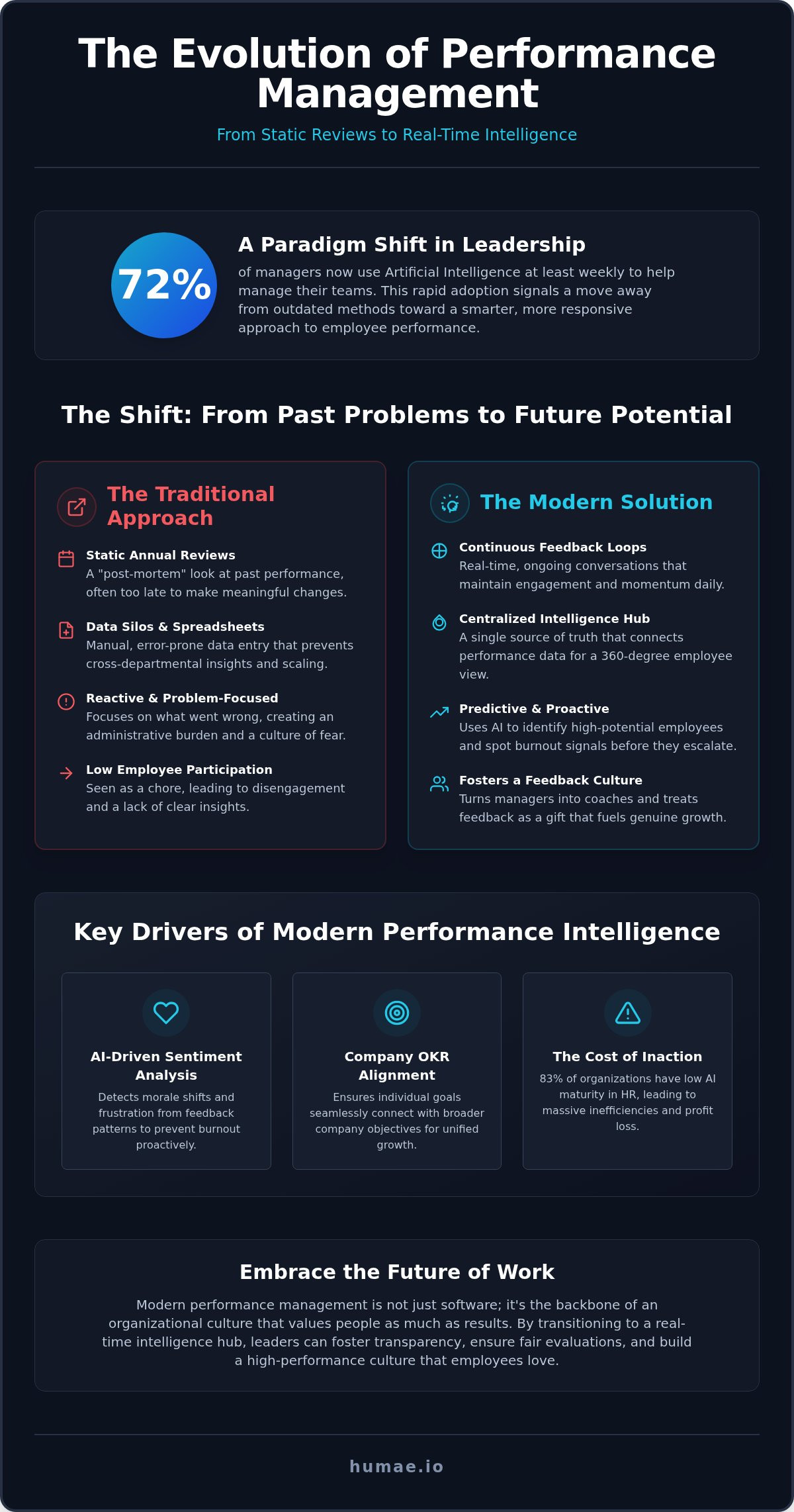
Did you know that 72% of managers now use artificial intelligence to help manage their teams at least weekly? Despite this rapid adoption, many organizations still struggle with manual spreadsheets and data silos that turn review cycles into a burden. If you feel like your current employee performance management software is just a digital filing cabinet for static annual reviews, you're not alone. It's time to bridge the gap between technical potential and human performance.
We understand the frustration of low employee participation and the lack of clear insights from your data. You deserve a system that doesn't just track history but predicts the future. In this guide, you'll learn how to transition to a real-time, AI-driven performance intelligence hub that fuels genuine organizational growth. We'll show you how to leverage predictive analytics to prevent burnout and ensure every individual goal aligns seamlessly with your company OKRs.
Discover how Humae is redefining the modern workplace at humae.io. You can always return to our home page for more insights or join our community on Facebook.
Key Takeaways
- Replace static annual reviews with continuous, real-time feedback loops to maintain high engagement and momentum.
- Discover how modern employee performance management software serves as a centralized intelligence hub for your entire workforce.
- Use AI-driven sentiment analysis to detect morale shifts and prevent burnout before it impacts your team's productivity.
- Align individual growth with company OKRs through a unified workforce management infrastructure that ensures everyone moves in the same direction.
- Foster a feedback culture that employees love by securing executive buy-in and modeling transparent, supportive communication.
What is Employee Performance Management Software in 2026?
In 2026, employee performance management software is no longer a simple record-keeping tool. It's a centralized intelligence hub designed to track, evaluate, and improve workforce output in real-time. To understand the foundations of this field, it's helpful to look at What is Performance Management? and how its core principles have evolved into the digital age. Today, the focus has shifted from the "once-a-year" administrative event to a living ecosystem that supports every team member's daily journey.
Modern organizations are moving away from isolated, periodic appraisals. They're adopting continuous feedback loops powered by modern HRIS systems. This integration ensures that performance data doesn't sit in a vacuum. By connecting these insights directly to a centralized employee directory, managers gain a 360-degree view of a person's development. Manual spreadsheets have become the biggest barrier to scaling in this fast-paced environment. They create dangerous data silos, invite human error, and make it impossible to spot trends across departments before they become problems.
The Evolution from Reviews to Intelligence
Traditional reviews were essentially a post-mortem of the past year. They focused on what went wrong after it was already too late to fix it. Performance intelligence is different; it's a predictive tool that looks toward potential. By analyzing real-time data, managers can identify high-potential employees months before they would have appeared in a manual report. This allows for proactive coaching that aligns with an individual's career aspirations. The old "tick-box" exercise was a chore for everyone involved. Today's data-driven culture treats feedback as a gift that fuels high performance, turning the manager-employee relationship into a partnership focused on future wins.
Why 2026 Leaders Prioritize Performance Infrastructure
Disengagement is a silent profit killer. Research from 2026 shows that 83% of organizations still demonstrate low AI and automation maturity in their HR functions, leading to massive inefficiencies. When employees don't see a clear path for their growth, they start looking elsewhere. A centralized employee performance management software provides the transparency needed in a hybrid and global workforce. It ensures that every team member is evaluated using the same objective criteria, regardless of their location. This infrastructure supports fair, unbiased promotions and helps leaders spot burnout signals in real-time. It's not just software; it's the backbone of a modern organizational culture that values people as much as results.
The Shift from Static Reviews to Real Time Performance Intelligence
The annual review is dead. In 2026, the market has moved decisively away from static, high-pressure events toward a continuous loop of performance intelligence. While traditional employee performance management software focused on what happened six months ago, modern systems focus on what is happening right now. This shift allows leaders to act as coaches rather than judges. It replaces the anxiety of the unknown with the clarity of real-time data. We've seen that when feedback is constant, it becomes a natural part of the conversation rather than a feared administrative hurdle.
Performance intelligence uses live data to create a vibrant picture of organizational health. Instead of waiting for an exit interview to learn why a top performer is leaving, managers can now see morale shifts as they occur. AI-driven sentiment analysis scans feedback patterns to detect frustration or disengagement early. This proactive approach saves talent and maintains momentum. It's about being human at scale; using technology to ensure no one's hard work goes unnoticed and no one's struggle goes unsupported.
Integrating OKRs with Daily Performance
Strategic alignment often fails when goals are hidden in a static document. By integrating OKR tracking directly into the daily workflow, every employee understands how their specific tasks contribute to the company's mission. Real-time analytics dashboards make this progress visible to everyone, fostering a sense of shared purpose. When a Key Result is at risk, performance intelligence identifies the bottleneck immediately. This allows teams to pivot their strategy in days rather than waiting for the end of a quarter. You can explore how real-time tracking transforms daily work to see this impact firsthand.
The Role of AI in Sentiment and Growth
AI is the engine behind personalized development. In 2026, 58% of managers already rate AI's output as equal to or better than that of an experienced human manager when it comes to objective analysis. The software doesn't just flag problems; it suggests tailored growth paths based on an individual's unique strengths and feedback history. In high-stress departments, sentiment analysis acts as an early warning system for burnout. It flags when a team's tone shifts from "challenged" to "overwhelmed." This allows for human intervention exactly when it's needed most. We believe technology should amplify empathy, ensuring that growth is always a shared journey between the individual and the organization.
Choosing the Right Infrastructure: Key Features and Comparison
Selecting the right employee performance management software requires looking far beyond a simple user interface. It's about how the tool fits into your broader workforce management infrastructure. In 2026, a fragmented system is a failing system. Standalone tools might offer niche features, but they often lack the deep integration needed to connect performance with the full employee lifecycle. An integrated HRMS platform ensures that when someone is promoted or moves teams, their performance history follows them seamlessly. This unified approach eliminates manual data entry and reduces the risk of errors that can frustrate your top talent.
Mobile-first design is no longer a luxury for modern teams. Whether your staff is on a construction site, in a retail store, or working from a home office, they need to give and receive feedback on the fly. If your system requires a desktop login to complete a simple check-in, participation will inevitably plummet. High participation is the only way to generate the actionable insights your leadership team needs to make informed decisions about growth and development.
Essential Features for High-Growth Teams
To scale effectively, you need more than just a basic goal tracker. A modern platform must include 360-degree feedback to gather insights from peers, managers, and direct reports. This provides a balanced view that helps prevent manager bias. Real-time analytics dashboards offer instant visibility into team health, allowing you to spot high performers and those needing extra support before issues escalate. Automated reminders and scheduling remove the administrative burden, ensuring your review cycles stay on track without HR having to chase every manager for updates.
Security and Compliance in Performance Data
Sensitive performance data requires enterprise-grade protection. SOC2 and GDPR compliance are essential benchmarks for any vendor you consider in 2026. Your platform must offer robust role-based access controls; this ensures that sensitive scores and feedback are only visible to authorized personnel. Centralized systems also simplify the audit process significantly. Instead of hunting through multiple spreadsheets or isolated files, HR teams can generate comprehensive compliance reports in seconds. This saves hundreds of hours and reduces the legal risks associated with data handling.
How to Implement a Performance System That Employees Actually Love
Rolling out employee performance management software isn't just a technical task. It's a cultural transformation. Many organizations fail because they treat implementation as a simple software install rather than a shift in how people connect. Success depends on how you frame the change. If your team perceives the new tool as a surveillance mechanism, they'll resist it. If they see it as a platform for their own career development, they'll embrace it. We've found that the most successful rollouts prioritize the human experience at every step.
Executive buy-in is the engine of adoption. Leaders must be the first to log in, share their own goals, and request feedback. When employees see the CEO receiving 360-degree feedback, it builds immediate trust in the system. To ensure the transition sticks, you should integrate proven employee engagement strategies into your rollout plan. This data-driven framework helps bridge the gap between a management requirement and a daily habit. Training shouldn't be a one-time event; it should be an ongoing conversation about how the software makes work life easier and more rewarding.
Ready to see the transition in action? Learn how to launch your performance intelligence hub with Humae.
Step 1: Define Your Performance Philosophy
Before you configure a single setting, decide what your culture stands for. Do you value radical transparency where everyone sees each other's OKRs? Or do you prefer private developmental feedback? You also need to set the rhythm of your organization. Some teams thrive on weekly check-ins, while others find monthly or quarterly cycles more effective. Aligning the software settings with your unique company values ensures the tool feels like a natural extension of your team, not an external imposition.
Step 2: Launch with a Focus on Growth
Frame the new platform as a benefit for employee career development. Start with a pilot program in a single department. This allows you to iron out any kinks and gather initial feedback before a company-wide launch. Use this period to refine your review questions and ensure that OKR links make sense for different roles. When employees see that the software helps them track their own wins and advocate for promotions, adoption rates naturally climb.
Step 3: Iterate Based on Performance Intelligence
The first 90 days are critical for gathering data on the process itself. Use the software's analytics to identify where participation lags or where goals are consistently unrealistic. Adjust your OKRs based on the real-world capacity revealed by the system. Most importantly, celebrate wins publicly. When the software helps a team hit a major milestone, highlight it. This reinforces the value of the system and proves that the data is being used to support, not just monitor, the workforce.
Scaling Your Team with Humae AI Powered Performance Platform
Humae stands at the intersection of advanced technology and human potential. It's a centralized hub where hiring, onboarding, and performance converge to create a seamless employee experience. In an era where 46% of organizations are expected to use AI in HR, having a platform that truly understands the human factor is a competitive necessity. Humae doesn't just collect data; it transforms raw feedback into actionable intelligence that helps you lead with confidence and empathy. We've built this system to ensure that your growth is never slowed down by administrative red tape.
Our intuitive interface is designed specifically to reduce friction for busy managers. While only 16% of managers and employees across the industry currently understand their company's AI vision, Humae makes the strategy clear for everyone. By automating the heavy lifting of performance tracking, we allow you to focus on what matters most: your people. It's the employee performance management software built for the future of work in 2026, where speed and human connection must coexist. You'll find that when the tools are this simple to use, participation becomes a natural part of your team's daily rhythm.
A Unified Workforce Infrastructure
True scalability requires a foundation that connects every piece of the organizational puzzle. Humae links your employee directory directly to performance metrics, creating a live map of your organization's talent and potential. Having time-off management, OKRs, and real-time sentiment analysis in a single view provides a level of clarity that traditional tools simply can't match. This visibility allows startups to move fast without losing their unique culture; meanwhile, enterprises find the agility they need to stay competitive in a global market. Humae grows alongside you, ensuring your infrastructure supports your ambitions rather than limiting them.
Start Your Journey to Better Intelligence
Transitioning from manual, fragmented processes to the Humae ecosystem is simpler than you might expect. We've designed the migration path to be as intuitive as the platform itself. You can discover our features today and see how easy it is to build a modern, high-performing team that values growth over bureaucracy. Don't wait for the next annual review cycle to start making data-driven decisions. The future of work is real-time, and it's waiting for you to take the first step. Build a culture of growth and shared success with a partner who understands the digital world.
Elevate Your Team Beyond the Annual Review
The shift toward a data-driven culture is no longer a trend; it's a requirement for organizations that want to thrive in 2026. You've seen how moving from static appraisals to real-time performance intelligence can transform your team's morale and output. By adopting a modern employee performance management software, you replace administrative friction with actionable insights that support genuine human growth.
Choosing the right infrastructure means more than just tracking goals. It's about creating a unified ecosystem where real-time OKR tracking and AI-powered intelligence work together to prevent burnout and spark innovation. Your leadership deserves a centralized workforce management infrastructure that simplifies complexity and empowers every employee to reach their full potential. The path to a more engaged and productive workforce starts with a single step toward better technology.
Streamline your team growth with Humae today and build a culture where everyone wins. We're excited to help you turn raw feedback into your organization's greatest strength. Let's work together to create a workplace that values people as much as results.
Frequently Asked Questions
What is the best employee performance management software for startups in 2026?
Startups in 2026 require a system that prioritizes rapid growth over administrative bureaucracy. Humae is the intuitive choice because it provides a centralized hub that scales alongside your team. It connects hiring directly to performance metrics; this ensures your culture stays strong and aligned as you expand your workforce.
How does AI improve employee performance management?
AI transforms employee performance management software from a simple record-keeper into a predictive partner. It uses sentiment analysis to detect subtle shifts in morale and provides coaching suggestions based on real-time data. This automation allows managers to spend less time on data entry and more time on meaningful human connections.
What is the difference between OKRs and traditional performance reviews?
Traditional reviews look backward at past mistakes; they're essentially a post-mortem of the previous year. OKRs focus on forward-looking growth and strategic alignment. They connect daily tasks to the company's mission in real-time, ensuring every team member understands their specific impact on the organization's success every day.
Can performance management software help reduce employee turnover?
Yes, it reduces turnover by identifying burnout signals before they lead to a resignation letter. Performance intelligence flags when a team is becoming overwhelmed, which allows for proactive human intervention. Providing clear, AI-driven developmental paths also keeps high-potential talent engaged and committed to your organization's long-term vision.
Is real-time feedback more effective than annual reviews?
Real-time feedback is significantly more effective because it allows for immediate course correction and constant growth. Waiting for an annual review means missing months of opportunities for improvement and recognition. Continuous loops foster a culture of trust and development rather than periodic anxiety and administrative burden.
How much does performance management software typically cost?
Pricing in 2026 has shifted toward flexible, usage-based models and tiered subscription plans. Most platforms offer different levels based on features like AI depth, integration requirements, and support levels. This allows organizations to pay for the specific value they receive and scale their investment as their team grows.
Does Humae integrate with existing payroll or communication tools?
Humae is designed as a unified workforce infrastructure that connects with your essential business tools. It bridges the gap between performance data and your broader communication platforms. This ensures that feedback and recognition happen naturally within the flow of your daily work, rather than in an isolated silo.
Is it possible to track performance for remote and hybrid teams effectively?
Tracking performance for remote and hybrid teams is highly effective with a centralized digital hub. Mobile-first design ensures that every employee can participate and receive feedback from any location. This creates a level playing field where objective data and results, rather than physical office presence, determine an individual's success.