Driving Adoption of Your HR Platform: The 2026 Strategy for High-Growth Teams
By Humae · 5 July 2026
driving adoption of your hr platform
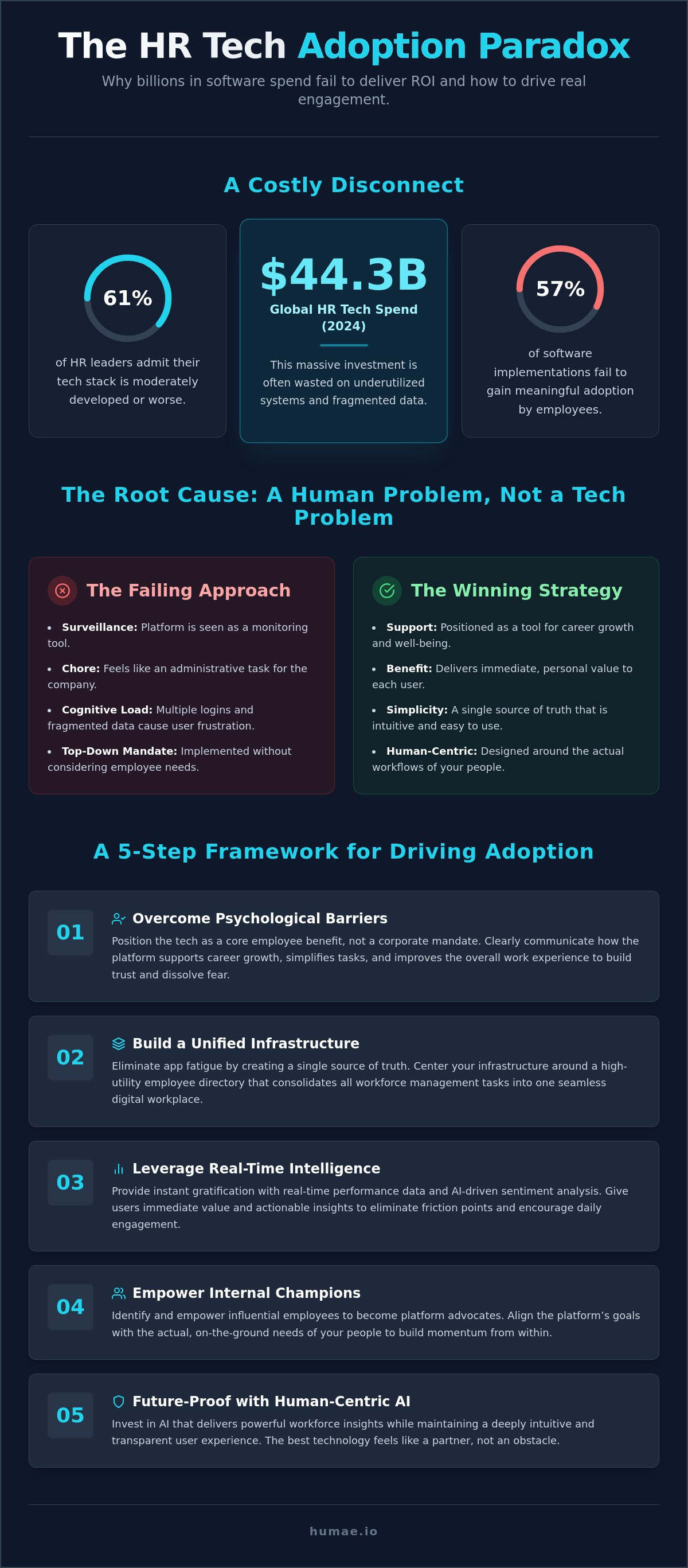
61% of HR professionals admit their tech stack is moderately developed or worse, even as global HR technology spending reaches $44.32 billion this year. It’s a frustrating reality for high-growth teams. You invest in sophisticated tools, yet find yourself constantly driving adoption of your hr platform while your inbox stays cluttered with basic questions and data remains fragmented across spreadsheets. With new regulations like the EU Pay Transparency Directive taking effect in June 2026, the cost of an underutilized system is higher than ever.
We believe that a platform is only as valuable as the people who use it. You deserve a system that feels like a partner, not an administrative chore. By moving beyond basic automation and focusing on a deeply human employee experience, you can turn a silent expense into the central nervous system for your team's growth. It is time to stop managing software and start empowering people.
This guide explores the specific psychological and technical strategies needed to foster high self-service rates and generate real-time performance data. We will show you how to centralize communication and ensure your SaaS spend finally delivers the positive ROI your organization expects. Get ready to transform your digital environment into a thriving workforce hub.
Key Takeaways
- Identify the psychological barriers causing 57% of software implementations to fail and learn how to position your tech as a core employee benefit.
- Master the strategies for driving adoption of your hr platform by building a unified workforce infrastructure centered on a high-utility employee directory.
- Leverage real-time performance intelligence and AI-driven sentiment analysis to deliver instant gratification and eliminate user friction points.
- Implement a strategic five-step framework to empower internal champions and align your platform goals with the actual needs of your people.
- Future-proof your organization with human-centric AI that provides powerful workforce insights while maintaining a deeply intuitive user experience.
The Psychology of Adoption: Why HR Tech Succeeds or Fails in 2026
Technology is rarely the bottleneck; human psychology is. Even with the global HR technology market reaching a value of $44.32 billion this year, 57% of software implementations still struggle to gain meaningful traction. This is the adoption paradox. Organizations build powerful systems, yet employees often ignore them. Successfully driving adoption of your hr platform depends on shifting your perspective from administrative control to individual value. When an employee logs in, they shouldn't feel like they're performing a chore for the company. They should feel like they're accessing a tool that makes their work life easier. This phenomenon is often explained through the Technology Acceptance Model, which highlights that perceived usefulness and ease of use are the non-negotiable foundations of any digital transition.
Trust acts as the silent engine of adoption. If your team perceives the platform as a mechanism for surveillance, they'll provide the bare minimum data required to stay compliant. However, if they see it as a workforce hub that supports their career path, engagement happens naturally. Social connectivity plays a massive role here. When a platform allows employees to see who is who, celebrate wins, and connect across departments, it transforms from a cold database into a living community. Organic daily logins don't come from mandates; they come from a desire to belong. This is why driving adoption of your hr platform is actually a culture project disguised as a software rollout.
The Shift from Surveillance to Support
Employee anxiety regarding new tech is real, especially with the rise of AI-driven sentiment analysis. You must position these tools as partners in career growth rather than digital monitors. Transparency is the only way forward. Modern human resources operations succeed when they clearly communicate how data is used to prevent burnout and improve the workplace experience. When people understand that the tech is there to support them, the psychological barrier of 'AI fear' begins to dissolve.
Reducing the Cognitive Load of New Tools
Every 'one more login' you add to an employee's day is a tax on their productivity. A fragmented workforce management infrastructure forces users to hunt for information across multiple spreadsheets and apps. This search frustration is a primary killer of engagement. By creating a single source of truth with an intuitive design, you respect your employees' time. The goal is to make the right path the easiest path. When the platform is the fastest way to get an answer, adoption becomes the path of least resistance.
Building a Workforce Infrastructure That Employees Actually Want to Use
High-growth teams don't just "roll out" software. They build a workforce infrastructure. This is the unified digital environment where hiring, onboarding, and management coexist. It acts as the backbone of your organization. When you shift from seeing a platform as a peripheral tool to seeing it as core infrastructure, driving adoption of your hr platform becomes significantly easier. Employees shouldn't feel like they're visiting a site to perform a task. They should feel like they're entering their digital workplace. A centralized hub for all workforce management tasks eliminates the app fatigue that plagues modern teams. By consolidating performance intelligence, time-off, and directories, you create a single, reliable destination. This consistency is what ultimately turns a dormant tool into a thriving hub.
The employee directory is the natural gateway to this engagement. It's often the most visited page in any HRMS because people are inherently social. According to Harvard Business Review research on AI in hiring, using technology to streamline the transition from candidate to employee significantly boosts long-term success. By making the directory a central hub, you bridge the gap between being hired and truly belonging. It becomes a place where people find their peers, not just their job descriptions.
The Modern Employee Directory as a Social Hub
Static contact lists are relics of the past. Today, rich employee profiles allow team members to showcase their skills, interests, and current projects. This visibility fosters cross-functional collaboration. When an engineer can easily find a designer with specific expertise, or a new hire can visualize the reporting structure, organizational belonging increases. It is about creating a map for the modern workplace that everyone can navigate with confidence.
Streamlining Daily Tasks to Drive Habit
Habit is the strongest driver of retention. Integrating time-off management into your hub makes the platform a daily necessity. When requesting leave is as simple as a few taps on a mobile device, you eliminate the friction that leads to HR bottlenecks. This mobile-first approach is critical for 2026, where deskless and remote workers expect the same level of connectivity as office-based staff. A seamless bridge between onboarding and active management ensures that the momentum of a new hire's first day carries through their entire tenure. If you want to see how this looks in practice, you might want to explore our unified workforce features to see how simplicity drives engagement.
Leveraging AI and Performance Intelligence to Create Immediate Value
Instant gratification is the secret sauce for driving adoption of your hr platform. While legacy systems focus on record-keeping, modern performance intelligence gives employees immediate feedback on their professional impact. Manual performance reviews are a primary cause of platform abandonment. They feel like a post-mortem rather than a growth tool. By automating these insights, you replace administrative anxiety with professional clarity. Continuous feedback loops ensure the platform remains a vital part of the workday. It stops being a "once a year" destination and becomes a daily companion for success.
AI-driven sentiment analysis identifies friction points before they escalate into turnover. When a system detects a drop in engagement or a bottleneck in a specific workflow, it allows leadership to intervene with empathy. This proactive approach proves to the workforce that the technology is working for them. It solves problems in real time. It’s about building a responsive environment where every voice is heard through data. When employees see their feedback resulting in actual changes, their trust in the digital ecosystem grows.
OKR Tracking as a Daily Engagement Driver
Understanding the OKR meaning is the first step toward building a goal-oriented culture. When individual tasks are visibly connected to company-wide objectives, employees feel a greater sense of purpose. Transparency in goals encourages team members to check the platform regularly to track their own progress and that of their peers. Gamifying this process adds an extra layer of engagement. Seeing a progress bar move toward a collective win is a powerful motivator that keeps users coming back to the hub.
AI-Powered Insights for Managers
Managers in high-growth teams often face a heavy "admin tax." AI-powered insights reduce this burden by providing automated reporting and real-time analytics dashboards. Instead of digging through fragmented spreadsheets, leadership can use actionable data to lead better teams. This shift allows managers to focus on coaching and human connection. It makes the platform an indispensable ally in their daily leadership journey. It’s not just about tracking; it’s about empowering people to do their best work.
The 5-Step Strategic Framework for Driving Long-Term Adoption
Success in 2026 isn't about the size of your tech budget; it's about the precision of your execution. While many leaders focus on the initial "go-live" date, driving adoption of your hr platform requires a sustained, multi-layered approach. You need a framework that respects the user's time and intelligence. This five-step strategy ensures your platform becomes an essential part of the daily workflow rather than a forgotten tab in a browser.
- Step 1: Define clear, employee-centric goals. Before the launch, identify how the platform solves specific pain points for your team. If the goal is only to make life easier for HR, the rest of the company will feel it.
- Step 2: Empower internal platform champions. Find the natural influencers in your organization. These are the people others turn to for help, and they shouldn't all be in the HR department.
- Step 3: Create a tiered communication plan. Move away from generic announcements. Every message should answer one question: "What is in it for me?"
- Step 4: Conduct interactive, role-specific training. An engineer's needs are different from a sales lead's needs. Tailor your training to the specific tasks each group performs daily.
- Step 5: Establish a continuous feedback loop. The launch is just the beginning. Regularly ask users what's working and what's causing friction, then iterate immediately.
If you're ready to see how a unified system can simplify these steps, you can see our platform in action to understand the impact of a truly human-centric design.
Identifying and Training Your Champions
Your best advocates are often the tech-savvy designers or the vocal team leads who aren't afraid to try new things. When you train these champions, focus on the "why" as much as the "how." They shouldn't just know which buttons to click; they should understand how the platform protects their time and supports their growth. Rewarding these early adopters with early access or public recognition creates the social proof needed to encourage others to follow suit.
Measuring Success Beyond Login Rates
Logins only tell half the story. To understand the true health of your digital ecosystem, you must track self-service completion rates for common tasks like time-off requests or profile updates. It is also vital to monitor the correlation between platform usage and your broader employee engagement strategies. If usage is high but engagement is low, the tool might be functional but not meaningful. Use your analytics dashboards to identify departments that are lagging behind. This allows you to offer targeted support rather than bothering the entire company with redundant reminders.
Future-Proofing Your Culture with Humae: The Human-Centric AI Platform
High-growth teams need more than a database; they need a visionary partner. Humae bridges the gap between sophisticated technology and human empathy. While legacy tools focus solely on automation, we prioritize the experience of the individual. Successfully driving adoption of your hr platform is effortless when the tool itself is designed for the person, not just the process. By balancing cutting-edge AI with a deeply intuitive user experience, Humae ensures that your workforce infrastructure feels like a natural extension of your team. It's about creating a digital environment where employees feel seen, supported, and empowered to do their best work.
Whether you're a startup scaling rapidly or an enterprise looking to modernize, a unified infrastructure is your greatest asset. It eliminates the friction caused by fragmented systems and provides a single source of truth that grows with you. Choosing a platform that prioritizes performance intelligence isn't just a technical decision; it's a commitment to a culture of transparency. In a landscape where compliance and transparency are becoming global standards, having a system that handles these complexities automatically allows you to focus on what matters most: your people. Humae is the logical choice for teams that want to turn data into a competitive advantage while keeping human connection at the center of their strategy.
Unified Features for a Frictionless Experience
Every touchpoint in the employee lifecycle matters. You can explore the Humae features that are specifically engineered to drive daily engagement. It starts with our integrated ATS and onboarding tools. These features set a positive tone before an employee's first day. When onboarding is seamless, it creates the momentum needed for long-term engagement. Real-time OKR tracking then becomes the core pillar of the ecosystem. It keeps everyone aligned by showing them exactly how their daily tasks contribute to company-wide success. This visibility transforms the platform from an admin tool into a roadmap for professional achievement.
Ready to Transform Your Workforce Management?
The future of work is data-driven, yet it remains deeply human. Early adoption of AI-powered HR tech isn't just a trend; it's a strategic necessity. It allows you to move faster, lead better, and retain your best talent by solving friction points before they lead to burnout. It's time to modernize your HR infrastructure and build a workplace where everyone can thrive. You can see how it works and start your journey toward a more connected, high-performing organization today. Don't just manage your workforce; inspire them with a platform they'll actually love to use.
Building the Future of Your Workforce Today
Success in 2026 requires more than just modern software; it demands a shift in how you view your digital environment. By moving from a record-keeping mindset to a support-first approach, driving adoption of your hr platform becomes a natural result of providing genuine value. You've seen how a unified infrastructure reduces cognitive load and how empowering internal champions creates the social proof needed for long-term engagement. The most effective teams are those that treat their HRMS as a living workforce hub where every employee sees a path to their own growth.
It's time to stop fighting against low login rates and start providing an experience your team actually wants to use. With AI-powered performance intelligence and real-time OKR tracking, you can provide the instant gratification that modern professionals expect. From our integrated employee directory to streamlined time-off management, every feature is designed to put people first. You have the strategy; now you need the right partner to bring it to life.
Discover how Humae can transform your workforce management and take the first step toward a more connected, high-performing culture. We're here to help you turn your vision into a reality.
Frequently Asked Questions
What is the biggest barrier to HR platform adoption?
The biggest barrier is the perception that the platform is an administrative burden rather than a personal benefit. Employees often view HR tech as a way for the company to monitor them. To overcome this, you must demonstrate how the tool simplifies their workday and supports their career growth. Shifting the focus from company tracking to employee support is essential for long-term success.
How long does it typically take to drive full adoption of a new HRIS?
Full adoption usually takes between 90 and 180 days. While the technical setup might finish in just a few weeks, building the daily habit of driving adoption of your hr platform requires consistent reinforcement over several months. You need to move past the initial honeymoon phase to see how the tool handles real-world workflows. It's a marathon that requires ongoing communication and iterative improvements.
Can AI really help with employee engagement and software usage?
AI significantly boosts engagement by delivering real-time performance intelligence. Instead of waiting for a yearly review, employees get instant feedback on their professional impact. This immediate value makes the software an indispensable part of their career development. AI also reduces the admin tax on managers by automating reports, which allows them to spend more time on human coaching and team connection.
How do I handle employees who are resistant to using new technology?
Address resistance by identifying specific friction points and using internal champions to provide peer-to-peer support. Don't just tell them how to use the buttons; explain why the new system makes their specific job easier. Providing interactive, role-specific training sessions helps reduce the anxiety often associated with new digital workflows. When employees see their peers succeeding with the tool, their resistance naturally begins to fade.
What features are most important for driving daily platform usage?
The employee directory and time-off management are the strongest drivers of daily usage because they solve immediate, personal needs. These features act as the hook that brings people into the system. When these social and utility tools are combined with OKR tracking, the platform becomes a central hub. It provides both the social connection and the professional purpose that high-growth teams need to stay aligned.
How do I measure the ROI of my HR platform adoption strategy?
Measure ROI by tracking the decrease in manual HR email queries and the increase in self-service completion rates. When driving adoption of your hr platform, you should also look for a positive correlation between platform activity and overall employee engagement scores. If your team is spending less time on basic admin and more time on high-value tasks, the platform is paying for itself through significant efficiency gains.
Is it better to roll out all features at once or in phases?
A phased rollout is generally more effective for high-growth teams to prevent cognitive overload. Launching every feature at once can lead to app fatigue and confusion. By introducing core features like the directory first, you allow employees to build basic habits. Once they're comfortable, you can layer in more complex tools like performance intelligence. This approach ensures each new feature receives the attention it deserves.
What role does executive leadership play in platform adoption?
Executive leadership must lead by example to validate the importance of the new system. If managers and directors don't use the tool for their own time-off requests or OKR tracking, the rest of the workforce will perceive it as optional. Their active participation acts as the ultimate endorsement. When leadership is visible within the platform, it signals that the digital infrastructure is a priority for the entire organization.