Centralized HR System: The 2026 Guide to Workforce Infrastructure
By Humae · 14 July 2026
centralized hr system
In 2026, an HR department running on fragmented spreadsheets and disconnected logins isn't just slow; it's practically invisible to the organization's growth. You've likely felt the friction of manually syncing your ATS with your HRMS or losing hours to data silos that lead to avoidable errors. It's frustrating to watch your team's potential get buried under administrative clutter while you struggle to find the actionable workforce analytics needed for high-level decision-making.
We understand that you want to be a strategic partner, not a data entry clerk. While only 13% of HR teams are currently leveraging AI, the shift toward a centralized hr system is the only way to join that elite group and remain compliant with new regulations like the Colorado AI Act. By unifying your infrastructure, you can eliminate the tool fatigue that hampers employee experience and finally unlock the power of AI-driven sentiment analysis and performance intelligence.
This guide reveals how to transform your workforce management into a high-performance engine. You'll learn how to leverage automated workflows, real-time OKR tracking, and a single intuitive interface to create a culture where both people and technology thrive together. We'll show you exactly how to build a resilient foundation for the modern world of work.
Humae | Official Website | Facebook | Return to Home
Key Takeaways
- Learn why a centralized hr system is the prerequisite for scaling AI and maintaining regulatory compliance in 2026.
- Identify the hidden costs of fragmented "Franken-stacks" and why native integrations outperform third-party connectors for data reliability.
- Discover how to transition to a unified hub by auditing your current tech stack and prioritizing your organization's core requirements.
- Explore how real-time OKR tracking and performance intelligence transform administrative data into actionable business strategy.
- Understand the security advantages of a single source of truth, including SOC2 compliance and simplified global access control.
Humae | Official Website | Facebook | Return to Home
What is a Centralized HR System and Why Does it Matter in 2026?
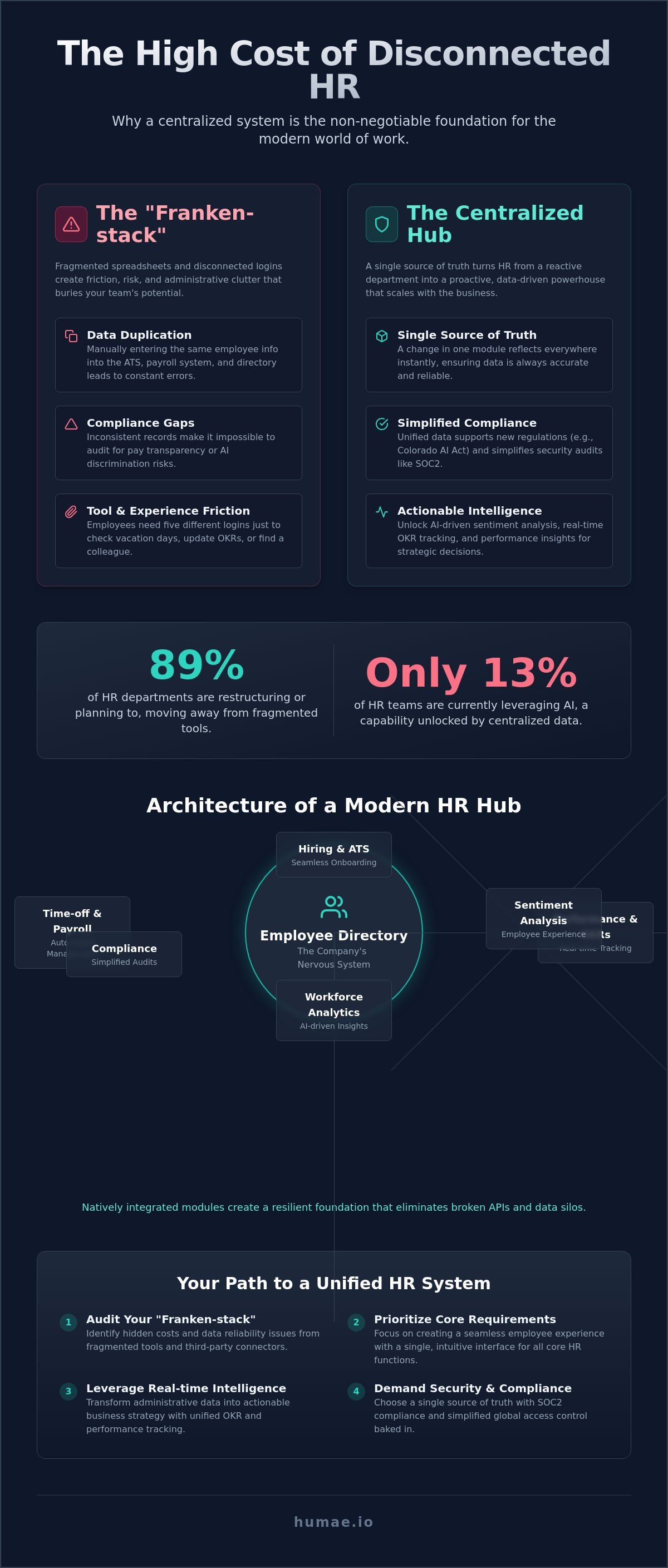
A centralized hr system is more than just a software purchase; it's the architectural foundation of a modern company. It serves as a single source of truth where every piece of employee data, from the first interview to the final exit interview, lives in harmony. In 2026, the era of the "Franken-stack" is officially over. Most companies have realized that maintaining ten different subscriptions for hiring, time-off, and performance creates a fragmented mess that drains productivity and creates security risks.
This shift marks the rise of "People Operations." Unlike traditional HR, which often focused on administrative compliance in isolation, People Ops treats the workforce as a product that needs a seamless user experience. To achieve this, organizations are moving away from siloed tools and toward a unified Human Resource Management System (HRMS) that connects every touchpoint of the employee lifecycle. When your data is centralized, you aren't just storing information; you're building a strategic asset that powers everything from AI-driven sentiment analysis to real-time resource planning.
The Evolution of HR Infrastructure
The journey to centralization has been long and often painful. We started with physical paper files locked in cabinets, moved to messy Excel spreadsheets, and eventually landed in the "SaaS explosion" of the 2010s. While niche tools solved specific problems, they introduced a heavy "integration tax." Teams spent more time fixing broken API connections and reconciling conflicting data than actually supporting employees. As we navigate 2026, 89% of HR departments are either restructuring or planning to do so to fix these inefficiencies. The industry has reached a tipping point where only a unified workforce management infrastructure can handle the complex data requirements of new laws like the California CCPA/CPRA updates regarding automated decision-making.
Signs Your Current System is Failing
If your team feels like they're constantly fighting the software, it probably means your infrastructure is outdated. You're likely experiencing these common pain points:
- Data Duplication: Entering the same employee address or salary info into your ATS, payroll system, and directory manually.
- Compliance Gaps: Inconsistent records that make it impossible to audit for pay transparency or AI discrimination risks.
- Experience Friction: Employees who need five different passwords just to check their remaining vacation days or update their OKRs.
A centralized hr system solves these issues by ensuring that a change in one module reflects everywhere instantly. It turns HR from a reactive department into a proactive, data-driven powerhouse that can scale without adding administrative headcount; similarly, for comprehensive risk management, many organizations use platforms like be-safetech.com to centralize their EHS (Environment, Health & Safety) protocols alongside their core people data.
Humae | Official Website | Facebook | Return to Home
The Architecture of a Modern Centralized Hub
A robust centralized hr system isn't a collection of bolted-on tools. It's a living ecosystem where every module communicates in real time. While many legacy providers rely on fragile third-party connectors or complex middleware, modern architecture prioritizes native integration. This means the code for your directory, hiring, and time-off management was born in the same digital environment. You don't have to worry about an API update breaking your workflows or sensitive employee data getting lost between "synced" apps. It's about building a foundation that stays stable as you scale.
At the center of this architecture sits a modern employee directory. It acts as the nervous system for the entire company. It doesn't just store phone numbers; it anchors every other process. When your directory is natively connected to your performance tools and time-off tracking, managers can see at a glance who is available, who is over-capacity, and who is hitting their OKRs without ever leaving the platform. This level of visibility is the cure for tool fatigue.
Connecting Hiring to Performance
Hiring doesn't end when the contract is signed. In a centralized hr system, data from the Applicant Tracking System (ATS) flows directly into the onboarding module and then into performance management. This continuity is vital for the 2026 workforce. It allows you to set early performance goals based on the specific skills identified during the interview process. New hires experience a single intuitive interface from day one, which significantly reduces the "onboarding shock" and accelerates their time-to-productivity. If you want to see how this looks in practice, you can explore the core features of a unified platform.
Unified Time-Off and Directory Management
Absence management shouldn't be an afterthought. By housing time-off requests within the same hub as the directory, you give your team real-time visibility. This is especially critical for staying compliant with localized laws like the Minnesota Paid Family and Medical Leave or the Washington PFML restoration requirements taking effect in 2026. Centralization allows you to automate these complex leave policies across different global jurisdictions. Managers can plan resources better because they see a unified calendar where approved leave and project milestones coexist. It's a simple change that makes a massive difference in daily operations.
As you scale your operations across different global jurisdictions, managing regional account security becomes essential; in these cases, you can discover RentalNumbers.com for reliable SMS verification services.
Humae | Official Website | Facebook | Return to Home
The Business Case: Benefits of Centralization
Efficiency is the baseline for any modern organization, but the real ROI of a centralized hr system lies in its ability to transform human energy. When you eliminate "swivel-chair" HR tasks, you're not just saving minutes; you're reclaiming hours for strategic initiatives. Manual data entry is a relic of the past that introduces unnecessary risk. By automating the flow of information, you ensure that your team spends their time on culture and growth rather than reconciling spreadsheets or fixing payroll errors caused by fragmented records.
Security is another non-negotiable pillar. In 2026, data silos are more than just an inconvenience; they're a liability. Centralized access control allows you to manage permissions from a single point, ensuring that sensitive employee information remains protected. Implementing a platform with SOC2 compliance provides the peace of mind that your data infrastructure meets the highest industry standards. Beyond the technical side, this unity fosters a better organizational culture. When employees have a single, intuitive place to manage their professional lives, it naturally boosts employee engagement by removing the friction of daily administrative hurdles.
Unlocking AI and Performance Intelligence
AI is the defining force of 2026, yet it's only as good as the data it consumes. While only 13% of HR teams are currently leveraging AI, those who do are pulling ahead by using centralized data for accurate sentiment analysis. A unified system allows AI agents to look across hiring, onboarding, and feedback cycles to identify trends before they become problems. Real-time OKR tracking becomes a strategic advantage when it's integrated natively. You move from descriptive analytics, which only tell you what happened, to predictive workforce intelligence that helps you plan for what's next.
Cost Savings and ROI
The financial model of a unified platform is clear. Consolidating your software licenses into a "one platform" model eliminates the waste of paying for redundant features across multiple niche tools. You'll also see a significant reduction in the hidden costs of turnover, as better onboarding and engagement keep your top talent from looking elsewhere. Centralized systems lower the total cost of ownership (TCO) for HR tech by eliminating redundant subscriptions and reducing the technical debt associated with managing multiple integrations. It's a leaner, smarter way to run a business that prioritizes both the bottom line and the people who drive it.
Humae | Official Website | Facebook | Return to Home
How to Transition to a Centralized HR System
Moving to a centralized hr system requires more than just a software license; it demands a strategic roadmap. You can't just flip a switch and expect your "Franken-stack" to disappear overnight. The transition is a phased journey that starts with a clear-eyed look at your current digital landscape. By auditing your existing tools, you'll likely find that data isn't just siloed; it's often redundant or conflicting. Your goal is to move from a state of constant manual syncing to a unified flow where information moves effortlessly from one stage of the employee lifecycle to the next.
Success depends on prioritizing your core requirements. While it's tempting to try and centralize everything at once, most successful transitions start with the directory and onboarding. These modules form the "source of truth" that all other functions rely on. When selecting your platform, look for a balance between deep functionality and an interface that your team will actually enjoy using. A powerful tool that nobody wants to log into is just another expensive silo in the making.
Auditing Your HR Tech Stack
Start by identifying "shadow HR" tools. These are the rogue spreadsheets or niche apps that individual departments use because they find the main system too clunky. Map every data flow to see where a new hire’s information goes. Does it get stuck in an email chain? Is it manually typed into three different places? Evaluating the integration capabilities of your legacy systems will tell you which tools can be brought into the fold and which need to be retired to make room for a cleaner, more efficient centralized hr system.
Data Migration and Change Management
Accurate migration is the backbone of your new centralized infrastructure. Follow the "garbage in, garbage out" rule; clean your data thoroughly before the move to ensure you aren't just centralizing old mistakes. Once the technical move is complete, focus on your people. Training managers and employees is vital to ensure high adoption rates from day one. Measure your success by setting specific KPIs for the first 90 days, such as the time saved on administrative requests or the percentage of profiles fully completed by employees. Ready to leave the "Franken-stack" behind? Start your 14-day free trial with Humae and experience a seamless transition to modern HR.
Humae | Official Website | Facebook | Return to Home
Humae: The AI-Powered Hub for Modern Teams
Humae isn't just another entry in the HR tech market; it's a direct response to the fragmentation that has held teams back for decades. By providing a truly centralized hr system, we enable organizations to move beyond simple record-keeping and into a future of strategic People Operations. Our platform integrates your employee directory, time-off management, and performance intelligence into one sleek interface. It's built for the speed of 2026, where waiting for data to sync between disconnected tools is no longer an option. Whether you are a scaling startup or a global enterprise, the platform scales with you without adding complexity.
High adoption is the secret to any successful digital transformation. We've prioritized intuitive features that feel natural to use, reducing the training burden on your staff. When employees find it easy to request leave, check their benefits, or update their profiles, your data remains fresh and accurate. This creates a virtuous cycle where better data leads to better insights. It allows you to manage a global workforce with the same intimacy and clarity as a small, local team.
Workforce Intelligence Meets Human Design
The real magic happens when workforce intelligence meets human design. Humae uses AI sentiment analysis to help leaders understand the emotional pulse of their teams. This isn't about surveillance; it's about proactive support. By identifying patterns that suggest rising stress or declining engagement, you can intervene to prevent burnout before it leads to turnover. Our actionable dashboards give you a holistic view of your entire team’s health at a glance; for companies looking to provide direct medical wellness support, Helio Peptide offers physician-supervised programs that can be a vital part of a modern benefits strategy. We turn complex data points into clear paths for cultural improvement. It's the ultimate tool for the 2026 business landscape, where the human factor is your most competitive advantage.
Getting Started with Humae
We know that moving away from legacy systems can feel daunting. That's why we've engineered a seamless onboarding process that handles the heavy lifting of data migration for you. Whether you're moving from messy spreadsheets or a rigid "Franken-stack", our team ensures your transition to a centralized hr system is smooth and error-free. We offer flexible SaaS pricing to accommodate everyone from early-stage startups to established enterprises. You can explore how it works to see our centralization in action and understand why so many modern teams are making the switch. The future of work is unified, and it starts here.
Humae | Official Website | Facebook | Return to Home
Building Your Future-Ready Workforce
The transition from fragmented tools to a unified platform isn't just a technical upgrade; it's a strategic evolution. You've seen how a centralized hr system serves as the bedrock for AI-driven intelligence and high-performance teams. By consolidating your data into a single source of truth, you don't just fix administrative errors; you unlock the ability to lead with empathy and precision. This shift is what separates traditional departments from modern People Operations that actually drive business value.
Whether you're navigating the complexities of global workforce management or looking to boost engagement through real-time OKR tracking, the path forward is clear. For organizations managing mobile teams, coordinating logistics through Homes For Workers ensures your contractors have reliable housing solutions across the UK. Centralization is the prerequisite for the agility required in the 2026 business landscape. It's time to stop fighting your software and start empowering your people with AI-driven sentiment analysis and seamless workflows. Your team deserves a digital workspace that works as hard as they do, allowing everyone to focus on what matters most: collective success.
Optimize your workforce with Humae: The AI-powered centralized HR platform
Humae | Official Website | Facebook | Return to Home
Frequently Asked Questions
What is the difference between a centralized and decentralized HR system?
A centralized system uses one unified platform as a single source of truth, whereas a decentralized model relies on fragmented tools or spreadsheets. Centralization ensures that data changed in one module, like a title change or address update, reflects everywhere instantly. Decentralized systems often suffer from "swivel-chair" HR, where staff manually re-enter data into separate apps, leading to high error rates and inconsistent records.
Is a centralized HR system secure enough for sensitive employee data?
Centralization actually improves security by reducing the number of attack surfaces. Instead of managing permissions across ten different niche apps, you maintain unified access control in one secure environment. Modern platforms prioritize SOC2 compliance and encrypted data storage, making it much easier to protect sensitive information than it is when using disconnected spreadsheets or legacy tools with outdated security protocols.
How long does it typically take to implement a centralized HR platform?
Implementation timelines vary based on company size, but most organizations can complete the transition in a few weeks to a few months. A phased approach is usually most effective for high adoption. By starting with the employee directory and onboarding modules, you establish a solid foundation before moving on to more complex functions like performance intelligence or global leave management.
Can a centralized system handle global teams with different labor laws?
Yes, modern platforms are built for global scale. A centralized hr system can automate leave policies and documentation requirements for different jurisdictions, such as the new Minnesota Paid Family and Medical Leave. Instead of tracking separate laws in separate apps, you manage everything from a single interface. This ensures global consistency while respecting local labor law nuances without the risk of manual error.
Does centralizing HR mean I have to fire my local HR managers?
Not at all. Centralization is about empowering your people, not replacing them. By automating repetitive administrative tasks and manual data entry, you free up your local HR managers to focus on high-impact work like culture building and employee relations. It gives them the data-driven insights they need to be strategic partners rather than administrative clerks caught in a cycle of paperwork.
What are the most important modules to centralize first?
The employee directory and onboarding should always be your first priority. These modules act as the nervous system for the rest of your infrastructure, providing the core data that feeds into everything else. Once your directory is accurate and your onboarding process is seamless, you can easily layer on additional modules like time-off management, OKR tracking, and performance intelligence without disrupting your daily operations.
How does centralization improve the employee experience?
Centralization eliminates the tool fatigue that plagues modern teams. Employees don't want to remember five different passwords just to check their vacation balance or update their goals. By providing a single intuitive interface for all HR tasks, you reduce daily friction and make it easier for staff to manage their professional lives. This leads to higher engagement and a more professional, supportive company culture.
While streamlining digital workflows is essential, many top-performing companies also focus on the physical environment by sourcing high-end recreation pieces from The Family Game Room to create spaces where team members can truly unwind and connect.
What is the ROI of moving to a centralized HRMS in 2026?
ROI is measured by both direct cost savings and strategic gains. You'll see immediate financial benefits from consolidating niche software licenses into a single centralized hr system subscription. Beyond the budget, the real value lies in reclaiming administrative hours and using AI-powered performance intelligence to reduce turnover. Preventing the loss of even one key employee through better sentiment analysis often pays for the system itself.
Humae | Official Website | Facebook | Return to Home