Centralized Employee Records Management: The 2026 Guide to Workforce Intelligence
By Humae · 26 May 2026
centralized employee records management
What if your HR data did more than just sit in a digital folder; what if it actually predicted your next turnover risk before it happened? In 2026, many leaders are still struggling with manual data entry errors and the constant compliance anxiety triggered by new mandates like California’s SB 513. It's exhausting to manage a growing team when you're flying blind without real-time visibility into performance trends. Mastering centralized employee records management is the only way to stop acting as a data gatekeeper and start acting as a visionary strategist.
We know you want more than just a digital filing cabinet; you want a single source of truth that empowers your entire organization. This guide will show you how to transform fragmented information into a centralized intelligence layer that directly improves retention and performance. We'll explore how automated workflows and actionable AI insights can replace administrative headaches with a culture of excellence. It's time to build a workforce infrastructure that's as innovative and human-centric as your business vision.
Humae
Return to Home |
Follow us on Facebook
Key Takeaways
- Identify why fragmented data silos are your team's biggest productivity killer and how to eliminate hidden compliance gaps before they lead to penalties.
- Discover how centralized employee records management creates a unified intelligence layer by aggregating personal data with real-time performance metrics.
- Move beyond static record-keeping by integrating active OKR tracking to turn passive data into actionable, real-time workforce insights.
- Follow a clear, five-step roadmap to audit your current tech stack and establish a single source of truth that simplifies the entire employee lifecycle.
- Learn how to bridge the gap between technical efficiency and a human-centric culture to drive long-term employee retention and peak performance.
Humae
Return to Home |
Follow us on Facebook
The Silent Cost of Fragmented Employee Data in 2026
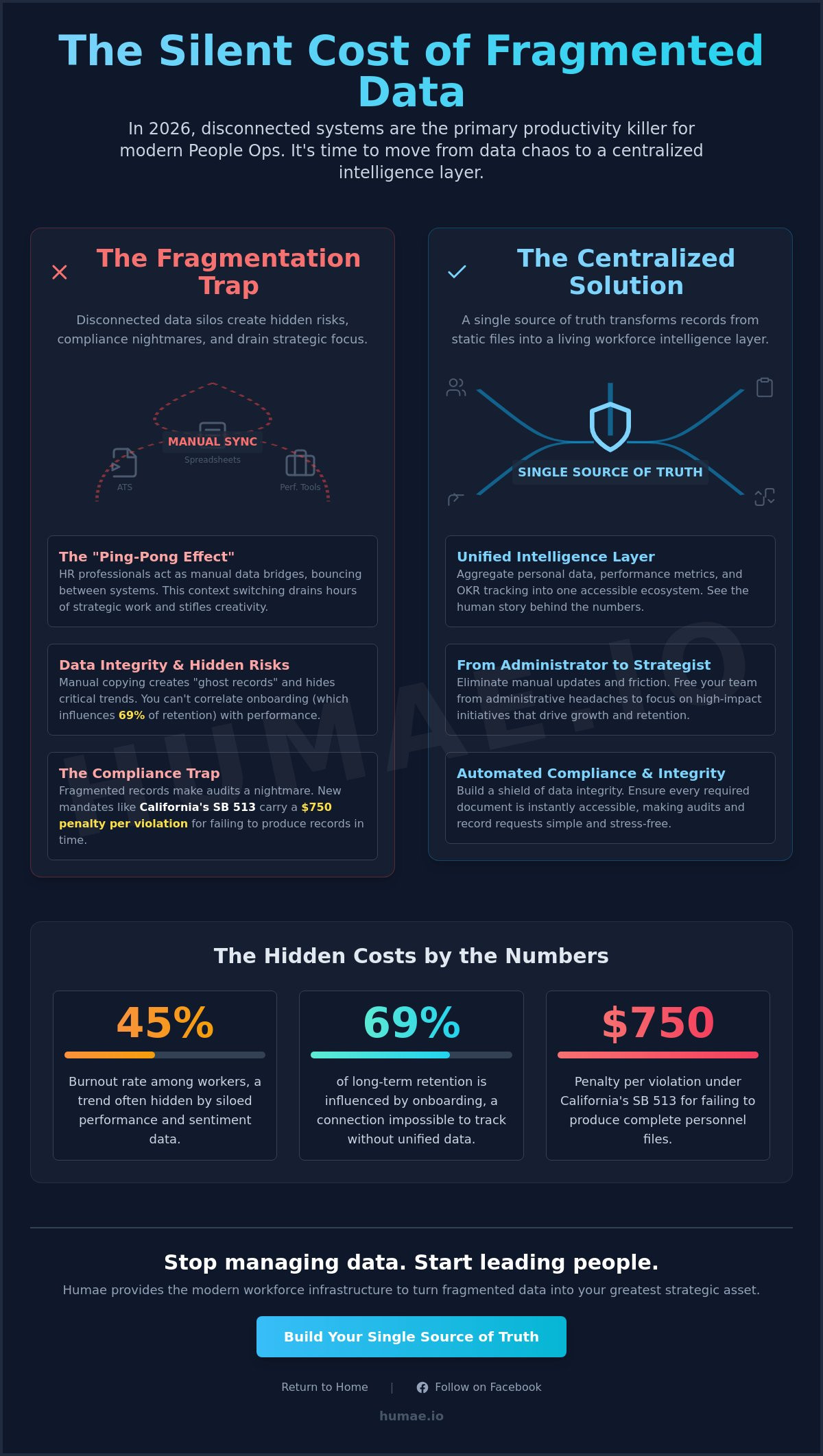
Data silos are no longer just a technical nuisance; they've become the primary productivity killer for modern People Ops. In an era where 91% of organizations are using at least one AI technology, relying on disconnected systems is like trying to run a high-speed train on wooden tracks. When your team's information is scattered across spreadsheets and isolated tools, you lose the ability to see the human story behind the numbers. This fragmentation hides critical trends, such as the 45% burnout rate reported by workers in recent years, until it's too late to intervene. Moving toward centralized employee records management isn't just an upgrade; it's a necessary evolution from digital filing cabinets to integrated workforce infrastructure.
The hidden risks of manual data synchronization go far beyond simple typos. Every time a record is manually copied, you risk creating a "ghost record" that exists in one system but not another. These gaps prevent leaders from seeing the big picture of organizational health. Without a unified view, you can't accurately track how onboarding experiences, which influence 69% of long-term retention, actually correlate with later performance. You aren't just managing data; you're managing the future of your talent.
The Ping-Pong Effect: Why Context Switching Kills HR Efficiency
HR professionals often find themselves acting as manual data bridges, bouncing between their Applicant Tracking System, performance tools, and time-off trackers. This "ping-pong effect" carries a heavy psychological toll and drains hours of potential strategic work every week. Navigating these separate interfaces creates a cognitive load that stifles creativity and empathy. A modern Human resource management system solves this by providing a single point of entry. By implementing a robust workforce management infrastructure, you eliminate the friction of context switching and allow your team to focus on high-impact initiatives that drive growth.
Data Integrity and the Compliance Trap
Fragmented records make regulatory audits a nightmare, especially with new mandates like California’s SB 513. Since January 1, 2026, employers must include education and training records in personnel files or face a $750 penalty per violation. If these records are siloed, meeting a 30-day request window becomes nearly impossible. Centralized employee records management ensures that every piece of required documentation, from workers' compensation notices to FMLA records, is instantly accessible. You can't afford to fall into the compliance trap of "I think we have that record somewhere." Understanding what is workforce management in this context is about building a shield of data integrity that protects your organization and your people.
Humae
What is Centralized Employee Records Management?
Think of centralized employee records management as the nervous system of your company. It's a unified digital ecosystem that aggregates every critical data point into one accessible layer. In the past, HR records were just digital versions of paper files. Today, they're living datasets that combine personal details, performance metrics, and real-time sentiment analysis. This shift allows for human-centric automation. Instead of chasing paperwork, your team can focus on the people who drive your success. Establishing this foundation usually starts with a modern HRIS, which acts as the architectural backbone for all workforce intelligence.
A centralized approach ensures that data flows seamlessly between different functions. It eliminates the friction of manual updates and ensures that every department is looking at the same information. This isn't just about efficiency; it's about building trust. When employees see that their records are accurate and their achievements are tracked in real-time, they feel valued. It transforms the HR department from a back-office function into a strategic partner that understands the heartbeat of the organization.
Key Components of a Modern Centralized System
A truly modern system goes beyond simple lists. It integrates various functions to provide a holistic view of the workforce. Consider these essential elements:
- Dynamic Employee Directories: These go beyond names and titles to include skills, certifications, and current OKRs.
- Integrated Time-Off Management: Linking availability directly to productivity tools helps managers plan projects without constant back-and-forth emails.
- Real-time Analytics: Moving from monthly reports to live dashboards allows for immediate adjustments and faster decision-making.
You can explore modern HR features that bring these components together into a single, intuitive interface.
The Intelligence Layer: Records as Data Fuel
Humae
Static Records vs. Performance Intelligence: The 2026 Shift
Traditional record-keeping has become a relic of a slower business era. In 2026, simply storing a PDF of a resume or a static performance review isn't enough to stay competitive. AI doesn't just want data; it wants context. This is where centralized employee records management shifts from a passive storage solution to an active intelligence engine. Descriptive analytics tell you what happened last quarter. Predictive workforce intelligence tells you what will happen next month. By aggregating every touchpoint, you move from reacting to historical data to shaping future outcomes.
The real power lies in data activation. When a record is "alive," it doesn't just list a job title. It reflects current contributions, evolving skills, and real-time engagement levels. This transformation allows leaders to identify high-potential talent before they're scouted by competitors. For specialized sectors like law, connecting with elite talent often requires the expertise of specialist headhunters such as hialegal.com. It's the difference between a static snapshot and a high-definition live stream of your organization's health. With 91% of organizations now leveraging AI, the quality of your centralized data determines the quality of your strategic decisions.
The OKR Connection: Aligning Records with Results
Individual records must do more than document a person's history; they should map their future. Integrating real-time OKR tracking directly into the employee record creates a powerful link between daily tasks and company-wide goals. This transparency isn't just for managers. Employees who see exactly how their work contributes to the bigger picture are more engaged and motivated. You can explore how these performance tools work within a unified system to drive measurable results. When results are visible, success becomes a shared journey rather than a mysterious annual review.
Sentiment and Feedback: The Heartbeat of the Record
A centralized record that ignores how an employee feels is incomplete. By integrating continuous feedback loops, you capture the "heartbeat" of your team. AI now analyzes sentiment trends across various interactions to flag cultural issues or turnover risks early. If a specific department shows a dip in sentiment, you can act immediately rather than waiting for an exit interview. This data-driven approach to employee engagement strategies ensures that your culture remains resilient. It's about using technology to be more human, not less. By centralizing these feedback loops, you create a supportive environment where every voice is heard and every trend is understood.
Humae
Implementing Centralized Management: A 5-Step Roadmap
Transitioning to a unified system is a structural shift that requires a clear plan. In 2026, your implementation must be AI-ready from day one. This means moving beyond simple data migration to creating a high-fidelity environment where your intelligence layer can thrive. Successful centralized employee records management follows a logical progression that balances technical precision with the human experience. By following this five-step roadmap, you'll transform your HR department from a back-office function into a strategic powerhouse.
- Step 1: Audit Your Current Data Map. Identify every siloed tool, from legacy spreadsheets to isolated performance apps. You can't centralize what you haven't found.
- Step 2: Define Your Source of Truth. Select a modern HRMS that acts as the architectural foundation. This system will be the single point of entry for all workforce data.
- Step 3: Establish Role-Based Access Controls (RBAC). Security is paramount. Define exactly who can see sensitive files to ensure privacy while maintaining operational speed.
- Step 4: Migrate and Cleanse. Follow the "garbage in, garbage out" rule. Use this transition to purge outdated files, keeping in mind that the IRS requires tax records for at least four years, while the FLSA mandates three years for payroll data.
- Step 5: Launch Employee Self-Service (ESS). Empower your team to maintain their own accuracy. When employees own their profiles, data integrity becomes a shared responsibility.
If you're ready to see how these steps come together in a real-world environment, you can explore our implementation process to see how we simplify the transition for modern teams.
Data Governance and Security Standards
Security is the foundation of employee trust. In a centralized system, data governance defines who owns each data point and how it's protected. You must ensure your platform uses high-level encryption and maintains SOC2 compliance to safeguard sensitive employee files. Clear governance prevents "ghost records" and ensures that your data remains a reliable asset for both compliance audits and AI-driven insights. It's about building a shield of integrity around your most valuable resource: your people.
Training and Adoption: The Human Factor
The best technology only works if people use it. Onboarding your managers to use data dashboards is critical for data-driven leadership. They need to understand how to interpret real-time trends to support their teams effectively. Simultaneously, encourage employees to keep their profiles updated through self-service portals. This creates a culture of transparency where everyone understands the value of accurate information. When your team sees that their records directly influence their growth and performance opportunities, adoption becomes a natural part of their daily workflow.
Humae
Humae: The Infrastructure for Modern Workforce Management
Humae isn't just another software vendor; we're your visionary partner in a world where 91% of organizations are already leveraging AI technology. Our infrastructure is built specifically for the 2026 workforce, blending an AI-first mindset with a deeply human approach. We believe that technology should empower your people, not replace the connections that make your organizational culture unique. By implementing centralized employee records management through Humae, you aren't just storing data. You're building a foundation for sustainable growth, performance, and empathy.
We centralize the entire lifecycle, ensuring no critical data point is left behind. From the first interaction in our Applicant Tracking System to the deep insights found in our Performance Intelligence dashboards, every stage of the journey is connected. Your Employee Directory becomes a living asset that showcases real-time skills and career paths. Because your centralized employee records management is seamless, you can finally see the through-line from a great hire to a high-performing leader. In cutting-edge research environments, this might even include data from neural interfaces—evaluating the MindRove EEG headset price is a practical step for teams exploring these advanced biometric inputs. This isn't just about software; it's about creating a culture where data supports human potential at every turn.
Real-time OKR tracking and sentiment analysis are standard features within our records, not expensive afterthoughts. We've moved beyond the descriptive analytics of the past that only told you what happened yesterday. Humae provides the predictive workforce intelligence you need to stay ahead of market shifts. If a team's sentiment drops or a key goal is at risk, you'll know immediately. This proactive stance is what separates modern leaders from those still caught in the reactive cycles of legacy systems. We help you value your data as much as you value your people.
The Humae Difference: AI-Powered Performance Intelligence
Our platform turns static records into actionable growth plans that evolve with your employees. We've built an interface that's so intuitive it naturally eliminates the context-switching fatigue mentioned earlier in this guide. You won't find yourself bouncing between five different tools to get a single answer. Instead, you'll have a clear, unified view of Time Off Management, OKR progress, and Analytics Dashboards in one place. It's the ultimate infrastructure for teams that want to move fast without losing their human touch. It's time to optimize your team's growth through a centralized infrastructure designed for the future of work.
Branding and Navigation
This content is powered by Humae, your partner in visionary HR. We're dedicated to helping organizations transition from fragmented systems to a single source of truth that drives real results and fosters community.
Master Your Workforce Intelligence Today
Fragmented data doesn't just slow your team down; it actively limits your strategic vision. By moving beyond static digital filing cabinets and embracing centralized employee records management, you unlock a predictive engine that anticipates organizational needs before they become crises. You've seen how a structured roadmap can secure your data and how real-time feedback loops protect your culture from the hidden costs of burnout. The transition from reactive administration to proactive leadership is within your reach.
The future of work belongs to organizations that treat their workforce data as a living, breathing asset. With a global workforce management infrastructure at your fingertips, your team can finally prioritize human connection over manual data entry. It's time to stop acting as a gatekeeper and start acting as a visionary strategist. Streamline your workforce with Humae’s centralized HRMS to leverage AI-powered performance intelligence and real-time OKR tracking. Your organization is ready for this evolution. Let's build a more resilient and human-centric workplace together.
Humae
Frequently Asked Questions
What is the primary benefit of centralized employee records management?
The primary benefit is the creation of a single source of truth that eliminates productivity-killing data silos. By unifying information, your team stops wasting time on manual data synchronization and starts focusing on strategic growth. This centralization ensures that every department works with the same accurate data, which is crucial for meeting 2026 compliance standards like California's SB 513. It transforms HR from a reactive function into a proactive organizational partner.
How does centralized data improve employee engagement and retention?
Centralized data builds trust by providing employees with transparency regarding their performance and career growth. When achievements are tracked in real-time alongside OKRs, people feel their contributions are visible and valued. Predictive analytics can also flag burnout trends early, allowing managers to intervene before a high-performer decides to leave. It creates a supportive environment where data is used to enhance the human experience rather than just monitor it.
Is a centralized employee database secure against data breaches?
Modern centralized systems are significantly more secure than fragmented spreadsheets or legacy paper files. They utilize advanced encryption and Role-Based Access Controls to ensure that sensitive information is only visible to authorized personnel. Centralization actually reduces your attack surface by eliminating "ghost records" scattered across multiple unsecured tools. By maintaining a single, hardened repository, you can more easily meet strict data privacy regulations and maintain employee trust.
Can I integrate my existing payroll tool with a centralized record system?
Yes, most modern platforms are designed to sync seamlessly with specialized payroll engines. While the centralized system acts as the primary record for employee identity and performance, it can feed accurate data directly into your payroll tool. This integration eliminates the need for manual data entry, which is the leading cause of payroll errors. It allows you to keep your preferred financial tools while benefiting from a unified workforce intelligence layer.
How does AI use centralized employee records to provide performance insights?
AI uses the high-quality data found in centralized employee records management to identify hidden patterns and performance trends. By analyzing aggregated data points like OKR progress and sentiment scores, the system can predict turnover risks or suggest personalized training. This intelligence layer turns passive storage into an active growth engine. It allows leaders to make decisions based on real-time evidence rather than outdated quarterly reports or gut feelings.
What is the difference between an HRIS and a centralized records management system?
An HRIS is the technical software platform, while centralized records management is the strategic practice of unifying all data points within that platform. Think of the HRIS as the digital engine and the centralized records as the high-quality fuel that makes it run. You can have an HRIS and still have fragmented data if you don't commit to a centralized approach. True workforce intelligence requires both the right tool and a unified data strategy.
How often should employee records be updated in a centralized system?
Employee records should be updated in real-time through automated workflows and self-service portals. The era of the "annual update" is over; in 2026, data must flow continuously to remain useful. When an employee completes a certification or hits a milestone, the record should reflect that change immediately. This constant stream of information ensures that your analytics dashboards always provide a current snapshot of your organization's health and capabilities.
Does centralized management help with remote or hybrid team oversight?
It is the essential backbone for managing remote and hybrid teams where physical presence isn't possible. Centralization replaces "management by walking around" with digital visibility into productivity, availability, and sentiment across different time zones. It allows managers to support their teams effectively without micromanaging through endless emails or check-in meetings. By having a clear view of everyone's records and results, you can maintain a strong culture regardless of where your people are working.