AI for Employee Sentiment Analysis: The 2026 Guide to Intelligent Infrastructure
By Humae · 17 July 2026
ai for employee sentiment analysis
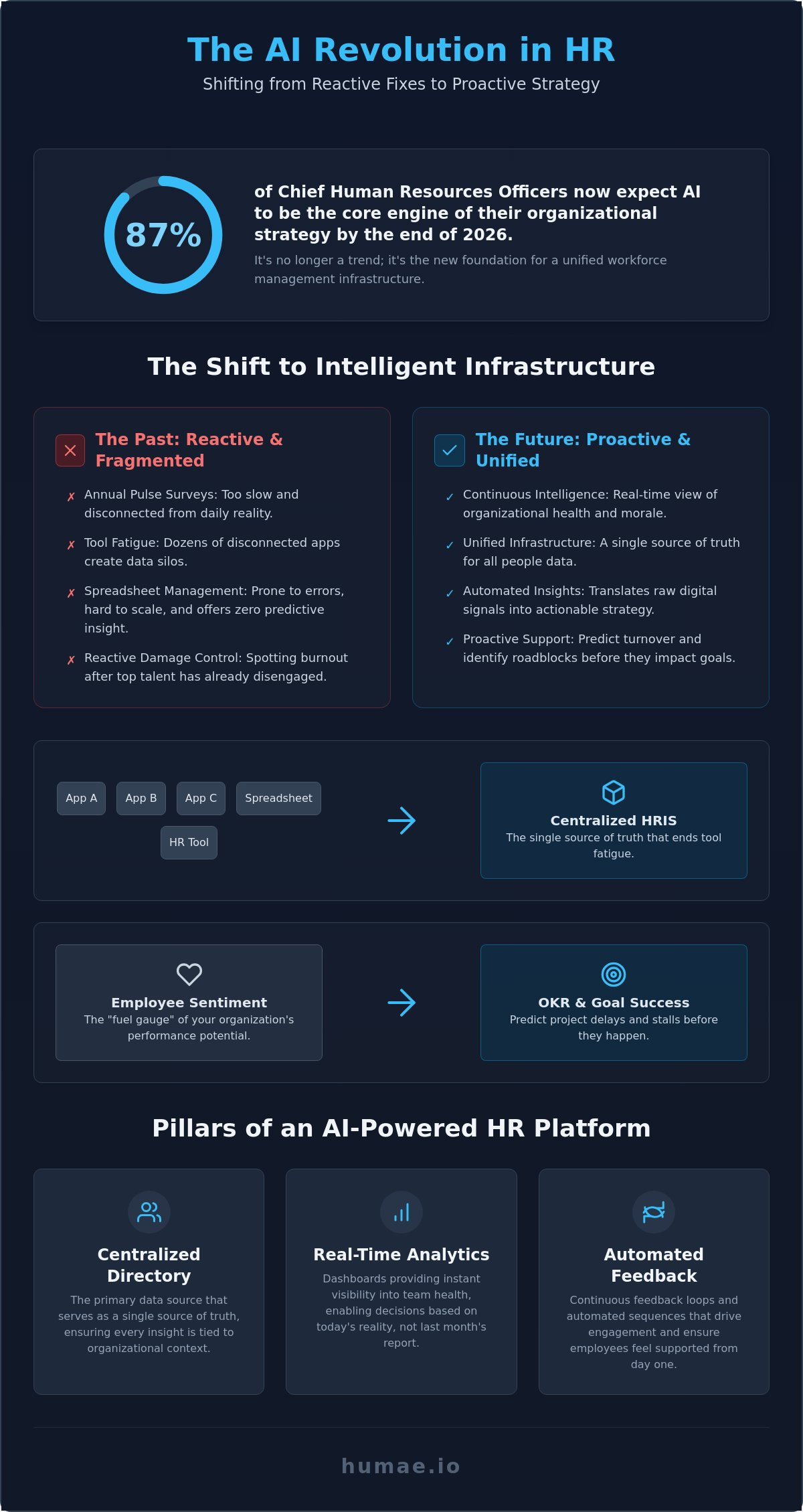
87% of Chief Human Resources Officers now expect AI to be the core engine of their organizational strategy by the end of 2026. You've likely experienced the tool fatigue that comes with managing a dozen different HR apps, each holding a tiny piece of the puzzle. It's painful to realize that by the time you spot signs of burnout in a spreadsheet, your best talent has already mentally checked out. Implementing ai for employee sentiment analysis is no longer about chasing a trend; it's about building a unified workforce management infrastructure that actually works.
We understand that you want to move beyond reactive fixes and start leading with proactive clarity. This guide will show you how to transform fragmented feedback into a single source of truth for your people data. You'll learn how to use automated insights to predict turnover and scale team performance with a human-first philosophy. We are moving from "what happened" to "what happens next," ensuring your leadership stays ahead of the curve through intelligent, real-time feedback loops.
Key Takeaways
- Understand how shifting from annual pulse surveys to continuous intelligence layers provides a real-time view of organizational health in 2026.
- Learn to integrate ai for employee sentiment analysis into your performance intelligence to identify roadblocks before they impact your OKRs.
- Discover why a centralized HRIS is the essential antidote to tool fatigue, creating a single source of truth for all your people data.
- Master a strategic roadmap for migrating from legacy spreadsheets to an intelligent, automated workforce management infrastructure.
- Explore how proactive leadership and automated feedback loops drive higher employee retention and scale team performance across your organization.
Defining AI for Employee Sentiment Analysis: The New Standard for HRMS
Legacy HR systems were essentially digital filing cabinets. They stored names, dates, and salary figures but remained blind to the actual pulse of the team. In 2026, we view ai for employee sentiment analysis as a continuous intelligence layer. It's not a standalone feature you toggle on; it's the nervous system of your people operations. By processing natural language from internal communication channels, this technology identifies trends in morale before they manifest as turnover.
The era of the "annual pulse survey" is over. Waiting 12 months to ask how your team feels is a recipe for disaster in a high-speed market. Sentiment analysis technology allows leaders to move from reactive damage control to proactive support. This shift is essential because 2026 demands a leadership style that is both data-driven and deeply empathetic. Employees expect their workplace to understand their needs without being prompted by a rigid questionnaire. This is the core of a modern workforce management infrastructure.
The Evolution of People Operations Technology
People operations technology has evolved from static records to dynamic performance intelligence. Legacy systems fail because they treat culture as a checkbox. They can't capture the nuance of a team's frustration during a difficult product launch or the sudden dip in enthusiasm after a reorganization. AI bridges this gap. It translates raw digital signals into actionable insights, allowing HR professionals to apply human empathy exactly where it’s needed most. It’s about using ai for employee sentiment analysis to humanize the data, not replace the manager. In this environment, transparency is key to building trust between the algorithm and the individual.
Core Components of an AI-Powered HR Platform
A truly intelligent HR platform relies on a few critical pillars to function effectively. It starts with a centralized employee directory that serves as the primary data source, ensuring every insight is tied to a specific organizational context. This creates a single source of truth that eliminates the need for multiple, disconnected apps. Real-time analytics dashboards then provide instant visibility into team health, allowing for decision-making based on today's reality rather than last month's report. Finally, automated onboarding sequences set the tone for engagement from day one, using feedback loops to ensure new hires feel supported immediately. This integrated approach ensures that every piece of data contributes to a larger picture of organizational success.
Connecting Performance Intelligence with Real-Time OKR Tracking
Performance isn't just about output; it's about the energy behind it. In 2026, we've moved past treating morale as a "soft" metric. When you use ai for employee sentiment analysis, you're essentially looking at the fuel gauge of your organization. If sentiment drops, your strategic goals are likely to stall next. By treating sentiment as a leading indicator, leaders can predict project delays weeks before they actually happen. This integration turns an HR tool into a high-level business intelligence asset.
The traditional annual performance review is a relic of the past. It's too slow and too disconnected from daily reality. Continuous feedback loops allow for immediate course correction. However, simply gathering data isn't enough. Many organizations struggle with the dangers of inaction, where collecting feedback without visible response actually erodes trust. Intelligent infrastructure solves this by highlighting exactly where leadership needs to step in, ensuring that every voice leads to a concrete improvement in the workflow.
How Sentiment Influences Objective Success
Success starts with understanding OKR meaning in a modern, automated context. Objectives aren't just targets; they're the result of a healthy, aligned team. AI identifies at-risk objectives by spotting linguistic shifts in project updates or team chats. For example, a sudden increase in passive language or a decrease in collaborative mentions can signal burnout before it impacts your key results. By centralizing goal tracking and morale data, you create a transparent environment where everyone knows their value. This visibility is exactly what a modern performance intelligence platform provides to growing teams.
The Science Behind AI Sentiment Analysis
The engine behind this insight is Natural Language Processing (NLP). In a workplace context, NLP does more than just count positive or negative words. It analyzes context and intent. It can distinguish between constructive frustration, such as a developer complaining about a bug, and toxic disengagement that threatens team cohesion. This nuance is vital for maintaining a healthy culture. While the AI provides the data, it's designed to respect employee privacy, focusing on aggregate trends and patterns rather than individual surveillance. This balance ensures that management gets the insights they need while employees feel safe and supported in their digital workspace.
Centralized Infrastructure vs Tool Overload: The Integration Advantage
Managing a dozen different HR apps isn't just an administrative headache; it's a significant drain on your company's resources. Hidden costs lurk in the hours spent on manual data entry and the subscription fees for redundant services. When your people data is scattered across disconnected platforms, you lose the ability to see the big picture. Integrating ai for employee sentiment analysis directly into a centralized system eliminates these silos. It allows you to move away from fragmented "best-of-breed" stacks that rarely talk to each other and toward a cohesive ecosystem that supports real growth.
A modern HRIS serves as the single source of truth for your entire organization. This consolidation is vital for executive-level strategy. When your hiring, onboarding, and performance metrics live in one place, you can make decisions based on comprehensive intelligence rather than guesswork. There’s also a significant security advantage. By consolidating sensitive employee data into one protected environment, you reduce the attack surface and simplify compliance with global privacy regulations. It’s a cleaner, safer, and more efficient way to manage your most valuable asset: your people.
The Problem with Fragmented HR Tech Stacks
The time lost to cross-platform synchronization is a silent productivity killer for HR teams. Beyond the manual labor, there is the risk of "dark data." This refers to valuable employee insights that get lost in Slack threads or buried in unused survey tools because they aren't linked to a central profile. Tool fatigue also takes a heavy toll on the employee engagement experience. If a team member has to log into four different portals to check their time off and update their goals, they simply won't do it. Friction leads to disengagement, which eventually leads to turnover.
Benefits of a Unified Analytics Dashboard
A unified dashboard brings hiring, time-off management, and performance intelligence into a single view. This clarity is a game-changer for managers who need to understand their team's capacity and morale at a glance. It drastically reduces the learning curve for new hires, as they only need to master one intuitive interface. Most importantly, it improves the accuracy of your predictive models. When ai for employee sentiment analysis has access to the full context of an employee's journey, from their initial onboarding to their latest OKR update, it can identify turnover risks with far greater precision. You aren't just looking at a snapshot; you're looking at a complete, living history of engagement.
A Strategic Roadmap for Implementing AI-First People Operations
Moving from legacy spreadsheets to a unified digital infrastructure is more than a technical upgrade; it's a cultural transformation. The transition requires a clear vision that moves beyond simply digitizing old processes. In 2026, 87% of Chief Human Resources Officers anticipate greater adoption of AI within their organizations. To join them, you must treat the implementation of ai for employee sentiment analysis as a strategic shift toward proactive leadership. Success depends on involving the right stakeholders early, including your IT security team, department heads, and the CHRO.
Data hygiene is the often-overlooked foundation of this roadmap. AI is only as effective as the information it processes. Before migrating to an intelligent platform, you must audit your existing data for accuracy and consistency. This migration planning ensures that your new system starts with a clean baseline, allowing for more precise performance intelligence from day one. Communicating these changes to your team is equally vital. Building trust requires radical transparency about why the technology is being introduced and how it serves the employees' interests.
5 Steps to Adopting an AI-Powered HR Platform
- Step 1: Audit your current stack and identify critical data silos where employee insights are currently trapped.
- Step 2: Evaluate platforms based on core features like an integrated ATS and real-time OKR tracking.
- Step 3: Cleanse your employee directory to ensure the AI has accurate, high-quality data for its initial sentiment scoring.
- Step 4: Train leadership on interpreting sentiment and performance intelligence so they can act on insights with empathy.
- Step 5: Launch with a focus on transparency and continuous feedback, showing employees the direct benefits of their input.
Addressing Privacy and Ethical Concerns
Trust is the currency of the modern workplace. When you implement ai for employee sentiment analysis, you must establish transparent data policies that protect individual identities. Reframing AI as a supportive assistant for human managers, rather than a replacement for human judgment, helps alleviate anxiety. It's about augmenting the manager's ability to support their team. Furthermore, ensuring compliance with global data protection standards, such as the EU AI Act, is non-negotiable. This commitment to ethics ensures your people operations remain both innovative and deeply human-centric. Ready to transform your organizational culture? Build your future with a unified workforce platform that puts your people first.
Scaling Human Potential: Why Humae is the Intelligent Choice
Building a modern organization requires more than just collecting data; it requires a partner that understands the delicate balance between technology and human connection. Humae offers a unified workforce management infrastructure that grows with you. Whether you are a team of 10 or scaling toward 1,000 employees, our platform ensures your people strategy remains agile. By integrating ai for employee sentiment analysis directly into your core HRMS, we eliminate the need for disconnected survey tools. You get a single source of truth that empowers leaders to act with confidence and empathy.
The beauty of a centralized system lies in its ability to simplify complex workflows. We have designed Humae to be the antidote to the tool fatigue that plagues modern HR departments. Instead of juggling multiple logins, your team has one intuitive home for hiring, OKRs, and performance intelligence. This consolidation doesn't just save time; it creates a more cohesive culture where everyone feels seen and heard. It turns raw data into a narrative of growth and success.
Intuitive UX: A Platform Employees Actually Enjoy
Tech adoption often fails because the interface is too clunky or impersonal. We prioritize a "Human-First" approach in everything we build. By reducing friction in how it works for everyday tasks like checking time off or updating a key result, we encourage daily engagement. When a platform is a joy to use, data quality naturally improves. This creates a virtuous cycle where your ai for employee sentiment analysis provides even deeper insights; bridging the gap between corporate objectives and individual career growth. It’s technology that feels like it’s on your side.
Next Steps for Your People Strategy
The future of work is intelligent, transparent, and deeply human. Modern leaders don't wait for annual reviews to understand their team's health. They build infrastructures that provide real-time clarity and foster proactive leadership. You can explore the Humae platform today to see how performance intelligence transforms organizational culture. We also invite you to join our growing community on the Humae Facebook page to stay updated on the latest HR innovations. If you are ready to move beyond fragmented feedback and start scaling human potential, book a demo with our team. Let’s build an environment where your team can truly thrive.
The Future of Proactive Leadership Starts Here
The landscape of people operations has shifted from static records to dynamic intelligence. By implementing ai for employee sentiment analysis, you aren't guessing how your team feels; you're seeing the real-time health of your organization. We've explored how a centralized workforce infrastructure replaces tool fatigue with clarity, ensuring that every piece of feedback directly fuels your real-time OKR tracking. It's about moving from "what happened" to "what's next," using AI-driven performance intelligence to protect your talent and scale your success. This transition isn't just about efficiency; it's about meeting the 2026 standard of empathetic, transparent leadership that employees now expect.
Don't let fragmented data or delayed feedback loops hold your team back. It's time to build a culture where technology serves human potential rather than complicating it. Build your intelligent workforce with Humae today and experience the power of unified people data. Your team is ready for a more supportive workplace that values their input in real time. Let's start building that future together.
Frequently Asked Questions
What is an AI-powered HR platform and how does it differ from a traditional HRIS?
An AI-powered HR platform is a dynamic intelligence layer that actively analyzes workforce data, whereas a traditional HRIS is primarily a static database for records. Traditional systems store names and dates; AI platforms like Humae provide performance intelligence and real-time OKR tracking. They move beyond administrative tasks to offer predictive insights that help leaders make proactive decisions about their team's future and growth.
Is AI for employee sentiment analysis secure and compliant with privacy laws?
Yes, modern solutions are built with privacy-first architectures that comply with global standards like the EU AI Act and GDPR. The ai for employee sentiment analysis focuses on aggregate trends and linguistic patterns rather than individual surveillance. We implement transparent data policies and high-level encryption to ensure that sensitive people data remains protected while providing actionable organizational insights for leadership.
How does AI sentiment analysis work without being intrusive to employees?
It works by analyzing anonymized communication patterns and feedback loops rather than monitoring private or personal messages. The system identifies organizational shifts and sentiment trends to spot signs of burnout or misalignment. It functions as a supportive assistant that highlights team-wide issues; this allows managers to address cultural friction without compromising the trust or privacy of any individual team member.
Can an AI platform actually help reduce employee turnover?
It helps reduce turnover by identifying the early warning signs of disengagement before they lead to a resignation. Predictive analytics are designed to catch drops in morale early, allowing leaders to intervene with support, workload adjustments, or wellness initiatives tailored for high-exhaustion roles. For those managing shift-based teams, you can learn more about fitness programs designed for demanding labor schedules. By addressing the root causes of frustration in real time, you can effectively prevent the "quiet quitting" cycle and keep your best talent engaged.
Do I need a large amount of data for AI performance intelligence to be effective?
No, you don't need massive datasets to start seeing value from the platform. Even for smaller teams of 10 people, the system establishes a baseline from initial onboarding and daily OKR updates. The intelligence becomes more refined as your team grows; however, the immediate benefit is the centralization of fragmented feedback into a single source of truth from day one.
How long does it take to implement a system like Humae for my team?
Implementation is designed to be rapid and frictionless, typically taking just a few weeks depending on your current data complexity. The process involves auditing your current stack, cleansing your employee directory, and migrating data to the centralized infrastructure. We focus on a smooth transition that minimizes downtime; so your team can start benefiting from automated insights and feedback loops almost immediately.
Will AI sentiment analysis replace the need for regular one-on-one meetings?
No, it enhances those meetings rather than replacing them. The ai for employee sentiment analysis provides managers with a data-driven agenda, highlighting specific areas of concern or success to discuss. This makes one-on-one time more meaningful and result-oriented. It removes the guesswork, allowing for deeper human connection and more effective coaching based on real-time performance intelligence.
What are the most important features to look for in an AI-driven HR platform?
Look for a centralized infrastructure that combines an Applicant Tracking System, real-time OKR tracking, and an intuitive employee directory. The platform should offer automated feedback loops and a user-friendly interface that employees actually enjoy using. Integration is the most critical factor; the system must bridge the gap between hiring, onboarding, and performance intelligence to create a unified view of your organization.