2026 Guide: How to Measure Employee Engagement Using AI and Data
By Humae · 29 August 2026
how to measure employee engagement
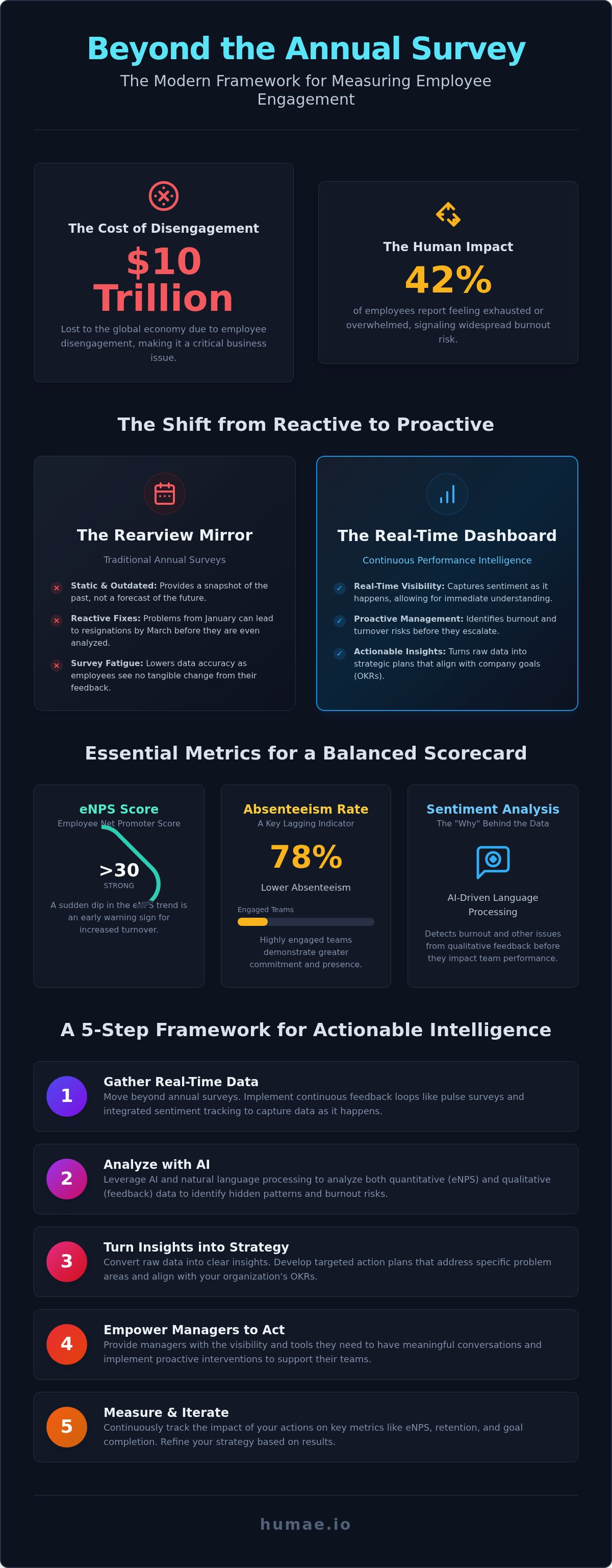
Did you know that disengagement now costs the global economy a staggering $10 trillion? If you're still relying on annual surveys to check your team's pulse, you're likely looking at a rearview mirror while the road ahead shifts. It's a common, frustrating cycle. You offer competitive salaries and flexible perks, yet turnover remains high and remote teams feel increasingly distant. Traditional methods simply can't capture the nuance of the 42% of employees who report feeling exhausted or overwhelmed in current work environments.
We believe you deserve more than just data; you need a real connection with your people. This guide reveals how to measure employee engagement by moving beyond static snapshots and embracing modern, AI-driven frameworks. We'll show you how to gain real-time visibility into team health and use performance intelligence to foster genuine commitment. We're going to explore a clear roadmap that helps you transition from reactive fixes to proactive management, ensuring your talent stays inspired and aligned with your mission.
Discover the Humae difference at humae.io and join our community on Facebook. Back to home.
Key Takeaways
- Shift from outdated annual snapshots to continuous, real-time visibility into your team's emotional and cognitive commitment.
- Identify high-risk turnover patterns by integrating eNPS scores with proactive sentiment tracking across your organization.
- Learn how to measure employee engagement through AI-driven natural language processing that detects burnout before it impacts team performance.
- Implement a 5 step framework to turn raw engagement data into strategic action plans aligned with your organization's OKRs.
- Leverage modern HRMS infrastructure to centralize performance intelligence and create a supportive, high-growth culture.
Discover the Humae difference at humae.io and join our community on Facebook. Back to home.
Why Traditional Methods to Measure Employee Engagement Fail in 2026
Employee engagement isn't just a metric for the HR dashboard; it's the emotional and cognitive commitment an employee has toward their organization. To truly understand What is Employee Engagement?, we must look at how people connect with their work on a daily basis. For decades, companies relied on annual surveys to gauge this connection. By 2026, this approach has become a liability. These surveys provide a static snapshot of the past. They don't offer a forecast of the future.
When leadership asks how to measure employee engagement effectively, they often find a massive "Engagement Gap." This is the distance between high-level company goals and the actual daily experience of the workforce. Bridging this gap requires more than a yearly questionnaire. It demands a continuous workforce management infrastructure that captures sentiment as it happens, turning raw data into actionable performance intelligence.
The Failure of Static Feedback Loops
Waiting months to hear from your team is a recipe for preventable turnover. In a fast-paced market, a problem that arises in January can lead to a resignation by March if it's left unaddressed. Static feedback loops also suffer from survey fatigue. When employees feel their input is just a box-ticking exercise that leads to no visible change, data accuracy plummets. HR teams are left with outdated data, making it impossible to perform proactive interventions. You can't fix a culture problem using information that's six months old.
The Shift Toward Continuous Performance Intelligence
Modern organizations are moving toward real-time dialogue. Continuous feedback isn't about constant surveillance; it's about an open, digital-enabled conversation. This shift aligns perfectly with the rise of modern HRIS systems that prioritize people over processes. By integrating sentiment tracking into daily workflows, companies move from reactive problem-solving to proactive people operations.
Knowing how to measure employee engagement in 2026 means having your finger on the pulse of the organization every single day. This visibility allows managers to support their teams before burnout sets in. It ensures that the human element remains at the center of the digital workplace. By linking engagement to real-time goals and transparent OKRs, you create a culture where everyone knows their value and feels supported in their growth.
Discover the Humae difference at humae.io and join our community on Facebook. Back to home.
Essential Metrics to Measure Employee Engagement Effectively
To understand how to measure employee engagement, you need a balanced scorecard. Hard numbers provide the "what," while qualitative feedback provides the "why." Relying on a single data point is like trying to navigate with half a map. You need a mix of indicators that reflect both the productivity of your team and their emotional connection to the brand. This dual approach ensures you aren't just seeing results, but also the human energy driving them.
Effective measurement relies on consistency. As noted by Forbes on Measuring Employee Engagement, creating a feedback system is critical for organizational survival. Without these metrics, leadership operates in a vacuum, often missing the early warning signs of burnout or cultural drift. By tracking specific data points, you can turn vague feelings into a strategic advantage.
Quantitative Metrics: The Hard Data of Engagement
The Employee Net Promoter Score (eNPS) remains a cornerstone of engagement measurement. You calculate it by asking one simple question: "How likely are you to recommend this company as a place to work?" In 2026, a score above 30 is considered strong, though the most important factor is the trend over time. A sudden dip in eNPS often precedes a spike in turnover.
Absenteeism is another vital lagging indicator. Research shows that highly engaged teams experience 78% lower absenteeism. When people feel valued, they show up. Similarly, you should track the link between engagement and goal completion. Understanding the OKR meaning in a modern context helps you see if employees feel connected to the mission. When goals are transparent and achievable, engagement naturally rises. You can monitor these trends easily through centralized analytics dashboards.
Qualitative Insights: Understanding the Why
Numbers tell you that a problem exists, but words tell you how to fix it. Pulse survey participation rates are a metric in themselves. If participation drops below 70%, it's a sign of survey fatigue or a lack of trust in the process. Open-ended feedback allows employees to voice specific concerns that multiple-choice questions might miss.
Stay interviews are another powerful tool. Instead of waiting for an exit interview to learn why someone is leaving, ask your top performers what keeps them motivated today. This proactive dialogue builds trust and provides raw, honest insights. Finally, look at peer recognition patterns. When teams frequently celebrate each other's wins, it indicates high levels of cohesion and psychological safety. These qualitative layers transform how to measure employee engagement from a clinical exercise into a deeply human one.
Discover the Humae difference at humae.io and join our community on Facebook. Back to home.
Using AI Sentiment Analysis to Measure Employee Engagement in Real Time
Traditional surveys often miss the subtle nuances of human emotion. While we have already explored Essential Employee Engagement Metrics like eNPS and turnover rates, AI takes this a step further. It analyzes the raw, unfiltered thoughts behind the numbers. Instead of forcing your team into rigid multiple-choice boxes, modern platforms allow people to speak in their own words. This shift from binary data to rich, contextual insights is changing how to measure employee engagement for the better.
Trust is the foundation of this process. For AI to be effective, employees must feel safe sharing their honest opinions. This means maintaining absolute anonymity while using advanced analytics to improve the workplace. When people see that their feedback leads to actual cultural improvements, participation becomes a natural part of their day. It transforms engagement from a metric into a shared organizational value.
How AI-Powered Sentiment Analysis Works
Sentiment analysis is the automated process of understanding emotional tone in text. Machine learning models process natural language to identify emotional trends across various teams. This technology goes far beyond simple keyword matching. It understands the context of employee concerns. If a team mentions "deadlines," the AI can distinguish between a healthy challenge and a source of deep-seated anxiety. Moving beyond keywords allows leadership to see the real story behind the feedback, providing a deeper understanding of workforce commitment.
Predictive Analytics: Spotting Turnover Before It Happens
The true value of AI lies in its ability to act as an early warning system. By using data triggers, these systems alert HR to significant sentiment shifts in real time. If a specific department shows signs of rising frustration or "exhaustion," predictive models help leaders allocate resources where they are needed most. This isn't about surveillance; it's about proactive care.
Identifying burnout and disengagement before they result in a resignation saves more than just money. It preserves team morale and protects your most valuable asset: your people. Balancing these data-driven insights with human-centric management ensures that your organization remains resilient. You can see how these insights integrate into a broader strategy by exploring real-time performance intelligence features. This proactive approach turns how to measure employee engagement into a tool for long-term retention.
Discover the Humae difference at humae.io and join our community on Facebook. Back to home.
A 5 Step Framework: How to Measure Employee Engagement and Act on Data
Data is only as valuable as the actions it inspires. Many leaders understand the theory of sentiment analysis but struggle with the practical execution. To bridge this gap, you need a structured approach that moves from initial goal-setting to tangible cultural change. This framework provides a repeatable process for anyone wondering how to measure employee engagement while maintaining a human-centric focus. It turns abstract feelings into a concrete strategy for growth.
- Step 1: Define Your Objectives. Start by aligning your engagement metrics with specific organizational goals. Are you trying to reduce turnover in remote teams or improve cross-departmental collaboration? Clear goals prevent data overwhelm.
- Step 2: Centralize Your Infrastructure. Move away from fragmented spreadsheets. Implement a robust HR platform that serves as a single source of truth for all workforce data.
- Step 3: Launch Feedback Loops. Use AI-driven pulse surveys to gather frequent, bite-sized insights. This ensures you are capturing real-time sentiment rather than annual snapshots.
- Step 4: Analyze Real-Time Trends. Use analytics dashboards to spot patterns. Look for correlations between engagement levels and productivity milestones to see the full picture.
- Step 5: Execute Action Plans. Transparency is key. Share the findings with your team and co-create solutions to address their specific concerns.
Centralizing Data with Modern Infrastructure
Fragmentation is the enemy of clarity. When your data lives in separate silos, you lose the ability to see the social fabric of your company. A centralized employee directory is essential for mapping team connections and understanding how information flows. By integrating measurement into your daily workflows, you reduce tool fatigue. It ensures that data collection feels natural rather than intrusive. This consistency across the entire employee lifecycle allows you to track commitment from onboarding through to long-term leadership development.
Turning Insights into Actionable Strategies
Data transparency builds trust. When employees see that their feedback leads to specific changes, they are more likely to stay committed. Sharing high-level insights with the entire organization demonstrates that you truly value their voice. You can implement proven employee engagement strategies to close the feedback loop effectively. Managers play a pivotal role here; they are the ones who execute these plans on the ground. Empowering them with real-time data ensures that how to measure employee engagement becomes a collaborative effort rather than a top-down mandate.
Ready to automate your engagement framework? Start building your modern workforce infrastructure with Humae today.
Discover the Humae difference at humae.io and join our community on Facebook. Back to home.
Leveraging Humae to Measure Employee Engagement and Performance Intelligence
Stop guessing about the health of your team. Humae provides the AI-powered infrastructure needed to automate and refine how to measure employee engagement by combining behavioral data with emotional sentiment. While traditional tools focus on manual survey distribution, we offer a centralized system that captures insights as they happen. By integrating real-time OKR tracking with sentiment analysis, we provide a holistic view of organizational commitment. This approach simplifies workforce management by turning fragmented HR tasks into a unified, intelligent ecosystem.
We believe that technology should serve the human connection. Humae is designed to bridge the gap between leadership vision and the daily reality of the workforce. By using our platform, you move away from reactive problem-solving and toward a proactive, data-driven culture. This ensures that your talent feels heard, valued, and aligned with your core objectives from day one.
The Power of Performance Intelligence Dashboards
Humae turns complex engagement data into actionable manager insights. Our performance intelligence dashboards allow you to track the ROI of your culture through clear productivity analytics. Instead of digging through disconnected spreadsheets, you can see exactly how engagement levels impact goal completion in real time. We simplify time-off and performance management by housing them in one intuitive interface. This centralization allows leaders to focus on their people instead of the paperwork. Managers can quickly identify which departments need extra support, ensuring that resources are allocated where they will have the most impact on retention and morale.
Building a Culture of Transparency and Growth
Transparency is the foundation of long-term growth. Humae helps you align individual career development with the broader company vision. Our automated onboarding processes and continuous feedback loops foster engagement from the very first interaction. This ensures that every new hire feels connected to the mission immediately, reducing the risk of early turnover. Humae empowers leaders to build high-performing teams through data that honors the human experience. By building a data-driven culture today, you secure the commitment of your workforce for years to come. You can explore our full range of performance intelligence features to see how we transform people operations.
Discover the Humae difference at humae.io and join our community on Facebook. Back to home.
Build a Resilient Culture with Real-Time Performance Intelligence
The future of work isn't just about physical presence; it's about deep, emotional connection. We've moved beyond the era of static annual surveys that only tell you what went wrong months ago. Mastering how to measure employee engagement in 2026 requires a blend of real-time performance intelligence and empathetic AI. By leveraging sentiment analysis and transparent OKR tracking, you can spot burnout before it leads to turnover and align your team's daily efforts with your company's visionary goals.
Building a high-performing culture isn't a one-time project; it's a continuous journey supported by the right global workforce management infrastructure. It's time to stop guessing and start listening to the heartbeat of your organization through data. You have the tools to turn raw sentiment into a strategic roadmap for growth. We're here to help you bridge the gap between company objectives and employee daily experiences.
Optimize your team’s growth with Humae’s AI-powered platform and start building a more transparent, committed workforce today.
Discover the Humae difference at humae.io and join our community on Facebook. Back to home.
Frequently Asked Questions
What is the most accurate way to measure employee engagement in 2026?
The most accurate method involves a continuous approach using performance intelligence. Instead of relying on annual snapshots, organizations now use real-time data to track workforce commitment. This involves monitoring pulse surveys, eNPS, and goal alignment simultaneously. By using a centralized platform, you can see how daily interactions correlate with long-term retention. This holistic view ensures you understand the emotional and cognitive state of your team as it evolves.
How does AI-powered sentiment analysis improve engagement measurement?
AI-powered sentiment analysis processes open-ended feedback to identify emotional trends that numbers alone might miss. It goes beyond simple keyword matching to understand the context of employee concerns. This technology helps leadership detect early signs of burnout or disengagement before they result in a resignation. By automating the analysis of thousands of comments, it provides a deep, real-time understanding of workforce sentiment without the need for manual effort.
What is the difference between employee satisfaction and employee engagement?
Employee satisfaction measures how happy or comfortable an employee feels with their current role and benefits. Engagement is much deeper. It reflects the emotional and cognitive commitment an employee has toward the organization's goals. While a satisfied employee might show up and do the bare minimum, an engaged employee is actively invested in the company's success. Understanding this distinction is key when learning how to measure employee engagement effectively.
How often should I measure employee engagement to avoid survey fatigue?
You should measure engagement continuously through short, frequent pulse surveys rather than long annual questionnaires. Weekly or bi-weekly check-ins provide a real-time dialogue without causing survey fatigue. AI-driven platforms integrate these touchpoints into daily workflows, making feedback feel like a natural part of the job. This consistent flow of data allows for proactive management and ensures that small issues don't escalate into major cultural problems.
Can OKR tracking really help measure employee engagement?
OKR tracking is a powerful proxy for engagement because it measures goal alignment and transparency. When employees clearly understand their objectives and see how their work contributes to the company's vision, their commitment naturally increases. Real-time OKR tracking provides a data-driven way to see if teams are motivated and moving in the right direction. It connects individual performance directly to organizational health, making it an essential part of people operations.
How do you measure engagement in remote or hybrid teams?
Measuring engagement in remote or hybrid teams requires a robust digital infrastructure. Centralized analytics dashboards and AI sentiment analysis help bridge the physical gap by capturing the emotional tone of digital communications. Tracking participation in pulse surveys and monitoring goal progress through OKR tracking tools provides visibility into team health. This ensures that remote workers feel just as heard and valued as their in-office colleagues.
What are the top drivers of employee retention this year?
The primary drivers of retention in 2026 include learning opportunities, wellbeing support, and flexible hybrid work models. Research indicates that 82% of employees prioritize growth, while wellbeing support significantly increases engagement levels. Managers account for 70% of the variance in team commitment, making their role critical. Proactive management and real-time visibility into team sentiment allow organizations to address these drivers before talent starts looking for new opportunities elsewhere.
Is it possible for small startups to use AI to measure engagement?
AI-powered engagement tools are now accessible to organizations of all sizes, including small startups. Cloud-based SaaS platforms provide the same advanced performance intelligence and sentiment analysis once reserved for large enterprises. Startups can use these tools to build a strong culture from day one without needing a massive HR department. It's a scalable way to ensure that your early hires stay aligned and engaged as the company grows.
Discover the Humae difference at humae.io and join our community on Facebook. Back to home.