What Is Turnover? A Comprehensive Guide to Business and Employee Attrition in 2026
By Humae · 19 March 2026
turnover
If you lose a high-performing manager in 2026, it'll cost your company up to 213% of their annual salary to find, hire, and train a replacement. This staggering financial hit is why mastering turnover is no longer just a task for the accounting department. You likely feel the pressure of keeping your team intact while trying to decipher if your board is asking about annual revenue or employee attrition. It's a common point of friction that slows down even the most agile businesses.
You're here because you want to bridge that gap and build a more resilient organization. This guide clarifies the confusing terminology between UK and US markets so your data stays accurate. We'll provide the exact formulas to calculate your rates and show you how modern tools turn raw data into a better experience for every person on your payroll.
Key Takeaways
- Master the dual definitions of turnover to accurately navigate global financial metrics and employee attrition trends.
- Distinguish between voluntary and functional separations to ensure your workforce strategy prioritizes high-impact talent.
- Apply the standard retention formula to benchmark your company’s health against 2026 industry standards.
- Shift from reactive exit interviews to proactive "stay interviews" and transparent OKR tracking for deeper team alignment.
- Discover how AI-driven Performance Intelligence identifies at-risk employees early to prevent talent loss before it happens.
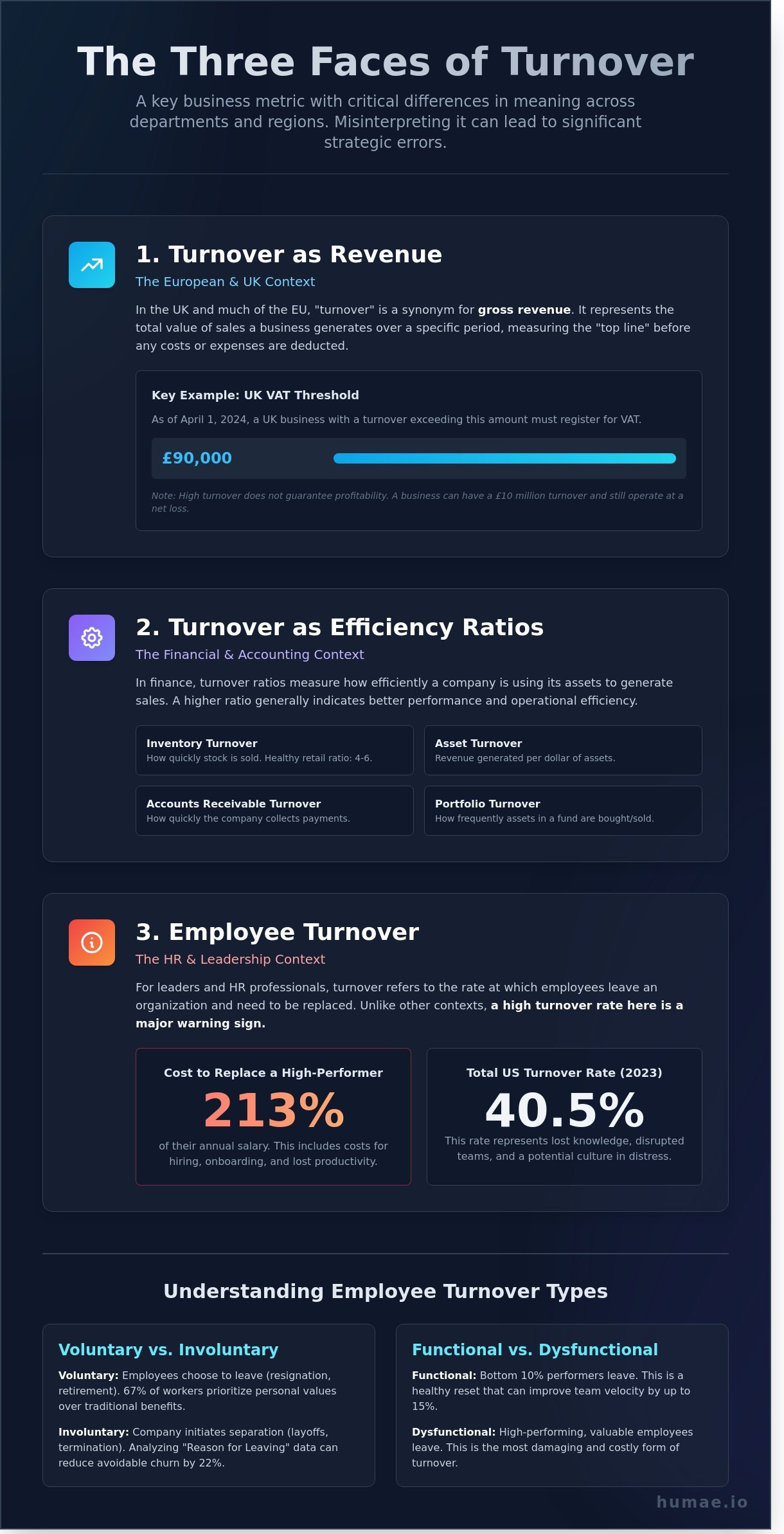
The Three Faces of Turnover: Disambiguating the Term
Turnover represents the pulse of a business. At its simplest, it measures the velocity at which an organization cycles through its resources. Whether it is products moving off shelves or employees walking through the front door, this metric tells a story of movement and replacement. Understanding the nuance behind the term is vital because its meaning shifts dramatically depending on which side of the Atlantic you stand or which department is running the report. In high-growth environments, misinterpreting this single word can lead to significant strategic errors.
Turnover as Revenue (The European Context)
In the United Kingdom and much of the European Union, turnover is a synonym for gross revenue. It tracks the total value of sales generated by a business over a specific period, usually a fiscal year. For a small business in London, crossing the £90,000 turnover threshold as of April 1, 2024, triggers mandatory VAT registration. This figure represents the "top line" before any expenses, taxes, or turnover costs are deducted. It is a raw measure of market demand and sales execution. Business leaders use this to benchmark against competitors, but it doesn't reveal the health of the bottom line. You can have a record-breaking £10 million turnover while still operating at a net loss if your margins are thin or your overhead is bloated.
Accounting & Financial Ratios
Financial analysts use the term to measure operational efficiency through specific ratios. These numbers reveal how hard a company's assets are working. In the retail sector, for instance, a healthy inventory turnover ratio typically falls between 4 and 6. This means the company sells and replaces its entire stock every two to three months. If that number drops to 2.0, it suggests capital is trapped in stagnant products. Other critical ratios include:
- Portfolio Turnover: This tracks how frequently assets within an investment fund are bought and sold. A 100% rate means the entire portfolio was replaced within a year.
- Asset Turnover: This measures how many dollars in revenue a company generates for every dollar it owns in assets. A ratio of 2.5 indicates high efficiency in utilizing physical tools and property.
- Accounts Receivable Turnover: This shows how quickly a business collects payments from customers. A higher number reflects a disciplined credit policy and strong cash flow.
Employee Turnover: The Human Element
For HR professionals and modern leaders, the term takes on a more personal and often more expensive meaning. Here, we focus on workforce stability. It is the rate at which people leave an organization and require replacement. According to the U.S. Bureau of Labor Statistics, the total turnover rate in the United States reached 40.5% in 2023 across all industries. This isn't just a spreadsheet entry; it represents lost institutional knowledge, disrupted team dynamics, and high recruitment costs. When a skilled developer or a compassionate nurse leaves, the "replacement" isn't just a transaction. It's a gap in the company culture that takes months to bridge. In this context, we aren't looking for high velocity. We're looking for retention, engagement, and the kind of stability that allows innovation to thrive. High numbers here aren't a sign of a fast-moving business; they're often a warning light for a culture in distress.
Understanding Employee Turnover: Types and Causes
High turnover costs U.S. businesses nearly 1 trillion dollars annually according to 2024 Gallup data. By 2026, the definition of a stable workforce has shifted significantly. AI automation now handles roughly 40 percent of routine administrative tasks; this change forces a pivot in what skills companies need to retain. It isn't just about people leaving. It's about who stays and how their roles evolve to meet technical demands.
Distinguishing between healthy and toxic exits is vital. Functional turnover occurs when bottom 10 percent performers leave the organization. This isn't a loss; it's a strategic opportunity. It allows for a fresh talent infusion that can improve team velocity by 15 percent in high-growth tech environments. When low performers exit, it clears the path for innovators who align with modern, automated workflows. It's a necessary reset for any brand aiming for 2026 market leadership.
Voluntary vs. Involuntary Attrition
Voluntary attrition reached a peak during the "Great Reshuffle," where 67 percent of workers prioritized personal values over traditional benefits. This includes resignations and retirements driven by a desire for better alignment. Involuntary attrition covers layoffs and performance-based terminations. Smart HR leaders now track the "Reason for Leaving" as their most critical data point. Analyzing this feedback helps companies reduce avoidable churn by 22 percent by fixing specific cultural friction points. Understanding why someone chose to walk away is the only way to build a better hiring and retention strategy for the future.
The Psychology of the Exit
Intrinsic motivation is the engine of retention. When employees feel like replaceable cogs, they disengage. By 2026, 80 percent of Gen Z workers report that they prioritize a "Growth Mindset" in company culture over a 5 percent salary increase. If a workplace feels stagnant, top talent will leave within 18 months. Modern retention also relies on work-life integration. This goes beyond simple balance; it's about how work fits into a digital-first lifestyle. When the boundary between professional output and personal well-being is ignored, burnout rates spike by 35 percent, leading to immediate resignations.
Management quality remains the primary trigger for turnover in mid-to-large enterprises. Statistics from 2024 show that 57 percent of employees who quit do so because of their direct supervisor. Poor leadership often manifests as misaligned OKRs (Objectives and Key Results). If goals are vague or unachievable, high performers lose confidence in the vision. Clear, data-driven objectives provide the roadmap talent needs to feel successful. Without this clarity, even the most skilled individuals will seek a more organized environment.
Remote work has also rewritten the rules of loyalty. In a 2025 survey, 45 percent of tech professionals stated they would leave a role if forced back to a physical office five days a week. Flexibility is no longer a perk; it's a baseline requirement for high-level recruitment. Companies that fail to adapt their management styles to asynchronous, results-oriented work see a 2x increase in resignation rates compared to their flexible competitors. Retention in the current era requires a blend of technological empathy and radical transparency.
Calculating and Analyzing Your Turnover Rate
Data drives smart decisions. To fix a retention problem, you must measure it with precision first. The standard formula is straightforward: (Number of Separations / Average Number of Employees) x 100. If your 200-person firm lost 10 people last quarter, your quarterly turnover rate is 5%. While the math is simple, the insights derived from it are what separate stagnant companies from high-growth organizations.
The Step-by-Step Calculation Guide
Accuracy depends on how you define the "Average Number of Employees." Calculate this by adding your headcount at the start of the period to the headcount at the end; then divide by two. While monthly snapshots help you identify seasonal spikes or immediate reactions to management changes, annual reports provide the high-level perspective stakeholders need for long-term strategic planning. Churn rate is the inverse of your retention success.
Benchmarking helps you understand if your numbers represent a red flag or a standard industry fluctuation. According to 2023 LinkedIn data, the tech sector averages a 12.9% rate, while retail often exceeds 60%. If your organization sits at 15% in a high-intensity field, you might actually be outperforming your competitors. Context is everything when presenting these figures to leadership.
The Real Cost of Losing an Employee
Losing a team member costs significantly more than a simple recruitment fee. Research from SHRM suggests that replacing a mid-level professional earning $50,000 often costs the company $150,000 or more. This 3x multiplier isn't an exaggeration; it accounts for the total disruption of your workflow and the massive resource drain required to return to baseline productivity.
Direct costs are easy to track on a balance sheet:
- $4,700 average cost-per-hire for recruitment, background checks, and administrative processing.
- Advertising spend on job boards, including specialized platforms like Alpha.jobs, and premium LinkedIn slots.
- Onboarding hours spent by HR and department heads instead of on revenue-generating tasks.
Indirect costs hit your bottom line much harder. You lose institutional knowledge that often takes 12 to 24 months to rebuild. When a key player leaves, team morale drops as remaining staff take on an extra 20% workload to cover the gap. This leads to "Cultural Debt," a state where high-performance teams lose their creative rhythm and start doubting the company's long-term stability. Frequent turnover creates a revolving door perception that can damage your employer brand for years.
Modern HR teams now use analytics dashboards to move beyond static spreadsheets. Visualizing these trends over a 12-month period allows you to spot "danger zones" in specific departments or demographic groups before they become systemic issues. By tracking these metrics in real-time, you transform from a reactive problem-solver into a proactive talent strategist who understands the pulse of the workforce.
Strategies to Reduce Turnover and Build Retention
Stop waiting for the exit interview. By the time an employee sits across from you explaining why they're moving on, the battle is already lost. High turnover costs aren't an inevitable tax on doing business; they're often the result of institutional silence. Smart leaders are switching to "Stay Interviews" conducted every six months. These conversations identify friction points before they turn into resignations. You don't need a complex script. Ask what keeps them at the company and what one thing might tempt them to leave. This proactive feedback loop catches issues that a yearly survey misses.
Transparency is your strongest retention tool. When 85% of employees feel disconnected from company goals, they start looking for the exit. Implementing a transparent OKR (Objectives and Key Results) system fixes this. It aligns individual tasks with the 2024 company vision, making work meaningful. When people see how their daily output moves the needle, they're less likely to disengage. Combine this with a modern workforce management infrastructure. A 2023 industry report found that 54% of workers prioritize flexibility over a slight pay increase. If your tech stack doesn't support seamless remote collaboration or flexible scheduling, you're building a revolving door.
- Stay Interviews: Conduct these bi-annually to uncover hidden frustrations.
- Transparent OKRs: Connect individual performance to high-level company success.
- Modern Infrastructure: Use tools that support asynchronous work and digital-first flexibility.
- Continuous Feedback: Weekly 1:1s prevent the slow drift toward "Quiet Quitting."
Quiet quitting happens in a vacuum. It's the byproduct of a feedback-starved culture where employees feel their extra effort goes unnoticed. Regular, bite-sized feedback sessions replace the dreaded annual review. This keeps energy high and ensures that small misunderstandings don't fester into a reason to quit.
Ready to transform your company culture and keep your best talent? Discover how Humae streamlines employee engagement
Performance Management as a Retention Tool
Frustration grows when progress is invisible. Use performance intelligence to map out clear career trajectories. When a developer knows exactly what skills lead to a Senior role by Q3 2025, they stay focused. This clarity builds long-term loyalty. Fostering psychological safety is equally vital. When team members feel safe to take risks without fear of retribution, involuntary turnover drops because performance improves naturally through honest communication.
Onboarding: The First Line of Defense
The first 90 days determine a three-year retention outcome. Research shows 69% of employees are more likely to stay for three years if they experience great onboarding. In a digital-first world, this means more than just sending a laptop. You must integrate new hires into the culture immediately. Use a centralized Employee Directory to foster social bonds from day one. It turns a "new hire" into a valued community member before their first month ends, creating a sense of belonging that's hard to walk away from.
Leveraging AI to Predict and Prevent Turnover
The era of reactive HR is over. Traditional departments often wait for the exit interview to understand why talent leaves, but by then, the damage is done. We're seeing a massive shift toward Performance Intelligence. This approach uses AI to analyze data patterns and identify at-risk employees before they even update their resumes. Research from 2023 indicates that companies utilizing predictive people analytics see a 25% decrease in voluntary turnover compared to those relying on annual reviews alone. It's about moving from "why did they leave?" to "how can we help them stay?"
Centralizing HRMS data is the first step in this transformation. When you house performance metrics, attendance, and feedback in a single ecosystem, you spot the warning signs. A sudden 20% drop in OKR completion or a pattern of fragmented time off often signals disengagement. AI doesn't just store this information; it interprets it. It transforms raw data points into a roadmap for leadership, allowing managers to step in with support exactly when it's needed most. You're no longer guessing about morale; you're measuring it.
AI-Powered Sentiment Analysis
Annual engagement surveys are relics of the past. They provide a snapshot of a single day, which is often biased by a recent deadline or a good lunch. AI-powered sentiment analysis offers a continuous feedback loop. It scans internal communication patterns and open-ended feedback to detect early signs of burnout or frustration. If team sentiment scores dip by 12% within a single month, leaders know immediately. This real-time visibility beats the yearly survey every time. It turns abstract feelings into actionable leadership interventions, helping managers address cultural friction before it leads to a resignation.
The Humae Advantage
Humae acts as the visionary partner for organizations that refuse to accept high churn as a cost of doing business. The platform integrates OKRs, Time Off, and Performance into one intuitive interface. This eliminates the data silos that usually hide employee dissatisfaction. Humae’s Analytics Dashboards provide the "Pulse" of your company, offering a transparent view of organizational health. You don't need to be a data scientist to understand the insights; the platform translates complex behaviors into clear, human-centric strategies for growth.
Modern growth requires a tech-driven approach that never loses sight of the individual. By leveraging these tools, you create a culture where employees feel seen and supported. Optimize your team’s growth and reduce turnover with Humae to stay ahead of the curve and build a resilient, high-performing workforce.
Turn Your Retention Data Into a Competitive Edge
High employee attrition costs modern businesses up to 213% of a lost staffer's annual salary based on 2026 economic forecasts. You don't have to let these numbers dictate your growth. Success in the current market relies on moving past reactive HR and adopting a proactive, tech-driven approach. We've explored how identifying early warning signs and aligning personal goals with company vision creates a resilient workforce. Data from 2025 shows that companies using integrated HR systems see a 40% increase in engagement levels. It's time to stop guessing and start leading with precision.
Humae provides the tools you need to build this future. Our platform features AI-powered sentiment analysis for proactive retention and real-time OKR tracking to keep every team member motivated. With a centralized HRMS, you'll eliminate friction and create a world-class employee experience that scales. Don't let your best talent walk out the door when the solution is within reach.
Streamline your workforce and reduce turnover with Humae
Your team's potential is limitless when you have the right partner to support their journey.
Frequently Asked Questions
What is the difference between turnover and attrition?
Turnover happens when you replace a departing employee; attrition occurs when you leave the position vacant to reduce headcount. In a 2023 study by LinkedIn, voluntary exits accounted for 67% of total departures in high-growth sectors. Turnover implies a cycle of hiring and onboarding, while attrition focuses on natural reduction through retirement or resignation without backfilling the role.
How do you calculate employee turnover rate step-by-step?
You calculate the rate by dividing the number of departures by your average employee count over a specific period. If you lose 10 people in a team of 100 over 12 months, your turnover rate is exactly 10%. First, add your starting and ending headcount, then divide by two to find the average. Finally, divide your total exits by this average and multiply by 100 to get the percentage.
Is a 10% turnover rate good for a startup in 2026?
A 10% rate is exceptional for a startup in 2026 because the tech industry benchmark remains closer to 18%. Low rates suggest your culture is strong and your hiring process is hitting the mark. While some movement is healthy for fresh ideas, keeping this figure below 12% ensures you don't lose vital institutional knowledge or waste your 2026 recruitment budget on constant backfilling.
What are the main causes of high employee turnover?
Poor management and stagnant career paths are the primary drivers of talent loss. A 2023 Gallup study found that 75% of workers quit because of their direct supervisor rather than the job itself. When you don't provide clear promotion paths or modern tools, your best talent will look elsewhere. High turnover often signals a disconnect between leadership promises and the daily employee experience.
How can HR software help in reducing staff turnover?
HR software boosts retention by automating pulse surveys and tracking engagement metrics in real time. Companies using data-driven platforms see a 31% increase in retention rates compared to those using manual spreadsheets. These tools help you spot burnout before it leads to a resignation. By streamlining the boring admin, you give your team more time to focus on genuine human connection.
What is the "Total Rewards" approach to retention?
The Total Rewards approach uses five pillars: compensation, benefits, work-life effectiveness, recognition, and talent development. It goes beyond the monthly paycheck to satisfy deeper employee needs. According to the WorldatWork 2024 framework, holistic rewards packages can lower exit intent by 25%. It's about creating an environment where people feel valued for their whole contribution, not just their output.
Can AI really predict when an employee is going to quit?
AI models now predict resignations with 95% accuracy by identifying subtle changes in communication and performance data. IBM famously patented a system that spots flight risks months before an employee submits their notice. These algorithms don't replace human intuition; they act as an early warning system. They allow managers to intervene with a stay interview or a new challenge before the relationship hits a breaking point.
What does turnover mean in a financial statement for a UK company?
In UK accounting, turnover represents the total income or net sales generated by a business over a specific period. The Companies Act 2006 defines it as the amount derived from the provision of goods and services after deducting trade discounts and VAT. Don't confuse this with HR metrics. While a high staff exit rate is usually bad, a high financial turnover is the primary goal for every growing UK business.