Using Data to Build a Better Company Culture: The 2026 Guide
By Humae · 26 June 2026
using data to build a better company culture
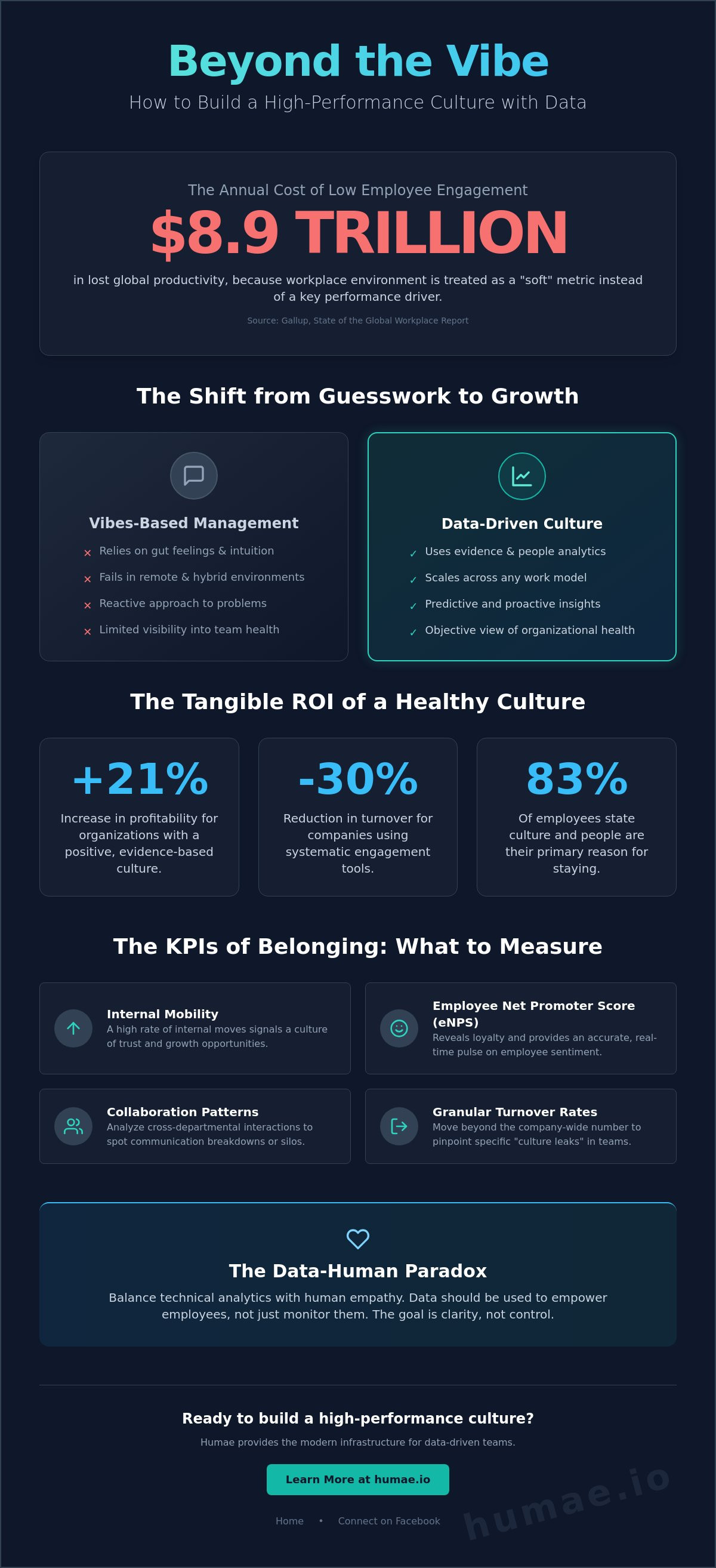
Gallup's latest research highlights a staggering $8.9 trillion lost in global productivity due to low employee engagement. It's a wake up call for leaders who still treat workplace environment as a "soft" metric. Moving from gut feelings to actionable insights isn't just a trend; it's the foundation of modern leadership. By using data to build a better company culture, you can stop guessing why your best talent is leaving and start creating an environment where they actually want to stay.
We know the frustration of low survey participation and the skepticism that often meets new HR initiatives. It's difficult to advocate for cultural shifts when the ROI feels invisible to the executive suite. This guide changes that narrative. You'll learn how to transform abstract values into measurable growth using modern people analytics and AI driven insights. We're providing a clear roadmap for 2026 to help you align team goals with your mission, ensuring your transformation is backed by evidence and leads to significantly improved employee retention.
This article is brought to you by Humae. Visit our official website at humae.io to discover how our analytics and performance tools can transform your workplace. Connect with us on Facebook for more insights on the future of HR. Navigate back to the Home Page.
Key Takeaways
- Learn to move beyond "vibes-based" management by creating an evidence-informed ecosystem that supports hybrid and remote teams.
- Identify the specific KPIs, such as internal mobility and eNPS, that translate the feeling of belonging into decision-ready data.
- Follow our actionable 5-step roadmap for using data to build a better company culture and drive measurable organizational growth.
- Balance technical analytics with human empathy to ensure your data-informed approach empowers employees rather than just monitoring them.
- Discover how centralized analytics dashboards and transparent directory tools provide the foundation for a high-performance culture.
Beyond Gut Feelings: Defining Data-Driven Culture in 2026
Traditional management once relied on the "vibe" of the office. In 2026, that vibe is a liability. Leading organizations are now using data to build a better company culture by treating their internal environment as a high-value asset rather than a vague atmosphere. We define a data-driven culture as a living ecosystem where evidence informs every people-centric decision. It's a shift from guessing how people feel to knowing how they engage. This approach replaces subjective intuition with objective visibility, ensuring that empathy is applied where it's actually needed.
Vibes-based management fails because it doesn't scale in remote or hybrid environments. When your team is distributed across time zones, you can't rely on watercooler chats to gauge morale. We've moved beyond descriptive analytics that simply tell us what happened last month. Modern leadership demands predictive intelligence. This means identifying patterns in collaboration and sentiment to understand what will happen next. Organizations that prioritize this positive, evidence-based culture benefit from a 21% increase in profitability, according to industry benchmarks.
The Evolution of People Operations
The 20th-century HR model was built on compliance and risk mitigation. Today, we've transitioned to a performance intelligence model. This new standard relies on modern HRIS systems to serve as the foundation for all organizational insights. AI now plays a vital role by processing vast amounts of unstructured cultural data, such as feedback loops and communication rhythms. It helps leaders see the invisible threads that connect team performance to individual well-being, turning complex information into simple, actionable steps.
Why Culture Analytics Matter for Retention
Cultural health is directly linked to your bottom line. Gallup's 2025 "State of the Global Workplace" report found that low engagement costs the global economy $8.9 trillion in lost productivity. Using data to build a better company culture allows you to identify "flight risks" long before an employee decides to leave. Research from SHRM shows that companies using systematic engagement tools can see up to a 30% reduction in turnover. When you align team goals with the company mission through transparent data, you don't just keep your talent; you empower them to do their best work.
The KPIs of Belonging: Which Metrics Actually Measure Culture?
If you wait for the annual survey to find out your team is unhappy, you're already too late. Most traditional methods are reactive; they tell you what went wrong months after the damage is done. Using data to build a better company culture requires a shift toward real-time, multi-dimensional indicators. We don't just look at who is leaving. We look at who is growing, how they communicate, and whether they feel a sense of shared purpose. Data isn't just numbers. It's the collective voice of your team, quantified for clarity.
To move beyond surface-level insights, focus on these core cultural metrics:
- Internal Mobility: A high rate of internal moves suggests a culture of trust and growth. If employees don't see a path up, they'll find a path out.
- Employee Net Promoter Score (eNPS): This simple metric reveals loyalty. Tracking this quarterly provides a far more accurate pulse than a yearly deep dive.
- Passive Collaboration Patterns: Analyze how teams interact across departments. Siloed communication often signals a breakdown in cultural transparency.
- Turnover Rates: While a lagging indicator, granular turnover data helps pinpoint specific "culture leaks" in certain departments or leadership tiers.
Research shows that 83% of employees stay at a company primarily for its culture and people. Measuring that "stay factor" involves more than just asking questions. It involves observing the digital footprint of your organization. When you integrate these metrics into a centralized Analytics Dashboard, you gain the visibility needed to lead with confidence.
Real-Time Sentiment Analysis
Modern AI tools now turn qualitative feedback into quantitative scores. Instead of reading hundreds of open-ended survey responses, sentiment analysis identifies the "mood" of a team instantly. This allows leaders to catch burnout patterns before they lead to a resignation letter. If the collective sentiment in a specific squad drops suddenly, you can intervene with support rather than wait for the exit interview. Pulse surveys facilitate this by keeping the feedback loop short and actionable.
Transparency Through OKR Tracking
Visibility is the bedrock of trust. When goals are transparent, everyone understands how their daily tasks fuel the company's mission. Goal completion rates serve as a cultural metric of alignment. If a team consistently misses marks, it might not be a performance issue; it might be a lack of clarity or resources. For those looking to implement this framework, our definitive guide to OKR meaning explains how to set objectives that actually inspire. Link these results to your cultural data to see the full picture of organizational health.
The Data-Human Paradox: Why Metrics Require Empathy to Work
Data without empathy is just surveillance. When organizations focus exclusively on hard numbers, they risk creating a culture of fear rather than growth. Using data to build a better company culture isn't about monitoring every movement. It's about gaining the visibility needed to be more human, not less. We call this the Data-Human Paradox. The more sophisticated our analytics become, the more we must prioritize the emotional context behind the dashboard. Metrics should empower your team, not diminish them.
The distinction lies in being data-informed rather than just data-driven. A data-driven culture can be rigid. It follows metrics blindly, often ignoring the nuances of human behavior. In contrast, a data-informed culture uses evidence as a compass. It tells you where to look, but it never replaces a leader's intuition. Data provides the "what," but only a conversation can reveal the "why." If engagement scores dip, the data isn't a final verdict. It's an invitation to listen.
Building Trust Through Data Ethics
Transparency is the only way to overcome the "Big Brother" stigma. As of 2026, with 20 US states implementing comprehensive privacy laws like the CCPA and the SECURE Data Act, data ethics are no longer optional. Establish clear rules for anonymity and data usage. When you collect feedback, explain exactly how it benefits the individual. Psychological safety is the fuel for honest data. If employees don't feel safe, they won't be truthful, and your analytics will lose their value.
The Manager as a Data Interpreter
Dashboards are tools for coaching, not weapons for discipline. We believe leaders should use these insights to spark meaningful 1:1 sessions. Instead of citing a drop in productivity as a failure, a manager can use it as an entry point to discuss workload or personal challenges. This involves knowing how to give constructive criticism that inspires growth. By combining hard metrics with a supportive attitude, managers transform raw numbers into a roadmap for professional development. The human touch is the final, most critical step in any data-led intervention.
The 5-Step Roadmap to Implementing Cultural Analytics
Transforming a workplace environment requires more than good intentions. It demands a structured approach that treats cultural health with the same rigor as financial performance. Using data to build a better company culture is a journey from ambiguity to clarity. By following a proven roadmap, you can move away from reactive fixes and toward a sustainable, high-performance ecosystem. This isn't just about collecting stats; it's about creating a system where insights lead directly to impact.
- Step 1: Identify the "Burning Platform": Start by defining the core business question. Are you battling high turnover in specific departments? Is engagement dropping among remote teams? Pinpointing the problem ensures your data collection has a clear purpose.
- Step 2: Audit Your Infrastructure: Evaluate whether your current tools can actually support modern employee engagement strategies. Many organizations struggle because their cultural insights are trapped in "dark data" silos.
- Step 3: Deploy AI-Powered Tracking: Implement systems that provide continuous sentiment analysis and OKR progress. This bridges the gap between high-level culture and day-to-day execution.
- Step 4: Analyze Root Causes: Look for the friction points. If data shows a drop in collaboration, investigate the cause. Is it a lack of transparency or an outdated meeting structure?
- Step 5: Execute and Measure: Take targeted action based on your findings. Whether it's a new recognition program or a shift in communication, measure the results immediately to see what works.
Auditing Your Data Infrastructure
Your cultural strategy is only as good as the data feeding it. Check for integration between your performance intelligence tools and your core employee directory. If these systems don't talk to each other, you'll miss the patterns that drive retention. Identifying these gaps early prevents the frustration of "blind spot" management. You need a centralized hub where every metric, from time-off patterns to goal completion, is visible and actionable. To see how a unified platform can streamline this process, explore our Analytics Dashboards.
From Analysis to Action
Data loses its value if it doesn't result in visible change. Create a feedback loop where employees can see the direct results of the feedback they provide. This builds the trust necessary for future data collection. Prioritize high-impact, low-effort wins to build momentum within the team. Finally, set a consistent cadence for reviewing cultural health dashboards with your executive team. When culture is a recurring agenda item at the board level, it stops being a "soft" metric and starts being a competitive advantage.
Humae: The Infrastructure for a High-Performance Culture
Humae is the missing piece in the organizational puzzle. While we've discussed the theory and the roadmap, implementing these changes requires a robust platform that bridges the gap between raw data and human experience. Humae provides the AI powered infrastructure designed specifically for modern, data informed teams. By centralizing your Employee Directory and Time Off Management, we create a foundation of transparency that is essential for using data to build a better company culture. It's about giving leaders the tools to act with precision and empathy simultaneously.
Guesswork has no place in 2026 leadership. Our platform automates the collection of cultural insights through real-time OKR tracking and sentiment analysis. This means you don't have to wait for quarterly reviews to understand your team's health. The actionable Analytics Dashboards provide a clear view of engagement levels, helping you identify successes and friction points instantly. When culture is built into your daily operations, it stops being a chore and starts being a competitive advantage. You gain the clarity needed to foster a sense of belonging at every level.
AI-Driven Sentiment and Feedback
Humae leverages AI to deliver continuous Performance Intelligence that evolves with your team. Managing your workforce management infrastructure becomes seamless within a single, intuitive interface. Instead of juggling multiple spreadsheets, you get a unified story of your organization's pulse. This real-time feedback loop allows you to address concerns before they escalate. We invite you to see the platform in action and discover how evidence-informed insights can transform your team dynamics from the ground up.
Scaling Culture with Confidence
Whether you're a growing startup or a large enterprise, Humae scales with your needs. Our comprehensive features, including Applicant Tracking and Performance Intelligence, ensure that engagement remains high at every stage of the employee lifecycle. You can now lead with the confidence that your cultural decisions are backed by evidence. Start your journey toward a better company culture today by choosing a partner that understands the value of every human connection. We're here to help you build a workplace where people and data thrive together.
Lead the Future of Workplace Culture
The shift from intuition-based management to evidence-informed leadership is no longer optional. We've explored how identifying the right KPIs and balancing them with psychological safety creates a resilient organization. By using data to build a better company culture, you move beyond reacting to turnover and start proactively designing an environment where talent chooses to stay. It's about turning visibility into a tool for genuine empathy and growth.
You don't have to navigate this transformation alone. Humae provides the centralized workforce management infrastructure needed to scale your vision with confidence. With real-time OKR and sentiment tracking, you can catch friction points before they impact morale. Our AI powered performance intelligence takes the guesswork out of your strategy, allowing you to focus on what matters most: your people.
Build a better culture with Humae today. The future of work is measurable, human, and within your reach.
Frequently Asked Questions
What is a data-driven company culture?
A data-driven culture is an organizational environment where evidence and insights guide every people-centric decision. It replaces subjective intuition with objective visibility, ensuring that leadership choices are backed by actual employee experiences. This approach treats culture as a measurable business asset that directly influences productivity and long-term success.
Can data really measure something as abstract as culture?
Data measures culture by quantifying behaviors and patterns that represent your core values. While culture feels abstract, metrics like internal mobility, response times, and collaboration patterns act as concrete indicators of organizational health. These data points provide a proxy for the "vibe" of an office, making the invisible visible for leaders.
How does AI sentiment analysis improve workplace culture?
AI sentiment analysis translates qualitative feedback into quantitative scores instantly. It helps leaders identify the emotional tone of a team, allowing for immediate interventions when burnout or misalignment patterns begin to emerge. By catching these issues early, you can provide proactive support rather than waiting for an exit interview.
What are the most important metrics for tracking employee engagement?
The most effective metrics include Employee Net Promoter Score (eNPS) for loyalty, turnover rates for retention health, and OKR completion for strategic alignment. These provide a multi-dimensional view of engagement. Tracking internal mobility is also vital, as it reflects whether employees see a future and growth path within your organization.
How often should a company collect cultural data in 2026?
Organizations in 2026 should move toward continuous data collection rather than annual events. Pulse surveys and real-time analytics provide "decision-ready" dashboards that reflect the current state of the office. This frequency ensures that your cultural strategy is based on what's happening today, not what happened six months ago.
Is data-driven culture a privacy risk for my employees?
It isn't a risk if you prioritize transparency and strict data ethics. Clear communication about anonymity and compliance with privacy laws, such as the CCPA and the SECURE Data Act, ensures that data remains a tool for support. When employees understand how their feedback leads to positive changes, it builds the trust necessary for honest participation.
How do I get leadership buy-in for cultural analytics?
Focus on the ROI of cultural health to secure executive buy-in. Highlight that using data to build a better company culture can lead to a 21% increase in profitability and significant reductions in recruitment costs. Presenting cultural data as a driver of business performance transforms it from a "soft" HR topic into a strategic priority.
What is the first step in moving away from gut-feeling management?
The first step is auditing your current digital infrastructure for data gaps. You need to ensure your performance tools and employee directory are unified to provide a single source of truth. Identifying these "dark data" silos allows you to build a foundation where every cultural insight is actionable and integrated into your daily operations.