Upward Feedback: The 2026 Guide to Modern Leadership Intelligence
By Humae · 24 July 2026
upward feedback
What if the most valuable leadership data in your organization is sitting silently in the minds of your employees, never reaching the people who need it most? That's the quiet reality behind most upward feedback programs today. The idea is sound, the intent is genuine, but fear of retaliation, low participation rates, and managers who simply don't act on the input they receive turn a powerful tool into a missed opportunity.
You already know this dynamic is costing you. Talented people disengage. Culture problems stay invisible until they become turnover problems. And annual review cycles move far too slowly to catch leadership issues before they compound.
This guide is here to change that. You'll discover how to build an upward feedback system that employees actually trust, how AI-driven insights transform raw responses into actionable leadership intelligence, and how modern platforms like Humae help organizations move from sporadic surveys to a continuous, psychologically safe feedback loop. Whether you're starting from scratch or fixing a process that's lost momentum, what follows is a practical, forward-looking playbook built for 2026 and beyond.
Key Takeaways
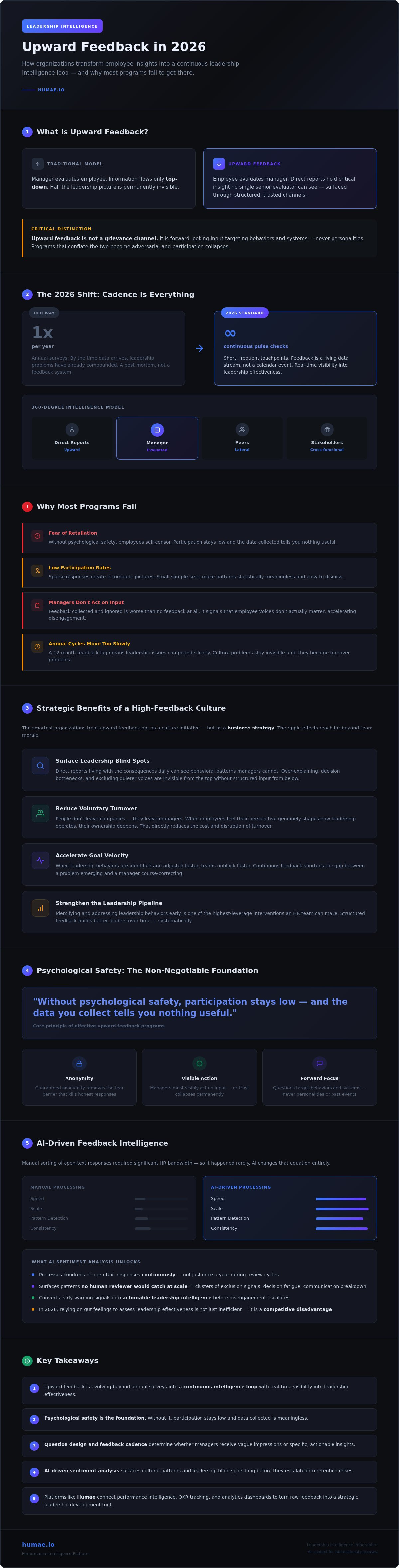
- Upward feedback is evolving beyond annual surveys into a continuous intelligence loop that gives organizations real-time visibility into leadership effectiveness and team health.
- Psychological safety is the foundation of any feedback program that actually works - without it, participation stays low and the data you collect tells you nothing useful.
- The right question design and feedback cadence determine whether managers receive vague impressions or specific, actionable insights they can act on immediately.
- AI-driven sentiment analysis can surface cultural patterns and leadership blind spots long before they escalate into retention problems or disengagement crises.
- Platforms like Humae connect performance intelligence, OKR tracking, and analytics dashboards to turn raw feedback into a strategic leadership development tool.
What is Upward Feedback and Why is it Shifting in 2026?
Upward feedback is the structured flow of insights, observations, and evaluations from direct reports to their supervisors. It flips the traditional performance conversation on its head. Instead of a manager assessing an employee, the employee assesses the manager. Simple in theory. Transformative in practice, when it actually works.
For decades, most organizations relied on top-down performance reviews as their primary source of leadership data. A senior leader evaluated those beneath them, and that was the end of the intelligence chain. The problem? That model captures only half the picture. 360-degree feedback frameworks emerged to address exactly this gap, recognizing that a manager's peers, direct reports, and stakeholders all hold critical information that a single evaluator simply cannot see. In 2026, that multi-directional model isn't a progressive experiment anymore. It's the baseline expectation for high-performing organizations.
What's changed most dramatically is the cadence. Annual surveys are giving way to continuous pulse checks, short and frequent feedback touchpoints that capture how leadership is landing in real time. Waiting twelve months to learn that a manager's communication style is eroding team trust isn't a feedback system. It's a post-mortem. Modern workforce management infrastructure treats feedback as a living data stream, not a calendar event.
The Core Difference: Feedback vs. Grievance
Upward feedback is not a complaint channel. That distinction matters enormously. A grievance addresses a specific wrong, a policy violation, or a personal conflict that requires formal resolution. Upward feedback, by contrast, focuses on professional growth and process improvement. It asks: "How could this leader communicate more clearly?" not "This person treated me unfairly." Constructive input is forward-looking. It targets behaviors and systems, never personalities. Organizations that conflate the two end up with feedback programs that feel adversarial, and participation collapses as a result.
Upward Feedback in the Age of AI
Technology has fundamentally changed what's possible here. Collecting and manually sorting hundreds of open-text responses used to require significant HR bandwidth, which meant it happened rarely. AI-driven sentiment analysis now processes responses continuously, surfacing patterns that no human reviewer would catch at scale. A cluster of comments signaling that a particular team feels excluded from decisions isn't just a data point; it's an early warning signal for disengagement.
Platforms like Humae embed this intelligence directly into their Performance Intelligence and Analytics Dashboards, giving leaders a real-time view of team health rather than a snapshot frozen in time. In 2026, relying on gut feelings to assess leadership effectiveness isn't just inefficient. It's a competitive disadvantage.
The Strategic Benefits of a High-Feedback Culture
Most organizations treat upward feedback as a culture initiative. The smarter ones treat it as a business strategy. When employees have a structured, trusted channel to share what's working and what isn't, the ripple effects reach far beyond team morale. They show up in retention numbers, goal velocity, and the long-term health of your leadership pipeline.
Start with blind spots. Every manager has them. The challenge is that the people who can see those blind spots most clearly, the direct reports living with the consequences daily, are rarely given a formal mechanism to surface them. A manager who consistently over-explains in meetings, bottlenecks decisions, or unintentionally excludes quieter voices from key conversations may never know it without structured input from below. These aren't personality flaws; they're behavioral patterns that compound quietly until they become productivity problems. According to performance management best practices outlined by SHRM, identifying and addressing leadership behaviors early is one of the highest-leverage interventions an HR team can make.
Retention is the other undeniable argument. People don't leave companies; they leave managers. When employees feel their perspective genuinely shapes how leadership operates, their sense of ownership in the organization deepens. That's not a soft benefit. It directly reduces the cost and disruption of voluntary turnover, which hits hardest among high performers who have the most options.
There's also a direct connection to goal execution. When OKR tracking stalls at the team level, the blocker is often managerial, whether it's unclear prioritization, insufficient resource allocation, or a communication gap between strategy and execution. Upward feedback surfaces these blockers before they derail quarterly results, giving senior leaders the visibility to intervene at exactly the right level.
Fostering Intrinsic Motivation
Having a voice in how leadership operates isn't just satisfying. It fundamentally changes an employee's relationship to their work. When people know their input influences real decisions, their commitment shifts from compliance to ownership. This is the engine behind sustainable employee engagement: not perks or ping-pong tables, but genuine participation in shaping the environment they work in every day. Growth becomes a shared project, not a top-down mandate, and that cultural shift is extraordinarily difficult for competitors to replicate.
Reducing Managerial Burnout
Managers are often the last people anyone thinks to ask how they're doing. That's a structural problem. Without feedback flowing upward, middle managers absorb pressure from both directions without the context to adjust. They may be overloading their teams without realizing it, or quietly drowning themselves. Regular upward insights give senior leaders the data to intervene before a high-performing manager burns out and walks out the door. In high-growth startups especially, where managerial spans are wide and resources are stretched, this feedback loop is often the difference between scaling sustainably and losing the people who built the culture in the first place.
Platforms like Humae connect performance intelligence with analytics dashboards so these patterns don't stay hidden until it's too late. If your organization is ready to turn feedback into a genuine strategic asset, that's where the conversation starts.
Overcoming the Fear: Building Psychological Safety
Fear is the silent killer of every upward feedback program. Not lack of interest, not poor question design, not even low participation rates. Fear. Specifically, the fear that honesty will cost someone their job, their next promotion, or their relationship with the person who controls both. Until organizations confront this reality directly, no feedback mechanism, however well-designed, will produce data worth acting on.
Psychological safety, the belief that you can speak up without being punished for it, is the non-negotiable foundation of any feedback culture that actually functions. Without it, employees don't lie on surveys. They simply say nothing meaningful. They select neutral ratings, skip open-text fields, or disengage entirely. The data looks fine on the surface, while the real signal stays buried.
Research from Harvard Business Review confirms that employees want honest feedback to flow in both directions, but only when they trust the system holding their words. That trust isn't built through policy statements or all-hands promises. It's built through consistent, visible evidence that input is received, respected, and acted upon without consequences for the person who gave it.
The Role of Anonymous vs. Attributed Feedback
Anonymity is the fastest way to lower the barrier to entry, especially in organizations that are early in building feedback culture. In smaller teams where writing styles are recognizable, even "anonymous" responses can feel traceable, so secure HR platforms that aggregate and anonymize data at the source are essential. This is where tools like Humae's Analytics Dashboards matter practically: they surface sentiment patterns across teams without exposing individual voices, protecting employees while giving leaders the signal they need.
As trust grows and managers demonstrate consistently that feedback is welcomed rather than weaponized, organizations can begin transitioning toward attributed input. This shift doesn't happen on a schedule. It happens when employees believe the culture has genuinely changed. Forcing open attribution too early reverses progress instantly.
The tradeoffs look like this:
- Anonymous feedback: Higher participation, more candid responses, lower risk perception; works best in early-stage programs and larger organizations where individual identification is harder to avoid.
- Attributed feedback: Enables richer dialogue, builds accountability on both sides, and supports developmental conversations; appropriate once psychological safety is established and demonstrated over time.
Training Managers to Receive Critique
The most underinvested piece of any upward feedback program is what happens the moment a manager reads something uncomfortable. Defensive reactions, whether expressed openly or quietly internalized, send a message through the team faster than any communication ever could. Employees watch what happens next. That reaction determines whether anyone speaks honestly again.
The fix isn't telling managers to "be open to feedback." That's too vague to change behavior. Specific frameworks help. Train managers to lead with a single response before anything else: "Thank you, tell me more." Not an explanation. Not a rebuttal. Not even a question that sounds like a challenge. Just genuine curiosity, expressed first.
Active listening in this context means resisting the impulse to contextualize or defend while the other person is still speaking. It means treating upward feedback not as an evaluation to pass or fail, but as intelligence that makes leadership more effective. Organizations that frame feedback as a leadership development asset, rather than a performance audit, see dramatically different manager behavior in response. Coaching managers through their first few feedback cycles, with HR support and structured reflection prompts, turns a potentially threatening process into a genuine growth mechanism.
The goal isn't managers who tolerate critique. It's managers who actively seek it, because they've experienced firsthand how much better their teams perform when the feedback loop is open.
How to Implement Upward Feedback: Frameworks and Examples
Execution is where most upward feedback initiatives fail. It isn't enough to simply want more transparency. You need a system that makes giving and receiving input a natural part of the work week. The most successful organizations in 2026 have moved away from the heavy, biannual survey. Instead, they favor a mix of quarterly deep dives and monthly pulse checks that keep the data fresh and relevant.
Before you send a single notification, you must communicate the "Why." If employees think this is a box-checking exercise or a trap to catch dissenters, they'll give you useless, polite data. Be explicit. Tell them that upward feedback is a tool for leadership growth, not a performance audit. Explain how the data will be used, who will see it, and most importantly, what the managers are expected to do with it. Trust is the currency here. If you don't spend it upfront, you won't get honest answers later.
Closing the loop is the final, non-negotiable step. When a team provides input, they expect to see a result. This doesn't mean every request is granted, but every theme must be acknowledged. A manager who says, "I heard that our meetings feel too long, so we're cutting them by fifteen minutes starting Monday," earns more respect than one who ignores the critique entirely. Action is the only thing that guarantees participation in the next cycle.
5 Powerful Upward Feedback Questions
The quality of your data depends entirely on the specificity of your questions. Avoid vague prompts like "How am I doing?" and replace them with targeted inquiries that require a concrete answer.
- What is one thing I could do differently to better support your work?
- Are there any blockers I am inadvertently creating for the team?
- How could I improve our weekly syncs to make them more valuable?
- What is one process we currently use that feels like a waste of your time?
- What should I stop doing?
Asking what to stop doing is the most important question because it forces a manager to identify the specific friction points and redundant habits that are actively draining team energy without providing any measurable value.
Modern Examples for Remote and Hybrid Teams
In 2026, the challenges of leadership have shifted toward digital coordination and asynchronous culture. Your feedback framework must reflect this reality. Generic questions about "office culture" no longer apply to a distributed workforce.
Consider asking for input on digital communication overload. Is the manager sending Slack messages at midnight? Are there too many "quick syncs" that break deep work? Feedback on meeting fatigue is often the first signal that a remote team is heading for burnout. Similarly, teams need a way to critique asynchronous project management styles. If a manager isn't providing enough written context for tasks, the team spends more time guessing than doing. Finally, ask for honest input on how "work from anywhere" policies are actually being executed. A policy that exists on paper but is discouraged in practice creates a culture of resentment that upward feedback can surface and fix.
Ready to turn these insights into a strategic advantage? Explore Humae's Performance Intelligence tools to build a feedback loop that actually works for your modern team.
Scaling Leadership Intelligence with Humae AI
Collecting feedback is only the beginning. Understanding it at scale is the real challenge. In a growing organization, reading every individual comment manually is impossible and prone to bias. This is where Humae AI changes the equation. By transforming raw upward feedback into actionable performance intelligence, it allows leaders to stop guessing and start knowing. It turns a collection of opinions into a strategic data stream.
Our AI sentiment analysis doesn't just count ratings. It identifies the emotional tone and recurring themes in team responses. If a specific department starts showing signs of meeting fatigue or a sudden drop in clarity, the system flags it immediately. This proactive approach lets HR teams address cultural shifts before they escalate into formal grievances or talent drain. It's about being predictive, not just reactive, in your leadership strategy.
This intelligence doesn't live in a silo. It's a core component of your workforce management infrastructure. When feedback data flows alongside performance metrics and attendance patterns, you get a 360-degree view of organizational health. You see the human story behind the business numbers, allowing for more empathetic and effective decision-making.
From Data to Action: The Humae Dashboard
The Humae dashboard removes the manual burden of sorting through hundreds of responses. You can visualize sentiment trends across different departments, locations, or seniority levels instantly. By linking these insights to real-time OKR progress, leaders can see exactly how managerial style impacts goal velocity. It isn't just about critique. It's about providing managers with a personalized growth path based on what their teams actually need to succeed. Real-time analytics dashboards make team health visible, measurable, and improvable.
Building the Workplace of the Future
A tech-enabled feedback culture is no longer a luxury. It's a massive competitive advantage in the 2026 hiring market. Top talent wants to work where their voice matters and where leadership is committed to transparency. Using Humae demonstrates that your organization values human connection as much as digital efficiency. It creates a workplace where trust is built into the software itself, fostering a human-centric environment that attracts and retains the best people.
The future of leadership isn't about having all the answers. It's about having the right intelligence to ask the right questions. Ready to see how your team's insights can drive your next stage of growth? Explore Humae features and start building a more transparent, human-centric organization today.
Your Leadership Intelligence Starts Here
The organizations winning in 2026 aren't waiting for problems to surface. They're building systems that catch signals early, act on them fast, and create cultures where honest input flows in every direction. Upward feedback is the engine behind that shift, but only when it's grounded in psychological safety, smart question design, and technology that turns raw responses into real decisions.
The takeaway is straightforward: feedback without action is just noise. Pair it with AI-driven sentiment analysis, connect it to real-time OKR tracking, and embed it inside a global workforce management infrastructure, and you've got something genuinely powerful. You've got leadership intelligence that compounds over time.
That's exactly what Humae is built for. Not another survey tool collecting dust, but a platform that makes every piece of feedback count toward something measurable.
Your team already has the insights your leaders need. Give them a trusted channel to share it. Optimize your team with Humae AI Performance Intelligence and start turning honest input into your strongest competitive advantage.
Frequently Asked Questions About Upward Feedback
What is the best way to give upward feedback to a defensive manager?
Lead with impact, not intention. Instead of saying "you interrupt people in meetings," try "when I don't finish my thought, I find it harder to contribute my best ideas." Framing feedback around your experience rather than their behavior removes the accusatory edge that triggers defensiveness. Specific, observable examples always land better than general character assessments.
Timing matters too. Dropping critical feedback during a stressful sprint or right before a deadline sets the conversation up to fail. Request a dedicated one-on-one, signal that you have something constructive to share, and give the manager a moment to shift into a receptive mindset before you begin.
Should upward feedback be anonymous or public?
Anonymous feedback is the right starting point for most organizations, particularly those still building a culture of trust. It lowers the perceived risk enough to generate honest, usable data. Platforms like Humae aggregate responses at the team level so that individual voices are protected while meaningful patterns still surface for leadership review.
Public or attributed feedback becomes viable only after managers have demonstrated, repeatedly and visibly, that honest input is welcomed rather than quietly penalized. Don't rush this transition. The moment employees suspect that attribution is being used to identify critics, participation collapses and it takes significant effort to rebuild.
How often should a company collect upward feedback?
Monthly pulse checks paired with a deeper quarterly review cycle is the cadence that works best for most organizations in 2026. Monthly touchpoints keep the data current and catch emerging issues before they compound. Quarterly deep dives give managers enough time to act on previous input and demonstrate visible change before the next round of questions arrives.
Annual-only cycles are simply too slow. If a manager's communication style is eroding team trust in February, waiting until December to discover that is not a feedback system. It's a delayed post-mortem. The goal is continuous intelligence, not a calendar event.
Can upward feedback affect my performance review?
In a well-designed program, upward feedback is a development tool for managers, not a disciplinary input about the employees who give it. Your responses should never flow back into your own performance evaluation. Organizations that conflate the two destroy psychological safety instantly, and rightly so. Before participating, confirm with your HR team how responses are stored, who accesses them, and whether individual attribution is possible.
If your organization uses a platform with proper anonymization controls, the structural risk is low. The cultural risk depends entirely on your specific leadership environment, which is why building genuine trust before launching any upward feedback program is non-negotiable.
What are the most common mistakes in giving feedback to a boss?
The most damaging mistake is being vague. "You could communicate better" tells a manager nothing actionable. "Our project briefs often arrive without deadlines, which makes it hard to prioritize" gives them something specific to fix. Concrete behavioral examples are the difference between feedback that drives change and feedback that gets filed away and forgotten.
Other common errors include making it personal rather than professional, bringing up old grievances that belong in a formal HR channel, and giving feedback that's purely negative without acknowledging what's working. Balance doesn't mean softening the truth; it means giving a complete picture that a manager can actually use.
How does AI help in processing employee feedback?
AI sentiment analysis processes large volumes of open-text responses simultaneously, identifying recurring themes and emotional patterns that no human reviewer could reliably spot at scale. Instead of reading three hundred individual comments, an HR leader sees a clear signal: "Meeting clarity scores dropped significantly in the engineering department over the past six weeks." That's an actionable insight, not a pile of raw data.
Humae's AI-driven approach goes further by connecting those sentiment patterns to real-time OKR tracking and analytics dashboards. When feedback signals align with stalling goal progress in the same team, leaders get a complete picture of what's happening and why, rather than two disconnected data streams that require manual interpretation.
What should a manager do after receiving negative upward feedback?
The first move is to resist the urge to explain or defend. Read the feedback, sit with it, and look for the behavioral pattern underneath the specific comment. One critical response might reflect a personal preference; three responses pointing to the same issue almost certainly reflect a real problem worth addressing. Distinguishing between the two requires honest self-reflection before any action is taken.
Then close the loop with the team. A manager who says "I heard that our status updates aren't giving you enough context, so I'm changing the format starting next week" builds more trust in one sentence than months of open-door-policy statements ever could. Visible action is the only thing that guarantees honest input in the next feedback cycle.
Is upward feedback effective for small startups?
It's actually where upward feedback delivers some of its highest returns. In a startup, a single manager's blind spots can affect the entire company's culture and velocity. There's no organizational buffer. A founder who bottlenecks decisions or unintentionally excludes key voices will feel those effects across every team, every quarter, faster than any enterprise would.
The main challenge in small teams is anonymity, since writing styles and context clues can make responses traceable even when names are removed. Using a platform that aggregates and anonymizes data at the source solves this structurally. The investment is modest; the leadership intelligence you gain is disproportionately valuable at exactly the stage when culture is still being shaped.