Time Off Tracking for Remote Teams: The 2026 Guide to Modern Leave Management
By Humae · 20 June 2026
time off tracking for remote teams
What if the very tool you use to manage rest is actually fueling anxiety? For many leaders, time off tracking for remote teams has become a source of friction rather than freedom. You've likely felt the frustration of manual spreadsheet errors leading to payroll mistakes or the sinking feeling of realizing half your engineers are offline in a different time zone when a crisis hits. It's exhausting to play detective every time someone needs a break.
We agree that managing a distributed workforce requires more than just a calendar; it requires a culture of trust. This guide will show you how to master the transition from messy, error-prone manual logs to intelligent leave management that protects your team from the "always-on" remote culture. You'll learn how to streamline approval workflows, ensure compliance with the complex web of 2026 global leave laws, and integrate everything directly into Slack or Teams.
Experience the future of HR with Humae. | Return to Home Page
Connect with our community on Facebook.
Key Takeaways
- Understand why manual spreadsheets fail distributed teams and how a single source of truth eliminates visibility gaps across global time zones.
- Discover the four pillars of effective time off tracking for remote teams that prioritize radical transparency and automated approval cycles.
- Learn how to reframe leave management as a tool for mutual respect and burnout prevention rather than a mechanism for micromanagement.
- Master a five-step implementation plan to audit your culture and establish compliant policies for diverse employment types and regions.
- Explore how AI-driven intelligence integrates leave data with real-time OKR tracking to provide a holistic view of organizational health.
Experience the future of HR with Humae. | Return to Home Page
Connect with our community on Facebook.
Why Traditional Time Off Tracking Fails Distributed Teams
Remote work changed the rules of engagement, but our tools are still stuck in the past. The "Invisible Employee" problem isn't about people hiding; it's about team members disappearing from the collective consciousness because they aren't on a centralized map. When your team spans from Tokyo to Toronto, a static spreadsheet is a liability. It can't account for the fact that Monday has already started for one developer while another is still finishing their Sunday. Effective time off tracking for remote teams isn't just about counting days; it's about maintaining the pulse of your organization and ensuring no one is left behind.
Traditional HR systems often ignore the nuances of remote flexibility. They assume everyone works a standard 9-to-5 in the same building. In a remote startup, the hidden cost of manual PTO management is measured in lost momentum and broken trust. Managers spend hours cross-referencing emails and Slack messages just to see who is available for a sprint. This lack of a single source of truth for availability creates a chaotic environment where asynchronous work becomes impossible to coordinate effectively. You aren't just losing time; you're losing the human connection that makes remote teams thrive.
The Death of the Manual Spreadsheet
Manual data entry is a silent killer of productivity. Even small teams face high error rates when tracking leave in Excel, which directly impacts payroll accuracy and employee morale. Implementing professional absence management through "just email me your dates" is a recipe for disaster once you scale past five people. You lose track of carryover balances, accrual rates, and regional nuances. It's not just a clerical headache. It's a systemic failure that leaves employees feeling undervalued when their hard-earned rest isn't properly recorded or respected. Modern teams deserve a system that works as hard as they do.
Remote Specific Challenges: Time Zones and Compliance
Managing a team across ten countries means managing ten different sets of statutory holidays. Without dedicated time off tracking for remote teams, you risk accidental over-scheduling during a local holiday you didn't know existed. The legal risks also loom large. In 2026, compliance with regional leave laws is stricter than ever, with new mandates appearing in several jurisdictions. If you can't prove you're following local labor codes in every remote hub, you're exposed to significant liability. A modern system provides the visibility needed to prevent burnout and ensure every team member, regardless of their zip code, is treated with the same level of professional care and legal protection.
The 4 Pillars of Effective Remote Leave Management
Success in a distributed environment requires a shift from policing to empowering. When you move beyond the limitations of manual logs, you can build a culture where rest is a performance strategy. Modern time off tracking for remote teams isn't an administrative burden; it's a strategic asset built on four specific pillars: transparency, automation, flexibility, and intelligence. These pillars transform leave from a spreadsheet entry into a vital sign of organizational health.
Building Transparency Without Surveillance
Transparency is the antidote to meeting fatigue. When availability is visible to everyone, the "quick sync" that interrupts someone's vacation finally disappears. Integrating leave status into tools like Slack or Microsoft Teams ensures that a person's absence is respected without them having to constantly remind the team. It's about creating a shared map of capacity. When a teammate sees a "Vacation" icon, it triggers a culture of celebration rather than a sense of missing out. This visibility reduces friction and reinforces that taking time off is a valued part of the company's DNA. It builds trust by showing that everyone follows the same rules.
Automated Workflows for Global Teams
Friction kills adoption. If an employee has to fill out three forms and wait 48 hours for an email, they'll hesitate to take the breaks they need. Automation removes this barrier. In 2026, managing a global workforce means navigating a complex web of local mandates. For example, Minnesota's new PFML program now offers up to 20 weeks of combined leave, while Maine's program launched in May 2026. Manual tracking can't keep up with these shifts. A self-service portal allows employees to see their specific balances, request time in seconds, and receive instant approvals. This speed reduces anxiety and ensures your time off management remains compliant with every local contract automatically.
Flexibility is the third pillar. Remote work often blurs the lines between professional and personal life. Your tracking system should accommodate this by allowing for partial days or flexible hours that respect individual work-life integration. Finally, intelligence turns raw data into actionable insights. By monitoring leave patterns, leaders can identify who hasn't taken a break in six months. This predictive approach allows you to step in before burnout occurs, transforming time off tracking for remote teams into a proactive wellness tool. You can't fix what you don't measure, and these pillars ensure you are measuring the right things for the right reasons.
Trust vs. Transparency: Solving the Remote Oversight Dilemma
Tracking is not monitoring. It is a fundamental sign of respect. In a distributed environment, the biggest threat to your culture isn't that people are working too little, but that they are working too much. When you implement time off tracking for remote teams, you aren't watching over their shoulders. You're ensuring they have the space to step away. Many leaders argue that "we are adults, we don't need to track leave," but this hands-off approach often leaves employees guessing about what is truly acceptable. Without a clear framework, silence becomes the default, and burnout follows shortly after.
Data provides the psychological safety remote workers need. It replaces the "always-on" anxiety with a transparent record of rest. By making leave visible, you remove the guesswork and the guilt associated with taking time off. It creates a fair environment where everyone, regardless of their location, operates under the same professional standards. This clarity is the foundation of a high-trust organization.
The Paradox of Unlimited PTO
Unlimited PTO is often a trap for remote teams. When rest is unmeasured, people tend to take less of it because they don't want to appear less committed than their peers. This lack of guardrails leads to a culture of exhaustion. To counter this, many forward-thinking companies are moving toward "Minimum Leave" policies. By using time off tracking for remote teams, managers can actively encourage people to hit their rest targets. It shifts the conversation from "Are you working?" to "Have you recharged lately?" This proactive stance is essential for long-term team health and retention.
Data as a Tool for Equity
Objective records are the best defense against proximity bias. It's easy to accidentally favor those who are more visible in digital channels or live in the same time zone as leadership. Objective leave data ensures that workload distribution remains fair, especially during peak holiday seasons when half the team might be offline. This objective data is a cornerstone of modern performance management systems, ensuring that results, not just presence, define success. When you track leave, you protect your team's most valuable asset: their energy.
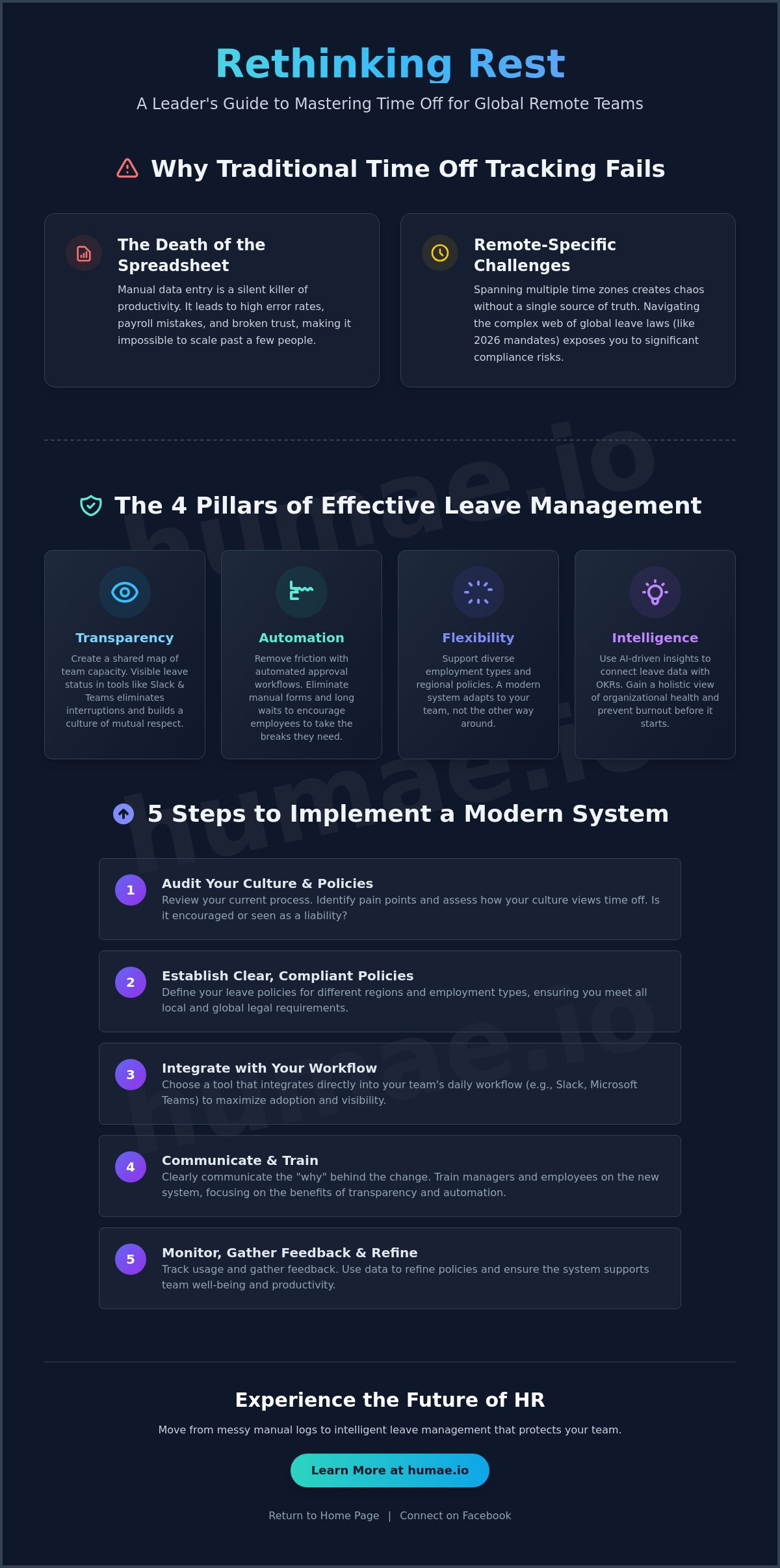
How to Implement a Remote Time Off System in 5 Steps
Transitioning from manual logs to a modern digital system is a journey of organizational change. It's about more than just clicking a button; it's about shifting habits. To successfully deploy time off tracking for remote teams, you need a roadmap that balances technical precision with human empathy. Implementation should feel like an upgrade to the employee experience, not an added layer of bureaucracy. By following a structured approach, you can eliminate friction and ensure your team feels supported from day one.
Step 1: Auditing Your Current Culture
Before you choose a tool, you must understand your people. Start by surveying your team to gauge their comfort level with taking leave. Do they feel pressured to stay online? Are there specific "bottleneck managers" who take days to approve requests? This audit reveals if your current workforce management infrastructure is actually serving your goals or if it's creating invisible barriers to rest. Identifying these friction points early allows you to design a system that solves real problems rather than just digitizing old ones.
Step 2 involves defining clear policies for different regions and employment types. Remote teams often face a "gray area" regarding local holidays and statutory requirements. Document these clearly so there's no room for confusion when the new system goes live. Ensure your policy covers how carryovers work and what the notice period for leave should be. Clarity is the foundation of trust in a distributed environment.
Step 3: Integration and Tool Selection
A tool that sits in a separate, lonely tab will be ignored. For remote teams, deep integration with Slack or Microsoft Teams is non-negotiable. You want a solution where a request can be approved without ever leaving the chat interface. When evaluating the features that matter for remote growth, prioritize mobile-first designs. Your team is on the go; they should be able to manage their time off from their phone as easily as from their laptop. Modern time off tracking for remote teams must meet people where they already work to ensure high adoption rates.
The final stages focus on execution and the "human" launch. Step 4 is the migration of your data. Verify every balance and ensure the transition is flawless to maintain credibility. Finally, Step 5 is the launch itself. Frame this not as a new administrative rule, but as a commitment to wellness and long-term productivity. When the system is easy to use and the intent is clear, your team will embrace it as a tool for their own protection.
Ready to simplify your operations? Explore Humae's intelligent leave management tools to see how we streamline the process for global teams.
Humae: AI-Powered Time Off Intelligence for Modern Teams
The future of work isn't just about recording hours; it's about understanding the human energy behind them. Basic time off tracking for remote teams often stops at simple approval stamps. Humae moves beyond this by transforming raw leave data into actionable workforce intelligence. We've built a centralized infrastructure that manages everything from hiring and onboarding to a dynamic employee directory. This isn't just a tool for HR; it's a platform for everyone. It's a holistic ecosystem where rest and productivity coexist in perfect balance, allowing leaders to see the big picture without losing the human touch.
The AI Advantage in People Ops
Humae uses predictive analytics to solve capacity planning before a crisis hits. Our AI identifies holiday surges and suggests adjustments to ensure your sprint stays on track. It looks at historical data to forecast when your team might be stretched too thin. More importantly, we use sentiment analysis to detect subtle shifts in leave patterns. If a high-performer stops taking breaks, the system triggers supportive feedback loops to encourage a healthy work-life balance. It also handles the heavy lifting of compliance. As global labor laws shift in 2026, Humae provides automated updates to keep your policies current without manual intervention. You get to focus on your people while we handle the legal fine print.
Scaling Your Remote Culture
A thriving remote culture requires more than just shared documents. It needs a sense of connection and alignment. By integrating time off with real-time tracking of OKRs, Humae ensures that individual rest is seen as a prerequisite for company success. Managers can see how leave impacts milestone delivery in real time, allowing for more realistic deadlines. When everyone can see who is available through a centralized portal, the "invisible employee" problem disappears. Rest is no longer a hurdle to your goals; it's the fuel that drives them. It creates a rhythm where work and life don't compete but complement each other.
Scaling a distributed team shouldn't mean losing your culture to spreadsheets. Humae provides the performance intelligence needed to keep your team engaged and healthy as you grow. We help you move from reactive damage control to proactive people management. Ready to modernize your approach? See how it works and join the organizations leading the remote revolution with confidence and empathy.
Building a Future-Proof Remote Culture
Rest is the ultimate fuel for long-term innovation. We have explored how moving from messy spreadsheets to automated systems builds radical trust and prevents burnout. By making availability transparent across every time zone, you empower your team to own their schedules while respecting their colleagues' boundaries. Modern time off tracking for remote teams is no longer just a clerical task; it is a strategic pillar for scaling a distributed organization in 2026. It is about creating a workspace where every individual feels seen, respected, and supported.
Humae provides the centralized global workforce infrastructure you need to simplify complex leave management. Our platform features AI-driven sentiment analysis to help you detect burnout before it occurs. With real-time OKR tracking integration, you can align rest with results and ensure your growth remains sustainable. It is time to replace manual friction with intelligent flow and focus on what truly matters: your people.
Start optimizing your remote team with Humae today. Your team's energy is your most valuable asset. Protect it with a system that understands the human side of digital technology and encourages a healthy, high-performing culture.
Frequently Asked Questions
Is time off tracking necessary for small remote teams?
Yes, tracking is essential even for small teams to avoid the "always-on" culture that leads to early exhaustion. Manual logs and spreadsheets often fail once a team grows past five people, leading to visibility gaps. Proper time off tracking for remote teams ensures that rest is documented, respected, and planned for from the very first hire.
How does time off tracking help prevent remote employee burnout?
Tracking prevents burnout by making rest visible to leadership. Managers can use objective data to identify team members who haven't taken a significant break in several months. This proactive approach allows you to encourage downtime before exhaustion impacts health or performance, turning leave data into a vital wellness signal.
Can we track different leave types like "Work from Anywhere" or "Mental Health Days"?
Modern systems allow you to create custom categories that go far beyond standard vacation or sick leave. You can easily track "Mental Health Days," "Work from Anywhere" stints, or even floating holidays to reflect the true flexibility of your remote culture. This granularity helps you understand how your team actually utilizes their benefits.
How do we manage public holidays for a globally distributed team?
You manage global holidays by using a platform that automatically syncs with localized calendars for every employee. In 2026, keeping track of diverse statutory dates across multiple countries is impossible to do manually. A centralized system ensures you don't accidentally schedule a major deadline on a teammate's local public holiday.
What is the difference between time tracking and time off tracking?
Time tracking monitors active work hours or billable tasks, while time off tracking manages absences and rest. Time tracking is often focused on productivity metrics. In contrast, time off tracking for remote teams focuses on long-term capacity, legal compliance, and ensuring that every team member is taking enough time to recharge.
Does time off tracking integrate with our existing payroll software?
Effective leave management tools are designed to sync seamlessly with your existing business infrastructure. While Humae provides the intelligence for managing rest, it also generates the clean data exports required by your payroll provider. This connection eliminates the manual double entry that often leads to frustrating payroll mistakes for remote workers.
How do we handle time off requests for non-exempt remote employees?
For non-exempt employees, you must track leave precisely to remain compliant with overtime and labor regulations. Accurate records ensure that paid time off is calculated correctly against their actual hours worked. This precision prevents legal disputes and ensures that hourly remote workers receive their full entitlements without any administrative delays.
What are the legal requirements for tracking leave in different countries?
Legal requirements vary by jurisdiction and are changing rapidly; for example, Maine's new PFML law began on May 1, 2026, and Minnesota now offers up to 20 weeks of combined leave. Using a configurable system is the only way to stay compliant with these shifting mandates. It ensures you meet local accrual and carryover rules automatically.