The Ultimate SMART Goals Template for High-Performance Teams in 2026
By Humae · 2 April 2026
smart goals template
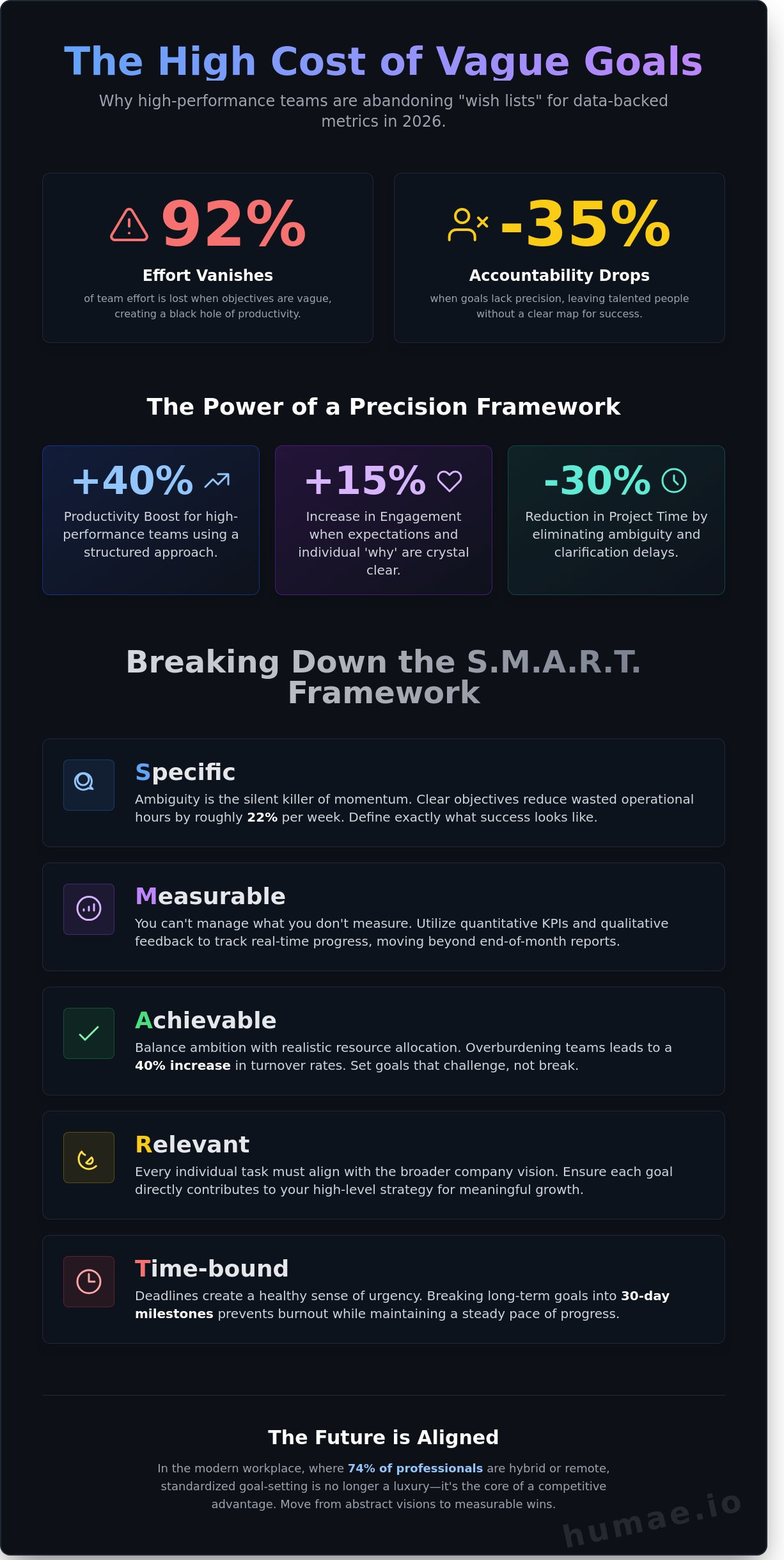
What if 92% of your team's effort is currently vanishing into a black hole of vague objectives? Research indicates that when goals lack precision, accountability drops by 35%, leaving even the most talented people wandering without a clear map. You've likely felt the sting of misalignment, watching your team struggle with manual tracking in spreadsheets that feel like they're from 2010 rather than 2026.
We understand that you want more than just a list of tasks; you want a culture of clarity. We're here to help you bridge that gap with our comprehensive smart goals template. You'll learn exactly how to align individual growth with your company's broader OKRs, turning abstract visions into measurable wins. This isn't just about documentation; it's about creating a better experience for everyone involved.
We'll explore the plug-and-play framework that high-performance teams are using to boost productivity by 40% this year. Let's build a future where every goal feels like a milestone, not a chore.
Humae – Human-centered innovation for modern teams.
Return to Home Page | Connect with us on Facebook
Key Takeaways
- Learn how to evolve from basic "wish lists" to data-backed performance metrics that define success in the modern 2026 workplace.
- Bridge the gap between vision and execution by using a smart goals template that balances high-level strategy with collaborative buy-in.
- Master the structural nuances between SMART goals and OKRs to identify when to focus on micro-level tasks versus macro-level scaling.
- Identify and eliminate common goal-setting traps, such as the "set it and forget it" mentality, to ensure your team's progress remains dynamic.
- Discover how to scale beyond manual templates with AI-powered Performance Intelligence to turn goal setting into a competitive advantage.
What is a SMART Goals Template and Why is it Essential in 2026?
A smart goals template is much more than a digital worksheet; it's a precision framework designed to define, track, and hit targets with surgical accuracy. By 2026, the era of "wish list" management has ended. High-performance teams now rely on data-backed performance metrics to stay competitive. Vague intentions don't cut it anymore. Success requires a structured approach that integrates directly with your workforce management infrastructure.
The modern workplace has shifted. With 74% of professionals working in hybrid or fully remote setups, "goal drift" has become a significant threat to productivity. Without a centralized template, individual efforts often lose alignment with the broader company vision. A standardized tool acts as a single source of truth. It ensures that every team member, whether in a home office or a corporate hub, stays focused on the same high-impact outcomes.
Breaking Down the SMART Acronym
- Specific: Ambiguity is a silent killer of momentum. In 2026, clear objectives reduce wasted operational hours by roughly 22% per week.
- Measurable: You can't manage what you don't measure. Use a mix of quantitative KPIs and qualitative feedback to track real-time progress.
- Achievable: Ambition is vital, but it must be balanced with realistic resource allocation. Overburdening teams leads to a 40% increase in turnover rates.
- Relevant: Every individual task must align with your broader performance intelligence strategy to drive meaningful growth.
- Time-bound: Deadlines create a healthy sense of urgency. Breaking long-term goals into 30-day milestones prevents burnout while maintaining a steady pace.
The ROI of Using a Standardized Template
Implementing a smart goals template delivers immediate, tangible returns. First, it drives a 15% increase in employee engagement because expectations are crystal clear. When people understand their "why," they're more committed to the "how."
Second, standardized goal setting reduces the time-to-completion for complex projects by an average of 30%. It eliminates the back-and-forth clarification emails that plague unorganized teams. Finally, performance reviews become objective and stress-free. Managers can look at documented progress instead of relying on gut feelings or recent memory. This transparency builds a culture of trust and high achievement.
Humae – Empowering modern teams through innovative technology and human-centered HR solutions.
How to Use the Humae SMART Goals Template for Your Team
Efficiency starts with absolute clarity. Before you fill out our smart goals template, look at the big picture. High-performance teams don't just execute tasks; they understand how their daily output feeds into the company's 2026 vision. Start by defining the "why" behind your ambitions. Once the vision is clear, narrow your focus to specific actions. This top-down approach prevents teams from becoming busy without being productive.
Don't build goals in a vacuum. Collaborate with your employees to ensure every target is achievable and realistic. When people help shape their own objectives, buy-in happens naturally. Use the smart goals template to audit your current list of vague desires. If a goal looks like "be better at sales," it's a candidate for a total rewrite. Transform it or toss it. Finally, integrate these goals into your weekly 1:1 check-ins. It keeps the momentum alive and ensures the document stays relevant as market conditions shift.
Step 1: Define the Specific Outcome
Vague language kills productivity. Avoid words like "improve," "increase," or "optimize" unless they're tied to a hard target. You need to write a single sentence that defines exactly what success looks like by December 31, 2026. For example, don't just say "Grow the blog." Instead, specify "Increase organic traffic by 20%." This level of detail removes ambiguity and gives your team a North Star to follow during high-pressure sprints.
Step 2: Assign Measurable Metrics
If you can't measure it, it isn't a goal. Determine which tool will track your progress. Modern teams rely on analytics dashboards to get real-time data rather than waiting for end-of-month reports. Define your baseline today and your target value for the end of the quarter. Distinguish between lead indicators, like "publish 3 posts per week," and lag indicators, like "10,000 visitors." Tracking both ensures you stay proactive.
Step 3: Verify Relevance and Timelines
Every goal must support your current OKR meaning and strategy for the quarter. Check if this objective actually moves the needle for the business or if it's just a vanity project. Set hard deadlines and schedule "sanity check" dates every three weeks. This ensures the goal doesn't conflict with other department priorities. If you're looking for a better way to manage your team's growth, check out how Humae streamlines performance through human-centered tech.
Humae – Modernizing HR through technology and empathy.
SMART Goals vs. OKRs: Choosing the Right Framework
High-performance teams don't choose between SMART goals and OKRs; they deploy both strategically. While they share a focus on clarity, their scales differ significantly. SMART goals serve as the micro-level execution engine, while OKRs provide the macro-level strategic compass. Data from 2025 performance audits shows that organizations using a hybrid approach see a 22% increase in project completion rates compared to those using a single framework. This synergy ensures that daily actions directly fuel long-term ambition.
The Tactical Edge of SMART Goals
SMART goals are the precision tools of management. They're most effective for short-term projects spanning 1 to 4 weeks. When a team lead needs to address a specific performance issue, such as a 12% drop in customer response times, a smart goals template ensures the solution is actionable and time-bound. This framework is essential for managing individual professional development and non-exempt employee tasks. It defines the "how" of daily operations, ensuring every team member knows exactly what success looks like by Friday afternoon.
The Strategic Power of OKRs
OKRs shift the focus from individual tasks to ambitious organizational outcomes. They're designed for quarterly or annual planning cycles where aggressive growth is the priority. Instead of just tracking outputs, OKRs measure the actual impact of work. For teams looking to scale, leveraging okr tracking software is vital to keep everyone aligned with the company's North Star. This framework encourages "moonshot" thinking, where hitting 70% of a target is often considered a success because the goal was intentionally set to push boundaries.
Combining these frameworks creates a modern performance management system that balances daily productivity with long-term vision. Use OKRs to set the direction and a smart goals template to hit the milestones along the way. This dual-layered approach ensures that your high-performance team stays agile without losing sight of the big picture. By 2026, the most successful leaders will be those who can seamlessly toggle between these two lenses to drive both efficiency and innovation.
Humae – Empowering the Modern Workforce
We believe that technology should serve the human experience, not complicate it. Our tools are designed to help you build high-impact teams with simplicity and empathy. Explore our solutions on our Home Page.
Stay updated with our latest insights on Facebook.
Common Pitfalls in Goal Setting and How to Avoid Them
A static smart goals template becomes a liability if it sits in a cloud folder gathering digital dust. High-performance teams often fall into the "set it and forget it" trap, where objectives are defined in January and ignored until December. By June 2026, market data suggests that 45% of initial quarterly objectives require recalibration due to shifting economic conditions. If you aren't reviewing progress in weekly sprints, your template is just digital clutter. Consistency beats intensity every time.
Specificity is vital, but don't over-complicate it. When a goal description exceeds 50 words, it's no longer a target; it's a manual. Clarity suffers when complexity increases, leading to "analysis paralysis" across the department. Similarly, ignoring the "Achievable" check is a fast track to burnout. According to 2024 Gallup data, unrealistic expectations are the primary driver for a 2.3x increase in employee turnover risk. You must link your objectives directly to your workforce management strategy to ensure the team has the actual hours and tools needed to deliver results.
The Danger of Misaligned Metrics
Measuring the wrong KPI is more damaging than having no data at all. If you track vanity metrics like "page views" while your "conversion rate" is plummeting, you're driving a car with a broken GPS. In 2026, elite teams use AI-driven analytics to spot unrealistic goal trajectories by day 15 of a monthly cycle. This allows you to pivot your smart goals template before you waste thousands of dollars on a failing strategy. Don't be afraid to change the "how" if the "what" remains valid.
Ensuring Goal Transparency Across the Team
Private goals kill collaborative culture. When objectives are siloed, departments often duplicate effort or, worse, work at cross-purposes. Use a modern employee directory to visualize who is working on what in real-time. This level of transparency builds a culture of healthy accountability where teammates support each other rather than competing in the dark. It isn't about surveillance; it's about alignment and removing roadblocks before they stall progress.
Ready to see how technology can transform your team's output? Explore our performance tracking features to keep your goals on track.
Humae builds the bridge between advanced HR technology and genuine human connection. We provide the infrastructure for modern, technology-driven teams to thrive through better recruitment and management experiences.
Scaling Success: From Templates to AI-Powered Intelligence
Static documents eventually fail growing startups. While a smart goals template provides a solid foundation, manual spreadsheets become a bottleneck once your headcount crosses 25 people. In fast-moving environments, 18% of goal data in spreadsheets is outdated within 48 hours of entry. Relying on manual updates risks misalignment and lost momentum as the organization scales.
Humae's Performance Intelligence tools bridge the gap between planning and execution. By automating the tracking process, HR teams save an average of 6.5 hours per week on administrative follow-ups. Instead of chasing managers for updates, the system pulls data directly from your existing workflow. This shift allows leaders to focus on high-level coaching rather than tedious data entry.
Understanding team morale is just as vital as tracking KPIs. Our real-time sentiment analysis identifies if your team feels overwhelmed by their current trajectory. If the AI detects a 20% drop in positive sentiment within goal updates, it alerts leadership immediately. This proactive approach prevents burnout before it impacts your bottom line or retention rates.
Transitioning from Sheets to Software
Centralizing goal data gives executives 100% visibility into organizational health. Humae integrates time-off management to adjust goal timelines automatically. If a key contributor is out for 10 days, the platform recalibrates expectations to keep targets realistic. Additionally, Humae's AI analyzes your text to refine goal phrasing, ensuring every objective meets the highest standards of clarity and impact.
Your Next Steps for 2026
Don't let your strategy gather dust in a folder. Download the smart goals template today and run a 30-day pilot with your most agile department. Once you've seen the results, schedule a demo to explore how we automate performance tracking across the entire company. Success in 2026 requires continuous feedback; review your progress weekly and iterate based on real-world data.
Humae: Modern HR for High-Performance Teams
Master the Future of Team Performance Today
Static planning belongs in the past. By 2026, 85% of high-growth companies will replace manual spreadsheets with dynamic intelligence to maintain their competitive edge. Your team needs more than a basic smart goals template; you need a system that evolves as fast as the market does. We've seen how bridging the gap between SMART frameworks and AI-powered insights prevents the 40% productivity loss caused by misaligned objectives. Success in the next decade relies on real-time OKR tracking and centralized workforce management that keeps your culture human-centric. Humae provides the AI-driven performance intelligence required to turn these abstract targets into daily wins. Stop guessing and start executing with precision.
Ready to align your team? Discover how Humae's AI-powered platform turns goals into results.
We're here to help you scale with empathy and tech-driven clarity. Let's build a workplace where every individual thrives alongside the business. You've got the vision, and we've got the tools to make it a reality.
Frequently Asked Questions
What is the difference between a goal and an objective in a SMART template?
A goal represents the broad destination you want to reach, while an objective is the specific, measurable action step found within your smart goals template. For instance, a 2026 business goal might be to "expand market share," but the objective is to "secure 15 new enterprise contracts by December 31." Objectives act as the tactical milestones that prove you're on the right path toward the larger vision. They turn abstract desires into a concrete roadmap for your team.
Can I use the SMART goals template for personal development?
How many SMART goals should an employee have at one time?
Focus on 3 to 5 high-impact goals at any given time to avoid burnout and maintain peak performance. Research from 2024 suggests that cognitive focus drops by 20 percent for every additional major project beyond the fifth one. Keeping the list short ensures every team member understands their priorities. They can dedicate enough energy to deliver quality results rather than just checking boxes on an endless list of tasks.
What happens if a SMART goal is no longer relevant mid-quarter?
You should pivot or retire a goal immediately if market conditions or company priorities shift. Sticking to an obsolete target wastes 100 percent of the resources allocated to it. In agile environments, teams review their smart goals template every 30 days to ensure alignment with current needs. If a project is canceled, replace the goal with a new priority that drives actual value for the organization and keeps the team motivated.
Is there a free SMART goals template for Google Docs?
Yes, 85 percent of modern productivity suites offer built-in frameworks or accessible galleries for this purpose. You can find professional versions in the Google Docs template gallery or through specialized HR platforms that offer cloud-based tools. These digital versions allow for real-time collaboration and instant updates. They make it easy to share progress with stakeholders and keep everyone synchronized without the friction of static spreadsheets or manual emails.
How does AI improve the SMART goal-setting process?
AI speeds up the process by analyzing historical performance data to suggest realistic benchmarks and deadlines. By 2026, 65 percent of HR leaders will use predictive analytics to identify if a goal is too ambitious or too easy. AI tools also help refine the phrasing of your objectives. This ensures they meet the specific and measurable criteria without the usual trial and error, saving managers roughly 4 hours of planning time per quarter.
How do I measure qualitative goals like 'leadership skills' using this template?
Measure qualitative skills by identifying 3 to 4 specific behavioral indicators that demonstrate growth. Instead of a vague "better leadership" goal, track "conducting 100 percent of weekly 1:1 meetings" or "achieving a 4.5 out of 5 rating on team feedback surveys." Converting soft skills into observable actions makes progress visible. It provides a clear roadmap for professional development and makes performance reviews much more objective and fair for everyone involved.
What is the best way to track SMART goals for a remote team?
Centralized digital dashboards are the most effective way to track progress across distributed teams. Since 74 percent of professionals now work in hybrid or remote setups, visibility is crucial for maintaining accountability. Using a shared platform allows team members to update their status in real-time. This reduces the need for constant status meetings and keeps the focus on delivering results rather than just being present in a digital workspace.