SMART Goals in 2026: The Ultimate Guide to High-Impact Goal Setting
By Humae · 28 March 2026
smart goals
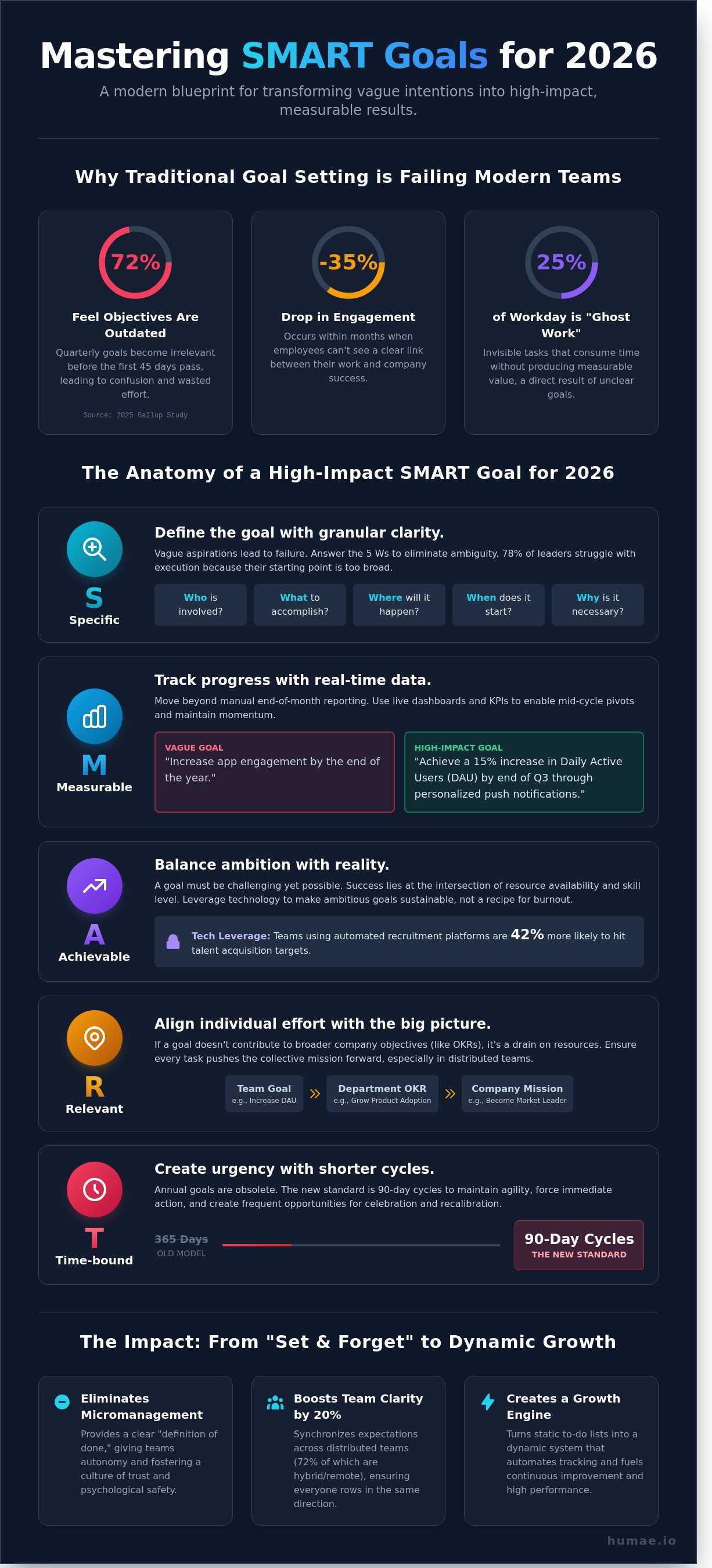
A 2025 Gallup study revealed that 72% of employees feel their quarterly objectives are outdated before the first 45 days pass. You've likely felt that frustration when targets set in January feel like ancient history by mid-February. It's exhausting to manage a team when expectations shift like sand, leaving everyone unsure of what actually matters. When people can't see a direct line between their effort and the company's win, engagement typically drops by 35% within months.
We're here to change that trajectory. You'll learn to master smart goals for the 2026 business environment, blending the classic framework with AI-driven tools that track progress in real-time. This guide promises a clear path to better alignment and a 20% boost in team clarity. We'll walk through the five pillars of modern goal setting and the tech stack that ensures your strategy never loses its pulse.
Key Takeaways
- Master the 2026 evolution of smart goals to transform vague intentions into precise, high-impact results for your team.
- Identify the subtle pitfalls that make most objectives too broad and learn the anatomy of a truly reachable goal.
- Determine exactly when to deploy OKRs versus tactical frameworks to ensure your strategy and execution remain perfectly aligned.
- Transition from top-down mandates to a collaborative drafting process that boosts engagement through shared ownership.
- Discover how integrating goal intelligence into your workflow automates tracking and turns static lists into a dynamic engine for growth.
What Are SMART Goals? Defining the Framework for 2026
A SMART goal is a precision-engineered methodology designed to turn vague intentions into high-impact results. In 2026, setting smart goals isn't about filling out a static form once a year; it's a dynamic process that reduces cognitive load by stripping away ambiguity. This framework ensures every team member knows exactly what success looks like, which is vital as 72% of the global workforce now operates in hybrid or remote-first environments.
The acronym stands for Specific, Measurable, Achievable, Relevant, and Time-bound. While these pillars remain constant, the application has shifted toward "continuous goal intelligence." We've moved past the "set and forget" era. Modern objectives now leverage real-time data streams to stay aligned with fluctuating market demands. By following the SMART criteria, leaders can synchronize expectations across distributed teams without the friction of constant status meetings.
The Origins and Evolution of Goal Setting
The journey began in 1954 when Peter Drucker introduced Management by Objectives (MBO). What started as a boardroom philosophy evolved into a core HR infrastructure component. By the early 2020s, the framework became the backbone of digital transformation. Today, 90% of leading HRMS platforms bake these criteria directly into their interfaces. This revival isn't a coincidence; it's a necessity for maintaining culture and output in a world where physical proximity is no longer the default.
The Core Benefits for Modern Teams
Clarity is the ultimate productivity hack. When teams apply smart goals, they effectively eliminate "ghost work," those invisible tasks that consume 25% of an average workday without producing measurable value. This structure provides a definitive "definition of done," which significantly boosts employee sentiment and psychological safety. When the finish line is visible, the need for micromanagement vanishes. Success becomes a transparent metric rather than a subjective opinion from a manager, creating a culture of trust and high performance.
Anatomy of a High-Impact SMART Goal (with Modern Examples)
Setting smart goals isn't a mere administrative task; it's a strategic engineering process. In 2026, precision is your greatest competitive advantage. Most professionals fail here because their "Specific" goals remain trapped in vague aspirations. If your objective doesn't clearly state the "who" and the "how," it isn't a goal; it's a wish. High-impact setting requires you to strip away the fluff and focus on granular clarity.
S & M: Specificity and Measurement in the Data Age
To anchor your objective in reality, you must use the 5 Ws. Who is involved, what do you want to accomplish, where will it happen, when does it start, and why is it necessary? This framework prevents the common pitfall of ambiguity. In the current business climate, 78% of leaders struggle with execution because their starting point is too broad. You can see how this works in practice by reviewing high-impact SMART goal examples that prioritize narrow focus over wide-reaching generalities.
Measurement has also evolved. Manual end-of-month reporting is too slow for 2026. You need real-time analytics and live dashboards to track progress. Moving beyond simple percentages to complex performance indicators allows for mid-cycle pivots. Consider these two approaches:
- Vague: "Increase app engagement by the end of the year."
- High-Impact: "Achieve a 15% increase in Daily Active Users (DAU) by the end of Q3 through personalized push notification triggers."
A, R, & T: Relevance and The Time Factor
Relevance ensures your individual efforts align with company-wide OKRs. If a goal doesn't contribute to the broader mission, it's a drain on resources. In our fast-paced market, the "Time-bound" element has shifted significantly. Annual goals are often obsolete by March; therefore, 90-day cycles are the new standard for maintaining momentum and agility. This shorter window forces immediate action and provides more frequent opportunities for celebration and recalibration.
Achievable is the intersection of resource availability and skill level. You must balance ambition with reality to avoid burnout. Data from Q1 2026 shows that teams using automated recruitment platforms are 42% more likely to hit their talent acquisition targets because they remove manual bottlenecks. Don't set a goal that requires 80-hour work weeks. Instead, leverage technology to make the "Achievable" part of your smart goals a sustainable reality. If your resources don't match your vision, you must either scale back the objective or upgrade your toolkit.
SMART Goals vs. OKRs: Choosing the Right Framework
Strategy isn't a monolith. You need a clear hierarchy to turn a 2026 vision into reality. OKRs (Objectives and Key Results) define your North Star, while smart goals provide the tactical map to get there. Think of OKRs as the strategic "what" and SMART goals as the granular "how."
Use OKRs when you need to align cross-functional teams around a high-level company mission. They're designed for growth and moonshot thinking. Switch to smart goals for individual performance metrics and specific project milestones where precision is non-negotiable. A 2025 survey of agile organizations found that 78% of high-performing teams use both frameworks simultaneously to bridge the gap between executive vision and daily execution.
The two frameworks don't just coexist; they feed each other. An OKR defines the destination, but the journey is paved with SMART milestones that keep the momentum high and the focus sharp.
Key Differences at a Glance
- Scope of Ambition: OKRs are broad and aspirational. SMART goals are narrow and executable. While an OKR might aim to "Dominate the European HR tech market," a SMART goal focuses on "Increasing demo conversions by 15% in the DACH region by Q3."
- Frequency and Rhythm: OKRs typically follow 90-day cycles to allow for strategic pivots. SMART goals are often tied to specific project deadlines or monthly performance cycles.
- The Definition of Success: In the OKR framework, hitting 70% of a target is often considered a win because it encourages risk-taking. Conversely, a SMART goal isn't finished until it's 100% complete. This distinction is vital when comparing SMART Goals vs. OKRs for your team's specific needs.
Integrating Both for Maximum Performance Intelligence
Maximum efficiency happens when you cascade an OKR down into actionable SMART steps. If your objective is to improve employee retention by 20%, your tactical SMART goal might be to "Implement a new automated onboarding flow by March 15th." This creates a direct line of sight from the CEO's office to the developer's desk.
Data visualization is the secret to making this work. Many teams use OKR tracking to see how these layers interact in real-time. Without a centralized dashboard, you risk framework fatigue. When employees see how their specific tasks contribute to the bigger picture, engagement scores typically rise by 25% or more. Technology should simplify this connection, not complicate it. By linking your tactical wins to your strategic objectives, you create a culture of purpose-driven performance that feels human, not just mechanical.
From Static Lists to Dynamic Tracking: Implementation
Turning abstract visions into reality requires a structured transition. In 2026, setting smart goals isn't a one-time event but a living process. Static spreadsheets are dead; success now lives in dynamic systems that breathe with your organization. Follow these four steps to modernize your execution strategy and ensure your team stays aligned.
- Step 1: Conduct a current state audit. Review your team's 2025 performance data. Identify where bottlenecks occurred and which KPIs fell short by 15% or more. You can't map a route without a starting coordinate.
- Step 2: Draft goals using a bottom-up approach. Engagement drops by 40% when targets are dictated solely from the top. Let teams propose their own milestones first, then align them with the broader corporate vision.
- Step 3: Centralize visibility. Input every objective into a unified HRMS. Transparency ensures that 100% of the workforce understands how their daily tasks impact the company's bottom line.
- Step 4: Establish a feedback cadence. Set a recurring 15-minute weekly sync. This replaces the outdated 12-month review cycle and allows for immediate pivots when market conditions shift.
The Role of AI in Goal Refinement
Modern platforms now use Large Language Models to scan for "vagueness" in your smart goals. If a manager writes "improve sales," the AI suggests "increase Q3 conversion rates by 12.5% through lead scoring automation." Sentiment analysis tools also monitor communication patterns within project channels. They alert leadership when the tone of status updates suggests a 20% increase in burnout risk. Predictive analytics can forecast a 78% probability of a goal missing its deadline three weeks before it happens, giving you the lead time needed to reallocate resources.
Continuous Feedback Loops
Performance Intelligence has replaced the static annual review. Real-time OKR tracking software keeps objectives visible on every employee's dashboard, ensuring they don't get buried in emails. This approach leverages the psychology of small wins. By celebrating a 5% incremental gain every Friday, you maintain momentum and dopamine levels. Data from early 2026 workplace studies shows that teams using weekly micro-milestones report 22% higher job satisfaction than those focused only on year-end targets.
Beyond the Acronym: Leveraging Humae for Goal Intelligence
Traditional goal setting often dies in a forgotten spreadsheet. By 2026, static documents simply won't cut it. Humae breathes life into the SMART framework by turning it into an automated, living ecosystem. We've built a single interface where hiring, onboarding, and goal-setting converge. This isn't just about tracking tasks; it's about managing your entire workforce infrastructure with surgical precision.
Modern leaders are moving away from fragmented tools. They're choosing AI-powered HR platforms to eliminate the 15% productivity leak caused by disconnected data. When you centralize these functions, you create a seamless flow from the first interview to the first major performance review.
Humae’s OKR and SMART Tracking Features
Visibility changes everything. Our platform provides real-time insights into employee progress, highlighting potential bottlenecks before they stall a project. We've integrated time-off management directly into the performance module. This ensures your smart goals stay truly "Achievable" by automatically adjusting expectations when a team member is out of the office.
CEOs get high-level growth trajectories while Team Leads access granular execution data. It's one source of truth for everyone. This level of transparency helped our partners reduce "goal drift" by 22% in 2025 alone. You can't manage what you can't see, and Humae makes sure everything is visible. The power of smart goals is amplified when they're backed by data-driven insights.
Getting Started with Modern Performance Management
Stop wrestling with manual updates and version control issues. Moving from messy spreadsheets to a centralized HRMS reduces administrative overhead by 30% within the first 90 days. The long-term ROI of performance intelligence software is clear: you get higher retention, better engagement, and faster scaling. You aren't just buying a tool; you're investing in a culture of clarity.
Most companies see a full return on investment within six months as team alignment improves and "busy work" disappears. It's time to ditch the clutter and focus on actual growth. Empower your team with Humae today.
Mastering Your 2026 Growth Trajectory
Goal setting isn't a static task you finish in January. By 2026, the most resilient teams have abandoned rigid spreadsheets for fluid, data-backed systems. Research from late 2025 shows that 80% of high-growth companies now prioritize dynamic frameworks over traditional annual planning. You've seen how smart goals provide the necessary structure, but execution requires more than just a clever acronym. It demands a shift toward continuous feedback and integrated technology that supports your people as much as your profits.
Success in this new era relies on bridging the gap between human ambition and technical precision. Humae offers an all-in-one workforce management infrastructure designed to do exactly that. You can leverage AI-driven sentiment analysis to understand team health while maintaining total visibility through real-time OKR tracking. It's time to replace guesswork with actionable intelligence that keeps everyone aligned and inspired. Streamline your team’s goals with Humae’s AI-powered platform today. Build the future you've planned; your team's best work is just one clear objective away.
Frequently Asked Questions
What is the difference between a SMART goal and a KPI?
SMART goals are the roadmap, while KPIs act as the speedometer. A SMART goal defines a specific destination, like increasing candidate conversion by 15% by Q4 2026. KPIs measure the ongoing health of your processes. Think of the KPI as the metric, such as a 90% retention rate; the SMART goal is the actionable project designed to improve that specific number.
Can SMART goals be used for personal development as well as business?
How many SMART goals should an employee have at one time?
Employees should focus on 3 to 5 goals at any given time to maintain peak productivity. Research shows that individuals with 2 or 3 goals usually achieve them with excellence, while those with 11 or more goals often achieve none. Limiting the scope ensures your team stays energized. It avoids the burnout that naturally comes from fragmented focus and over-commitment.
What happens if a SMART goal becomes irrelevant before the deadline?
You should pivot or retire a goal immediately if market shifts or company strategy changes render it obsolete. In a 2025 survey, 64% of high-growth companies reported reviewing goals monthly to ensure alignment. Don't waste resources on a dead objective just because it was set in January. Document the reason for the change and redirect that energy into a high-impact priority.
How do you make a goal "Measurable" for creative or qualitative roles?
You make creative goals measurable by tracking output quality, stakeholder feedback scores, or specific project milestones. Instead of "be more creative," set a goal to deliver 4 unique brand concepts that achieve a 4.5/5 rating on internal review surveys. Use specific dates for delivery and clear rubrics for success. This approach turns subjective art into objective progress without stifling the creative process.
Is the SMART framework still relevant in an agile work environment?
The framework remains vital in agile environments because it provides the clarity needed for short-term sprints. While the 12-month plan might change, a 2-week sprint goal must be specific and time-bound to succeed. Using smart goals within 2-week iterations allows teams to maintain a 100% focus on immediate deliverables while staying flexible enough to adapt to new data every fortnight.
How does AI help in setting SMART goals for large teams?
AI automates the alignment of individual objectives with corporate strategy by analyzing thousands of data points in real-time. Modern platforms use algorithms to suggest 3 to 5 optimized targets based on historical performance and current market trends. This reduces the time managers spend on goal setting by 40%, ensuring every team member's effort directly contributes to the 2026 growth roadmap.
What is the most common mistake when writing SMART goals?
The most common mistake is setting goals that are realistic but not truly specific. Many people write "improve the candidate experience," which lacks a clear finish line. A proper smart goals approach defines the exact metric, like reducing time-to-hire from 45 days to 30 days by December 31. Without that precise number, you can't accurately measure your success or identify where the process failed.