OKR Tracking Software: The Definitive Guide to Performance Intelligence in 2026
By Humae · 16 March 2026
okr tracking software
By 2026, the traditional spreadsheet is no longer a strategic tool; it is a graveyard for ambitious goals. You likely know the feeling of a 40% drop in team engagement because your current okr tracking software feels like a bureaucratic chore rather than a growth catalyst. It's exhausting to watch 12 hours every month vanish into manual data entry while your actual objectives gather digital dust. If you're tired of the disconnect between daily tasks and high level vision, you're not alone.
We agree that the gap between strategy and execution shouldn't be this wide. This guide reveals how to transition to AI-powered systems that actually fuel organizational momentum. You'll discover how to automate progress updates and unlock a 22% increase in cross-departmental alignment through real time visibility. We'll break down the shift from static monitoring to performance intelligence, providing a clear roadmap to choose a platform that turns team sentiment into actionable growth.
Key Takeaways
- Stop losing momentum to "zombie OKRs" by replacing static spreadsheets with a dynamic workforce management infrastructure.
- Discover how AI-driven sentiment analysis and predictive analytics can identify burnout risks and forecast Key Result completion in real-time.
- Identify the essential features of modern okr tracking software, including automated check-in nudges and bidirectional integrations with tools like Slack and Jira.
- Master a 5-step implementation framework to build a culture of radical transparency and empower internal OKR Champions for a successful rollout.
- Learn the advantage of embedding performance intelligence directly into your HR ecosystem to connect team goals with employee directory and time-off data.
The Evolution of OKR Tracking: Why Spreadsheets are Dead in 2026
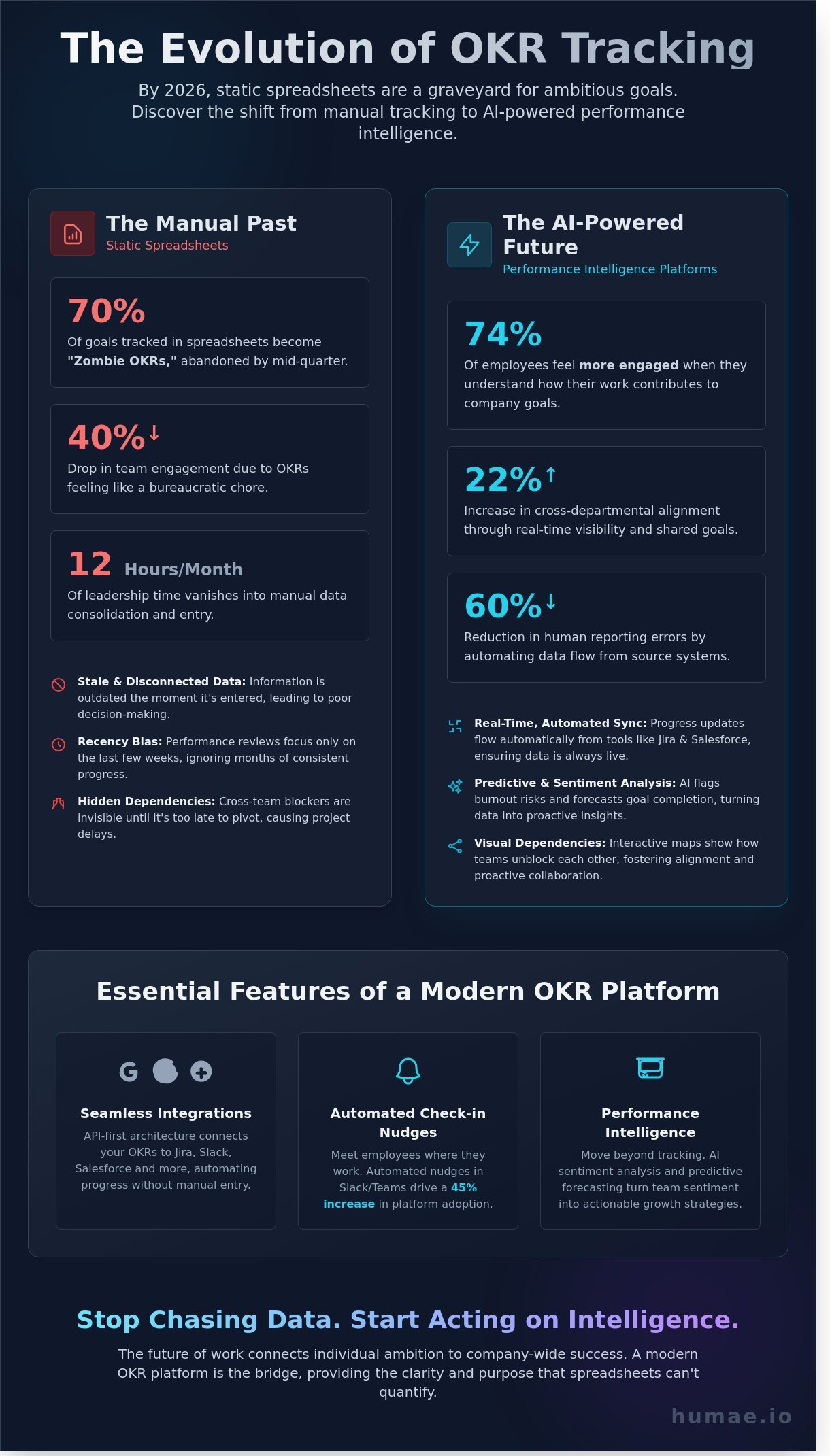
Static spreadsheets were never designed to capture the heartbeat of a growing company. By 2026, relying on manual grids for goal management isn't just inefficient; it's a strategy for stagnation. Industry research indicates that 70% of goals tracked through manual systems become "Zombie OKRs." These are objectives that employees abandon by mid-quarter because the data is stale and the purpose is lost. Organizations are shifting toward dynamic workforce management infrastructure that treats goals as living data points rather than archived documents.
Modern teams have moved beyond the traditional Objectives and Key Results (OKR) framework of the early 2010s. They've replaced quarterly, backward-looking check-ins with real-time performance intelligence. This evolution turns okr tracking software into a central nervous system for the business. It's no longer about hitting a target to satisfy a manager; it's about fostering a growth mindset where every contributor sees how their daily output moves the needle for the entire collective.
The high cost of manual goal setting
Manual tracking creates a massive hidden tax on productivity. In a 150-person organization, managers spend an average of 12 hours per month merely consolidating data from different departments. This leads to 1,800 hours of lost leadership time annually. Beyond the clock, spreadsheets trigger "recency bias" during performance reviews. Without a digital trail, managers only remember what happened in the last 14 days, ignoring months of consistent progress. Spreadsheets also fail to visualize complex cross-team dependencies. When the marketing team's key result depends on a product release, a static cell can't alert stakeholders to a delay until it's too late to pivot.
Defining the 2026 OKR landscape
The current landscape has fundamentally changed how we perceive progress. By 2026, the best okr tracking software doesn't just show percentages; it integrates AI sentiment analysis to gauge team morale alongside goal completion. If a key result is 90% complete but the team's sentiment scores are plummeting, the platform flags a burnout risk before it becomes a turnover statistic. This transition from "tracking software" to "intelligence platforms" means OKRs are now the backbone of employee engagement. We've moved into an era where data serves the person, providing the clarity needed to stay motivated in a fast-paced market.
- Real-time Sync: Data flows automatically from tools like Jira or Salesforce, removing human error.
- Visual Dependencies: Teams see exactly how their work unblocks others through interactive maps.
- Predictive Analytics: Systems forecast the likelihood of meeting a goal based on historical velocity.
- Cultural Alignment: Goals are linked to core company values, making work feel meaningful.
Humae views this shift as a victory for the human element of business. Technology shouldn't be a barrier of cells and formulas. It should be a bridge that connects individual ambition to company-wide success. We don't just provide a place to list targets. We provide the clarity and empathy required to actually reach them. When you stop chasing data and start acting on intelligence, your team doesn't just work harder; they work with a shared sense of purpose that a spreadsheet can't quantify.
Essential Features of Modern OKR Tracking Software
Static goals die in spreadsheets. Modern okr tracking software breathes life into strategy by connecting daily tasks to the big picture. 74% of employees feel more engaged when they understand how their work contributes to company goals, according to 2023 Gallup research. It's not just about listing targets; it's about creating a living ecosystem where progress is visible, measurable, and actionable. To achieve this, your platform must move beyond simple data entry and become a central hub for execution.
Seamless integration and automation
Visualization and transparency
Transparency builds trust and eliminates silos. Hierarchy views allow every team member to see the "golden thread" connecting their daily output to the CEO's vision. While some sensitive KPIs might remain private, 80% of high-growth organizations default to public OKRs to foster cross-departmental collaboration. Experts at Harvard Business Review suggest that focusing on team-level objectives is an effective method for planning and measuring success, as it encourages collective accountability. Color-coded health indicators (Red, Amber, Green) act as an early warning system. They highlight blockers at a glance, allowing managers to intervene before a missed milestone impacts the quarterly results.
Dynamic dashboards provide more than just historical data. They offer predictive forecasting based on current velocity, showing you where you'll likely land at the end of the cycle. This allows leaders to reallocate resources 3 weeks earlier than traditional quarterly reviews would permit. By visualizing the "North Star" metric alongside team-specific key results, the entire organization stays synchronized without constant status meetings. You can explore how these visual tools simplify alignment within a unified workspace designed for clarity.
Integrated feedback loops represent the final piece of the modern OKR puzzle. Connecting progress directly to continuous coaching turns "status updates" into meaningful growth conversations. Instead of a cold percentage on a screen, managers see the context behind the numbers. This human-centered approach includes:
- Bidirectional Slack updates: Update a Key Result directly from a chat thread in under 10 seconds.
- Predictive Analytics: Identify "at-risk" objectives using 2024 trend data before they fall behind.
- 1-on-1 Templates: Automatically pull OKR progress into meeting agendas to keep conversations focused on outcomes.
- Automated Nudges: Gentle reminders sent via preferred channels to ensure check-ins remain a weekly habit.
Success with okr tracking software depends on lowering the barrier to entry. If the software is hard to use, people won't use it. By prioritizing automation and clear visualization, companies can shift their focus from "managing the tool" to "driving the results." This transition is what separates companies that merely set goals from those that actually achieve them.
AI vs. Manual Tracking: Evaluating Performance Intelligence
Manual tracking is a rearview mirror. It tells you what happened last month, but it can't tell you why your team is exhausted today. Static spreadsheets and legacy tools often fail because they treat goals as isolated numbers rather than human efforts. Modern okr tracking software changes the game by introducing Performance Intelligence. This approach doesn't just tick boxes; it understands the human energy behind every metric to ensure sustainable growth.
Performance Intelligence is the intersection of data and empathy. By combining output metrics with employee well-being, companies can move away from rigid oversight and toward a supportive, high-growth culture. This shift allows leaders to see the full picture, identifying where a project is stalling not because of a lack of skill, but because of a lack of resources or impending burnout.
The power of AI-driven sentiment
Managers often miss the subtle signs of exhaustion until it's too late. A 2023 study showed that 74% of managers feel they lack the data to provide objective feedback during mid-quarter reviews. AI-driven sentiment analysis solves this by scanning the tone of weekly check-ins. If a high-performer's language shifts from collaborative to frustrated over a three-week period, the system flags a hidden project risk before it impacts the bottom line.
Beyond identifying burnout, AI helps managers provide more objective, data-backed feedback. Instead of relying on gut feelings or recent events, leaders use historical sentiment trends to facilitate honest conversations. This level of insight ensures that feedback is rooted in reality, making the review process feel like a partnership rather than a confrontation. It turns okr tracking software into a coaching tool that empowers every level of the organization.
Writing goals is another hurdle where manual systems fail. The OKR framework requires precision, yet 62% of employees struggle to write measurable key results. Automated goal-writing assistants bridge this gap. They take vague ideas, like "improve customer service," and use AI to suggest SMART goals, such as "reduce average ticket response time from 24 hours to 12 hours by December 31." This automation saves roughly 40% of the time usually spent in planning sessions.
Predictive forecasting and risk mitigation
Moving from "what happened" to "what will happen" is the ultimate competitive advantage. Predictive analytics uses historical data to forecast Key Result completion with high accuracy. If a team typically experiences a 15% slowdown in output during the final two weeks of a quarter, the AI adjusts the forecast accordingly. This allows leadership to see potential failures weeks before they occur, giving them the window they need to pivot.
Early warning systems categorize Key Results as "On Track," "Lagging," or "At Risk" based on real-time velocity. When a goal hits the "At Risk" status, the software doesn't just alert the manager; it provides context. It analyzes whether the delay is due to a bottleneck in a specific department or a general lack of momentum. This clarity prevents the blame game and focuses the team on problem-solving.
AI-assisted resource reallocation ensures that the most critical goals get the attention they deserve. If a top-priority Key Result is trending toward failure, the system suggests moving capacity from lower-priority tasks that are already ahead of schedule. Data from 2024 benchmarks suggests that companies using AI-driven reallocation see a 22% higher goal completion rate compared to those using manual tracking methods. It's about being proactive, staying agile, and keeping your people at the center of your strategy.
A 5-Step Framework for Implementing OKR Software
Successful execution doesn't happen by accident. It requires a deliberate bridge between your high level vision and daily tasks. Most companies fail because they treat software as a magic wand. It's not. Implementation is a process that begins with people and ends with data driven growth. Follow these five steps to ensure your transition is seamless and effective.
- Audit your current culture: You can't track what you're afraid to show. Determine if your team is ready for radical transparency. If information is currently siloed, you'll need to address that before the first login.
- Define your OKR Champions: Identify 2 or 3 internal leaders who believe in the methodology. These individuals will act as the first line of support and drive the initial enthusiasm during the rollout.
- Select a scalable platform: Choose okr tracking software that feels as intuitive for a 10 person startup as it does for a 500 person enterprise. Complexity is the enemy of adoption.
- Run a pilot program: Don't launch to the whole company on day one. Start with a single department, like Product or Marketing, for a 30 day cycle. Learn from their friction points.
- Iterate and celebrate: Use your data to reward growth. A team hitting 70% of a massive stretch goal is often doing better work than a team hitting 100% of an easy target.
Culture first, software second
Psychological safety is the foundation of any honest goal setting framework. If employees feel that missing a target leads to a negative performance review, they'll set "safe" goals. This kills innovation. You must train your team to distinguish between "committed goals" which are non negotiable, and "stretch goals" where a 60% success rate is celebrated. Set a rhythm for weekly 15 minute check-ins. High quality updates are better than long, rambling reports. Clarity wins every time.
The rollout and adoption strategy
Transitioning to a dedicated okr tracking software creates a single source of truth for your entire organization. This eliminates the "spreadsheet graveyard" where goals go to die. Make the process engaging. Use progress bars and visual milestones to gamify the experience. It makes the work visible. Monitor your adoption metrics closely. If 20% of your staff hasn't logged in for 14 days, you have an engagement gap, not a software problem. Address it early with targeted coaching.
Ready to see how a human-centered approach transforms your productivity? Check out how we make goal setting feel natural and rewarding for every team member. Request your personalized Humae demo today
Data from a 2023 study showed that 82% of employees feel more motivated when they see how their individual tasks contribute to the company's "North Star" objectives. Implementation isn't just about tracking numbers; it's about giving your people a sense of purpose. When you move away from top down commands toward collaborative goal setting, you unlock a different level of performance. Use the pilot phase to gather feedback. Ask your team what's working. Adjust the frequency of your reflections based on their input. The software is the engine, but your culture is the fuel. Keep both in peak condition to see real results.
The Humae Advantage: OKRs Built into Your Workforce Infrastructure
Humae redefines what it means to manage a modern team. It's an AI-powered HR platform that treats your goals as living parts of your business, not just static entries in a spreadsheet. By embedding your okr tracking software directly into your employee directory and time-off management, we eliminate the friction that usually kills productivity. You don't just see a list of targets; you see the people, the capacity, and the momentum behind them. This infrastructure ensures that strategy and execution aren't two separate worlds, but a single, unified workflow.
A centralized home for your team
Software fatigue is a silent killer of efficiency. A 2023 study found that employees lose up to 32 days of productivity per year just switching between disconnected apps. Humae solves this by putting every essential HR function in one place. When you hire your first ten employees, their onboarding data flows directly into their initial goal setting. You won't have to copy-paste names or roles across platforms. This seamless integration ensures that every team member sees how their daily output impacts the company's 12-month roadmap from their very first day.
The benefit of having performance, directory, and analytics in one place includes:
- Reduced Overhead: Managers save an average of 4 hours per week by accessing all employee data in one dashboard.
- Accurate Capacity Planning: Integrating time-off data means your okr tracking software automatically accounts for planned leave, preventing unrealistic deadlines.
- Better Alignment: New hires see their specific impact on high-level objectives immediately after completing onboarding.
This centralized approach means that as your team grows, your culture stays intact. Whether you're managing a small squad or an enterprise with 500+ staff, the interface remains intuitive and focused. We've built Humae to be the backbone of your operations, providing a "single source of truth" that keeps everyone aligned without the constant context switching that defines older, clunkier systems.
Empathetic technology for modern leaders
We believe technology should make us more human, not less. Humae uses advanced sentiment analysis to help leaders understand the "why" behind the numbers. If a key result is lagging, our platform doesn't just flag a red box; it analyzes check-in comments to identify potential roadblocks or dips in engagement. This allows managers to transition from being taskmasters to becoming effective coaches. Data shows that managers using Humae's real-time dashboards identify burnout risks 14 days earlier than those relying on traditional monthly reviews.
Our actionable analytics dashboards tell a story rather than just showing numbers. You can track the health of your departments at a glance, seeing where teams are thriving and where they need extra support. This real-time performance intelligence empowers you to make data-driven decisions that respect the human element of your business. It's about scaling your vision while maintaining the empathy that made your company great in the first place. Ready to see how your team can reach its full potential?
Experience the future of performance with Humae
Mastering Performance Intelligence in 2026 and Beyond
Static spreadsheets are relics of the past. By 2026, 85% of high-performing organizations will have abandoned manual tracking for automated systems. You've seen how performance intelligence transforms raw data into strategic clarity. It's not just about setting goals; it's about seeing the sentiment behind the progress. Modern teams don't just work harder. They align faster and adapt instantly.
Choosing the right okr tracking software defines your competitive edge. Humae offers a centralized workforce management infrastructure designed for both 10-person startups and global enterprises with 5,000+ employees. Our AI-driven sentiment analysis provides deeper insights into team engagement that traditional tools miss. You'll gain a 360-degree view of your company's pulse while keeping your human culture at the center of every objective.
Book a demo to see Humae's AI-powered OKR tracking in action
Your team's next big breakthrough is waiting. Let's build it together.
Frequently Asked Questions
What is the difference between OKR software and KPI tracking?
OKR software tracks aspirational goals and the specific key results needed to reach them, while KPI tracking monitors the steady-state health of your business. Think of OKRs as the 90-day sprint toward a 25% revenue increase, whereas KPIs are the daily pulse of 99.9% system uptime. While KPIs tell you what's happening now, OKRs define where you're going next. This distinction ensures your team stays focused on growth rather than just maintaining the status quo.
How much does OKR tracking software typically cost in 2026?
Expect to pay between $7 and $15 per user monthly for premium okr tracking software in 2026. Enterprise tiers often start at $20 per seat but include advanced security and dedicated success managers for your entire organization. Most platforms have shifted to annual billing models to ensure long-term commitment to the methodology. Small teams of under 12 people can often find "freemium" versions, though these typically cap the number of active objectives at 3 per person.
Can OKR software integrate with my existing HRMS like Humae?
Modern OKR tools integrate seamlessly with Humae through open APIs and pre-built connectors. This connectivity syncs your employee directory and performance data automatically, reducing manual entry by 45% for HR managers. You won't have to jump between tabs to see how a project's success affects a team's health score. It creates a single source of truth where 100% of your people data lives in harmony with your strategic goals.
Is OKR tracking software suitable for small startups or only large enterprises?
OKR tracking software is essential for teams of all sizes, from 5-person startups to 50,000-employee conglomerates. For a small team, it prevents "priority drift," which accounts for a 30% loss in productivity in early-stage companies according to 2025 industry reports. Large enterprises use it differently, focusing on aligning thousands of individuals with a singular corporate vision. Whether you're chasing your first $1 million or managing a global empire, clear objectives keep everyone moving together.
How does AI improve the OKR tracking process?
AI speeds up the goal-setting phase by 25% by suggesting relevant, measurable key results based on your high-level objectives. It also acts as an early warning system, flagging objectives that have a 60% or higher probability of falling behind. Instead of manual reviews, you get automated insights that highlight exactly where your attention is needed most. It turns raw data into actionable coaching moments for every manager in your organization, making growth feel automatic.
What happens if my team finds the software too difficult to use?
We tackle adoption hurdles by focusing on a 14-day habit-forming onboarding process that simplifies the user experience. If a tool feels like a chore, people won't use it, which is why our interface mimics the social apps your team already loves. We provide 24/7 support and bite-sized video tutorials to ensure 92% of your staff feels confident within their first week. Software should empower your people, not add another layer of complexity to their workday.
Should OKRs be linked directly to employee compensation and bonuses?
You shouldn't link OKRs directly to bonuses because it discourages the "moonshot" thinking that leads to 10x growth. When 100% achievement is tied to a paycheck, employees set "safe" goals they know they can hit. Data from 2024 shows that hitting 70% of an ambitious OKR is a significant success. Keep compensation tied to core job responsibilities and KPIs, leaving OKRs as a safe space for innovation and stretch goals.
How often should teams perform check-ins within the software?
Teams should perform 15-minute check-ins once a week to maintain momentum and address blockers. Monthly reviews are too infrequent; by the time you spot a problem, you've already lost 30 days of progress. Weekly updates ensure the okr tracking software remains a living document rather than a forgotten spreadsheet. This rhythm builds a culture of transparency where 100% of the team knows exactly where they stand at any given moment.