The Best Automated Candidate Screening Tools for 2026: A Leader’s Guide
By Humae · 17 May 2026
automated candidate screening tools
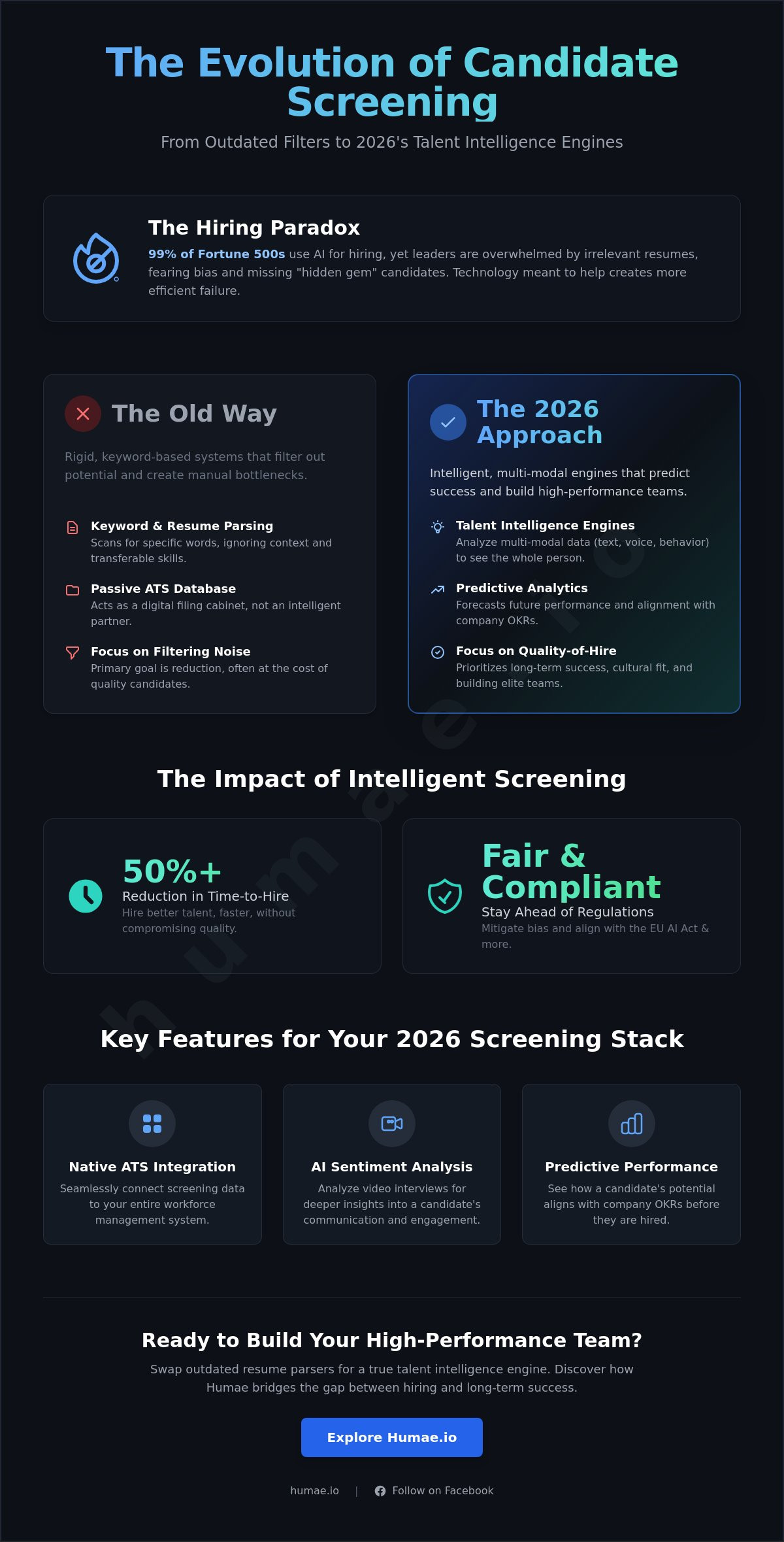
99% of Fortune 500 companies now use AI to filter job applicants, yet many hiring leaders still feel like they're drowning in a sea of irrelevant resumes. It's an exhausting paradox. You want the efficiency of modern tech, but you're rightfully concerned about AI bias and losing that vital human connection. You've likely felt the pressure of missing out on "hidden gem" candidates because a rigid filter didn't see their true potential.
We believe screening shouldn't just be about filtering out noise. It should be the first data point in a lifelong performance intelligence journey. This guide shows you how to leverage the best automated candidate screening tools for 2026 to reduce your time-to-hire by 50% or more. You'll learn how to identify top talent with predictive analytics while staying ahead of new regulations like the EU AI Act and the Colorado Artificial Intelligence Act. We'll preview the top platforms that balance high-speed automation with a fair, standardized experience for every applicant.
Discover how Humae empowers your team at our home page or follow our latest updates on Facebook.
Key Takeaways
- Swap outdated resume parsers for talent intelligence engines that analyze multi-modal data to find the right fit faster.
- Leverage automated candidate screening tools to bridge the gap between initial hiring and long-term workforce management success.
- Evaluate non-negotiable 2026 features like native ATS integration and AI-driven sentiment analysis for video interviews.
- Implement a human-first screening process by auditing your manual bottlenecks and defining your ideal hire profile.
- Predict future performance by seeing how a candidate's potential aligns with your company OKRs before they join the team.
Explore more at Humae Home or join our community on Facebook.
What Are Automated Candidate Screening Tools in 2026?
Manual screening is dead. In high-growth environments, expecting a human to read every resume is a recipe for burnout and bias. By 2026, automated candidate screening tools have evolved far beyond simple keyword matching. These systems are no longer just digital filing cabinets; they're multi-modal AI engines that analyze voice, text, and even behavioral patterns to find the perfect fit. They don't just scan for words; they interpret the candidate's journey.
While a traditional Applicant tracking system (ATS) was once a passive database, modern tools act as "Talent Intelligence Engines." They use Natural Language Processing (NLP) to understand a candidate's intent and context. Instead of just seeing a skill listed on a page, the AI understands the complexity of the projects the candidate managed. It looks for the "why" behind their career moves, identifying the potential that a simple search query would miss.
The Evolution of Screening: From Keywords to Competencies
The era of hiring based on pedigree or degrees is fading. Modern automated candidate screening tools prioritize a skills-first approach. They don't care about the name of a university if the candidate can't solve the specific problems the role requires. These systems use situational judgment automation to see how a candidate thinks in real-time. They often identify transferable skills that a tired recruiter might overlook, such as recognizing how a former teacher's classroom management translates perfectly into high-stakes project coordination.
Why Efficiency is Only Half the Story
Reducing time-to-hire is a great metric, but speed without quality is expensive. If you hire the wrong person 50% faster, you're just failing more efficiently. The best tools in 2026 focus on "Quality-of-Hire" and long-term cultural alignment. They prioritize candidates based on predicted performance and longevity within your specific organization. This intelligent prioritization doesn't just fill seats; it builds high-performance teams while protecting your recruiters from the crushing weight of irrelevant applications. It's about using technology to make the hiring process feel more human again, not less.
Ready to transform your hiring process? Visit Humae to see how our integrated solutions can help you build your dream team. Stay connected with us for the latest HR innovations on Facebook.
How Automated Screening Tools Drive High-Performance Teams
High-performance teams aren't built in the interview room; they're built at the very first touchpoint. By integrating automated candidate screening tools into your workforce management infrastructure, you create a seamless flow from "applicant" to "high performer." This early-stage data is precious. It allows you to spot patterns that lead to long-term success or, conversely, identify traits that suggest a candidate might not thrive in your specific culture. Preventing turnover starts here, long before an offer letter is ever signed.
Consistency matters. When every candidate experiences the same standardized screening process, you eliminate the variance caused by human mood or recruiter fatigue. This ensures that every "first impression" is professional, timely, and reflective of your brand values. A candidate’s journey should feel like a cohesive experience, not a series of disconnected hurdles. When the process is smooth, you attract talent that values professionalism and innovation.
Predictive Analytics and Future Performance
Screening tools in 2026 don't just look at what a person has done; they look at what they will do. By comparing assessment data with your internal performance management metrics, these systems identify the specific competencies that correlate with success in your organization. Predictive Screening is the use of AI to forecast a candidate’s 12-month success rate based on these data-driven correlations. It bridges the gap between hiring a "good resume" and hiring a future leader who will actually move the needle on your goals.
Eliminating Unconscious Bias in the Funnel
Fairness is a competitive advantage. Standardized automated candidate screening tools help remove the noise that often clouds human judgment. Features like "Blind Screening" automatically strip away names, photos, and university names, forcing the focus onto skills and potential. While a Harvard University study highlighted how older automated systems could accidentally screen out qualified talent, 2026 technology is built with bias-auditing at its core.
These modern tools ensure a level playing field for neurodivergent and non-traditional candidates. By focusing on objective behavioral data rather than social cues, companies can tap into pools of talent that were previously invisible. You can explore how these advanced features work within a unified platform to build a more diverse, equitable workplace.
Key Features to Evaluate in Your 2026 Screening Stack
Selecting the right automated candidate screening tools in 2026 requires looking far beyond basic resume filtering. You need a tech stack that feels like a natural extension of your hiring team. Native integration with your Applicant Tracking System (ATS) is the non-negotiable foundation. Without this, your data remains siloed, and your recruiters waste hours manually moving information between platforms. A unified system ensures that every assessment, score, and note is instantly accessible where it matters most.
Modern screening now includes AI-powered sentiment analysis for asynchronous video or voice interviews. This technology doesn't just record what a candidate says. It analyzes tone, confidence, and engagement levels to provide a nuanced view of their communication style. This gives you a deeper understanding of their soft skills before you ever schedule a live meeting. It's about finding the human story hidden within the digital application.
Static, one-size-fits-all quizzes are a thing of the past. Dynamic skills testing now adapts to the candidate's performance level in real-time. If they answer correctly, the questions become more challenging; if they struggle, the system adjusts to find their actual baseline. To keep the experience empathetic, automated communication workflows ensure no one is left in the "recruitment black hole." Candidates stay informed and engaged at every stage, which directly protects your employer brand.
The "Must-Have" vs. "Nice-to-Have" Checklist
Prioritize your investment by focusing on compliance and transparency first. In 2026, "Explainable AI" (XAI) is the new standard. You must be able to clearly explain why the AI made a specific recommendation to satisfy both legal audits and candidate inquiries. Transparency builds trust, and trust attracts top-tier talent.
- Must-Have: GDPR compliance, mobile-first interface, and regular bias-reduction audits.
Seamless Integration with Workforce Management
Your screening tool shouldn't live on an island. It needs to "talk" to your employee directory and OKR tools from day one. When data flows seamlessly from the Humae features into the onboarding process, you create a single-source-of-truth for all employee data. This continuity allows you to track how an applicant's initial assessment scores eventually translate into their ability to hit specific quarterly goals. It’s the difference between just filling a role and strategically growing your organization's performance intelligence.
Implementing Automated Screening Without Losing the Human Touch
Technology doesn't have to be cold. Successfully deploying automated candidate screening tools requires a strategy that puts people at the center of the process. It's not about replacing human judgment; it's about augmenting it so your team can focus on what they do best: building relationships. This transition is a cultural shift that turns your hiring department into a high-impact talent consultancy.
To get it right, follow this structured five-step framework:
- Step 1: Audit and Define. Identify where your current manual bottlenecks live. Define your "ideal hire" profile with objective metrics before the AI starts its work.
- Step 2: Industry Alignment. Don't settle for generic software. Choose a tool that understands the specific nuances and role types of your industry.
- Step 3: The Pilot Phase. Roll out the tool in a single department first. Gather internal feedback and refine the AI parameters to ensure the results match your expectations.
- Step 4: Advisor Training. Shift your recruiters' mindset. Train them to act as "Talent Advisors" who interpret data rather than "Resume Sorters" who just move files.
- Step 5: Experience Monitoring. Continuously collect candidate feedback. Use these insights to ensure the automated steps feel supportive and fair.
Check out our modern Applicant Tracking System to see how we blend high-speed tech with deep empathy.
The New Role of the Recruiter: From Sorter to Advisor
Automation is the best thing to happen to the recruiter role in decades. It clears the administrative clutter, freeing up hours for high-value human interaction. Instead of scanning 500 resumes, your team spends that time building deep connections with the top five candidates. AI insights provide a roadmap for live interviews, allowing recruiters to ask more targeted, meaningful questions based on the candidate's specific assessment data. Humans stay in control, providing the necessary oversight for "edge case" decisions where nuance is everything.
Optimizing the Candidate Experience
Ghosting is the number one complaint among job seekers today, and it's a massive blow to your employer brand. Automation solves this by ensuring every applicant receives timely, personalized updates. These messages don't have to feel robotic. By using supportive language and providing candidates with their own assessment results, you add value to their professional journey regardless of the hiring outcome. This transparency builds respect and keeps your talent pipeline healthy for future roles.
The Humae Advantage: Integrated Screening and Intelligence
Hiring doesn't end with a signature; it's the beginning of a performance story. While most automated candidate screening tools focus solely on solving the "inbox" problem, Humae looks toward the future. We've built an ecosystem where our intuitive Applicant Tracking System flows directly into deep performance intelligence. This isn't just about finding someone who can do the job. It's about finding the person who will thrive within your specific mission and contribute to your long term success.
Imagine seeing a candidate’s potential alignment with your company OKRs before they even join the team. Humae makes this possible. By mapping assessment data against your strategic objectives, we help you identify leaders who are ready to contribute to your key results from day one. This centralized approach eliminates the friction caused by a patchwork of disconnected tools. You gain a single source of truth for your entire talent lifecycle, from the first application to the annual performance review.
Our commitment to "Human-Centric Tech" means we don't build tools to replace your HR team. We build them to empower your people. By removing the administrative weight of automated candidate screening tools, we allow your leaders to lead with empathy and focus on the human connections that define your culture.
From Applicant to High-Performer: A Unified Journey
Our how it works section demonstrates how we bridge the gap between recruitment and management. Humae’s sentiment analysis helps maintain culture from day zero by ensuring new hires naturally resonate with your team's core values. Real-time analytics allow you to monitor the success of your screening strategy, adjusting parameters as your organization grows. You aren't just hiring; you're engineering a high-performance culture through data-driven insights.
Ready to Modernize Your Talent Acquisition?
The hiring environment of 2026 demands more than just speed. It requires a balance of sophisticated automation and genuine empathy. Organizations that continue to rely on fragmented systems will struggle to keep up with the pace of innovation and the expectations of top-tier talent. It's time to move beyond simple filtering and embrace a smarter, more integrated approach to talent acquisition. We are ready to be your visionary partner in this digital transformation.
Experience the future of hiring with Humae.
Discover more at our home page or connect with us on Facebook.
Build Your Future-Ready Talent Engine
The hiring landscape of 2026 demands a shift from simple filtering to deep talent intelligence. By now, you understand that automated candidate screening tools aren't just about speed. They're about predicting long-term success and building teams that truly align with your mission. You've seen how a centralized workforce management infrastructure replaces fragmented tools with a single source of truth.
Transitioning your recruiters into talent advisors allows them to lead with empathy while AI handles the heavy lifting. This balance ensures your organization stays compliant with evolving regulations while providing a supportive experience for every applicant. It's time to move beyond the traditional resume and start seeing the full potential of your future workforce. You're ready to build something remarkable.
Discover how Humae’s AI-powered platform transforms your hiring process. Our system provides AI-driven sentiment analysis for deeper insights and integrated OKR tracking to align new hires with company goals from day zero.
Explore more at our home page or join the conversation on Facebook.
Frequently Asked Questions
Do automated candidate screening tools actually reduce bias?
Yes, modern tools reduce bias by focusing on objective data points rather than subjective human impressions. They ignore factors like age, gender, or zip codes, prioritizing instead the specific skills and competencies required for the role. This creates a more level playing field for every applicant who enters your funnel.
How do automated screening tools handle non-traditional resumes or career gaps?
These systems use Natural Language Processing to identify transferable skills that might not be obvious in a linear timeline. Instead of penalizing a gap, the AI looks for the underlying expertise gained through various projects or certifications. This approach ensures you don't miss out on "hidden gem" candidates with non-linear career paths.
Will using AI for screening hurt my company’s candidate experience?
It actually improves the experience by eliminating the common problem of "ghosting." Candidates receive instant confirmation and timely updates throughout the process. When you use automated candidate screening tools, you ensure that every applicant is seen and acknowledged, which protects your employer brand and builds trust with potential hires.
Can automated screening tools integrate with my existing HRMS or ATS?
Most leading platforms are built to sync seamlessly with your current workforce management infrastructure. This integration ensures that data flows directly into your employee directory and performance tracking systems without manual entry. It creates a single source of truth that spans from the first application to long-term performance reviews.
What is the difference between a resume parser and an AI screening tool?
A resume parser is a basic tool that extracts text into data fields; it's a digital copier. In contrast, an AI screening tool is a talent intelligence engine that interprets the context and intent behind the words. It evaluates potential and cultural alignment, providing a much deeper analysis than a simple keyword search ever could.
How much time can my HR team realistically save by automating screening?
Recruiting teams typically save up to 75% of the time they previously spent on initial manual reviews. By implementing automated candidate screening tools, your team can skip the repetitive task of sorting through irrelevant applications. This freedom allows them to act as advisors and focus on high-value interviews with the most promising talent.
Are automated screening tools compliant with global privacy laws like GDPR?
Compliant tools are built with privacy by design, featuring encrypted data storage and automated deletion protocols. They include built-in consent workflows that ensure your hiring process meets the strict requirements of GDPR and other regional privacy laws. This transparency protects both your organization and the candidates who trust you with their data.
How do I know if the AI in a screening tool is making fair decisions?
Look for systems that offer "Explainable AI" (XAI), which provides a clear rationale for every recommendation the system makes. You should also conduct regular bias audits to ensure the parameters remain fair and accurate. Human oversight remains a vital part of the process, allowing your team to review and refine the AI's logic over time.